

The conceptually systematic dimension of ABA asks whether procedures are tied to recognizable behavioral principles, not merely whether an intervention has a technical name or produced a quick change. If you are studying the conceptually systematic dimension of ABA, focus on the connection between principle, procedure, and explanation. A plan should not look like a bag of disconnected techniques. The practitioner should be able to explain why the procedure fits the behavior-analytic principle and how that explanation guides decisions when the context changes.
Table of Contents
- Conceptually Systematic Dimension of ABA: Start With the Principle
- Map Principle to Procedure, Not Just to a Label
- Conceptually Systematic vs Technological and Effective
- What the Dimension Looks Like in Practice
- A Five-Step Scenario Reading Method
- Common Exam Traps
- Practice the Dimension Without Memorizing a Slogan
- Frequently Asked Questions
- Sources and Verification Notes
- Quick Review Checklist
- Take the Free BCBA Mock Exam
This is a focused study guide, not a replacement for the original dimensions article, the current BCBA Test Content Outline, the BACB Handbook, or qualified supervision. The seven dimensions are a framework for evaluating applied work. They are not a menu of treatments, a guarantee that a procedure is ethical, or proof that a credential authorizes every service.
Conceptually Systematic Dimension of ABA: Start With the Principle
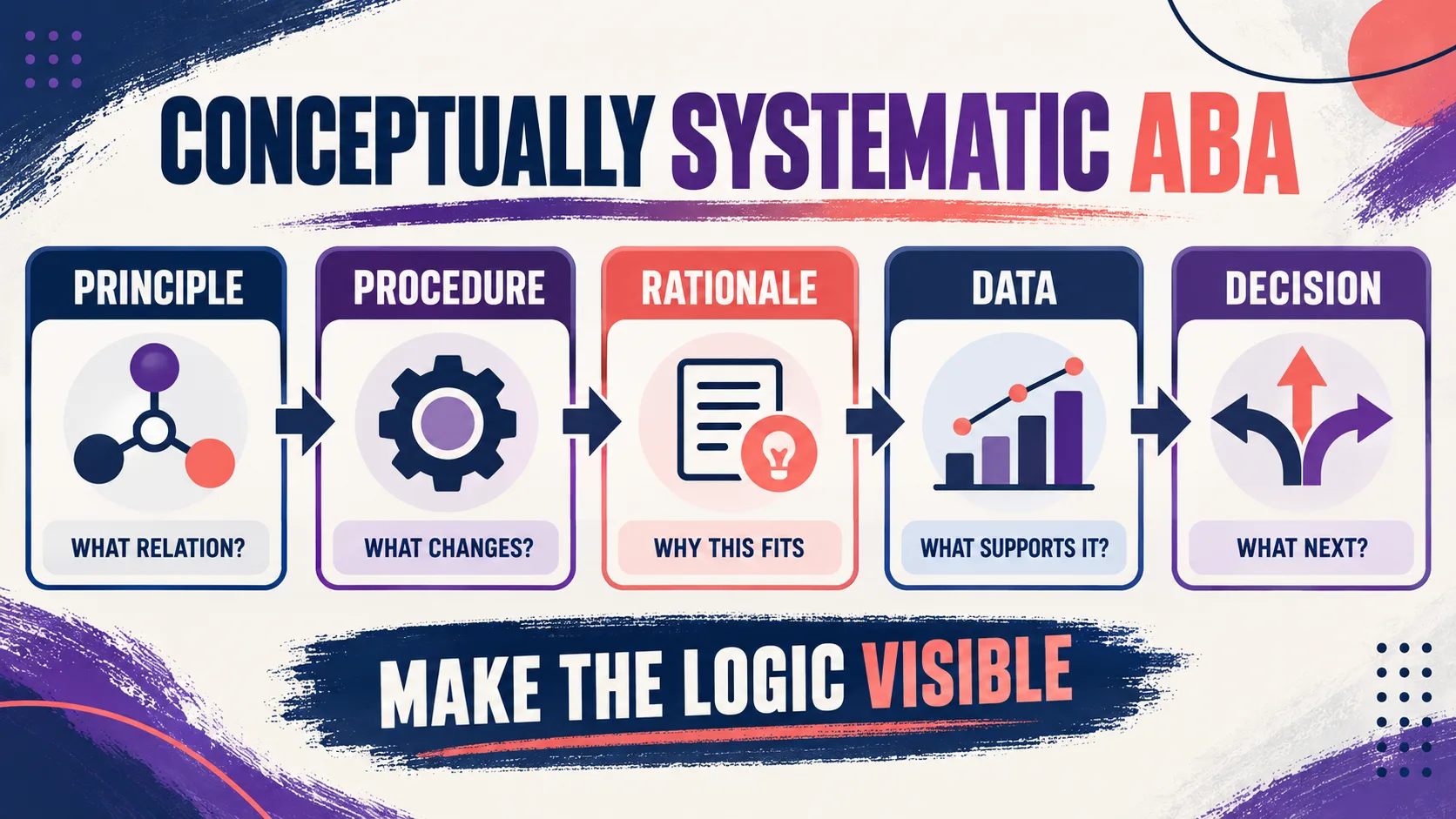
In the classic seven-dimensions framework, conceptually systematic means that the procedures used in applied behavior analysis are described and interpreted in relation to basic principles of behavior. The point is not to decorate a plan with vocabulary. The point is to show a coherent behavioral rationale: what relation is being changed, which principle explains the procedure, and why that procedure should affect the target behavior under the stated conditions.
For example, a plan might arrange a consequence after an appropriate communication response and explain that the consequence is expected to strengthen that response. The explanation becomes stronger when it identifies the relevant contingency, describes how the consequence will be delivered, and states what data would support or challenge the hypothesis. The plan is conceptually systematic because the technique is connected to a principle and the connection can guide revision.
Conceptual does not mean vague or theoretical in the everyday sense. Systematic does not mean rigid or identical for every learner. Together, the words ask whether the intervention has a principled structure that another trained analyst can understand, evaluate, and adapt without guessing what the author intended.
A useful exam question is: “If the named procedure stopped working in this setting, could the practitioner explain the behavioral relation well enough to make a reasoned adjustment?” If the answer is yes, the scenario may be pointing toward conceptually systematic. If the only evidence is that the plan is written in detail, look first at technological. If the only evidence is that the graph improved, look first at effective.
Map Principle to Procedure, Not Just to a Label
Use the table as a study map. It does not prescribe treatment. It shows the type of explanation a strong conceptually systematic description would make visible.
| Behavioral question | Possible principle link | Procedure description | Evidence to watch |
|---|---|---|---|
| What consequence may strengthen a skill? | Reinforcement depends on an increase in future responding. | Deliver the selected consequence after the defined response under stated conditions. | Later response rate, conditions, and whether the consequence actually changes behavior. |
| What stimulus should signal the response? | Stimulus control develops when reinforcement is correlated with a stimulus. | Arrange practice across relevant discriminative stimuli and fade unnecessary prompts. | Correct responding in the presence of the intended cue and not just the prompt. |
| What may be maintaining a response? | A functional relation concerns the effect of environmental events on future behavior. | Collect assessment data and arrange an ethically appropriate test of the relevant conditions. | A defensible hypothesis, direct data, and the limits of the assessment design. |
| How should a complex skill be built? | Shaping and chaining rely on differential reinforcement and ordered response components. | Define approximations or task steps, arrange teaching, and adjust prompts or criteria. | Progress toward the operational target, independence, and transfer beyond training. |
| What should happen after teaching? | Generalization and maintenance ask whether behavior transfers and persists. | Plan relevant people, settings, stimuli, responses, and later checks from the start. | Performance across contexts and time, not only the final teaching session. |
The table illustrates an important distinction: citing a principle is not enough. A plan that says “use reinforcement” but never defines the response, consequence, schedule, or measurement may be using a label without a systematic rationale. Conversely, a plan can use ordinary language and still be conceptually systematic if its behavioral relation is clear and testable.
Conceptually Systematic vs Technological and Effective

These dimensions often appear together in study questions, which is why they are easy to confuse. Ask what the stem is asking you to judge.
- Technological: Could a trained reader understand the procedures well enough to reproduce them? The clue is procedural completeness and replicability.
- Conceptually systematic: Can the procedures be tied to behavioral principles and explained as a coherent intervention? The clue is principle-to-procedure rationale.
- Effective: Did the intervention produce a meaningful improvement in the target behavior? The clue is the size, importance, and practical value of the outcome.
A detailed recipe can be technological without being conceptually systematic if it lists steps but gives no behavioral reason for them. A principled rationale can be conceptually systematic while still failing to be effective if the data show little or no meaningful change. An intervention can be effective in one context yet require more analysis before claiming generality. Treat each dimension as a different question about the same work.
In a multiple-choice item, underline the verbs. “Describe each step” points toward technological. “Explain why the procedure fits reinforcement, stimulus control, or another behavioral principle” points toward conceptually systematic. “Demonstrate meaningful improvement” points toward effective. The words can coexist in one scenario, but the best answer depends on the claim the question asks you to evaluate.
What the Dimension Looks Like in Practice
Consider a learner who does not begin a routine after an instruction. A weak description says, “Use a visual schedule and praise compliance.” A stronger conceptually systematic description defines the start response, identifies the antecedent, explains the consequence arrangement, specifies how prompts will be faded, and states how independence will be measured. The procedure is not automatically correct, but its logic is visible.
Now consider a communication plan. If a practitioner teaches a functional request, the conceptually systematic explanation identifies the motivating operation or relevant context, arranges access to a consequence that reinforces the request, and plans how the response will contact reinforcement across people and settings. The explanation can be revised if the data show that the selected consequence is not functioning as reinforcement or that the response is not under the intended stimulus control.
For a behavior maintained by escape, a plan might teach an appropriate break request while changing how the task and break are arranged. The phrase “because escape maintains the response” is a hypothesis, not a conclusion by itself. The analyst still needs appropriate assessment, ethical safeguards, and data. Conceptually systematic helps the learner see the connection between the hypothesis, the procedure, and the measurement; it does not remove the need to verify the relation.
A Five-Step Scenario Reading Method
- Name the target: What observable behavior or outcome is being discussed? Ignore broad impressions until the response is defined.
- Find the principle clue: Does the stem mention reinforcement, punishment, stimulus control, prompting, shaping, chaining, extinction, or a functional relation?
- Connect the procedure: Which action follows from that principle? If the procedure is merely listed, ask what behavioral relation would make it sensible.
- Separate the nearby dimension: Is the question emphasizing replicable steps, a meaningful outcome, transfer over time, or the rationale itself?
- Check the evidence: What data or description would support the claim, and what would show that the conclusion is too strong?
Try this quick example: a question says an intervention manual lists every prompt, timing rule, and consequence-delivery step, but never explains the behavioral principles behind the choices. If asked which dimension the description most clearly demonstrates, technological is stronger than conceptually systematic. If a second sentence explains how prompt fading transfers stimulus control to the natural cue, the conceptually systematic evidence becomes stronger too.
Common Exam Traps
- “Evidence-based” means conceptually systematic. Evidence matters, but the target dimension is the link between behavioral principles and procedures.
- “It worked” means conceptually systematic. A successful outcome is evidence for effectiveness, not automatically for the rationale.
- “It has many steps” means conceptually systematic. Many steps may show technological detail. Look for the principle explanation.
- “Conceptually systematic” means use only one technique. A coherent plan can combine procedures when each has an understandable behavioral function and ethical justification.
- The framework replaces current authority. It does not. Use the current BACB exam materials and professional requirements for current certification decisions.
Practice the Dimension Without Memorizing a Slogan
Write three columns in your notes: principle, procedure, and evidence. For each practice item, fill the columns before choosing an answer. Then add a fourth line: “Which nearby dimension could the distractor be testing?” This method turns a definition into a discrimination task.
Use the Free BCBA Mock Exam for a focused scenario check. When you miss a question, identify whether you confused the rationale with the recipe, the outcome, the measurement, or the generalization claim. Return to the current source when a question extends beyond the framework into certification, ethics, or practice authority.
Frequently Asked Questions
What is the conceptually systematic dimension of ABA?: It is the expectation that applied procedures can be related to recognizable behavioral principles and explained as a coherent intervention. It is more than naming a technique and different from simply reporting that the intervention worked.
Is conceptually systematic the same as technological?: No. Technological asks whether the steps are described clearly enough to replicate. Conceptually systematic asks whether the procedures make principled behavioral sense and can be explained in relation to behavioral concepts. One intervention may demonstrate both.
Does an effective intervention automatically meet the dimension?: No. Effectiveness concerns meaningful improvement. A change can occur without a clear or accurate explanation of why the procedure produced it. Read the question for whether it emphasizes outcome or rationale.
Where should I verify the seven dimensions?: Use the primary 1968 dimensions article for historical context and the current BACB Test Content Outline and handbook for exam and certification boundaries. Study guides can help with practice, but they do not replace current official requirements.
Sources and Verification Notes
For historical context, read Some Current Dimensions of Applied Behavior Analysis. For current exam boundaries, use the BACB Test Content Outline, the BCBA Handbook, and the BACB ethics-code hub. This page is a focused study explanation; it is not an official BACB definition or a substitute for qualified supervision.
Bottom line: Conceptually systematic means the procedure is connected to a behavioral principle in a clear, coherent, and usable way. In a BCBA scenario, separate that rationale from the recipe, the outcome, and the generalization claim before selecting the answer. For targeted review, use our conceptually systematic dimension of aba practice questions to apply the concept in exam-style scenarios.
Quick Review Checklist
Use this final checklist to turn conceptually systematic dimension of aba into exam-ready reasoning. The goal is not to memorize a label in isolation; it is to identify the relevant evidence and explain why the best answer fits the scenario. Key ideas to review:
- State the central definition or decision point for conceptually systematic dimension of aba in your own words.
- Identify the detail that makes conceptually systematic dimension of aba different from its closest related ABA term.
- Separate the observable facts in a scenario from assumptions that are not supported by the facts.
- Write one example and one nonexample so you can recognize the concept in a new setting.
Exam application checks:
- Ask what the question is actually requesting before comparing the answer choices.
- Mark the antecedent, response, consequence, or other evidence that supports the selected answer.
- Look for a distractor that describes a related process but does not answer the specific question.
Final self-check:
- Explain how you would verify the interpretation with clear observations or data.
- Change one detail in the scenario and decide whether your answer should change.
- Give a one-sentence rationale that a supervisor or study partner could evaluate.
Take the Free BCBA Mock Exam
When you are ready to apply the idea, use the free practice resource below for additional feedback. Take the Free BCBA Mock Exam



