
A practical, non-official BCBA supervision contract template checklist for fieldwork parties who need clear roles, records, review points, and an exit plan before signing. If you are searching for a BCBA supervision contract template, the most useful document is not a blank form that everyone copies without reading. It is a shared plan that makes the relationship, fieldwork scope, supervision contacts, records, and correction process easy to explain. A clear draft also helps you notice what is missing before a signature creates confusion.
Table of Contents
- BCBA Supervision Contract Template: What It Can and Cannot Do
- Nine Fields to Fill Before Anyone Signs
- A Plain-Language Template Outline
- Use the Template to Audit Hours and Records
- Multiple Supervisors, Fees, and Communication
- Exit Terms and the Application-Date Version Check
- Turn Contract Decisions Into Exam Practice
- Frequently Asked Questions
- Sources and Verification Notes
- Quick Review Checklist
- Take the Free BCBA Mock Exam
This page provides an original educational checklist. It is not a BACB form, legal contract, employment agreement, university policy, or guarantee that fieldwork hours will qualify. The Behavior Analyst Certification Board maintains the authoritative fieldwork resources and sample materials. Open the current official sources, compare them with your program, employer, state, and application timeline, and have the actual parties review the final document.
BCBA Supervision Contract Template: What It Can and Cannot Do
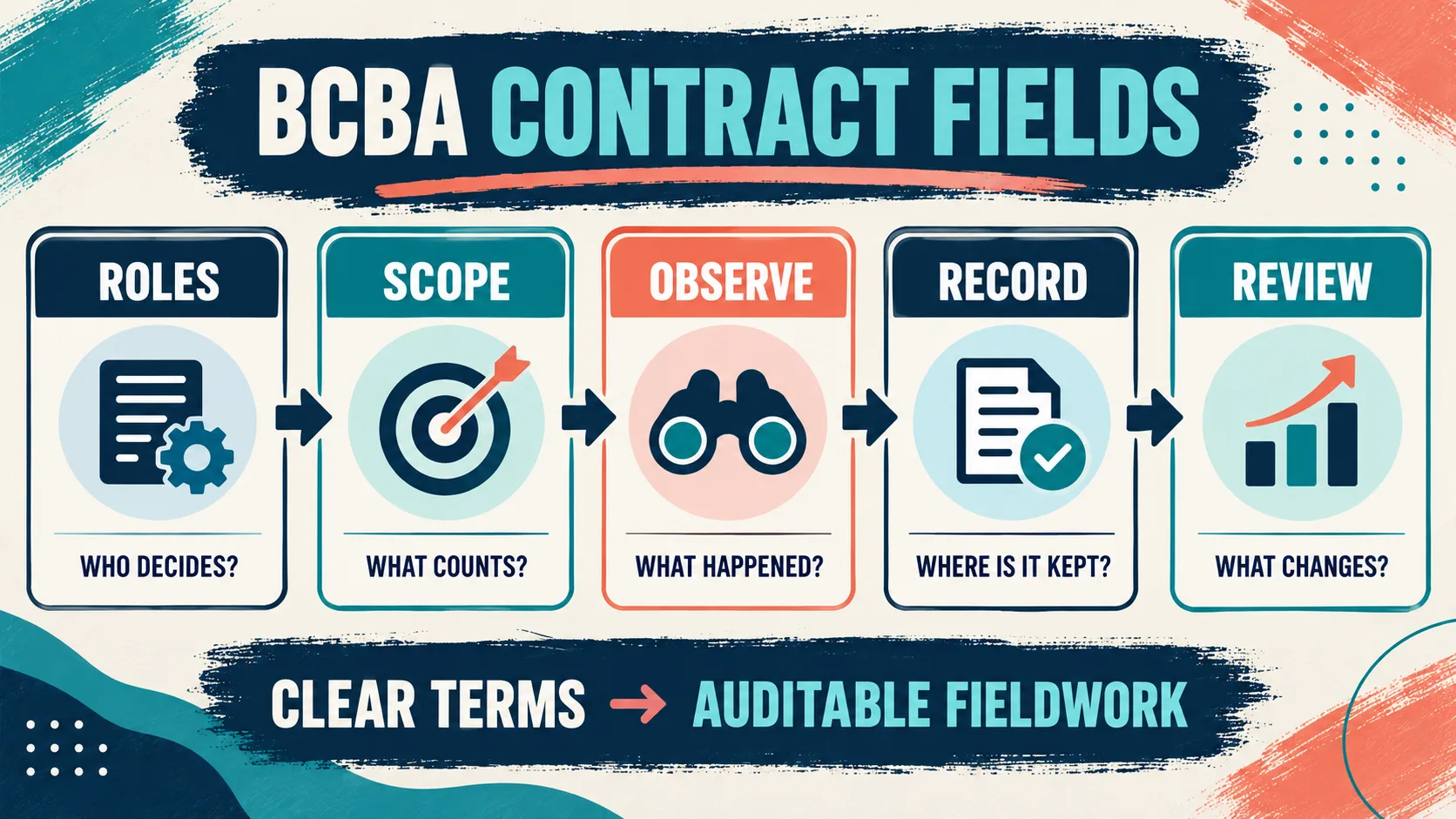
A supervision contract should make a professional relationship observable. Someone reading it should be able to identify who supervises, what the trainee is trying to learn, which activities are in scope, when contact and observation happen, how records are checked, and what happens when the plan changes. If the only useful information is a start date and a signature line, the document is too thin to guide the work. Keep three things separate from the beginning:
- The contract: the operating agreement between the trainee, supervisor, and any organization involved.
- The fieldwork record system: the logs, activity descriptions, observation notes, meeting records, feedback, corrections, and secure copies created over time.
- Official verification forms: the forms and attestations required for the application route that applies to the trainee.
A contract can tell the parties how they intend to work together, but intention is not evidence by itself. A signed agreement cannot turn an unobserved activity into a supervised activity, make a state requirement disappear, or prove that an individual supervisor is eligible. The record of what actually happened still has to support each applicable requirement.
Use the official BACB fieldwork page to locate the current sample supervision contract and related resources. Do not paste that document into this article or treat a site-created checklist as a replacement. The safest use of a template is to ask better questions, write the answers in plain language, and then compare the finished draft with the current authority.
Nine Fields to Fill Before Anyone Signs
Complete these fields together. If a question cannot be answered, mark it as an open issue rather than using vague language such as “as needed.” The table is a drafting checklist, not a required BACB layout.
| Field | What to record | Question before signing |
|---|---|---|
| 1. Parties and authority | Names, contact details, roles, supervisor status, organization, and any responsible supervisor. | Who is allowed to make each decision and sign each applicable record? |
| 2. Purpose and route | Whether the arrangement supports BCBA fieldwork, a course, consultation, employment training, or another purpose. | Are we describing certification fieldwork or a different service? |
| 3. Dates and review points | Start date, planned review dates, pause conditions, and the application-date assumption. | Which requirements and forms are we checking, and when will we recheck them? |
| 4. Scope and learning goals | Settings, clients or projects, competencies, feedback method, and limits of the training relationship. | What should the trainee be able to do, and how will improvement be observed? |
| 5. Activities and time | How activities will be described, reviewed, classified, and recorded without estimating after the fact. | Who checks whether an activity belongs in the planned route? |
| 6. Supervision and observation | Meeting format, observation access, remote or in-person method, feedback timing, and missed-contact procedure. | What happens if a meeting, observation, or client session is cancelled? |
| 7. Records and privacy | Log location, observation notes, signatures, correction method, backup, access control, and confidentiality rules. | Who keeps a copy, who can access it, and how are errors corrected? |
| 8. Fees and resources | Payment, cancellation, platform or travel costs, materials, and any employer or university responsibility. | Are financial terms separate from the certification evidence and client-care duties? |
| 9. Changes and exit | Amendments, notice, record transfer, final review, client continuity, and escalation of unresolved concerns. | How do we end or change the relationship without losing accurate records or abandoning clients? |
A Plain-Language Template Outline
Use the following outline as a starting point for a shared draft. Replace the bracketed prompts with facts, then ask every signer to explain the result in their own words.
- Purpose: “This agreement describes [the relationship and intended route]. It does not replace the current BACB handbook, official forms, state law, employer rules, or university requirements.”
- People and responsibilities: “The trainee will [record activities and raise questions]. The supervisor will [provide the agreed supervision, observation, feedback, and review]. [Organization or responsible supervisor] will [coordinate any additional duties].”
- Working plan: “The parties will meet through [format] on [frequency or scheduling rule]. Observations will be arranged through . Feedback will be recorded in [location] within [agreed time] when practicable.”
- Records: “The log will identify the date, activity, duration, setting, supervisor contact, observation details, and corrections required by the applicable guidance. The trainee and supervisor will retain secure copies.”
- Boundaries: “The parties will protect confidential information, stay within competence, disclose conflicts, obtain applicable permission, and escalate concerns through [named process].”
- Change or termination: “A material change will be documented in writing. If the relationship ends, the parties will complete supported records, address client continuity, and state who will handle final verification or transition questions.”
Use the Template to Audit Hours and Records
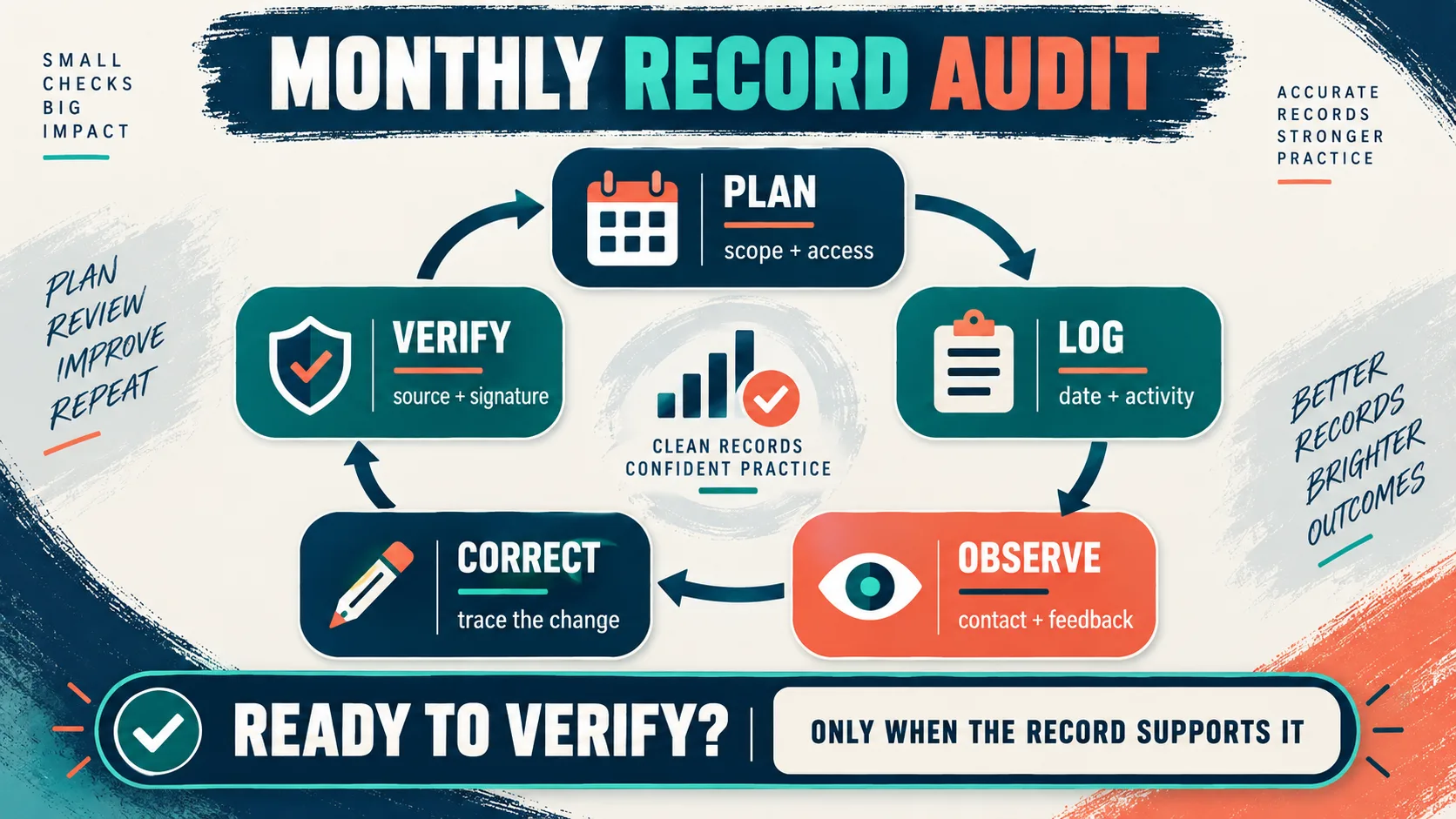
A contract becomes useful when it creates a repeatable review rhythm. The BACB documentation guidance emphasizes collaboration and accurate records; the exact forms and requirements depend on the route and application timing. Build the review into the relationship instead of waiting until an application is nearly due.
- At the start of a period: confirm the setting, available activities, planned supervisor contact, observation access, and the record location. If the client or work opportunity changes, update the plan before assuming the original scope still fits.
- During the period: record what happened while it is fresh. Use observable descriptions, actual dates and durations, the relevant supervisor, and the feedback or decision that followed. Do not turn a planned observation into a completed observation.
- Before review or signature: compare the log with the current source and the contract. Look for missing dates, unclear activity descriptions, mismatched supervisor names, unsupported totals, duplicate entries, or a signature that would attest to more than the reviewer can verify.
- After correction: preserve an audit trail. Document the correction rather than silently overwriting history, retain the version that the parties can support, and save a secure copy for each person who has a responsibility to keep it.
- At a planned checkpoint: ask whether the application date, handbook, forms, state authorization, employer setting, or supervision structure has changed. A template should prompt a recheck, not freeze an old rule in place.
Use a simple traffic-light review: green means the record and authority are clear; amber means a question needs written clarification before the next signature; red means stop counting or signing until the responsible people resolve the issue. This is a quality-control habit, not an official BACB rating system.
Multiple Supervisors, Fees, and Communication
When more than one supervisor participates, identify the coordination model in writing. State who reviews the complete log, who observes, who provides feedback, who signs which records, and how disagreements are escalated. Do not assume that a group meeting or a copied signature answers those questions. If the organization uses a responsible supervisor, name that role and the communication path.
Fees belong in the contract when there are fees, but payment should not be disguised as certification evidence. State whether charges are per meeting, per month, per hour, or part of another agreement. Include cancellation terms, refunds, platform costs, and access to records. A dispute about money should not prevent appropriate client continuity or the release of records that each party is entitled to retain.
Exit Terms and the Application-Date Version Check
Good templates plan for change. Supervision can end because of relocation, a schedule change, a conflict, a safety concern, nonpayment, a change in employment, or a mismatch between the training plan and the available work. The exit section should cover notice, the last supported period, record copies, outstanding corrections, client continuity, and who will answer a future verification question.
Also add a version-check box near the dates: “Before each monthly or final verification, confirm the current BACB handbook, fieldwork resources, form set, application route, and applicable state or employer requirements.” This matters when a candidate’s timeline crosses a requirements update. Official transition guidance may describe different expectations for different application dates; a generic template should never silently choose one set for everyone.
Do not hard-code a number into a template just because it appeared in an older article, social post, or downloaded form. Instead, link the parties to the current authority, record the date it was checked, and note who resolved the question. When the rule is high-stakes or unclear, ask the supervisor, program advisor, state authority, or the BACB through the appropriate channel before signing or counting.
Turn Contract Decisions Into Exam Practice
BCBA exam questions can hide the important clue in a contract scenario: the supervisor cannot verify the record, the planned activity is outside the stated scope, the observation was cancelled, a confidentiality boundary is missing, or the application timeline changes the applicable form. Practice reading for the evidence, not for the most official-sounding label.
Use the Free BCBA Mock Exam for a focused practice check after you complete the contract checklist. When an item is missed, write down the fact that should have controlled the decision: authority, observation, documentation, privacy, competence, or client continuity. Then return to the current official source rather than memorizing an isolated answer.
Frequently Asked Questions
Is this BCBA supervision contract template an official BACB form?: No. It is an original educational checklist. Use the current BACB fieldwork resources and official sample materials for the authoritative documents, and adapt the actual agreement to the parties, program, employer, state, and application route.
Does a signed contract make my BCBA fieldwork hours count?: No. The contract explains an intended relationship. Hours still need to satisfy the applicable requirements and be supported by accurate activities, supervision, observation, records, signatures, and verification.
What if I have more than one BCBA supervisor?: Name the coordination structure. Identify who supervises, who observes, who reviews the complete record, who signs each form, and what happens when supervisors disagree or one becomes unavailable. Confirm the details with the current official guidance.
Should the template include 2027 requirements?: It should include a version and application-date check, not a frozen set of numbers copied from an old document. Recheck the current handbook, transition guidance, forms, and any state or program requirements before each important verification step.
Sources and Verification Notes
Use the BACB BCBA fieldwork resources, the BACB fieldwork documentation FAQ, the current BCBA Handbook, and the official transition resource as the primary verification points. The article’s template is a study and planning aid; it does not replace those sources, legal advice, a state authorization, or a signed agreement reviewed by the actual parties.
Bottom line: A good BCBA supervision contract template makes authority, scope, supervision, observation, records, privacy, fees, changes, and exit responsibilities visible. Draft it together, audit the records throughout the relationship, and recheck the current rules before anyone signs or verifies.
Quick Review Checklist
Use this final checklist to turn bcba supervision contract template into exam-ready reasoning. The goal is not to memorize a label in isolation; it is to identify the relevant evidence and explain why the best answer fits the scenario. Key ideas to review:
- State the central definition or decision point for bcba supervision contract template in your own words.
- Identify the detail that makes bcba supervision contract template different from its closest related ABA term.
- Separate the observable facts in a scenario from assumptions that are not supported by the facts.
- Write one example and one nonexample so you can recognize the concept in a new setting.
Exam application checks:
- Ask what the question is actually requesting before comparing the answer choices.
- Mark the antecedent, response, consequence, or other evidence that supports the selected answer.
- Look for a distractor that describes a related process but does not answer the specific question.
Final self-check:
- Explain how you would verify the interpretation with clear observations or data.
- Change one detail in the scenario and decide whether your answer should change.
- Give a one-sentence rationale that a supervisor or study partner could evaluate.
Take the Free BCBA Mock Exam
When you are ready to apply the idea, use the free practice resource below for additional feedback. Take the Free BCBA Mock Exam



