
Blurred lines: ethical implications of social media for behavior analysts appear whenever a personal post, professional educational post, client story, or online reply changes how people understand a behavior analyst’s role. Social platforms make it easy to share useful information, but speed and visibility can hide important questions about confidentiality, informed consent, competence, professional boundaries, and whether a public statement is truthful and appropriately limited.
Table of Contents
- What Are the Ethical Implications of Social Media for Behavior Analysts?
- Why Social Media Creates Blurred Lines
- The BACB Framework to Apply
- Personal and Professional Accounts
- Client Stories, Images, and Digital Content
- Public Advice Is Not Individualized Care
- Marketing, Claims, and Testimonials
- A Practical Posting Decision Process
- BCBA Exam Takeaways
- Blurred Lines and Social Media Ethics FAQs
- Quick Review Checklist
- Take the Free BCBA Mock Exam
The safest BCBA decision is not simply “never use social media.” It is to identify the audience, purpose, information source, relationship, and foreseeable consequences before posting. A behavior analyst can educate the public without turning a public comment into individualized treatment advice or turning a client’s experience into marketing content.
What Are the Ethical Implications of Social Media for Behavior Analysts?
The main ethical implications are privacy and confidentiality, professional boundaries, public accuracy, scope of competence, informed consent, and the risk that a general post will be interpreted as a clinical recommendation. A post can be technically true and still be misleading if it omits important limits, exaggerates outcomes, uses a client example that people can identify, or implies that a behavior analyst has assessed a person whom the analyst has never met.
The BACB Ethics Code for Behavior Analysts includes specific standards for public statements, social media channels, websites, and digital content. Those standards should be read with the current code rather than with an old social-media checklist. They also do not replace applicable privacy law, employer policy, licensing rules, platform terms, or clinical judgment.
| Risk area | Question before posting | Safer direction |
|---|---|---|
| Confidentiality | Could a client, family, coworker, school, or community member recognize the case? | Remove client content or stop until the applicable consent and privacy review are complete. |
| Boundaries | Does the interaction change a professional relationship or expose private information? | Use a clear communication channel and document boundary decisions when needed. |
| Public advice | Would the reader apply this answer to one identifiable person’s treatment? | Give general education, state the limits, and direct case-specific concerns to an appropriate professional relationship. |
| Public statements | Is the claim truthful, evidence-informed, and free of exaggerated promises? | Use precise language, cite the evidence when appropriate, and correct material errors. |
Why Social Media Creates Blurred Lines
A social-media account may combine friends, family members, supervisees, former clients, current clients, employers, students, and strangers in one audience. The same sentence can be read as a personal opinion by one person and as professional guidance by another. A short video can also travel outside its original audience, lose its context, and be copied after the author deletes it.
The peer-reviewed article Blurred Lines: Ethical Implications of Social Media for Behavior Analysts explains how online interaction can confuse professional roles, privacy, and advice. Its practical lesson remains useful: the technology does not remove responsibility for the relationship, context, audience, and consequences of a post. Engagement is not proof that content is accurate or ethical.
The BACB Framework to Apply
For an exam question or a real posting decision, organize the analysis around the current Ethics Code rather than trying to memorize one social-media rule in isolation. Protect rights and confidentiality: Public statements must protect clients, stakeholders, supervisees, and trainees. A code, nickname, altered age, or cropped image may not make a case anonymous if the setting, dates, behavior, or family details identify the person. “The family gave permission” is incomplete unless consent covers the content, audience, purpose, and foreseeable reuse.
Keep professional statements truthful: Professional statements should not mislead or exaggerate through what they say, suggest, or omit. This applies to captions, videos, comments, website claims, employer marketing, and content created by others to promote the analyst’s services. A disclaimer does not repair a claim such as “this strategy works for every child.”
Respect the limit on individualized public advice: The code states that behavior analysts do not provide specific advice related to a client’s needs in public forums. General teaching is different. When a question invites a case-specific recommendation, avoid diagnosing, selecting a treatment, or directing a family’s next step without the appropriate relationship and assessment.
Apply the current social-media and digital-content standards: Standard 5.10 addresses social-media channels and websites: understand privacy risks, do not publish client information or digital content on personal accounts, and meet additional conditions for client content on professional accounts. Standard 5.11 reinforces confidentiality, informed consent, intended purpose and audience, and remedial action when misuse occurs.
These standards do not replace clinical documentation. If a post creates a concern, save the record, consult an appropriate supervisor or qualified adviser, and document corrective steps. The BACB states that it does not provide individual legal or ethics advice.
Personal and Professional Accounts
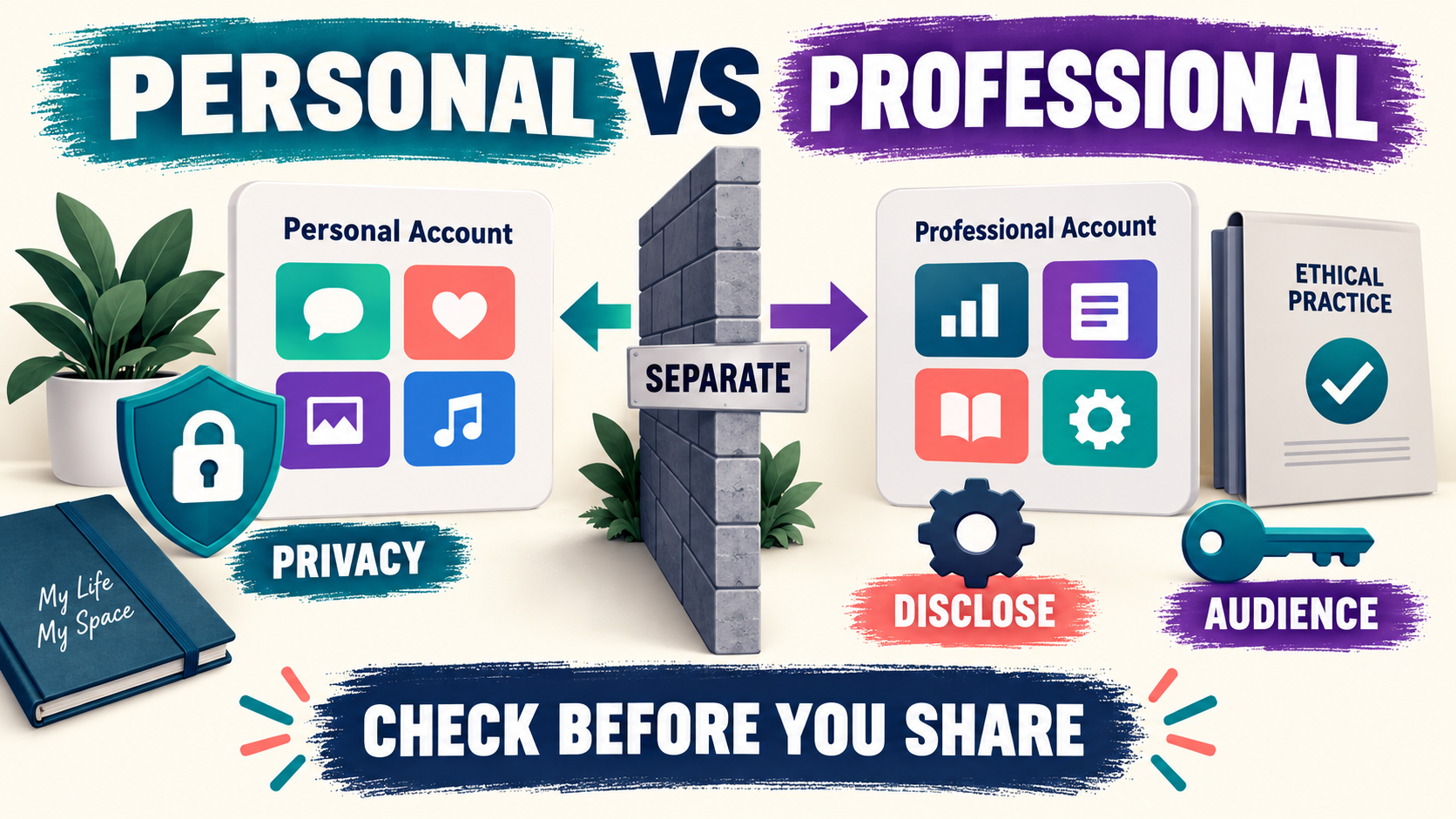
Calling an account “personal” does not make every post private. A public personal account can still be associated with a credential, employer, clinic, or professional role. Make the account’s role, audience, and boundaries understandable. Before posting, check whether the content:
- identifies the account owner as a BCBA, student, supervisor, employer, or service provider;
- mentions a client, family, school, workplace, or case event, even without a name;
- could be read as a promise about treatment, outcomes, or certification;
- creates a direct-message clinical question needing assessment or documentation;
- includes employer, copyrighted, or client content needing separate approval;
- could be shared without its context, disclaimer, or intended audience.
Clear boundaries are not unfriendly. A reply such as “I can share general education here, but I cannot recommend a plan for an identifiable client in a public thread; please discuss the case with the treating BCBA” clarifies the role.
Client Stories, Images, and Digital Content
Client-related content deserves the highest caution. Ask whether someone could identify the client from the setting, age, diagnosis, behavior, school event, treatment history, or unusual success story. A viral post can create an audience the family never intended.
When a professional account is permitted to publish client digital content, the current code requires more than a casual “okay.” The analyst should obtain informed consent before publication, include the required notice that consent was obtained and the content should not be captured or reused without express permission, publish in a way that reduces sharing when possible, and make reasonable efforts to prevent and correct misuse. The analyst must also monitor the account for accuracy and appropriateness.
Consent is not unlimited permission. Internal training permission may not cover public advertising, and a testimonial still requires review of the relationship, power difference, and advertising rules. If the content is not necessary, remove it.
Public Advice Is Not Individualized Care
General education can explain terms such as reinforcement, functional assessment, prompting, or data display. Individualized care requires more: a defined professional relationship, a clear referral or service context, assessment, relevant history, consent, documentation, and consideration of risks and benefits.
Consider a post asking, “My child drops to the floor in a grocery store. Should I use planned ignoring?” A responsible response can explain that the plan depends on function, safety, communication, setting events, and consequences. It should not prescribe a procedure from one sentence or reveal a recognizable client example. Several online comments do not become a functional assessment. The safest public response teaches the boundary and provides a route to appropriate care.
Marketing, Claims, and Testimonials
Social media often blends education and promotion. A BCBA may discuss a behavior-analytic concept, invite people to a webinar, link to a course, or describe a service. The ethical question is whether a reasonable reader can tell what is general education, what is an advertisement, what evidence supports the claim, and what the analyst is actually qualified to provide.
Avoid absolute promises, context-free before-and-after stories, “guaranteed” outcomes, and claims based on one case. Review the current code and advertising rules for testimonials; consent alone does not make marketing appropriate. Do not let a third party publish a claim that you could not publish yourself.
| Post type | Main ethical check | Common trap |
|---|---|---|
| Concept explainer | Is the explanation accurate and within the author’s competence? | Turning a general principle into a universal treatment promise. |
| Case story | Can the person be identified, and is the consent specific to this audience and purpose? | Assuming that removing a name makes the story anonymous. |
| Service promotion | Are qualifications, outcomes, limitations, and evidence represented honestly? | Allowing a third party to exaggerate what the BCBA or service can do. |
| Reply to a clinical question | Would the reply function as individualized advice? | Giving a treatment instruction without assessment, consent, or follow-up. |
A Practical Posting Decision Process
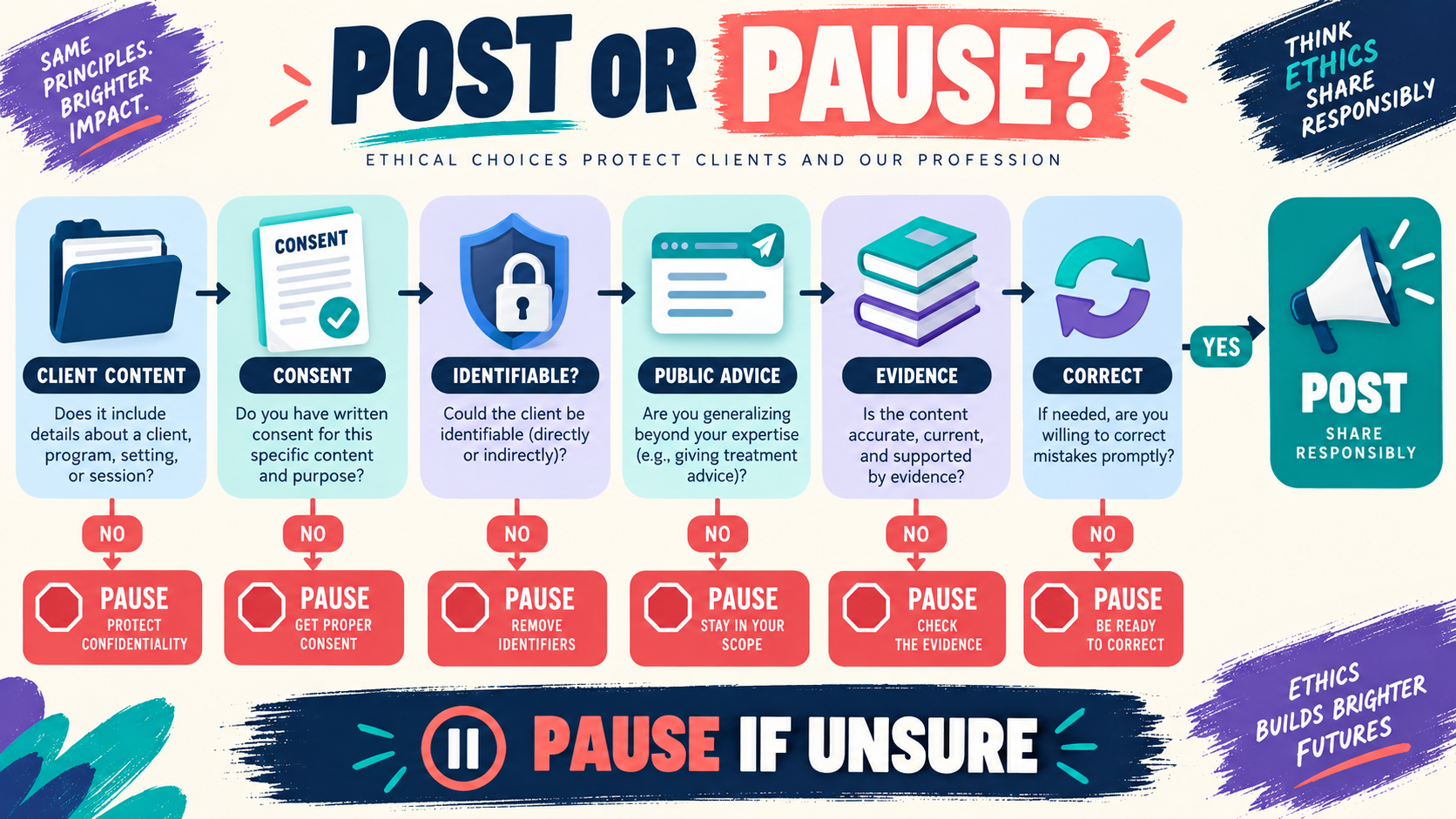
Use this short sequence before publishing or replying:
- Name the purpose: Is the post education, professional discussion, marketing, recruitment, supervision, or client communication?
- Map the audience: Who can view, copy, search, or misunderstand the content now and later?
- Remove identifying details: Treat combinations of facts as potentially identifying, not just names and photographs.
- Separate general from specific: If a reader could apply the post as a treatment instruction for one person, rewrite it or move the discussion to an appropriate professional setting.
- Check evidence and scope: Confirm that the claim is accurate, current, research-informed, and within your competence.
- Check consent and approvals: Verify the intended purpose, audience, employer policy, client consent, intellectual-property permission, and required disclaimer.
- Plan correction: Decide how you will monitor the post and respond if it is copied, misunderstood, identified, or shown to be inaccurate.
If any answer is unclear, pause. Asking a supervisor, compliance professional, attorney, or other qualified adviser is more defensible than posting first and trying to repair the result after it spreads.
BCBA Exam Takeaways
For a scenario question about social media, look for the answer that protects confidentiality, maintains role boundaries, avoids specific client advice in a public forum, uses informed consent for permitted client content, and keeps public statements truthful and evidence-informed. A response that says “the client agreed” may still be incomplete if it ignores purpose, audience, disclaimer, sharing controls, or monitoring.
Also distinguish the setting from the action. A professional account is not automatically safe, and a personal account is not automatically outside the code when the analyst’s credential or professional activity is involved. The best answer usually addresses the full chain: what is posted, who can identify it, how it could be reused, what relationship exists, and what corrective action is required.
Blurred Lines and Social Media Ethics FAQs
Can a BCBA post a general ABA tip on social media?: Generally, a general educational explanation can be appropriate when it is accurate, within the BCBA’s competence, and not disguised individualized advice. Avoid client details, exaggerated promises, and language that tells an identifiable family what treatment to implement.
Can a BCBA post a client success story?: Only after carefully reviewing confidentiality, informed consent, purpose, audience, employer policy, and applicable law and ethics standards. A story may remain identifiable even when the name and photograph are removed, and consent for internal training may not cover public marketing.
Is a private social-media account exempt from professional ethics?: No automatic exemption exists. Privacy settings reduce exposure but do not eliminate screenshots, sharing, professional relationships, or the possibility that the account is linked to the analyst’s role. Apply the current code and the relevant workplace and jurisdictional requirements.
Can a BCBA answer a parent’s treatment question in a public group?: The BCBA can provide general education and recommend an appropriate route for individualized care, but should not provide specific advice related to a client’s needs in a public forum. The response should protect privacy and avoid creating an unassessed treatment relationship.
Social media is not ethically neutral just because it is informal. The strongest practice is deliberate: protect people’s information, state only what the evidence and role support, keep general education separate from individualized care, and correct problems when they arise. For additional practice applying ethics scenarios to BCBA-style questions, try the free BCBA mock exam. It is a study resource, not legal or ethics advice and not a guarantee of certification.
Quick Review Checklist
Use this final checklist to turn ethical implications of social media for into exam-ready reasoning. The goal is not to memorize a label in isolation; it is to identify the relevant evidence and explain why the best answer fits the scenario. Key ideas to review:
- State the central definition or decision point for ethical implications of social media for in your own words.
- Identify the detail that makes ethical implications of social media for different from its closest related ABA term.
- Separate the observable facts in a scenario from assumptions that are not supported by the facts.
- Write one example and one nonexample so you can recognize the concept in a new setting.
Exam application checks:
- Ask what the question is actually requesting before comparing the answer choices.
- Mark the antecedent, response, consequence, or other evidence that supports the selected answer.
- Look for a distractor that describes a related process but does not answer the specific question.
Final self-check:
- Explain how you would verify the interpretation with clear observations or data.
- Change one detail in the scenario and decide whether your answer should change.
- Give a one-sentence rationale that a supervisor or study partner could evaluate.
Take the Free BCBA Mock Exam
If you want a low-pressure way to check your recall, use the free practice resource below. Take the Free BCBA Mock Exam



