
Clinical supervision California board certified behavior analysts can refer to several different relationships. A BCBA candidate may mean supervised fieldwork toward BACB certification. A California employer may mean oversight of RBTs, BCaBAs, or behavioral-health staff. A Medi-Cal organization may mean the supervision and provider-reporting duties attached to Qualified Autism Service enrollment. Those are connected, but they are not one rulebook.
Table of Contents
- Clinical supervision California board certified behavior analysts: the short answer
- Which supervision lane are you in?
- Which official source controls?
- What does BACB supervision require for fieldwork?
- What does California add for Medi-Cal services?
- What should a California supervision workflow include?
- How should the 2027 BACB changes affect planning?
- Common California supervision mistakes
- How can this improve BCBA exam preparation?
- Clinical supervision California BCBA FAQ
- Take the Free BCBA Mock Exam
The safest way to plan is to identify the role first, then follow the current BACB requirements and the California program or payer rules that actually apply. This guide separates national certification supervision from California Medi-Cal enrollment and from supervision rules for separately licensed professions. It is educational planning support, not a license determination or billing decision. Table of Contents
Clinical supervision California board certified behavior analysts: the short answer
Start with this three-part distinction:
- BACB fieldwork supervision: a qualified supervisor guides and documents practical experience for a person pursuing BCBA or BCaBA certification. The BACB handbook, supervision page, forms, and application-date rules control this lane.
- Ongoing behavior-analytic service supervision: a BCBA may supervise RBTs, BCaBAs, or other people implementing behavior-analytic services. The BACB identifies these roles separately and requires the applicable training, oversight, documentation, and ethical responsibility.
- California Medi-Cal supervision and enrollment: California’s Department of Health Care Services (DHCS) sets QAS provider and reporting requirements for covered behavioral health treatment. A BCBA credential does not automatically answer enrollment, roster, attestation, record, or payer questions.
If the supervisee is accruing hours for BACB certification, begin with the BACB. If the question is whether a California organization can report or bill behavioral health treatment providers, begin with DHCS. If the supervisee is pursuing a psychology, MFT, social-work, or counseling license, use that profession’s California board rules as well; do not substitute BACB fieldwork rules for a state-licensed profession’s supervised-experience requirements.
Which supervision lane are you in?
A role check prevents most California supervision errors. Use the table before drafting a contract, accepting hours, or changing a payer workflow.
| Reader situation | Start here | Core question |
|---|---|---|
| BCBA trainee collecting fieldwork | BACB BCBA Handbook | Will this supervisor, activity, observation, and record meet the BACB pathway that controls my application? |
| BCBA supervising trainees, RBTs, or BCaBAs | BACB supervision resources | Which role am I performing, what training is required, and what do I remain responsible for? |
| California Medi-Cal QAS provider or organization | DHCS QAS enrollment guidance | Who must enroll, who must be reported, which qualifications and supervision requirements must be attested, and what records can be audited? |
| California psychology or behavioral-science licensure trainee | The appropriate California licensing board | Which state license, supervised-experience agreement, scope, and board form control the hours? |
Which official source controls?
There is a useful hierarchy, but it depends on the task:
- Use the BACB handbook and current supervision pages for national certification eligibility, supervised fieldwork, supervisor roles, and certification maintenance.
- Use the California DHCS QAS pages, Behavioral Health Treatment policy, provider manual, and enrollment bulletins for Medi-Cal behavioral health treatment, QAS reporting, provider enrollment, and payer documentation.
- Use the California Board of Psychology, Board of Behavioral Sciences, or another licensing board only when the person is accumulating supervised experience toward that board’s license or registration.
- Use the employer contract and managed-care plan instructions for local workflow, authorization, roster, claims, and record-retention details.
California’s Board of Behavioral Sciences regulates professions such as LMFTs, LCSWs, LEPs, and LPCCs. Its supervision materials may be relevant to those licensees, but they do not replace BACB fieldwork standards for a BCBA candidate. Similarly, DHCS enrollment guidance can explain a payer’s attestation and audit expectations without telling you whether a particular activity counts as BACB fieldwork.
What does BACB supervision require for fieldwork?
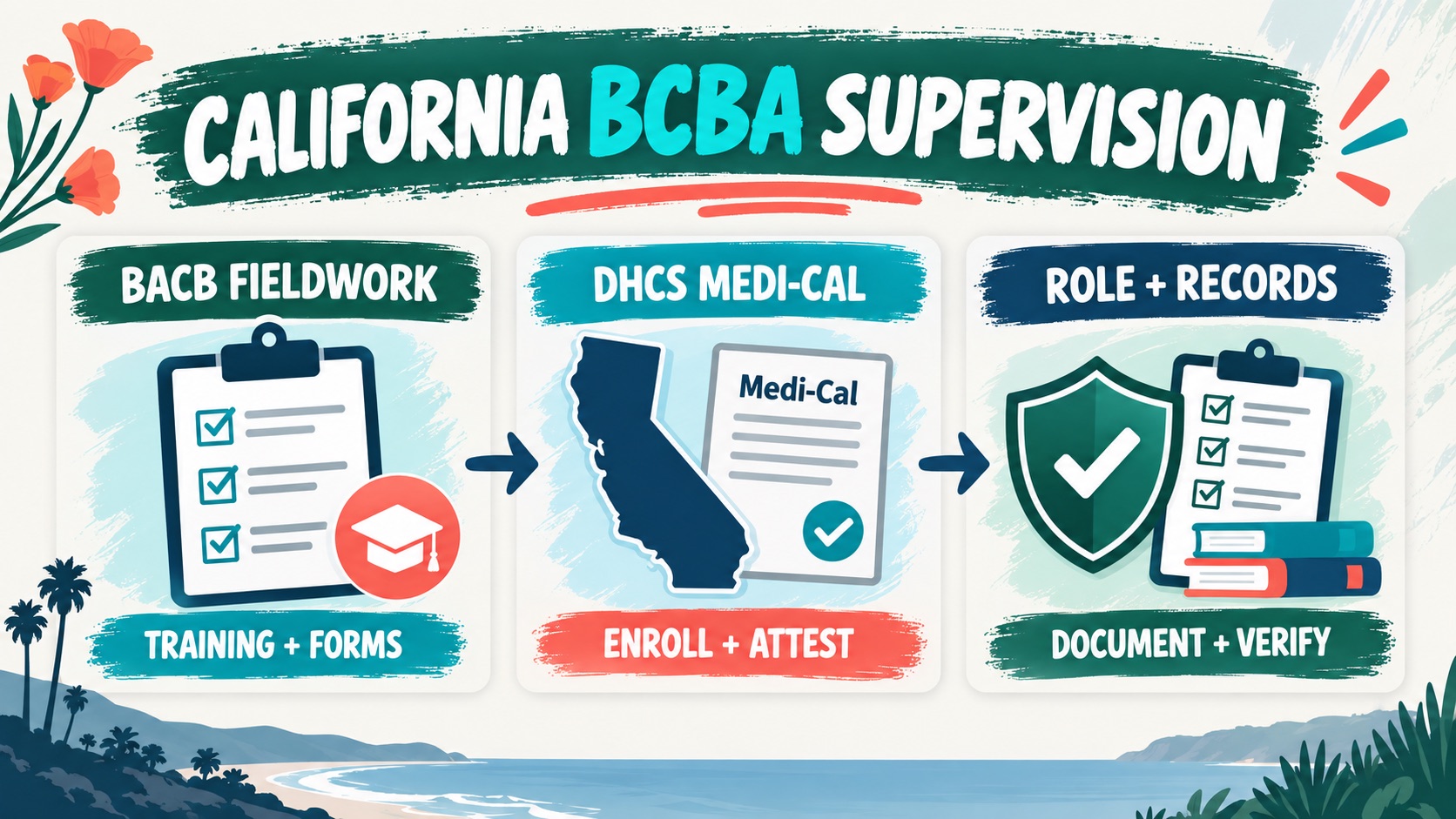
For a BCBA candidate in California, the central relationship is the BACB supervised-fieldwork relationship. The supervisor should be qualified under the applicable handbook and should be able to explain the supervision structure, observations, feedback, activities, and records before the first hour is counted. Before starting, confirm:
- the supervisor’s current BCBA status and eligibility for the role;
- the application date and BACB requirement set that will control your forms;
- the written supervision agreement, planned contacts, observations, and feedback schedule;
- how restricted and unrestricted activities will be distinguished and reviewed;
- who stores the monthly records, who signs them, and how you obtain copies if you change employers;
- how concerns, missed contacts, scope limits, and corrective feedback will be documented.
Good supervision is not simply a signature at the end of a month. It is a teaching and quality-assurance process: the supervisor observes relevant work, reviews data and written products, explains decisions, gives feedback, and corrects problems while the record is still repairable. If the supervisor is a new BCBA supervising trainees, review the BACB’s current consulting-supervisor guidance before accepting a fieldwork arrangement.
What does California add for Medi-Cal services?
California’s DHCS has a separate payer and enrollment layer. Its QAS application information says individual BCBAs and educational psychologists may enroll using the QAS application. QAS provider organizations and individuals must report the relevant providers, professionals, and paraprofessionals and attest that people for whom they bill meet the qualifications and follow the supervision requirements in the State Plan for behavioral health treatment services.
The DHCS FAQ also distinguishes who needs to enroll. The QAS enrollment pathway is for BCBAs and educational psychologists who will enroll as QAS Providers; QAS professionals and paraprofessionals generally do not separately enroll in the same way, but the organization must report them and maintain supporting information. The exact workflow can depend on whether the applicant is an individual, organization, or community-based organization and whether the service is fee-for-service or managed care.
That means a California clinical supervision file for payer work should answer more than “Who is the BCBA?” It should identify the organization or individual applicant, the person providing each role, certification or license numbers where applicable, the supervision relationship, service records, claim responsibility, and the process for updating DHCS when reported information changes. DHCS materials also describe audit and documentation expectations, so do not treat an attestation as a substitute for retaining evidence.
DHCS telehealth and BHT materials add another boundary: an enrolled provider’s ability to deliver or bill a service depends on the applicable Medi-Cal pathway, plan approval, and service rules. A BCBA’s national certification, the organization’s QAS status, and the member’s plan are related but not identical decisions.
What should a California supervision workflow include?
Build one workflow with separate folders for certification, service delivery, and payer administration:
| Folder | Keep | Review trigger |
|---|---|---|
| BACB fieldwork | Agreement, activity plan, contacts, observations, feedback, monthly and final forms. | New supervisor, new application date, handbook or form change. |
| Clinical service supervision | Role assignments, treatment-plan review, data review, staff feedback, safety and ethics escalation. | Change in client, scope, staff role, service model, or responsible BCBA. |
| California payer and enrollment | QAS enrollment, roster, attestations, credential records, claims and audit-support documents. | DHCS update, plan change, personnel change, or reported-information change. |
Do not merge these folders into one generic “supervision” spreadsheet. The same observation or meeting may be clinically useful but still need different evidence to satisfy BACB, employer, or payer purposes. Label the purpose of each record.
How should the 2027 BACB changes affect planning?
The BACB has announced core eligibility and maintenance changes beginning January 1, 2027, including changes to degree, coursework, supervised fieldwork, continuing education, and ongoing supervision. California does not erase that national transition. At the same time, a BACB change does not automatically rewrite DHCS enrollment instructions, a managed-care contract, or a California licensing board’s supervised-experience rules.
Write the planned BACB application date at the top of your fieldwork file. Then read the official 2027 requirements and transition guidance, confirm which form version and pathway apply, and ask the supervisor to review any hours that cross the transition boundary. Keep a second date check for DHCS or the relevant employer and payer. One calendar date can affect several files differently.
Common California supervision mistakes
- Calling every oversight relationship “clinical supervision”: fieldwork, ongoing service supervision, payer oversight, and licensed-profession supervision have different purposes.
- Using California psychology or BBS rules for a BACB application: the state board may regulate a different credential and different supervised experience.
- Assuming the BCBA credential completes Medi-Cal enrollment: QAS reporting, attestation, plan approval, and documentation remain separate tasks.
- Letting a payer form replace a BACB form: service authorization evidence does not automatically prove fieldwork compliance.
- Failing to define the supervisor’s role: write who observes, teaches, signs, reviews, and handles a missed or unsafe service.
- Ignoring the 2027 application date: old and new rules should not be mixed casually.
How can this improve BCBA exam preparation?
Turn the topic into a source-matching exercise. For each practice question, label the answer as BACB certification, BACB fieldwork, ongoing service supervision, California DHCS payer administration, or another California license. Then explain why that authority controls. This trains the exact decision skill that prevents a plausible but wrong answer from a different rulebook.
After reviewing the official materials, use the free BCBA mock exam to practice under time pressure. Tag missed questions as role confusion, documentation, ethics and scope, payer versus certification, or transition timing. The practice resource supports study; it is not BACB approval, a DHCS enrollment decision, legal advice, or a guarantee of a passing score.
Clinical supervision California BCBA FAQ
Does California have one clinical supervision rule for all BCBAs?: No. BACB certification supervision, ongoing behavior-analytic service oversight, California Medi-Cal QAS requirements, and supervision for a separately licensed profession can involve different authorities and documents.
Can a BCBA supervisor in California sign my BACB fieldwork?: Only if the supervisor meets the current BACB eligibility and documentation requirements for the role and provides supervision in accordance with the applicable handbook. California location alone does not make a supervisor eligible.
Do California Medi-Cal QAS professionals need individual enrollment?: DHCS distinguishes QAS Providers from QAS professionals and paraprofessionals. Individual BCBAs who enroll as QAS Providers may apply through the QAS pathway, while organizations must report the relevant personnel and attest to qualifications and supervision. Check the current DHCS enrollment guidance for your applicant type and plan.
Do California payer records count as BACB fieldwork automatically?: No. A payer record may be useful evidence, but BACB fieldwork still has its own supervisor, activity, observation, contact, form, and application-date requirements. Ask the supervisor to map the record to the BACB standard before counting it.
The practical answer to clinical supervision California board certified behavior analysts is to keep three questions separate: does the supervision count for BACB certification, does it support safe and competent behavior-analytic services, and does the California payer or program accept the provider and documentation? Start with the authority that owns the decision, date the rule, and keep evidence that matches the purpose. For targeted review, use our clinical supervision california board certified behavior practice questions to apply the concept in exam-style scenarios.
Take the Free BCBA Mock Exam
When you are ready to apply the idea, use the free practice resource below for additional feedback. Take the Free BCBA Mock Exam



