

True or false oversight is strictly a BACB requirement? False. The BACB is one important source of supervision and oversight requirements, but it is not the only authority that can shape a behavior analyst’s responsibilities. The BACB Ethics Code says behavior analysts must follow all applicable supervisory requirements, including BACB rules, licensure requirements, funder requirements, and organization policies. The word strictly makes the statement too absolute.
Table of Contents
- True or false oversight is strictly a BACB requirement: what is the answer?
- What does oversight mean in a BCBA context?
- What does the BACB actually control?
- Which authority creates which requirement?
- How can licensure requirements change the answer?
- Why do funder and organization policies matter?
- How should you read an oversight question on an exam?
- Quick review checklist
- What changes with the 2027 BCBA requirements?
- What mistakes should you avoid?
- How can you turn this into a study plan?
- Oversight and BACB requirements FAQ
- Take the Free BCBA Mock Exam
This distinction matters for BCBA candidates because an exam question may test whether you can identify the controlling layer in a scenario. It also matters in practice: a current BCBA certification does not erase state law, a payer contract, an employer’s policy, or a client-specific supervision plan. This guide explains what the BACB controls, what other authorities can add, and how to read “oversight” questions without turning one rule into a universal rule. Table of Contents
True or false oversight is strictly a BACB requirement: what is the answer?
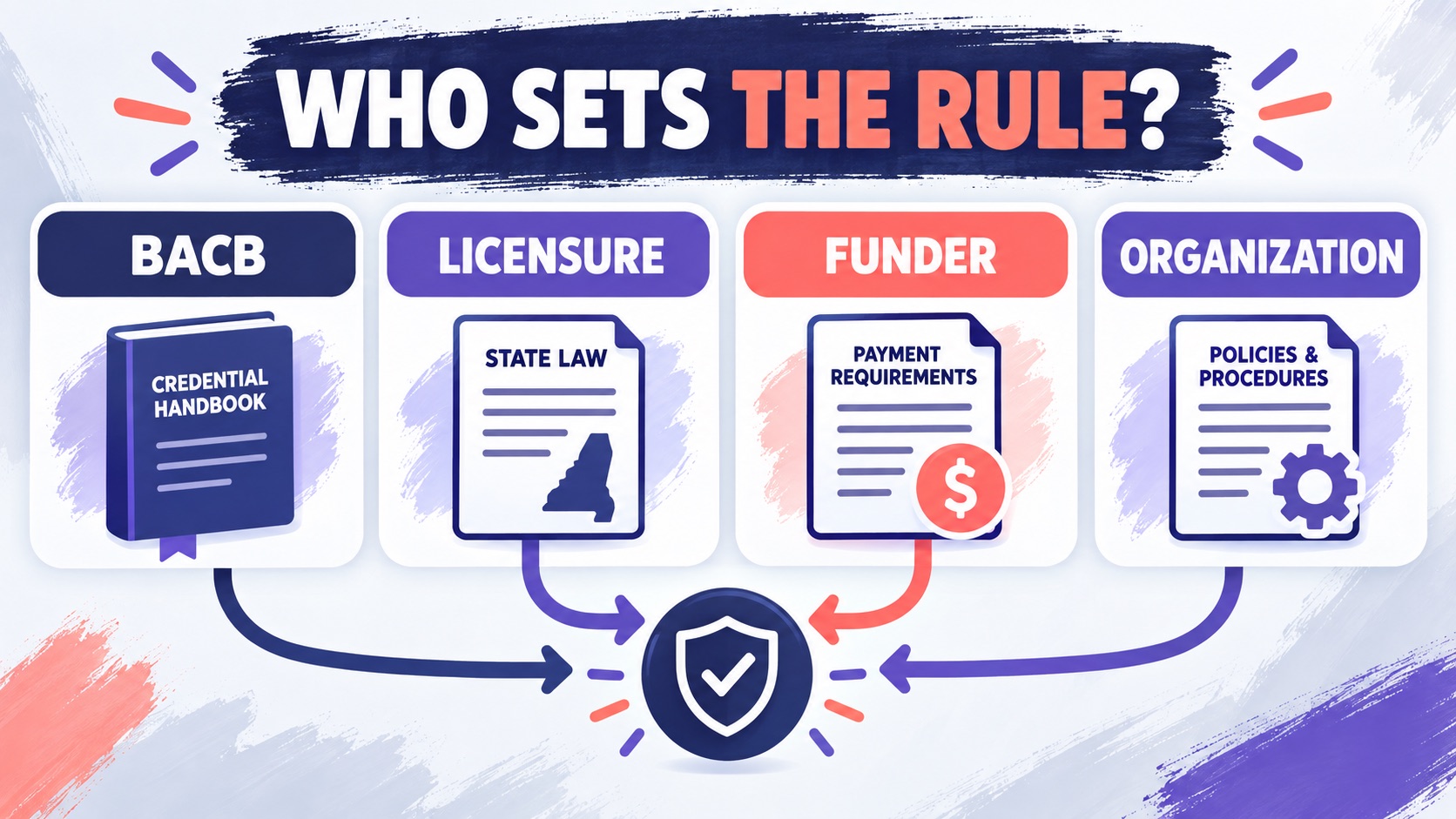
The correct answer is false. The BACB creates certification rules and ethical obligations for people within its jurisdiction, but supervision and oversight can also be required by a state licensing board, a funder, an employer, a school district, a contract, or another governing body. The BACB’s Ethics Code specifically gives examples of “BACB rules, licensure requirements, funder and organization policies” when describing applicable supervisory requirements. There are two separate ideas in the statement:
- Who can impose a requirement? The BACB is one source, but other legal and contractual authorities can impose additional conditions.
- What does oversight cover? It may refer to supervised fieldwork, ongoing supervision of RBTs or BCaBAs, delegation of tasks, documentation, or accountability for supervisee work. Each context has its own rules.
A safer exam habit is to replace the absolute sentence with a precise one: “BACB rules may require oversight in certification and ongoing practice contexts, while other applicable authorities may add requirements.” That version preserves the BACB role without claiming that every oversight duty comes only from the BACB.
What does oversight mean in a BCBA context?
Oversight is a broad word, not a single BACB form or one universal supervision ratio. In behavior analysis, it can describe the responsible professional’s monitoring, direction, review, feedback, documentation, and accountability for work performed by another person. The relationship might involve a trainee accruing fieldwork, an RBT receiving ongoing supervision, a BCaBA working under supervision, or a qualified assistant carrying out a delegated assessment or training task.
The BACB’s Supervision, Assessment, Training, and Oversight page separates several roles. It discusses supervising RBTs, assessing and training RBTs, supervising BCaBAs, and supervising future behavior analysts. It also explains that some assessment or training tasks may be delegated to qualified and proficient assistants, while the BCBA or BCaBA remains responsible for the work and signs off on it. That is different from saying that every person in an organization is automatically under a BACB oversight requirement.
Before applying a rule, identify the relationship. Ask who is being supervised, whether the person is a trainee or a current certificant, what service or task is being performed, and which credential or license is being used. The same word can describe different obligations in different settings.
What does the BACB actually control?
The BACB controls its certification system. That includes eligibility routes, application and examination requirements, certification maintenance, relevant handbook instructions, and ethics standards for applicants and certificants. The BACB’s Ethics Code applies to BCBA and BCaBA applicants and certificants and covers professional activities such as service delivery, consultation, supervision, training, management, and research. For supervision-related questions, the BACB may establish requirements such as:
- who may supervise fieldwork toward BCBA or BCaBA certification;
- what documentation a trainee or supervisor must maintain;
- when an 8-hour supervision training is required before supervising certain roles;
- how a supervisor must remain accountable for supervision and delegated work; and
- what certification or ongoing-supervision conditions apply to a role.
The BACB page says supervisors who oversee individuals accruing certification fieldwork, or current BCaBA or RBT certificants who require ongoing supervision, must complete the specified 8-hour supervision training before providing supervision. That is a BACB requirement for the roles described on the page. It does not prove that a state board, funder, or employer has no additional requirement.
The BACB also states that it does not have separate jurisdiction over organizations or corporations. That boundary is useful when reading a question: the BACB can govern certificants and applicants within its jurisdiction, while an employer or organization may separately set operational expectations for its staff.
Which authority creates which requirement?
Use the following map to identify the rule source before deciding whether a statement is true. The table is a study aid; the live handbook, law, contract, and organizational policy control when they differ.
| Authority | Typical question it answers | What to do |
|---|---|---|
| BACB | Does this affect certification, fieldwork, ongoing supervision, ethics, or a BACB application? | Check the current handbook, Ethics Code, TCO, or role-specific BACB resource. |
| State licensing board | May this person practice or supervise under the state license, and what does state law require? | Read the current statute, rule, license conditions, and board guidance. |
| Funder or payer | What documentation, provider credential, or supervision model is required for payment? | Review the contract, provider manual, and authorization terms. |
| Employer or organization | How will supervision be scheduled, documented, reviewed, and escalated at this workplace? | Follow the written policy and clarify conflicts with the responsible administrator. |
One situation can involve all four layers. A BCBA may satisfy a BACB supervision rule, still need a state license, follow a payer’s documentation schedule, and comply with an employer’s stricter staffing policy. The strictest applicable condition may control the work arrangement, but do not assume that satisfying one layer automatically satisfies the others.
How can licensure requirements change the answer?
State licensure is the clearest reason the keyword statement is false. A state can define who may practice, what title may be used, who may supervise, what services require a license, and which records must be kept. Some states regulate behavior analysts directly; others regulate related professions or use different terminology. A state board may also require supervision that is more specific than the national certification rule.
The BACB Ethics Code tells behavior analysts to comply with applicable licensure requirements as well as BACB rules. That means a BCBA candidate should not answer a state-law question from memory of a national handbook. For real work, identify the state where the service occurs, the license under which the service is delivered, the supervisee’s role, and whether telehealth or payer rules add another layer.
For exam preparation, watch for wording that quietly changes the authority. “What does the BACB require?” is narrower than “What must the supervisor do in this state?” If the stem names a licensure board or a payer, the BACB may not be the only source needed to solve it. If the stem asks about certification fieldwork, the current BCBA Handbook is usually the first source to check.
Why do funder and organization policies matter?
Funder and organization requirements are not automatically BACB rules. A payer may require a certain provider credential, treatment-plan review, observation frequency, or signature before it will authorize or reimburse services. An employer may require more frequent meetings, a particular documentation system, or an internal clinical review. Those conditions can affect how services are delivered even when they are not part of BACB certification.
The Ethics Code makes this practical rather than theoretical. It says behavior analysts should comply with applicable supervisory requirements, including funder and organization policies, and should take on only the number of supervisees or trainees that allows effective supervision. A question that says “the BACB sets the only acceptable caseload” is therefore suspect. The responsible answer may depend on the BACB, state rules, client needs, available time, employer policy, and payer contract.
How should you read an oversight question on an exam?
Start with the qualifier. Words such as strictly, only, always, and never are not automatically wrong, but they require proof. Ask whether the statement eliminates other authorities that the governing source explicitly recognizes. In this case, the BACB Ethics Code itself names licensure, funder, and organization requirements, so “strictly a BACB requirement” is too broad. Then identify the question’s target:
- Credential target: Is the question about becoming or remaining a BCBA? Start with BACB requirements.
- Service target: Is it about delivering care, supervising a person, or delegating a task? Check the role-specific BACB rules plus applicable law and policy.
- Authority target: Does the stem name a state, payer, employer, or contract? Treat that named source as relevant rather than defaulting to BACB.
- Accountability target: Who must monitor, document, correct, or sign off on the work? Separate delegation from transfer of responsibility.
A useful mini-example is this: “A BCBA may ignore a state supervision rule because the BACB credential is national.” The answer is false. National certification does not cancel applicable state law. Another statement—“The BACB may require supervision training for certain supervisors before they provide supervision”—can be true because it is limited to the BACB rule and the roles described by the source.
Quick review checklist
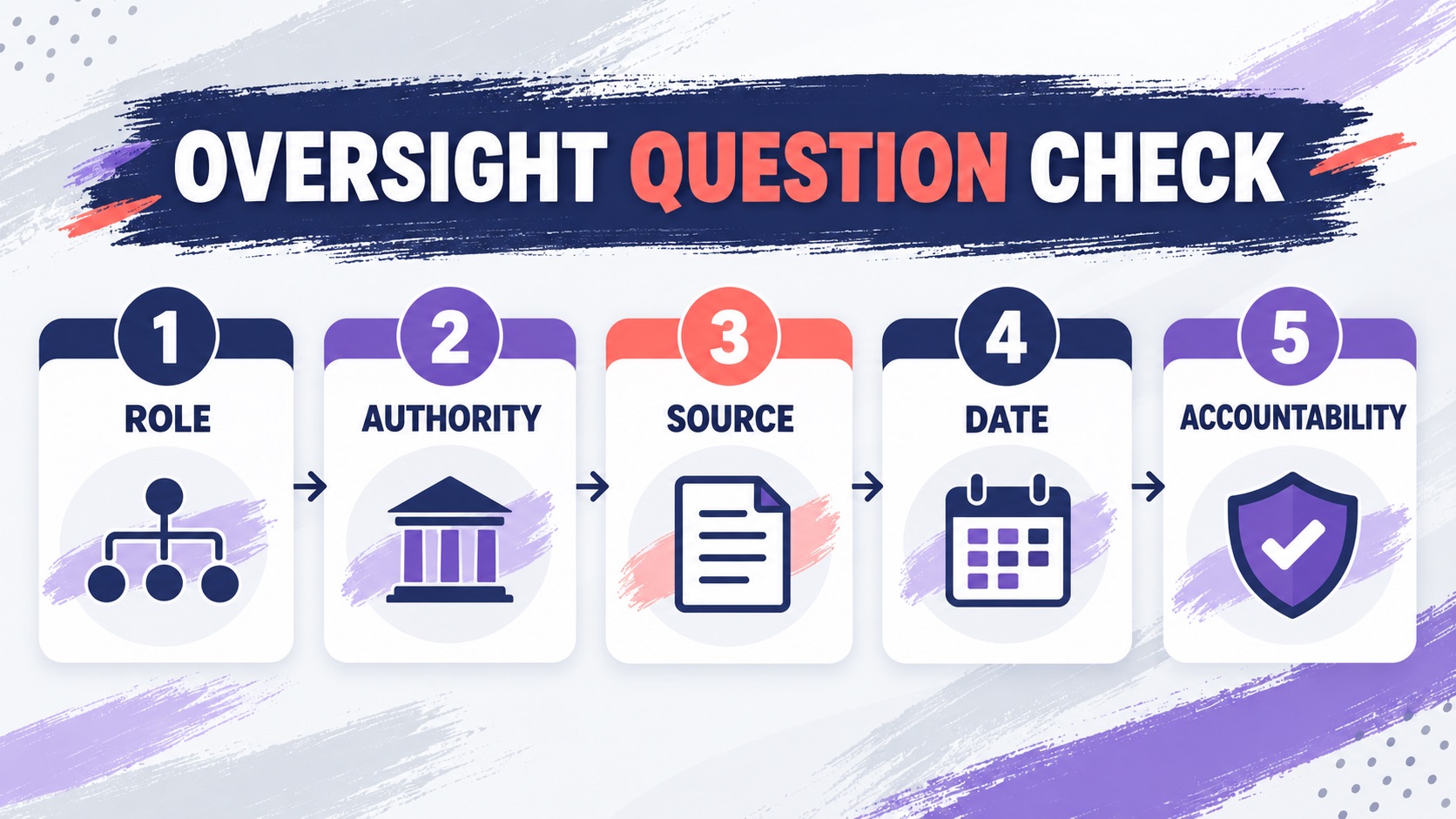
Before selecting an answer or making a workplace decision, run this short check:
- What person, credential, or service is being supervised?
- Is the question about BACB certification, practice licensure, payment, or internal operations?
- Which current source names the requirement?
- Does the source say “must,” or does it offer guidance and examples?
- Has a state, payer, employer, or contract added a stricter condition?
- Who remains accountable after a task is delegated?
- Could the answer change on or after January 1, 2027?
What changes with the 2027 BCBA requirements?
The 2027 transition is another reason to avoid absolute wording. The BACB says significant BCBA and BCaBA certification changes take effect January 1, 2027, and that a complete application—including payment and required documents—must be received by December 31, 2026 to be reviewed under the current 2022 requirements. That deadline is about the national certification transition; it does not turn every state or employer oversight rule into a BACB rule.
The published 2027 BCBA requirements describe supervised fieldwork and concentrated supervised fieldwork, supervisor qualifications, supervision percentages, observation expectations, individual-supervision limits, and unrestricted-activity percentages. The current page lists 2,000 hours for supervised fieldwork or 1,500 for concentrated supervised fieldwork, with 5% or 7.5% supervision requirements respectively. It also describes a route for a newer BCBA to receive monthly consultation from a qualified consulting supervisor. Use the exact version of the handbook and forms that applies to your application date.
The BACB’s recent-and-upcoming-changes page also lists revisions to continuing education and ongoing supervision beginning January 1, 2027. Those changes are national certification requirements. A state licensing board can still have its own requirements, and a funder or employer can impose operational conditions. Cite the authority and effective date instead of writing “oversight is a BACB-only requirement.”
What mistakes should you avoid?
- Collapsing certification and licensure: a BCBA credential does not answer every state-practice question.
- Treating a broad word as a single rule: define whether oversight means fieldwork supervision, ongoing supervision, delegation, or documentation.
- Ignoring the named authority: a payer or state board may control the detail the question is testing.
- Confusing delegation with accountability: a qualified assistant may perform a task while the responsible certificant still reviews and signs off.
- Using an old handbook: current 2027 transition pages and handbooks can change the applicable requirements.
- Inventing a universal supervisee number: volume limits may depend on effective supervision, client needs, BACB rules, licensure, and policy.
- Choosing an answer because it sounds strict: precise source matching is more reliable than the most confident wording.
How can you turn this into a study plan?
Make authority matching part of your practice routine. For each missed item, record the exact phrase that controlled the answer, the role involved, the governing source, and the reason an absolute alternative failed. Then write a one-sentence rule in your own words and test it with a new scenario. This process is more useful than memorizing that “oversight belongs to the BACB” because it teaches you to locate the boundary.
For a timed checkpoint, use the free BCBA mock exam after reviewing the supervision and ethics material. Mark questions containing qualifiers such as only or strictly, and review the source behind every missed item. The practice resource is study support, not BACB approval, legal advice, licensure advice, or a guarantee of a passing score.
Oversight and BACB requirements FAQ
Is oversight a BACB requirement?: Sometimes. BACB rules require specific supervision, training, documentation, and accountability in defined certification or ongoing-service contexts. Other authorities may also require oversight, so it is not accurate to say that oversight is strictly or exclusively a BACB requirement.
Does the BACB control employer supervision policies?: No. The BACB can set rules for applicants and certificants within its jurisdiction, while an employer may set additional workplace policies. The policies must still be followed when they apply to the work arrangement.
Can a state require more supervision than the BACB?: A state’s laws and rules can impose requirements that are separate from national certification. Check the current state licensing source and do not assume that meeting a BACB rule answers a state-practice question.
Does delegated work remove the BCBA’s responsibility?: Not automatically. The BACB describes situations in which qualified assistants may perform tasks under oversight while the responsible BCBA or BCaBA remains responsible and signs off. Confirm the role-specific rule before delegating.
Will the 2027 changes make oversight a BACB-only issue?: No. The 2027 changes revise national certification and maintenance requirements. State licensure, payer contracts, employer policies, and client-specific obligations remain separate sources that may also apply.
The exam-ready conclusion is simple: the statement “oversight is strictly a BACB requirement” is false because supervision and oversight can arise from several applicable authorities. First identify the role and the decision being made, then match it to the current BACB rule, licensure requirement, funder term, or organization policy. That source-first habit will produce a more accurate answer than treating one credentialing board as the only rule-maker.
Take the Free BCBA Mock Exam
When you are ready to apply the idea, use the free practice resource below for additional feedback. Take the Free BCBA Mock Exam



