
Short answer: aba staff training should produce observable, repeatable performance in the skills a team actually uses—not just course completion. A practical system defines the target behavior, uses instruction and modeling, creates rehearsal opportunities, gives specific feedback, checks performance in context, and schedules follow-up coaching.
Table of Contents
- What ABA Staff Training Should Produce Beyond Attendance
- Build the Training System Before the First Session
- Use BST to Teach a Performance, Not Just a Topic
- Turn Onboarding Into a 30-Day Plan
- Define Competency With Observable Criteria
- Use Rehearsal and Feedback to Close Skill Gaps
- Observe Implementation Fidelity in Real Contexts
- Document Training Without Exposing Client Information
- Separate Training, Supervision, and Professional Development
- Handle Staff Errors and Escalation Safely
- Measure Whether the Training System Is Working
- Common ABA Staff Training Mistakes
- Frequently Asked Questions
- Sources
The phrase aba staff training can describe onboarding for behavior technicians, direct-care staff, teachers, caregivers, or other team members who implement a behavior-analytic plan. A technician may need practice with data collection and prompting; a supervisor may need a system for observing fidelity; a new staff member may first need privacy, safety, documentation, and escalation expectations.
This is a practical implementation guide, not a substitute for a current BACB handbook, a client-specific treatment plan, a supervisor’s clinical direction, or applicable law. When staff training touches RBT certification, supervision, or competency assessment, check the current BACB supervision and training resources and the responsible supervisor before treating a local checklist as a credentialing rule.
What ABA Staff Training Should Produce Beyond Attendance
Start by naming the performance the learner should demonstrate. “Understand reinforcement” is a topic. “Deliver the programmed reinforcement within the stated interval after the target response and record what occurred” is an observable performance. The second version gives a trainer something to teach, a staff member something to practice, and a supervisor something to check.
| Training target | Evidence of performance | Warning signal |
|---|---|---|
| Collect data | The staff member selects the defined measure, records observable events, and flags uncertainty. | The record is completed later from memory or uses vague labels. |
| Implement a procedure | The staff member follows the written steps in the stated order and requests help when needed. | The staff member improvises a new consequence or skips a safety step. |
| Document a session | The note separates observation from interpretation and protects confidential information. | The note copies a template without describing what actually occurred. |
| Escalate a concern | The staff member pauses when appropriate, follows the chain of support, and records the handoff. | The staff member hides an error or acts outside the assigned role. |
Build the Training System Before the First Session
Good onboarding is easier when the training system is designed before the new employee is placed in a high-stakes situation. The trainer does not need a giant manual; the team needs a clear map of what must be learned, practiced, observed, documented, and revisited.
- Define the role: identify what the staff member may do independently, what requires supervision, and what must be escalated.
- List the target skills: group them into safety, measurement, implementation, communication, documentation, and professional conduct.
- Prepare the materials: use current programs, sample data sheets, role-play scripts, decision aids, and privacy-safe examples.
- Name the trainer and observer: the person teaching a skill may not be the only person checking performance in context.
- Set a mastery criterion: decide what accuracy, fluency, completeness, or fidelity is needed before independent implementation.
- Plan feedback: specify where staff can ask questions, how errors are corrected, and when a recheck occurs.
- Protect information: keep client-identifiable details out of generic training slides, shared examples, and unsecured notes.
Use BST to Teach a Performance, Not Just a Topic
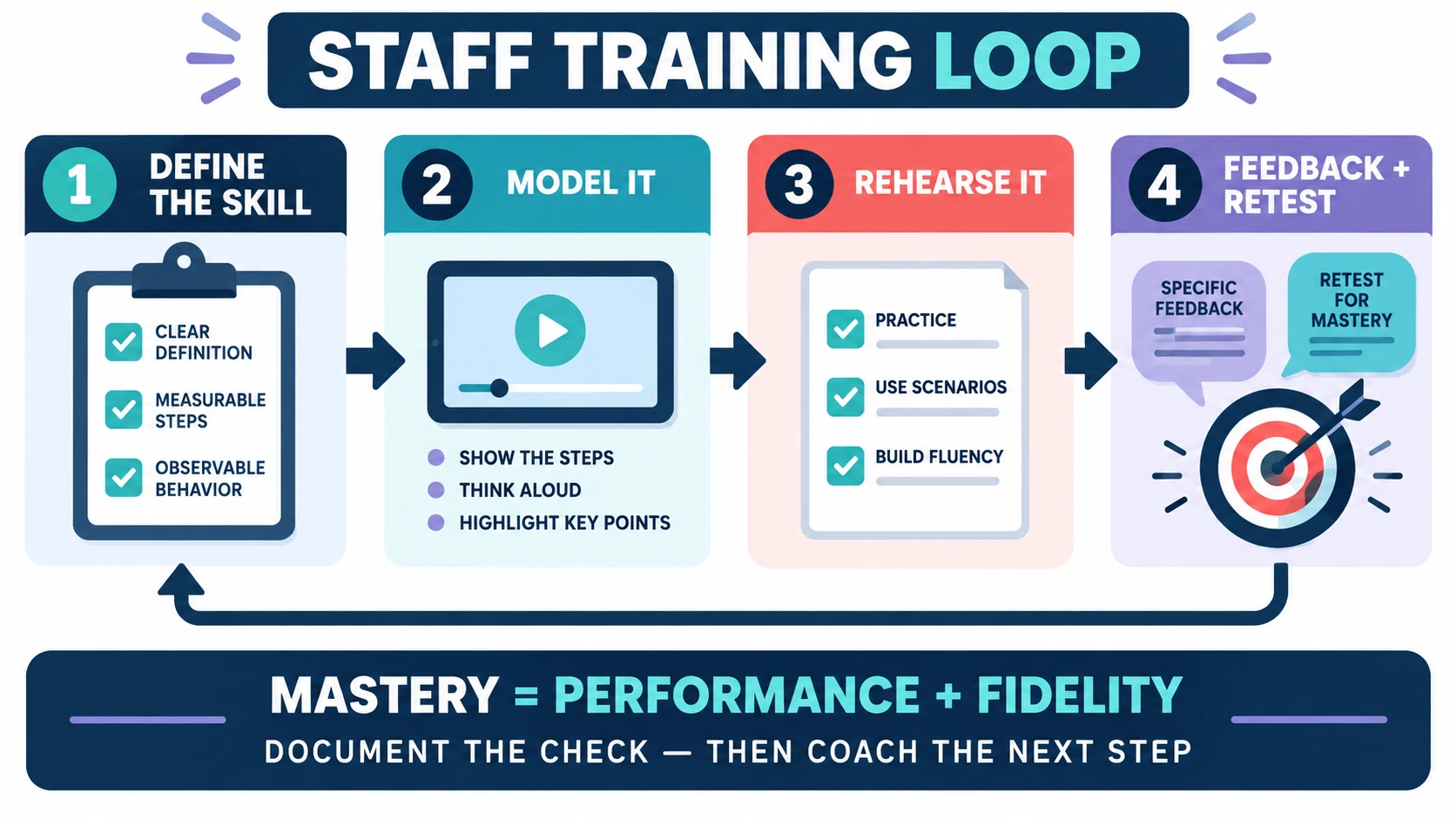
Behavioral Skills Training (BST) is a useful structure for many direct-care skills because it turns explanation into practice. The core sequence is instruction, modeling, rehearsal, and feedback. The current BACB Supervisor Training Curriculum Outline also emphasizes active participation, mastery criteria, fidelity, generalization, and follow-up checks. Use the four steps as a loop: return to instruction or modeling when rehearsal reveals a gap, then check transfer in the service context.
| BST step | Trainer action | Record to keep |
|---|---|---|
| Instruction | Describe the target skill, rationale, cues, steps, and stop or escalation conditions. | Version of the procedure and questions that need follow-up. |
| Modeling | Demonstrate the complete skill, including how to respond to an error or unexpected event. | Skill modeled, trainer, date, and any approved video or demonstration aid. |
| Rehearsal | Have the learner perform with a role-play, simulation, or safe practice opportunity. | Steps completed, errors observed, and level of prompting used. |
| Feedback | Give immediate, descriptive feedback; repeat the cycle until the agreed criterion is met. | Criterion, result, feedback, next practice date, and responsible coach. |
Turn Onboarding Into a 30-Day Plan
A staged plan prevents the common mistake of treating orientation as readiness. The exact calendar can change with role, setting, risk, and experience, but the sequence should move from context to demonstration to supported implementation and then to maintenance.
| Stage | Primary focus | Exit evidence |
|---|---|---|
| Days 1–5: orient | Role boundaries, privacy, safety, communication, documentation, and the current treatment materials. | The staff member can explain the role, locate the current documents, and identify when to ask for help. |
| Days 6–12: model and rehearse | BST cycles for the highest-priority skills using role-play or a safe practice context. | The staff member performs the defined steps with the agreed prompts and feedback. |
| Days 13–21: implement with support | Supported service delivery, direct observation, data checks, and rapid correction of errors. | Performance is checked in the actual context, not only in a classroom. |
| Days 22–30: recheck and maintain | Fidelity review, generalization, follow-up coaching, and a plan for the next competency check. | The team has a current result, a documented next step, and an owner for follow-up. |
Define Competency With Observable Criteria
Competency checks work best when the observer can mark what happened without guessing at the staff member’s intentions. For each skill, describe the antecedent or context, the staff response, the quality standard, and what happens if the skill cannot be completed safely.
- Data collection: the staff member identifies the defined measure, records it close to the event, and asks when the observation is ambiguous.
- Prompting: the staff member follows the written prompting procedure, avoids adding unapproved prompts, and records relevant information.
- Reinforcement: the staff member delivers the programmed consequence as written and does not substitute a personal preference without direction.
- Communication: the staff member gives an objective handoff that distinguishes observed facts, completed steps, and questions.
- Documentation: the staff member completes the approved note or data record accurately and stores it in the authorized system.
- Escalation: the staff member recognizes a safety, health, ethical, or clinical concern and contacts the responsible person promptly.
Use a rating that matches the purpose of the check. For example, a checklist can mark independent, prompted, not observed, or needs retraining. Avoid a false sense of precision when the observation was too short or the opportunity did not occur. “Not observed” is better than a guessed score.
Use Rehearsal and Feedback to Close Skill Gaps
Rehearsal is the point where a trainer can see whether the instructions and model were usable. Use realistic but privacy-safe scenarios. Ask the staff member to narrate the decision when appropriate, then observe the actual response. Keep the feedback specific: identify the step, describe what occurred, state the expected response, and give another opportunity to practice.
Feedback should be immediate enough to be useful and respectful enough to preserve a working relationship. “Be more professional” is not a teachable correction. “You recorded the event after the session; next time, record the defined measure immediately after the response and ask for help if the data sheet does not match the program” is more actionable.
If an error repeats, change the training arrangement before repeating the same lecture. The gap may reflect an unclear procedure, missing materials, insufficient rehearsal, or a mismatch between the training and service contexts. A supervisor can decide whether to revise the procedure, add modeling, increase observation, or limit independent implementation.
Observe Implementation Fidelity in Real Contexts
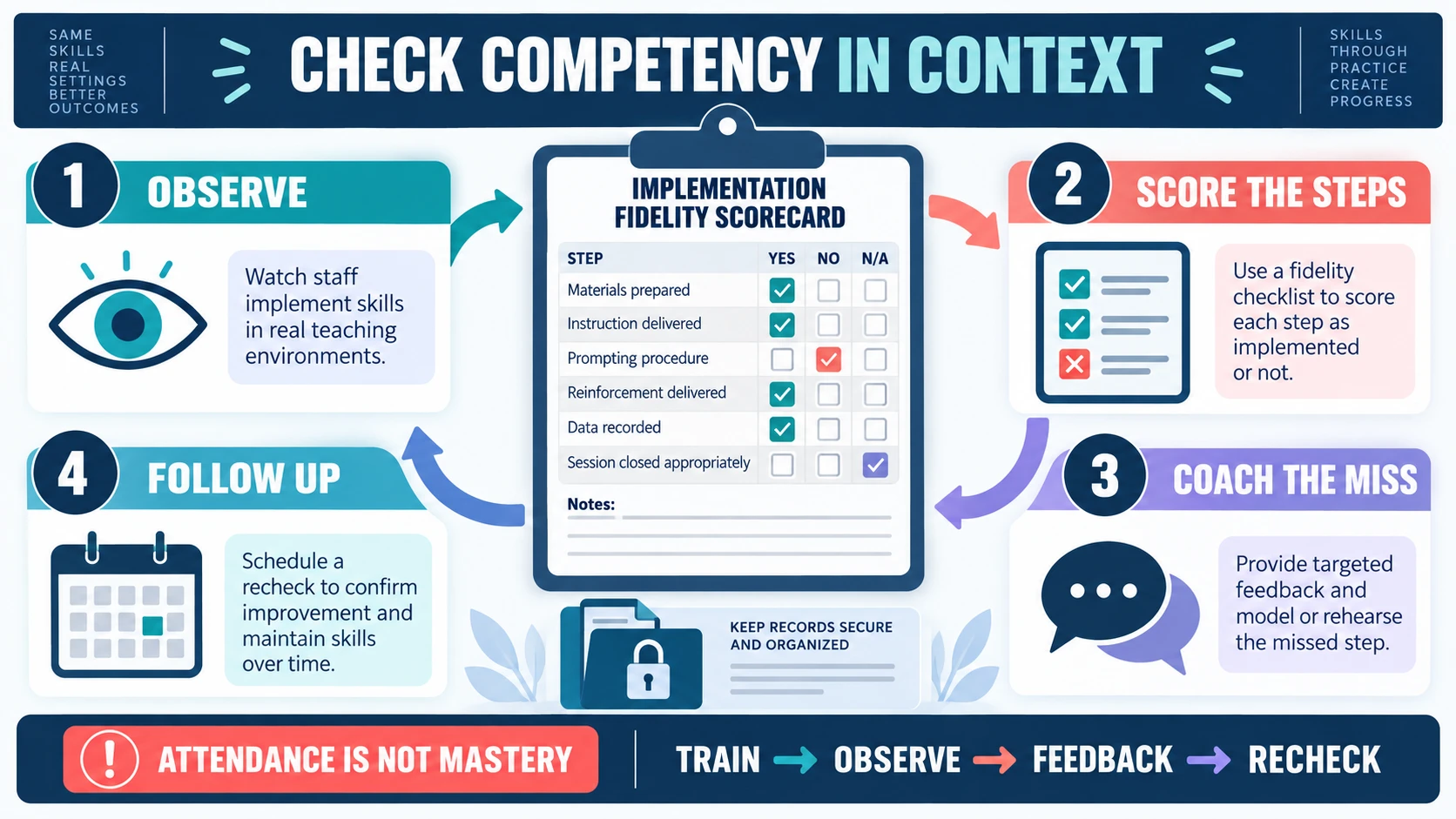
Training is not complete just because a staff member passes a role-play. Sample the skill where it will be used and compare the observed steps with the current plan. Fidelity review asks whether the procedure was implemented as designed; it is different from asking whether the client outcome was good on one occasion.
A practical check can include whether materials were ready, instruction was delivered as written, prompting matched the plan, reinforcement followed the program, data were recorded, and the session ended safely. Keep the checklist short and record what was and was not observed.
Use the result to select the next step. One missed step may call for immediate feedback and a recheck. A pattern across staff may point to a confusing protocol, a missing material, or a workflow problem. High fidelity with poor outcomes may require clinical review of the plan; it does not automatically justify retraining every staff member.
Document Training Without Exposing Client Information
A useful training record answers five questions: what skill was taught, who taught it, what the staff member did, what feedback was given, and what happens next. Include the procedure version or source so the record does not imply that an outdated handout is still current.
- Plan: objective, context, trainer, materials, and mastery criterion.
- Practice: date, setting type, scenario or skill, prompts, and observable result.
- Observation: fidelity items checked, what was not observed, and any safety concern.
- Feedback: descriptive correction, modeling or rehearsal completed, and staff questions.
- Follow-up: recheck date, responsible person, and whether independent implementation is authorized.
Use de-identified examples in group training and keep client details in the approved clinical record. When training is part of RBT supervision or another credentialing process, follow the current BACB record, portal, and retention requirements rather than assuming that a local attendance log is enough.
Separate Training, Supervision, and Professional Development
These activities can overlap in a well-designed system, but they are not interchangeable labels. Training teaches a skill. Supervision provides ongoing oversight and clinical direction within the applicable role and credentialing requirements. Professional development broadens knowledge or maintains a credential. A meeting should be labeled according to what actually happened and what the applicable standard requires.
- Skill training: asks whether the staff member can perform a defined skill to the agreed criterion.
- Supervision: provides ongoing oversight and clinical direction under the responsible role.
- Professional development: broadens knowledge or maintains a credential but does not, by itself, prove client-specific independent competency.
Qualifications and requirements vary by role. Use the current BACB supervision page and relevant handbook when a staff member’s credential is part of the question.
Handle Staff Errors and Escalation Safely
Not every performance error has the same risk. A minor documentation omission may call for correction and a recheck; a safety concern, unapproved procedure, suspected harm, or privacy incident may require the staff member to pause and contact the responsible supervisor immediately. The training system should teach this distinction before the first independent session.
- Protect the client and service: follow the current safety or emergency procedure and stop an action that is outside the staff member’s authorization when it is safe to do so.
- Describe what actually occurred: use objective language and preserve the original record according to policy.
- Notify the responsible person: use the defined supervisor, coordinator, clinical, or incident-reporting pathway.
- Choose the response: the supervisor determines whether the next step is retraining, closer observation, a procedure revision, a restriction on independent implementation, or another action.
- Recheck the skill: document the coaching and verify performance before assuming the gap is closed.
Never solve a missed check by backdating a form or changing a record to make attendance look like competency. A transparent record gives the supervisor a chance to correct the system and protects the staff member, client, and organization.
Measure Whether the Training System Is Working
Track a small set of measures that answer whether staff can perform, generalize, maintain, and document the target skills. Attendance can be a leading indicator, but it is not the outcome. Avoid using a single percentage as a verdict when the observation opportunities, skill difficulty, or client context differ.
| Measure | What it tells you | Follow-up question |
|---|---|---|
| Time to criterion | How long a staff member needs to reach the defined performance standard. | Was the skill or training sequence unclear? |
| Fidelity sample | Whether the taught procedure appears during actual implementation. | Does performance transfer across people, targets, and settings? |
| Maintenance check | Whether the skill remains accurate after coaching is less immediate. | Is a booster rehearsal or job aid needed? |
| System pattern | Whether several staff members miss the same step. | Does the protocol, material, schedule, or supervision need revision? |
Common ABA Staff Training Mistakes
- Lecture-only onboarding: information is presented, but the staff member never rehearses the target response.
- Vague mastery language: “looks good” is used instead of an observable criterion.
- Attendance equals readiness: a completed module is treated as permission to work independently.
- No context check: role-play performance is never sampled during real implementation.
- Feedback without a retry: the trainer gives advice but does not watch the staff member try again.
- Outdated materials: staff are trained from a handout that no longer matches the current plan.
- Unclear escalation: the staff member is told to “use judgment” without a defined support path.
- Role confusion: staff training, supervision, and continuing education are counted as the same activity without checking the applicable rule.
- No maintenance plan: the team assumes a skill will stay strong because the first check passed.
Frequently Asked Questions
What is the best first step in ABA staff training?: Define the staff member’s role and the observable skills needed for the work. Then identify the current procedure, mastery criterion, trainer, observer, feedback path, and follow-up check before scheduling a lecture or module.
How do I know whether a new staff member is ready to work independently?: Use evidence from rehearsal and a context-appropriate observation against a defined criterion. Readiness is a role and risk decision made by the responsible supervisor or organization; a course certificate or attendance record alone is not proof of independent competency.
How does RBT training fit into a broader staff-training system?: RBT onboarding may include organization orientation, client-specific training, ongoing supervision, and credential-related requirements. Those components are related but not interchangeable. Use the current BACB RBT Handbook and supervision resources for the credentialing requirements, and keep local clinical training aligned with the responsible supervisor.
Bottom line: strong aba staff training moves from a defined skill to instruction, modeling, rehearsal, feedback, context-based fidelity checks, secure documentation, and scheduled rechecks. If your team needs a separate study checkpoint for BCBA concepts, try our aba staff training study companion and Take the Free BCBA Mock Exam. It is a practice resource, not a substitute for BACB requirements or supervision.
Sources
- Behavior Analyst Certification Board: Supervision, Assessment, Training, and Oversight
- Behavior Analyst Certification Board: Registered Behavior Technician Handbook
- BACB Supervisor Training Curriculum Outline (2.0)
- Evidence-Based Staff Training: A Guide for Practitioners



