
BCBA preparation works best as a feedback loop, not a pile of study materials. First confirm the eligibility timeline, then use the current BCBA Test Content Outline to diagnose gaps, learn the underlying concepts, practice scenarios, simulate the exam, and change the plan based on evidence.
Table of Contents
- What Does Good BCBA Preparation Include?
- What Is the BCBA Preparation Map?
- Should You Check Eligibility Before Studying?
- How Should You Use the BCBA Test Content Outline?
- How Do You Diagnose Your Starting Point?
- How Should You Learn the Content?
- How Should You Review Practice Questions?
- When Should You Simulate the Exam?
- How Do the 2027 Changes Affect Preparation?
- What Should Be on Your Final Preparation Checklist?
- Which Preparation Resources Should You Trust?
- BCBA Preparation FAQ
This guide is about preparing intelligently for the BCBA examination. It is not an eligibility determination, a guarantee of a passing score, or a substitute for the current BACB Handbook, Test Content Outline, Ethics Code, or instructions attached to your application. Check the official documents that apply to your testing date. Table of Contents
What Does Good BCBA Preparation Include?
Good BCBA preparation has five connected parts: eligibility awareness, blueprint alignment, concept learning, scenario-based practice, and performance review. If you skip eligibility, you can study against the wrong application timeline. If you skip the blueprint, you may spend equal time on domains that do not carry equal weight. If you skip review, practice scores become a number rather than a decision tool.
The BACB’s current guidance points candidates toward the BCBA Test Content Outline (6th ed.), the Ethics Code for Behavior Analysts, and materials from their training. The BACB does not endorse a particular commercial study guide, and buying a resource does not guarantee a result. Your preparation system should therefore make the official outline the spine and use outside resources to explain, question, and test your reasoning.
What Is the BCBA Preparation Map?
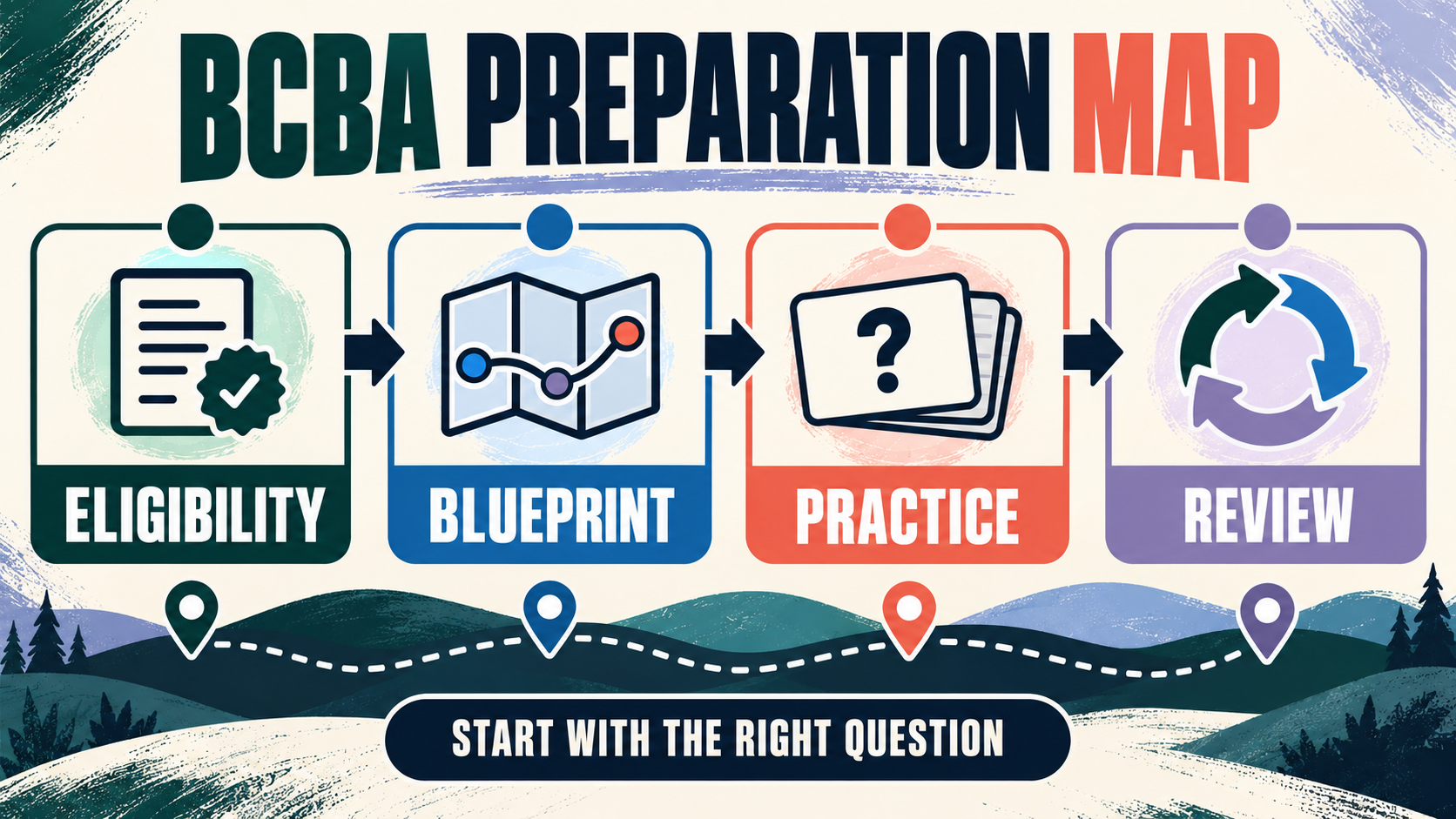
Use this sequence to keep your preparation proportional to the decision in front of you:
- Eligibility: confirm your degree, coursework, fieldwork, application timing, and current BACB pathway before setting an exam date.
- Blueprint: map the 6th-edition Test Content Outline to the domains and tasks you must understand.
- Practice: answer new scenarios, explain why the best option fits, and record the distractor that fooled you.
- Review: use accuracy, response time, and error patterns to decide what to study next.
The order matters. A mock exam can tell you that you missed a question; it cannot by itself tell you whether the problem was a missing definition, weak discrimination, data interpretation, reading error, or fatigue. Review is where the score becomes a plan.
Should You Check Eligibility Before Studying?
Yes. Preparation is more efficient when you know which milestone you are preparing for. If you are still completing graduate coursework or fieldwork, your immediate task may be pathway documentation rather than exam simulation. If you have an approved application and an Authorization to Test, your study plan can become date-specific. If your application crosses January 1, 2027, read the current transition materials before assuming that an older plan still applies. Make a short eligibility file and mark what is confirmed, what is pending, and who controls the answer:
- Degree: record the qualifying degree and conferral date.
- Coursework: keep transcripts, course mapping, and the applicable program contact or attestation information.
- Fieldwork: separate monthly verification forms, supervisor records, and final documentation from study notes.
- Application: save the BACB correspondence, deadlines, fees, and Authorization to Test when issued.
- Exam version: confirm the Test Content Outline and appointment rules that apply to your authorization.
This is not busywork. A candidate can be academically prepared and still be unable to schedule because an application document, date, or authorization step is missing.
How Should You Use the BCBA Test Content Outline?
The current BCBA examination is based on the BCBA Test Content Outline (6th ed.). The outline identifies the knowledge and skills assessed; it is not a page-by-page textbook. Turn it into a study map by grouping tasks into definitions, discriminations, procedures, data decisions, ethics decisions, and application scenarios.
| Domain | Current question count | Preparation emphasis |
|---|---|---|
| A. Behaviorism and Philosophical Foundations | 8 | Assumptions, dimensions, and how philosophical positions affect analysis. |
| B. Concepts and Principles | 24 | Precise definitions, examples, nonexamples, and discrimination among related terms. |
| C. Measurement, Data Display, and Interpretation | 21 | Selecting measures, reading graphs, validity, reliability, and procedural integrity. |
| D. Experimental Design | 13 | Features, logic, threats to validity, and design selection. |
| E. Ethical and Professional Issues | 22 | Apply the code, protect clients, manage scope, and handle transitions and public statements. |
| F. Behavior Assessment | 23 | Sources of information, preference and functional assessments, and data-based decisions. |
| G. Behavior-Change Procedures | 25 | Choose, implement, monitor, and adjust procedures based on evidence and context. |
| H. Selecting and Implementing Interventions | 20 | Social validity, generalization, maintenance, cultural responsiveness, and treatment integrity. |
| I. Personnel Supervision and Management | 19 | Training, feedback, performance systems, supervision, and organizational decisions. |
The table is a prioritization aid, not permission to ignore Domain A or E. High-frequency domains deserve more practice volume, while lower-frequency domains still require accurate foundations because one difficult item can expose a conceptual gap.
How Do You Diagnose Your Starting Point?
Take a short, mixed-domain diagnostic before building a long calendar. The goal is not to predict your final score. It is to discover whether your errors cluster by domain, task type, or test behavior.
- Concept error: you cannot state the definition or distinguish it from a close term.
- Application error: you know the term but cannot select the procedure that fits the scenario.
- Data error: you misread a graph, measure, trend, or design feature.
- Ethics error: you choose a fast action without checking client welfare, consent, competence, or the code.
- Reading error: you miss “best,” “most appropriate,” “first,” or a limiting fact in the stem.
- Stamina error: accuracy drops after sustained timed work even when untimed reasoning is sound.
Track the reason for each missed question in one sentence. “I forgot the definition” leads to retrieval practice. “I chose an intervention before identifying the function” leads to a decision routine. These are different repairs.
How Should You Learn the Content?
Use active learning instead of repeatedly rereading. For each task or concept, write a plain-language definition, one example, one nonexample, the variable that changes the decision, and the data that would support your choice. Then close the notes and retrieve the answer later. If you can recognize a term but cannot explain it without prompts, the concept is not ready for scenario practice.
Build connections across domains. Measurement affects assessment; assessment affects intervention selection; intervention integrity affects interpretation; supervision affects implementation. Ethics is not a separate decoration on those decisions. It constrains how the service is selected, delivered, documented, and communicated.
Keep a “not sure yet” list. It prevents a confusing topic from silently becoming a false rule. Resolve it with your training materials, supervisor, current BACB source, or a worked example, then update the note with the reason—not just the answer.
How Should You Review Practice Questions?
Do not count a question as learned merely because you selected the correct letter. A strong review can reconstruct the decision: what the stem established, what the question asked, why one option fits, and which detail makes the distractors less appropriate.
| Review note | Question to ask | Next action |
|---|---|---|
| Stem facts | Which facts are observable, measured, or explicitly stated? | Underline the facts before naming a procedure. |
| Task demand | Is the item asking for a definition, design, assessment, intervention, or ethical action? | Rewrite the demand in your own words. |
| Distractor logic | Why is each tempting option not the best answer here? | Write the missing condition that would make it fit. |
| Transfer | Would the answer change if one important fact changed? | Create one variation and solve it without looking back. |
When Should You Simulate the Exam?
Use short, untimed sets while learning and introduce timed blocks after you can explain your errors. A full simulation is most useful when it answers a readiness question: can you maintain careful reading, data interpretation, and ethical reasoning across the length of the appointment?
The current BCBA examination is described as 185 multiple-choice questions, with 175 scored, completed in four hours. Use the official examination information and your authorization for the rules that apply to your appointment. A practice simulator should test pacing and decision quality; it should not encourage rushing through items just to finish early.
After a simulation, separate knowledge from endurance. If your accuracy is stable but your pace collapses, schedule shorter timed blocks and planned breaks. If your pace is fine but Domain F or G errors repeat, return to concept and application work instead of taking another full mock immediately.
How Do the 2027 Changes Affect Preparation?
The BACB’s 2027 BCBA Requirements change eligibility and maintenance rules beginning January 1, 2027. The transition resource explains changes to pathways, coursework structure, fieldwork forms, and content allocations. Those are important for your application plan, but they are not a reason to replace the current exam blueprint with a rumor about a new test.
The current BCBA exam is based on the 6th-edition Test Content Outline, which took effect January 1, 2025. Check the examination version tied to your authorization, and keep eligibility planning separate from exam content planning. A candidate can use the right TCO and still need to meet the newer application requirements.
If your timeline crosses the transition, ask your program contact or supervisor to review the official documents with you. Write down the application date, coursework version, fieldwork forms, and exam authorization rather than relying on a social-media summary.
What Should Be on Your Final Preparation Checklist?
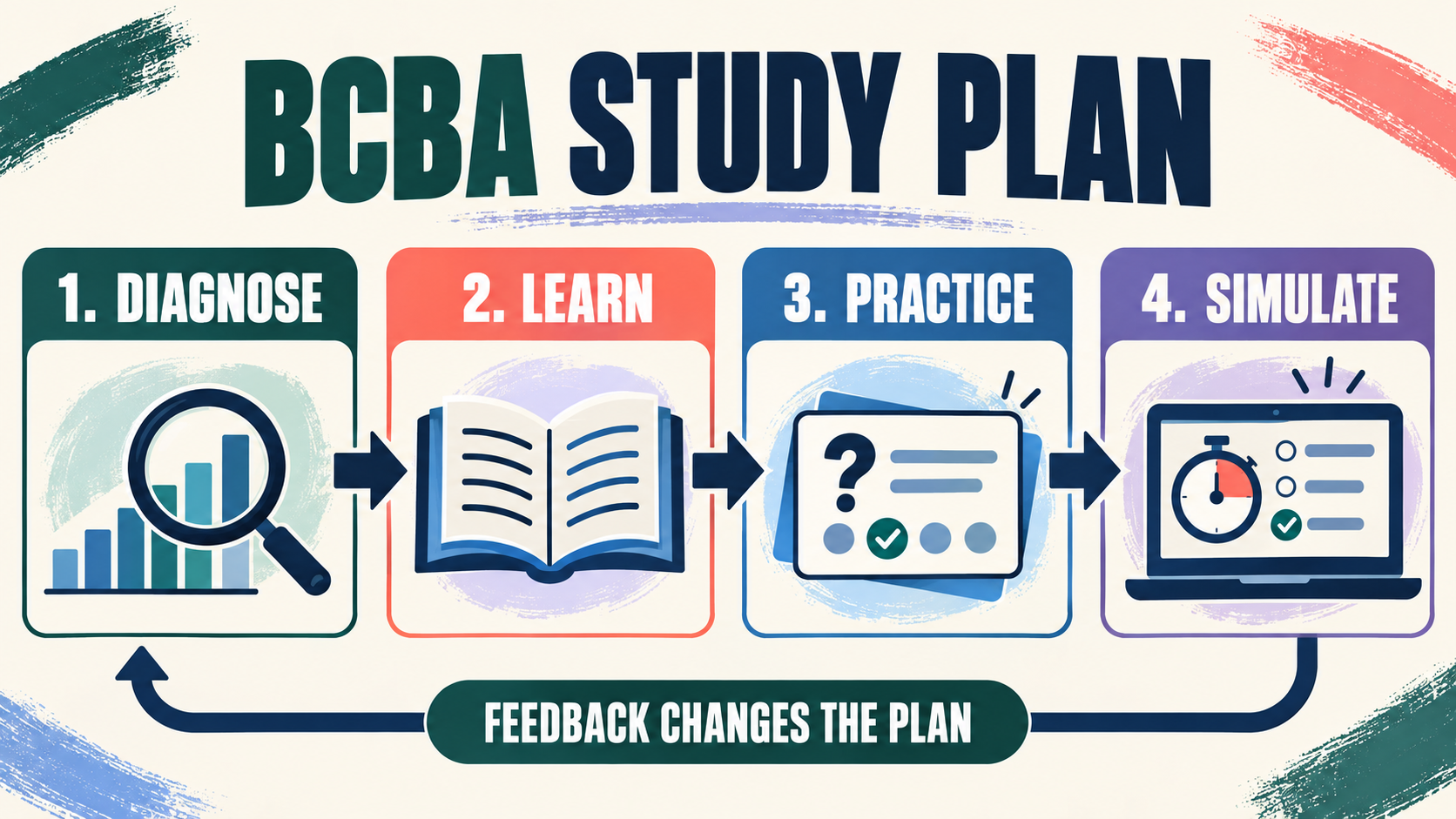
In the final phase, your checklist should measure readiness rather than create more content. Complete the following before you decide that “more materials” is the answer:
- Diagnose: identify your lowest domains and the error types that cause the misses.
- Learn: retrieve definitions, procedures, data rules, and ethics principles without notes.
- Practice: complete mixed scenario sets and explain why the distractors do not fit.
- Simulate: test pacing and concentration under conditions that resemble the appointment.
- Keep the current TCO, Ethics Code, and official handbook easy to access.
- Review a running error log instead of restarting every resource from page one.
- Use feedback to change the next study block, not merely to record a score.
- Protect sleep, attention, and a realistic study schedule during the final week.
Which Preparation Resources Should You Trust?
Start with primary sources. The BACB’s Test Content Outlines page, current BCBA Handbook, examination information, Ethics Code, and transition documents tell you what the credentialing body expects. A commercial guide, course, flashcard deck, or mock exam can add explanations and practice, but it should not silently replace the official blueprint.
- Good sign: the resource identifies its TCO edition, separates practice from official requirements, and explains answer rationales.
- Good sign: the provider updates its content when BACB sources change and avoids promising a passing result.
- Warning sign: the resource uses an old “task list” without telling you how it maps to the current outline.
- Warning sign: the sales page treats a score, certificate, or course completion as proof of exam eligibility.
For a low-pressure next step, Take the Free BCBA Mock Exam. Use the result as a diagnostic and follow it with targeted review. You can also use bcba preparation practice questions to rehearse the feedback loop; practice is not a certification or eligibility decision.
BCBA Preparation FAQ
What should I study first for the BCBA exam?: First confirm your eligibility timeline and current exam outline. Then take a short mixed-domain diagnostic so your study order reflects actual gaps rather than a generic list. Build from definitions and principles into scenario application, data decisions, ethics, and timed practice.
How long does BCBA preparation take?: There is no reliable universal number of days. The duration depends on your training, fieldwork, available study time, test date, and diagnostic gaps. Use a calendar with weekly retrieval, practice, and review targets, then change it when the error data changes.
Should I read the entire BCBA Test Content Outline?: Yes, use the full outline as your boundary and map, but do not treat reading it once as preparation. Convert tasks into definitions, examples, decision rules, and practice scenarios, then verify your reasoning with feedback.
Do the 2027 changes mean I need a new BCBA exam study guide?: Not automatically. The 2027 changes primarily affect eligibility, coursework, fieldwork, and maintenance. Confirm the exam version tied to your authorization and use the current official TCO. Replace a study resource when it is outdated or inaccurate, not merely because the calendar changed.
Are mock exams enough for BCBA preparation?: No. Mock exams are useful for diagnosis, application, and pacing, but they cannot replace training, the Ethics Code, the official outline, or targeted review. The value comes from analyzing why an answer was right or wrong and changing the next study action. Bottom line: Strong BCBA preparation is a measurable loop: confirm the route, map the blueprint, learn actively, practice scenarios, simulate the appointment, and let the error data change the plan.



