
BCBA tuition reimbursement can make graduate coursework, supervised fieldwork, or certification preparation more affordable, but the phrase covers several very different employer benefits. One company may reimburse tuition after you pass a course. Another may pay a university directly. A third may offer a loan that becomes forgivable only after you remain employed and meet certification milestones.
Table of Contents
- What Is BCBA Tuition Reimbursement?
- How Employer Programs Are Structured
- Who May Qualify for BCBA Tuition Reimbursement?
- What Costs May Be Covered?
- BCBA Tuition Reimbursement: Tax and Timing Questions
- Reimbursement vs Direct Payment vs Tuition Loan
- Clawbacks and Repayment Agreements
- How to Compare Two BCBA Tuition Benefits
- BCBA Requirements and the 2027 Transition
- BCBA Tuition Reimbursement FAQs
- Quick Review Checklist
- Take the Free BCBA Mock Exam
The best offer is not necessarily the one with the largest headline amount. You need to know who qualifies, what costs are covered, when money is paid, whether a tax rule applies, and what happens if you leave the employer or do not complete the program. This guide shows how to compare those details before you enroll or sign a repayment agreement.
What Is BCBA Tuition Reimbursement?
BCBA tuition reimbursement is an employer benefit that helps an employee pay for education connected to a path toward BCBA certification. The employer may reimburse eligible expenses, pay an education provider, provide a tuition discount, pay student-loan principal or interest, or combine tuition support with paid work and supervised fieldwork. The exact meaning comes from the written employer policy, not from the job advertisement.
Some programs support a behavior technician or BCBA trainee before certification. Others are continuing-education benefits for an already certified BCBA. Ask which population the program is designed for. A benefit advertised to “BCBAs” may not cover a master’s program, while a benefit advertised to “team members pursuing certification” may require you to work in a specific clinical role.
| Benefit label | Possible arrangement | First question to ask |
|---|---|---|
| Tuition reimbursement | You pay an approved expense and submit proof for repayment. | Do I have to pay first, and when is reimbursement issued? |
| Direct tuition payment | The employer pays the school or approved provider directly. | Which schools, programs, and billing cycles are approved? |
| Tuition loan or advance | The employer advances money that may be forgiven under conditions. | What event makes the balance repayable? |
| Education stipend | A fixed allowance may be used for approved education costs. | Is the payment taxable and what documentation is required? |
How Employer Programs Are Structured
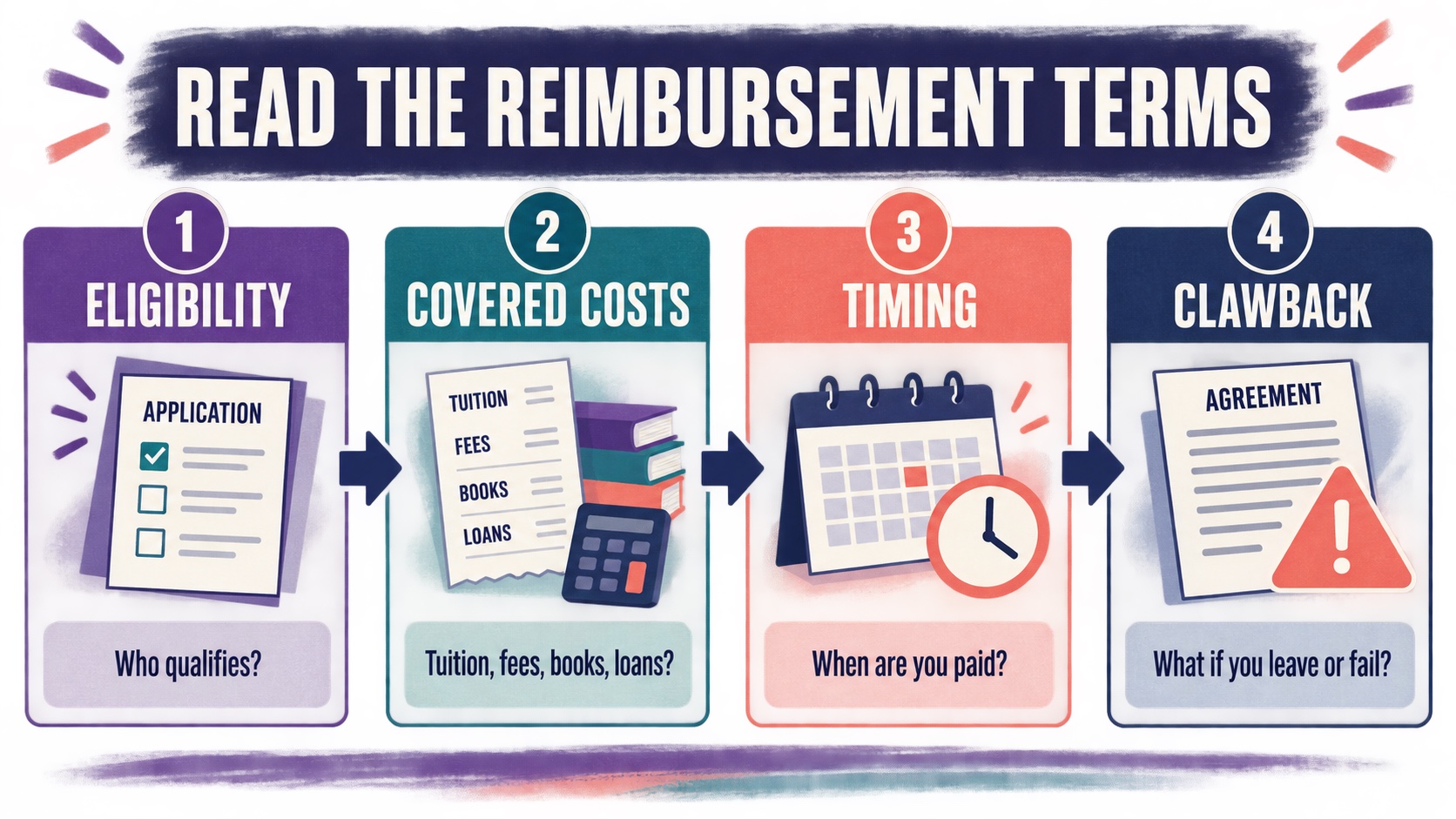
A well-designed BCBA tuition program usually has a written policy with eligibility rules, covered expenses, deadlines, approval steps, academic standards, and repayment language. The Council of Autism Service Providers model policy is useful because it shows the kinds of questions an organization should address. It is a model, not a universal employee benefit, and it does not turn into a promise until an employer adopts its own policy.
Read the program from the employer’s perspective as well as the student’s. The employer may be trying to build a pipeline of future BCBAs, retain staff, support a specific university partnership, or fill a shortage of qualified supervisors. That can be valuable, but it may also mean the benefit is connected to a work commitment, a particular program, a minimum schedule, or a required role after graduation.
Who May Qualify for BCBA Tuition Reimbursement?
Eligibility differs by employer. Common conditions include a minimum length of employment, a minimum number of hours per week, good standing, an accepted school or course sequence, supervisor approval, a passing grade, or continued employment after the payment. Some employers limit the benefit to full-time staff. Others include behavior technicians, practicum students, BCaBAs, or employees in a formal trainee program.
Ask whether eligibility is based on your status when you apply, when the course begins, when you submit the receipt, or when the reimbursement is paid. Those dates can produce very different results. Also ask whether a leave of absence, reduced schedule, transfer to another clinic, or change in supervisor affects eligibility.
- Employment: How long must you work for the organization before applying?
- Role: Must you be a technician, trainee, BCaBA, or another employee category?
- Academic standing: Is there a minimum grade, GPA, enrollment status, or completion deadline?
- Certification path: Must the coursework or degree meet a particular BCBA eligibility route?
- Work commitment: Must you remain employed for a defined period after the employer pays?
What Costs May Be Covered?
Never assume that “tuition” means every cost on your student account. A policy may cover tuition only, or it may include required fees, books, exam preparation, application fees, supervision, travel, or certification exams. It may exclude retakes, late fees, housing, transportation, meals, laptops, elective courses, or expenses incurred before you joined the company.
Some programs support a master’s degree; others cover a BACB-verified course sequence, a single class, continuing education, or exam preparation. The BACB BCBA resources and current handbook explain certification requirements, but they do not require an employer to reimburse your education. Use the official BACB requirements to check whether a proposed program supports your pathway, then use the employer’s policy to determine what the company will pay.
Request a sample approval form before enrolling. It should tell you whether the employer needs an invoice, proof of payment, final grade, transcript, enrollment letter, or school accreditation information. Keep copies of every submission and confirmation.
BCBA Tuition Reimbursement: Tax and Timing Questions
Tax treatment depends on how the employer’s plan is written and how the payment is made. The IRS Section 127 FAQs state that, for calendar years 2025 and 2026, up to $5,250 of qualifying educational assistance under a Section 127 program can generally be excluded from an employee’s gross income. The IRS also explains that the limit can include certain qualified education-loan payments and that amounts above the exclusion may be treated differently.
That federal rule is not a guarantee that your BCBA tuition benefit is tax-free. The employer must have a qualifying plan, the expense must fit the applicable rules, and state tax treatment may differ. Do not assume that a reimbursement is tax-free because the job ad calls it education assistance. Ask payroll how the benefit will appear on your W-2 and consult a qualified tax professional for advice about your situation.
Timing matters too. A reimbursement may be paid after the semester ends, after grades are released, or after you submit documents within a short deadline. A direct payment may reduce the amount you must front, but it may require preapproval. If you depend on the benefit to enroll, calculate the cash you need before the employer’s payment arrives.
Reimbursement vs Direct Payment vs Tuition Loan
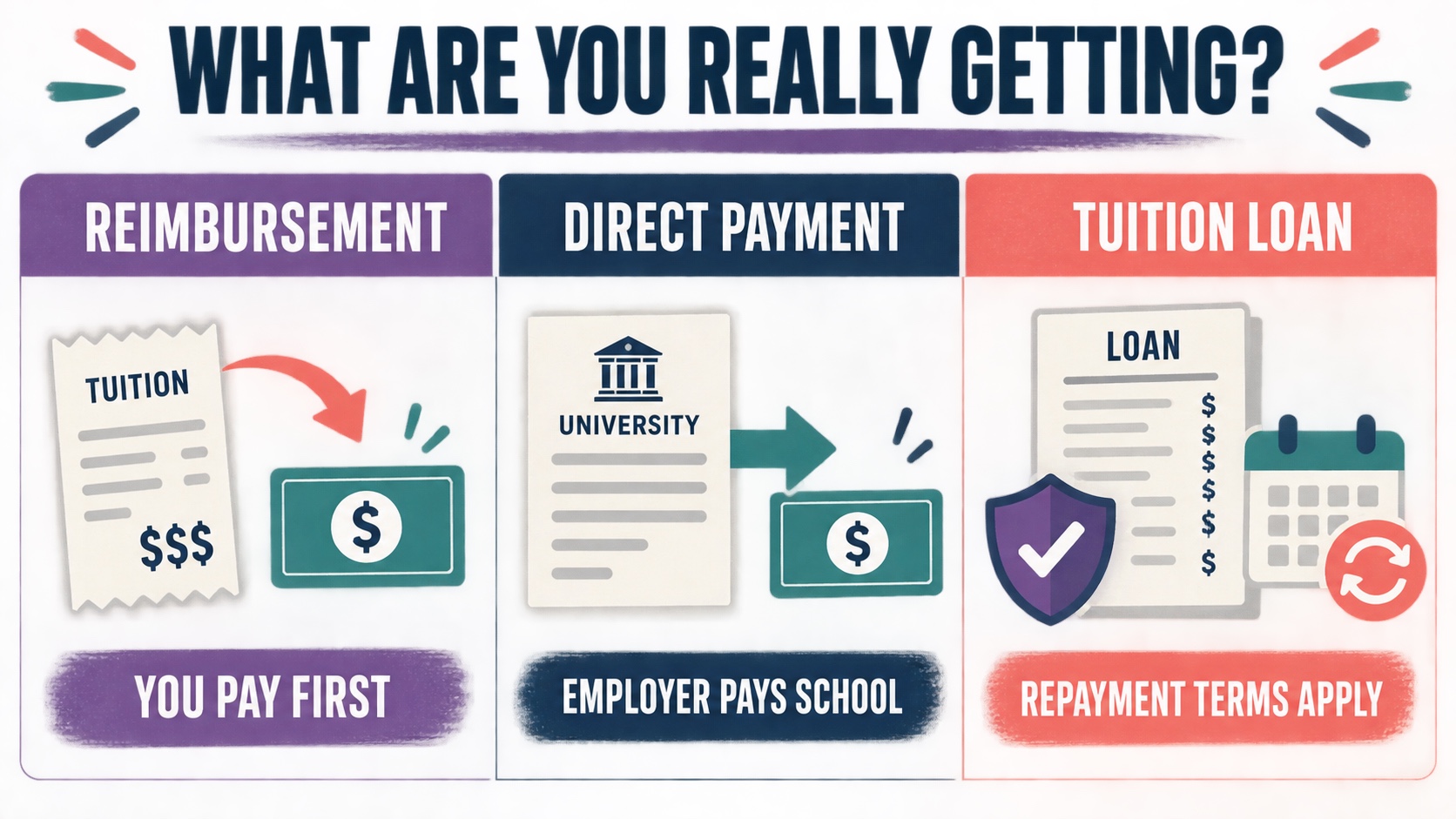
These arrangements can look similar in a recruiting conversation but create different financial risks. Compare the cash-flow impact and the repayment conditions, not only the advertised total.
| Arrangement | Cash-flow question | Risk to clarify |
|---|---|---|
| Reimbursement | Can you cover the bill until the employer pays? | A missed deadline or rejected course may leave you responsible for the cost. |
| Direct payment | Does the school receive payment before your registration deadline? | The approved-school list or authorization can limit your choices. |
| Tuition loan | Do you receive money now or only after a milestone? | Leaving, failing, or missing a certification deadline may trigger repayment. |
Clawbacks and Repayment Agreements
A clawback is a condition requiring you to repay some or all of the employer’s education payment. It may apply if you resign before a service commitment ends, are terminated for a specified reason, fail to complete coursework, fail to sit for an exam, change programs, or do not meet a grade requirement. The contract may use a sliding scale, or it may demand the full amount.
Read the repayment section before accepting the benefit, not after you have built your semester around it. Look for the trigger event, the repayment schedule, interest, payroll deductions, collection rights, and whether the balance is forgiven over time. Ask whether the repayment amount is reduced after each month of continued employment and whether the employer can change the policy for future payments.
If a clause is unclear, ask for a written explanation and consider legal or financial advice before signing. A verbal statement such as “we usually do not enforce that” is not a substitute for the written agreement.
How to Compare Two BCBA Tuition Benefits
Convert each offer into the same questions. This keeps a large headline benefit from hiding a difficult repayment obligation.
- Write the maximum annual amount and the amount you are realistically likely to receive.
- List eligible expenses and identify what you must pay upfront.
- Record the approval, grade, and submission deadlines.
- Calculate the work commitment after each payment.
- Identify the repayment triggers and the maximum amount at risk.
- Ask whether the benefit supports your actual BCBA pathway and current BACB requirements.
- Ask payroll how the payment is taxed and documented.
- Compare the education benefit with salary, supervision quality, schedule, benefits, and clinical support.
Free tuition is not free if the arrangement forces you into an unsuitable program, prevents you from changing jobs, or leaves you without adequate supervision. The education and the work environment both affect your path to certification.
BCBA Requirements and the 2027 Transition
Employer programs should be reviewed against the requirements in effect for the application path and date that applies to you. The BACB’s upcoming changes page lists revisions to BCBA eligibility and maintenance requirements beginning January 1, 2027, including changes to degree, coursework, fieldwork, continuing education, and ongoing supervision rules. That means a tuition benefit tied to a particular program or timeline should be checked against the current handbook and transition guidance.
Do not assume that a company’s approved-school list is current merely because it was used for a previous employee. Ask who updates the list, which handbook version the program is designed around, and what happens if BACB requirements change while you are enrolled. The employer can promise to pay tuition, but only the BACB determines whether your education and experience satisfy certification requirements.
BCBA Tuition Reimbursement FAQs
Do employers pay for BCBA master’s programs?: Some employers offer full or partial tuition support, but the amount, approved programs, eligibility rules, and work commitment vary widely. Ask for the written policy and do not rely on a recruiting headline.
Is BCBA tuition reimbursement tax-free?: It may be partly excluded under a qualifying educational-assistance plan. The IRS currently describes a $5,250 federal exclusion for qualifying benefits in calendar years 2025 and 2026, but your employer’s plan and your circumstances control. Ask payroll and a tax professional rather than assuming every payment is tax-free.
Can tuition reimbursement include BCBA supervision?: Some employers combine tuition assistance with paid or sponsored fieldwork supervision, but that is a separate promise from tuition reimbursement. Confirm who supervises you, whether the supervision meets the current BACB requirements, how the contract is documented, and whether the supervision continues if you change roles.
What happens if I leave the company?: The written agreement may require partial or full repayment, or it may forgive the balance over time. Check the service commitment, termination language, repayment schedule, and payroll-deduction terms before accepting the benefit.
BCBA tuition reimbursement can be a meaningful way to reduce education costs, but only when the policy fits your certification path and the repayment risk is manageable. Compare the written terms, verify the current BACB requirements, and keep documentation for every approved expense. When you are preparing for the examination itself, the free BCBA mock exam provides additional exam-style practice. It is a study resource and does not determine eligibility or guarantee certification.
Quick Review Checklist
Use this final checklist to turn bcba tuition reimbursement into exam-ready reasoning. The goal is not to memorize a label in isolation; it is to identify the relevant evidence and explain why the best answer fits the scenario. Key ideas to review:
- State the central definition or decision point for bcba tuition reimbursement in your own words.
- Identify the detail that makes bcba tuition reimbursement different from its closest related ABA term.
- Separate the observable facts in a scenario from assumptions that are not supported by the facts.
- Write one example and one nonexample so you can recognize the concept in a new setting.
Exam application checks:
- Ask what the question is actually requesting before comparing the answer choices.
- Mark the antecedent, response, consequence, or other evidence that supports the selected answer.
- Look for a distractor that describes a related process but does not answer the specific question.
Final self-check:
- Explain how you would verify the interpretation with clear observations or data.
- Change one detail in the scenario and decide whether your answer should change.
- Give a one-sentence rationale that a supervisor or study partner could evaluate.
Take the Free BCBA Mock Exam
If you want a low-pressure way to check your recall, use the free practice resource below. Take the Free BCBA Mock Exam



