
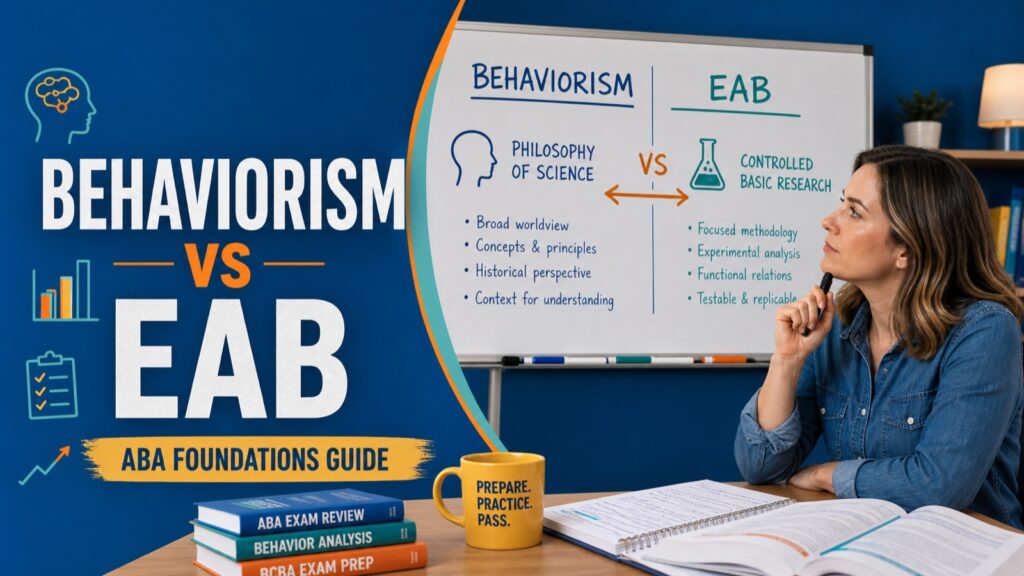
If you are studying behaviorism vs experimental analysis of behavior, separate the philosophical framework from the research tradition. Behaviorism is a philosophy of science that explains behavior through observable relations with the environment and treats behavior as a legitimate subject matter. Experimental analysis of behavior, or EAB, is a research tradition that uses controlled experiments to discover functional relations between behavior and environmental variables. EAB operates within a behavior-analytic science; it is not simply another word for behaviorism.
Table of Contents
- Direct Answer: Behaviorism or EAB?
- What Behaviorism Means
- What Experimental Analysis of Behavior Means
- Where Applied Behavior Analysis Fits
- Core Scientific Assumptions
- Experimental Methods and Functional Relations
- Side-by-Side Comparison
- Worked Classification Scenario
- Research, Applied Work, and Professional Practice
- Data and Graph Clues
- Private Events and Radical Behaviorism
- Why the Distinction Matters for BCBAs
- A BCBA Exam Decision Rule
- Common Exam Traps
- Quick Review Checklist
- Frequently Asked Questions
- Take the Free BCBA Mock Exam
- Reference
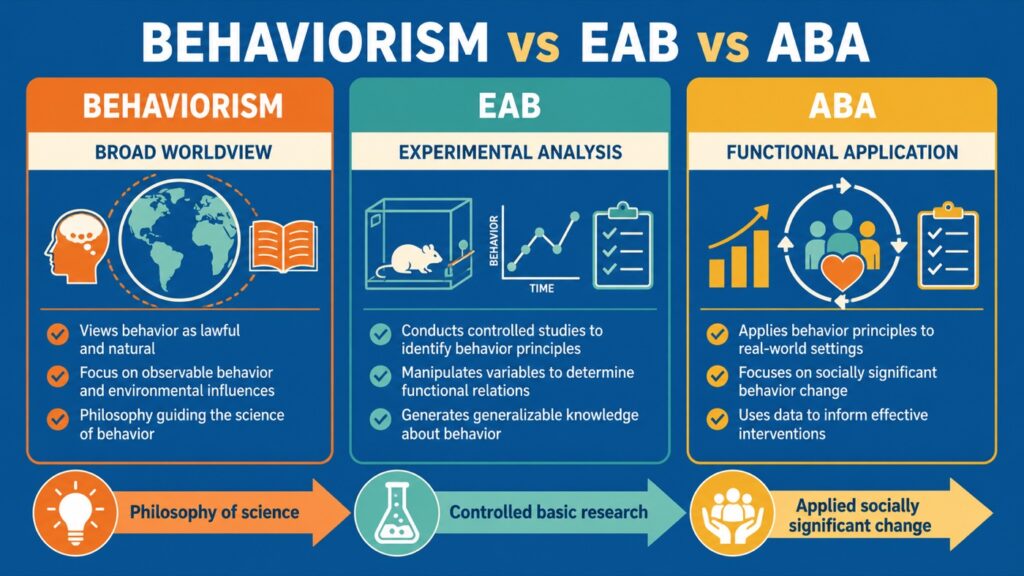
The practical exam distinction is this: behaviorism addresses the assumptions and scientific viewpoint, while EAB uses experimental methods to study behavior under controlled conditions. Applied behavior analysis uses those principles and methods to address socially important behavior in applied settings. A BCBA question may ask you to distinguish the philosophy, the basic research tradition, applied research, and professional practice.
This guide uses original examples, comparison tables, research-design clues, and BCBA exam traps. The examples are study illustrations, not recalled examination items. Do not treat the terms as interchangeable when a question asks for the level of analysis or the type of activity being described.
Direct Answer: Behaviorism or EAB?
Classify the item by asking what kind of activity or claim it describes. If the item discusses the scientific assumptions used to study behavior, it is describing behaviorism. If it describes controlled research that manipulates environmental variables and measures behavior to identify functional relations, it is describing experimental analysis of behavior. If it describes socially significant behavior in a natural setting, it may be applied behavior analysis.
| Feature | Behaviorism | Experimental analysis of behavior |
|---|---|---|
| Level | Philosophy or conceptual framework | Basic research tradition and scientific method |
| Main question | What counts as a scientific account of behavior? | What environmental variable functionally changes behavior? |
| Typical evidence | Conceptual analysis and philosophical assumptions | Controlled manipulation, repeated measurement, and experimental comparison |
| Typical setting | Any discussion of the science of behavior | Laboratory or tightly controlled research setting |
| Common error | Calling a philosophy a research design | Calling any behavior measurement EAB |
- Behaviorism: defines a scientific stance toward behavior and its environmental relations.
- EAB: experimentally analyzes behavior to discover functional relations.
- ABA: applies behavior-analytic principles and methods to socially important behavior.
- Professional practice: delivers services within ethical, legal, organizational, and competency boundaries.
- Exam priority: identify the level before choosing the term.
A researcher who changes the reinforcement schedule across conditions and measures response rate is conducting an experimental analysis. A student explaining why behavior should be studied as a relation between behavior and environment is discussing behaviorism. A BCBA using functional assessment data to design a treatment plan is practicing applied behavior analysis. The activities may be connected, but they are not the same category.
What Behaviorism Means
Behaviorism is a philosophy of science concerned with the subject matter, goals, and assumptions of a science of behavior. It rejects the idea that a scientific explanation must rely on hypothetical inner causes when observable environmental relations can be analyzed. A behavior-analytic account looks at behavior in context, identifies relevant antecedent and consequence relations, and uses data to refine the explanation.
Different forms of behaviorism have made different claims about private events, language, and the role of physiology. On a BCBA exam, the stem may be testing the distinction between methodological behaviorism, which limits scientific analysis to publicly observable events, and radical behaviorism, which includes private events as behavior while still analyzing them functionally. Do not treat behaviorism as one intervention package.
- It addresses the philosophical foundation of behavior analysis.
- It treats behavior as a subject matter for scientific study.
- It emphasizes functional relations with environmental variables.
- It supports prediction and influence through systematic analysis.
- It is not itself a single-case experimental design or treatment procedure.
What Experimental Analysis of Behavior Means
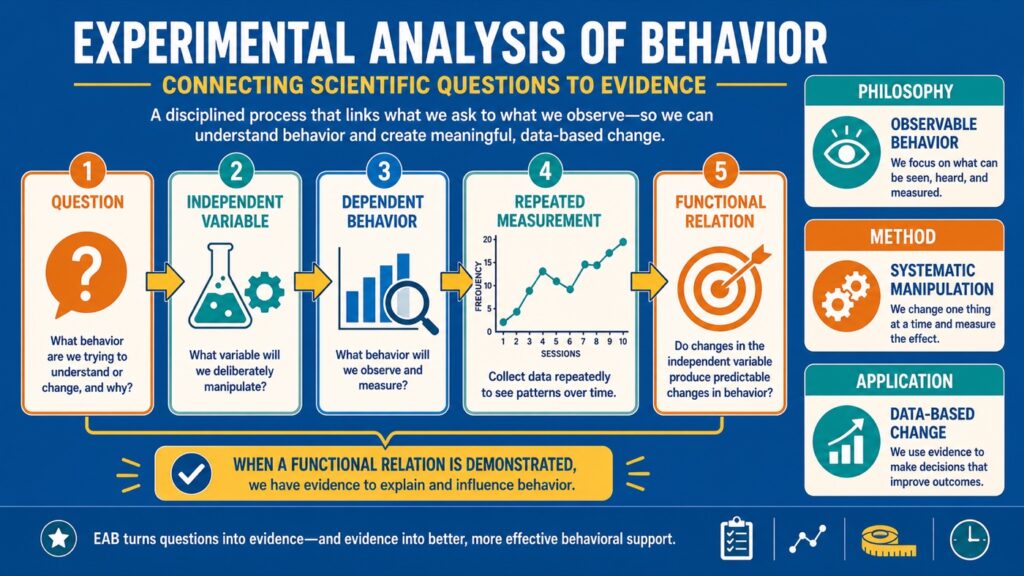
Experimental analysis of behavior is the basic research branch that uses controlled experiments to study behavior. Researchers manipulate environmental variables, measure behavior repeatedly, and compare conditions to determine whether a functional relation is demonstrated. EAB may study reinforcement, stimulus control, motivating operations, schedules, discrimination, choice, and other behavioral processes.
The defining clue is not the presence of a graph or a laboratory. It is the experimental question and the degree of control used to test it. A study can occur in a natural environment and still use experimental analysis if it systematically manipulates a variable and evaluates its effect. Conversely, simply collecting data in a laboratory does not automatically make an activity EAB.
- Identify the independent variable being manipulated.
- Identify the dependent behavior being measured.
- Check whether conditions are systematically compared.
- Look for repeated measurement and replication within or across subjects.
- Ask whether the purpose is to discover a functional relation rather than only describe behavior.
For example, a researcher might compare fixed-ratio and variable-ratio schedules while measuring response rate under controlled conditions. The schedule is the manipulated variable, response rate is the measured behavior, and the design addresses a basic behavioral process. That is an EAB example even if the participants are humans and the setting is not a traditional laboratory.
Where Applied Behavior Analysis Fits
Applied behavior analysis uses behavior-analytic principles and procedures to improve behavior that matters to the learner and stakeholders. The applied dimension concerns social significance, the behavior dimension concerns measurable behavior, and the analytic dimension concerns evidence that the intervention caused change. ABA may draw from basic findings while adapting assessment and intervention to a natural setting.
Professional practice is broader than applied research. A BCBA may conduct an assessment, train caregivers, supervise staff, review data, coordinate care, and make ethical decisions without conducting a formal experiment intended to contribute to general scientific knowledge. The work can be behavior analytic and evidence-informed without being an EAB study.
- EAB: asks basic questions about behavioral processes under experimental control.
- ABA: applies behavioral principles to socially significant goals.
- Professional practice: delivers competent and ethical services to a specific client or organization.
- Shared foundation: measurable behavior, environmental relations, and data-based decisions.
- Different purpose: discovering basic relations is not the same as changing a client’s socially important behavior.
Core Scientific Assumptions
Behavior analysis is commonly described through assumptions such as determinism, empiricism, experimentation, replication, parsimony, and philosophic doubt. These assumptions help analysts organize scientific work. They do not mean that every behavior is simple, that one variable always explains behavior, or that practitioners should ignore context and individual differences.
Determinism means behavior is orderly and related to conditions, not that a practitioner can predict every response perfectly. Empiricism means relying on observation and measurement. Experimentation means manipulating variables to evaluate their effects. Replication means repeating observations or procedures to assess reliability. Parsimony means considering simpler explanations before more complex ones, and philosophic doubt means remaining willing to revise a conclusion when data do not support it.
- State the behavior in observable and measurable terms.
- Identify environmental variables that may influence the behavior.
- Collect data before making a strong causal claim.
- Replicate effects and inspect treatment integrity.
- Revise the interpretation when new evidence conflicts with it.
Experimental Methods and Functional Relations
An experimental analysis uses design features that allow a researcher to evaluate whether a change in an independent variable produces a change in behavior. Depending on the question, the design may use reversal, multiple baseline, alternating treatments, changing criterion, or another arrangement. The design must fit the behavior, setting, ethical constraints, and scientific question.
A functional relation is supported when systematic changes in the independent variable are accompanied by predictable changes in the dependent variable and the pattern is replicated according to the design. Correlation, a pre-post difference, or a visually appealing graph may be informative but does not by itself establish experimental control.
- Independent variable: the environmental variable arranged or changed by the researcher.
- Dependent variable: the behavior measured as the outcome.
- Control: the design features that rule out plausible alternative explanations.
- Replication: repeated demonstrations of the relation.
- Social validity: whether goals, procedures, and outcomes matter to the people affected.
In applied work, a BCBA may use a single-case design to evaluate treatment effects. That work can be analytic and applied at the same time. The distinction from EAB is usually the purpose, context, and social significance of the question, not a claim that applied work is less scientific.
Side-by-Side Comparison
The following table is a study aid for classification. When an item includes more than one dimension, identify the primary activity being described and then note the related dimensions.
| Question | Behaviorism | EAB | ABA |
|---|---|---|---|
| What is it? | Philosophy of science | Basic experimental research tradition | Applied science and professional field |
| What does it emphasize? | Scientific account of behavior | Controlled discovery of behavioral relations | Socially important behavior change |
| What does it manipulate? | Conceptual assumptions, not a treatment variable | Environmental variables under experimental control | Intervention variables in an applied context |
| What does it measure? | Observable relations and conceptual claims | Behavior under controlled conditions | Client or group behavior with social validity |
| Common confusion | Calling philosophy a procedure | Calling any graph basic research | Calling every clinical service a formal experiment |
- Philosophy asks what a science of behavior should study and how it should explain behavior.
- Basic research tests behavioral processes with experimental control.
- Applied science addresses socially meaningful behavior in relevant contexts.
- Professional practice includes ethical service delivery beyond research design.
Worked Classification Scenario
Consider three activities. First, a professor explains why behavior should be analyzed through environmental relations and why private events can be included in a functional account. Second, a researcher changes reinforcement schedules across conditions and measures response rate to study choice. Third, a BCBA interviews caregivers, observes a learner, and designs a function-based communication intervention.
- Activity one is primarily philosophical behaviorism, possibly with a radical-behaviorist emphasis.
- Activity two is an experimental analysis of behavior because it tests a basic behavioral process under controlled conditions.
- Activity three is applied behavior analysis and professional practice because it addresses a socially important client goal.
- All three can use measurement and behavior-analytic language.
- The distinction comes from purpose, level, context, and method, not vocabulary alone.
An exam distractor might call all three ABA because each concerns behavior. Another might call activity three EAB because the BCBA collects data. The better answer recognizes that data collection is shared across the field; the type of work is determined by the question, setting, social significance, and experimental purpose.
Research, Applied Work, and Professional Practice
Research and practice can inform each other without being identical. A basic study may identify how reinforcement schedules affect responding. An applied study may evaluate a communication intervention for a specific population. A practitioner may use the findings to select an assessment or intervention for one learner. Each step requires careful reasoning, but only some steps are formal experiments.
- Research questions should be specified before selecting a design.
- Applied goals should be socially significant and meaningful to stakeholders.
- Professional decisions should stay within the practitioner’s competence and scope.
- Data should be interpreted in light of measurement quality and treatment fidelity.
- Evidence from research should be adapted thoughtfully rather than copied without context.
A BCBA may use a reversal design to evaluate a treatment effect, which makes the work analytic and applied. The same practitioner may also provide caregiver coaching during routine service delivery without running a research study. The exam may ask for the dimension being demonstrated, so read whether the question is about appliedness, behavioral measurement, analysis, or professional responsibility.
Data and Graph Clues
Graphs and data tables are useful clues, but they do not define the branch of behavior analysis by themselves. Look for the independent variable, the dependent variable, the phase structure, and the purpose of the measurement. A graph showing repeated response rates under two schedules may support an EAB classification. A graph showing problem behavior across baseline and treatment may support an applied single-case analysis.
- Check whether the independent variable is manipulated or merely observed.
- Check whether the dependent variable is operationally defined.
- Check whether conditions are replicated or compared systematically.
- Check whether the behavior is socially significant in the context described.
- Check whether the conclusion is causal, descriptive, or philosophical.
A survey about staff opinions is not automatically an experimental analysis. A detailed observation is not automatically ABA treatment research. A laboratory setting is not required for every experimental question, and an applied setting does not remove the need for experimental control when a causal claim is made.
Private Events and Radical Behaviorism
Radical behaviorism treats private events such as thinking and feeling as behavior that can be included in a complete behavior-analytic account. Including private events does not mean treating them as unmeasurable inner causes or abandoning environmental analysis. The analyst may consider verbal behavior, learning history, physiological conditions, and current contingencies while remaining precise about what is directly observed and what is reported.
Methodological behaviorism traditionally restricted scientific analysis to publicly observable events. A question that contrasts public-only measurement with a broader functional account may be testing this philosophical distinction. Do not assume that mentioning thoughts or feelings makes an explanation nonbehavioral. Ask how the event is being analyzed and whether it is treated as a cause outside the behavior-environment relation.
- Private does not mean supernatural or exempt from scientific discussion.
- Reported thoughts and feelings are behaviorally relevant events to analyze carefully.
- Private events should not be used as unsupported explanations that stop inquiry.
- The philosophical position is separate from the experimental design used to test a relation.
Why the Distinction Matters for BCBAs
Knowing the difference helps a BCBA communicate accurately with families, teachers, supervisees, and other professionals. It prevents a practitioner from presenting a philosophical claim as a treatment recommendation or treating a single observation as proof of a functional relation. It also clarifies when the practitioner is applying established principles, conducting an applied analysis, or participating in research with additional requirements.
- Use functional, measurable language in assessment and treatment plans.
- Explain whether a conclusion is conceptual, descriptive, or experimentally supported.
- Choose a design that fits the behavior and ethical constraints.
- Separate client-care decisions from claims about general scientific laws.
- Document data, fidelity, limitations, and stakeholder priorities.
For example, a BCBA can say that a break request increased when it produced a break under a treatment plan. That is a data-based applied conclusion. Saying that the result proves a universal law of behavior would overstate the evidence. Scientific humility is part of good practice.
A BCBA Exam Decision Rule
When a question includes behaviorism, EAB, ABA, or professional practice, use this sequence.
- Identify the level: is the stem discussing philosophy, basic research, applied science, or service delivery?
- Identify the purpose: is it defining a scientific viewpoint, discovering a behavioral process, changing socially important behavior, or delivering care?
- Identify the method: are variables experimentally manipulated and compared?
- Identify the context: is the behavior studied under controlled conditions or in a meaningful applied setting?
- Identify the claim: is the conclusion conceptual, descriptive, or causal?
- Reject category errors: a graph is not automatically EAB, and a clinical service is not automatically a formal experiment.
Use the compact memory aid: philosophy, basic experiment, applied change, professional service. If the question asks what behaviorism is, choose the philosophical level. If it asks what EAB does, choose controlled experimental analysis. If it asks how a BCBA addresses a socially important goal, choose applied behavior analysis or professional practice as appropriate.
Common Exam Traps
Most errors occur when a question uses shared vocabulary across different levels. Translate the stem before choosing the answer.
- Trap 1: behaviorism equals ABA. Behaviorism is a philosophy; ABA is an applied science and professional field.
- Trap 2: every experiment equals EAB. Identify whether the experiment studies basic behavioral processes or an applied socially significant intervention.
- Trap 3: every clinical graph proves a functional relation. Check the design, manipulation, replication, and alternative explanations.
- Trap 4: a laboratory is the only EAB setting. Experimental analysis depends on the controlled research question and method, not a room label alone.
- Trap 5: private events are automatically mentalistic. Radical behaviorism can include private events in a functional account without treating them as inner causes.
- Trap 6: applied means unscientific. Applied work can be analytic, data based, and experimentally controlled.
- Trap 7: professional practice equals research. Ethical assessment, supervision, and treatment delivery can occur without a formal research study.
- Trap 8: one term identifies the answer. Use purpose, level, method, context, and claim together.
Quick Review Checklist
- Is the question about a philosophy of science?
- Is a basic behavioral process being tested with controlled manipulation?
- Is socially important behavior being changed in an applied context?
- Is the activity client service, supervision, or professional decision making?
- What is the independent variable and what is the dependent behavior?
- Are the data descriptive, correlational, or experimentally controlled?
- Does the conclusion match the strength of the design?
- Are private events analyzed functionally rather than used as unsupported causes?
Memory aid: behaviorism sets the scientific viewpoint; EAB tests basic relations; ABA applies behavior analysis to meaningful goals. Keep professional practice as the service-delivery context that uses these foundations responsibly.
Frequently Asked Questions
What is the difference between behaviorism and experimental analysis of behavior?: Behaviorism is a philosophy of science about the subject matter and assumptions of a science of behavior. Experimental analysis of behavior is a research tradition that experimentally manipulates environmental variables and measures behavior to discover functional relations.
Is EAB the same as applied behavior analysis?: No. EAB generally addresses basic behavioral processes under controlled conditions, while ABA applies behavior-analytic principles to socially significant behavior. Applied work can still use rigorous experimental designs.
Is behaviorism a treatment procedure?: No. Behaviorism is a philosophical framework. Procedures such as reinforcement, prompting, functional communication training, and single-case designs belong to behavior-analytic research or applied practice, not to behaviorism as a standalone treatment. Does radical behaviorism include private events?: Yes. Radical behaviorism can include private events in a functional account of behavior while avoiding unsupported explanations that treat them as unexamined inner causes.
Why does this distinction matter on the BCBA exam?: Exam items may ask you to classify a philosophy, basic research activity, applied intervention, or professional service. Identifying the level, purpose, method, and context helps prevent category errors.
Take the Free BCBA Mock Exam
Ready to practice behaviorism, experimental analysis of behavior, applied behavior analysis, functional relations, and single-case design clues? Take the free BCBA mock exam for realistic scenarios across foundations, measurement, assessment, behavior change, and ethics. For each question, classify the level and purpose before selecting an answer. For related review, read our experimental analysis of behavior guide and experimental control in ABA guide. Use this comparison to keep philosophy, basic research, applied science, and professional practice distinct.
Reference
For examination content context, review the BACB BCBA Test Content Outline, 6th edition. Apply conceptual, research, applied, ethical, and professional distinctions with current guidance.
Next step for BCBA exam prep
Turn this topic into exam-day practice
Use this topic as a focused review, then test it in exam-style conditions with a free mock before deciding whether five full-length mocks are the right next step.
Start the Free BCBA Mock Exam
Continue with Five Full-Length Mocks — $99
Review the included materials and access details before ordering. No pass guarantee is implied.



