
Listener response ABA questions are easier when you classify the controlling relation instead of guessing from the learner’s movement. A listener response usually occurs when a verbal stimulus controls a nonvocal, selection, or motor response, such as touching the named item or following a direction.
Table of Contents
- What Listener Response ABA Usually Means
- Use the Verbal-Stimulus-Control Test
- Remember That Listener and Speaker Are Changing Roles
- Classify the Response Without Guessing From Its Form
- Run the Five-Step Listener-Response Check
- Measurement and Teaching Cautions
- FAQ and Practice Next Step
- Take the Free BCBA Mock Exam
Short answer: listener responding is behavior evoked by another person’s verbal stimulus, where the learner responds as a listener rather than producing a verbal operant as the immediate answer. “Point to the cup” followed by touching the cup is a listener response. Repeating “cup,” answering “What is it?” with a word, or requesting the cup may look related, but each is controlled by a different combination of stimuli, motivation, response form, and consequence.
What Listener Response ABA Usually Means
The phrase listener response ABA is often used as a shorter search phrase for listener responding. In a functional analysis of verbal behavior, the listener’s behavior can be controlled by a verbal stimulus even when the response is not spoken. The learner may select an item, orient toward a speaker, perform an action, or use an alternative communication response. The label comes from the relation between the antecedent and the response, not from whether the person appears attentive or compliant.
A useful first test is: Did another person’s verbal stimulus make this response more likely? If an instructor says “touch the red card” and the learner touches the red card, the spoken direction is part of the controlling relation. If the learner touches the card only because it is visually salient, the same movement may be controlled by a nonverbal stimulus instead. The topography is similar; the function and stimulus control are different.
| Question | Listener-response evidence | What would make the label weaker |
|---|---|---|
| What came immediately before? | A spoken, signed, written, or otherwise mediated verbal stimulus gave the response its direction | Only an object, picture, model, or physical prompt was present |
| What did the learner do? | Selected, oriented, matched, or performed the instructed nonvocal action | The learner repeated the words or answered verbally, suggesting another relation |
| What consequence followed? | The response contacted the programmed or socially mediated consequence for following the verbal cue | The consequence was delivered for a request, label, or imitation instead |
| Could the controlling variable be isolated? | The scenario distinguishes the verbal cue from visual prompts, motivation, and modeled movement | Several prompts are delivered together and the question never identifies which one controlled the response |
Use the Verbal-Stimulus-Control Test
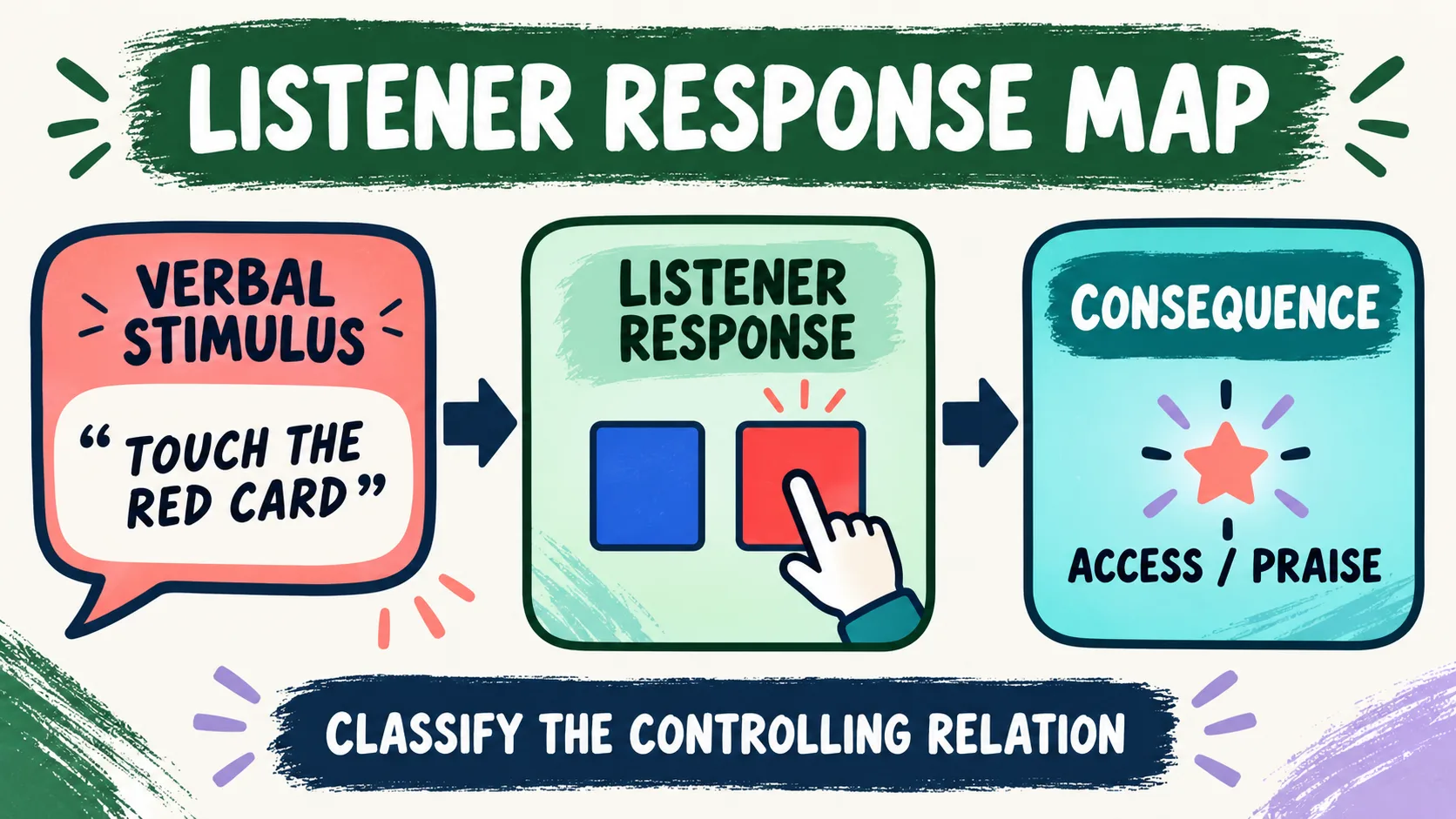
Start with a simple three-part map: verbal stimulus → listener response → consequence. The verbal stimulus can be a spoken instruction such as “give me the spoon,” a signed direction, a written direction, or a conditional verbal instruction embedded in a task. The response can be touching, selecting, handing over, moving, sorting, or completing an action. The consequence might be praise, access to a preferred activity, progress in the task, or another programmed outcome. Consider three versions of the same scene:
- Listener responding: The instructor says, “Put the block in the box,” and the learner places the block in the box. The verbal direction controls the action.
- Visual selection without a verbal cue: The learner sees a preferred sticker and reaches for it. The visual item and motivation may control the reach; this is not enough evidence for listener responding.
- Mixed prompts: The instructor says, “Put it in,” points to the box, and models the action. The learner succeeds, but the question must tell you whether the verbal cue, point, or model is the relevant prompt. Do not pretend the controlling variable is isolated when it is not.
The peer-reviewed analysis of verbal stimulus control is useful here because it separates the verbal stimulus from the learner’s response and from the broader idea of “understanding language.” For a BCBA exam scenario, read each word for what it does in the contingency: does it select the response, alter motivation, describe an object, or provide a model?
Remember That Listener and Speaker Are Changing Roles
“Listener” and “speaker” are functional roles, not permanent identities. During a conversation, one person may first listen to “Where is the restroom?” and point toward the hall, then become the speaker by saying “It is next to the office.” The same person can switch roles from trial to trial.
This matters because a learner can have a strong speaker repertoire and a weak listener repertoire, or the reverse. Saying “ball” when shown a ball is not proof that the learner will select the ball when told “touch the ball.” Naming and following a verbal direction involve different stimulus-control relations. A complete assessment can look at both instead of treating one as a substitute for the other.
Do not reduce listener responding to obedience. A listener response can involve choice, conditional discrimination, problem solving, or responding to a socially meaningful message. The ethical question is whether the target is functional, dignified, client-informed, and relevant to the learner’s environment—not whether the learner simply follows more adult instructions. When a scenario switches roles, look for these clues:
- Listener role: another person’s verbal behavior is part of the antecedent for the learner’s action or selection.
- Speaker role: the learner produces a communicative response that changes a listener’s behavior or contacts a socially mediated consequence.
- Role switch: the same learner may listen on one trial and speak on the next; the person does not permanently belong to one category.
- Unclear control: if a model, gesture, object, and spoken cue occur together, search for the comparison condition before naming the relation.
Classify the Response Without Guessing From Its Form
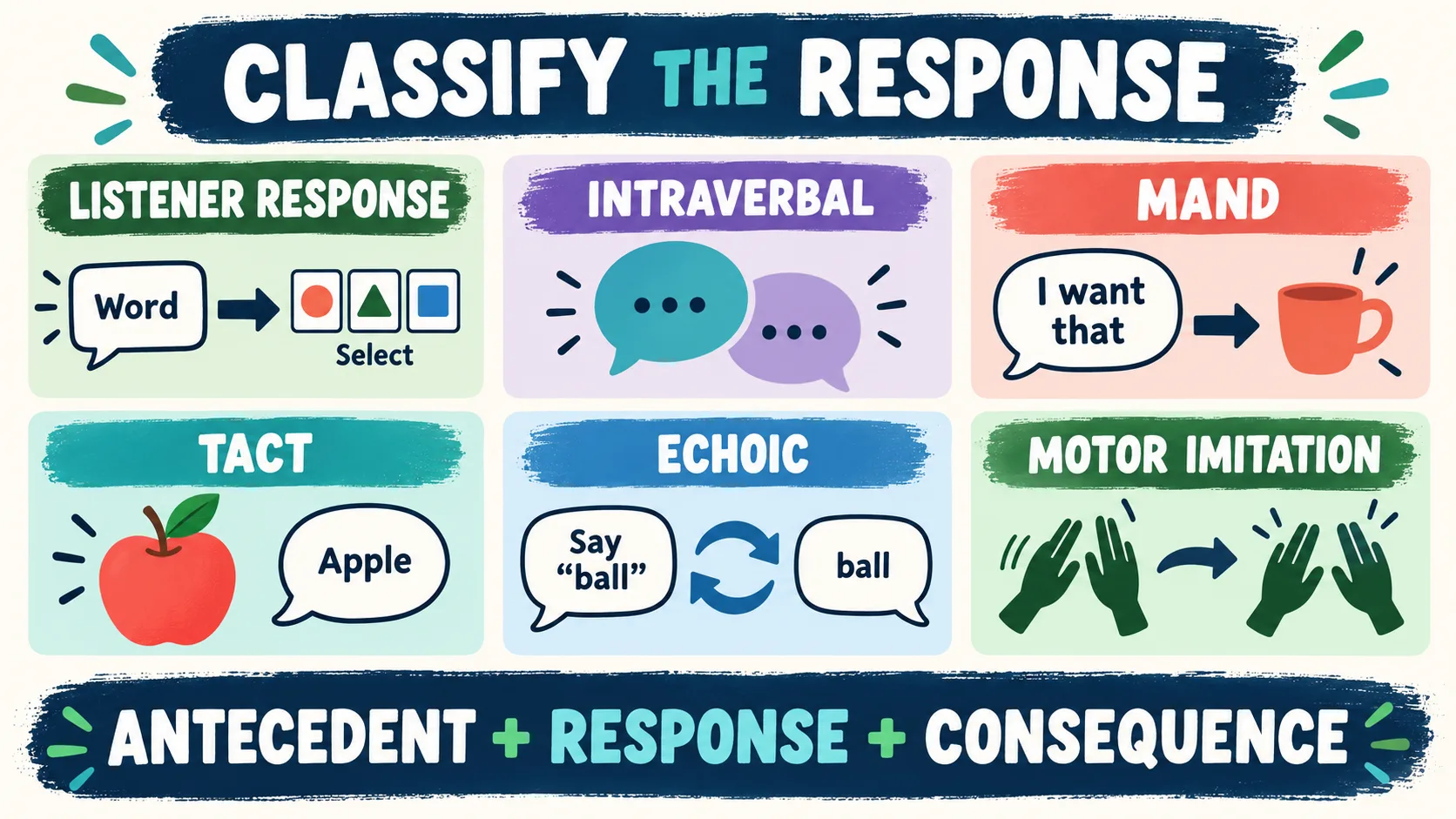
Many BCBA questions use the same object and the same word while changing the controlling variables. The following comparison keeps the response form from doing all the work.
| Relation | Main controlling variable | Example response | Fast boundary |
|---|---|---|---|
| Listener responding | Verbal stimulus controls a nonvocal or selection response | “Point to the dog” → touches the dog picture | The learner acts as the listener; the immediate response is not a repetition of the cue |
| Intraverbal | Verbal stimulus evokes a verbal response without point-to-point correspondence | “What do you drink?” → “Water” | The response is verbal and conversational rather than an instructed selection or action |
| Mand | Motivating operation and a history of reinforcement for requesting | Reaches for or says “water” when thirsty | The learner is requesting a consequence, not merely following someone’s cue |
| Tact | Nonverbal stimulus controls a verbal label or comment | Sees a dog and says “dog” | The object or event, not another person’s verbal direction, is central |
| Echoic | Verbal stimulus evokes a vocal response with point-to-point correspondence | Instructor says “ball” → learner says “ball” | The learner repeats the verbal form rather than carrying out the direction |
| Motor imitation | Observed model or movement cues the matching action | Adult claps → learner claps | The modeled movement is the key antecedent; “Do this” alone is not the same evidence |
These categories can be multiply controlled. If an instructor says “touch the spoon,” points to the spoon, and holds a preferred snack nearby, more than one variable may influence the learner. The correct exam move is to identify the relation the question asks about and avoid claiming that a single cue controlled behavior when the scenario deliberately includes several.
Run the Five-Step Listener-Response Check
Use this sequence whenever a question uses phrases such as “responded to the instruction,” “receptively identified,” “followed a direction,” or “selected the correct item.”
- Write the exact antecedent. Copy the verbal cue rather than summarizing it as “language.”
- Describe the response topography. Was it pointing, selecting, handing over, moving, speaking, signing, or repeating?
- Ask what made the response likely. Separate the verbal cue from the object, model, motivating operation, and physical prompt.
- Check the consequence. Was the learner reinforced for following the direction, requesting the item, labeling it, or matching the model?
- Choose the narrowest defensible label. If the data do not isolate verbal stimulus control, state what is supported and what remains ambiguous.
A practical exam trap is the phrase “the therapist says ‘touch nose’ while touching her own nose.” If the learner touches their nose, the verbal cue and modeled movement are both present. Unless the question changes one prompt while holding the other constant, do not use the scene to prove a pure listener response or pure motor imitation. Look for the comparison condition.
Measurement and Teaching Cautions
To measure listener responding, define the target response in observable terms. “Understands directions” is too broad to score consistently. A better definition might specify that, within five seconds of the verbal direction, the learner selects the named item from an array of three without a gesture or physical prompt. The exact latency, array size, prompt level, and correction procedure should match the program’s purpose. Before scoring a listener-response target, check four design details:
- Opportunity: the verbal cue is delivered consistently and the learner has access to the materials needed to respond.
- Prompt level: verbal, gestural, model, and physical prompts are recorded separately rather than collapsed into “correct.”
- Response window: latency or time-to-response is defined before data collection begins.
- Independence: the team decides when a response is independent and how prompts will be faded.
| Program decision | Better question | Why it protects interpretation |
|---|---|---|
| Target definition | What exact action counts as correct listener responding? | Separates selection, imitation, compliance, and verbal answering |
| Prompt plan | Which verbal, gestural, model, or physical prompt is delivered, and when is it faded? | Prevents a prompt from being mistaken for the target controlling variable |
| Generalization | Does the response occur with new speakers, settings, materials, and wording? | Shows transfer without changing the definition of listener responding |
| Social validity | Is this listener skill useful and meaningful for the learner’s real routines? | Keeps teaching connected to communication and participation rather than compliance alone |
The current BACB task-list resources are the right official place to anchor exam preparation, but a study article should not replace the applicable outline or handbook. For clinical decisions, coordinate with the relevant team and protect the learner’s communication access, dignity, and preferred response mode.
FAQ and Practice Next Step
What is a listener response in ABA? It is a nonvocal, selection, or motor response controlled by another person’s verbal stimulus, such as selecting the named object after hearing a direction. Is listener responding the same as receptive language? The terms overlap in everyday clinical language, but receptive language is broader. For an ABA exam question, identify the exact verbal stimulus and observable response instead of assuming that any comprehension activity is listener responding.
Is pointing to a picture a listener response? It can be, if a verbal cue such as “show me the apple” controls the pointing or selection. If the learner points because the picture is preferred or because a visual prompt controls the response, more evidence is needed.
What is the fastest way to separate listener responding from intraverbal? Check the response form and controlling relation. Listener responding usually ends in an action or selection; an intraverbal is a verbal response to a verbal stimulus without point-to-point correspondence. Then check the consequence and any competing prompts.
Once you can identify the verbal stimulus and the response relation, practice the distinction under timed conditions with our free BCBA mock exam. The goal is not to memorize “listener response” as a label; it is to explain which variable controls the learner’s behavior and why the nearest alternative does not fit.
Take the Free BCBA Mock Exam
When you are ready to apply the idea, use the free practice resource below for additional feedback. Take the Free BCBA Mock Exam



