
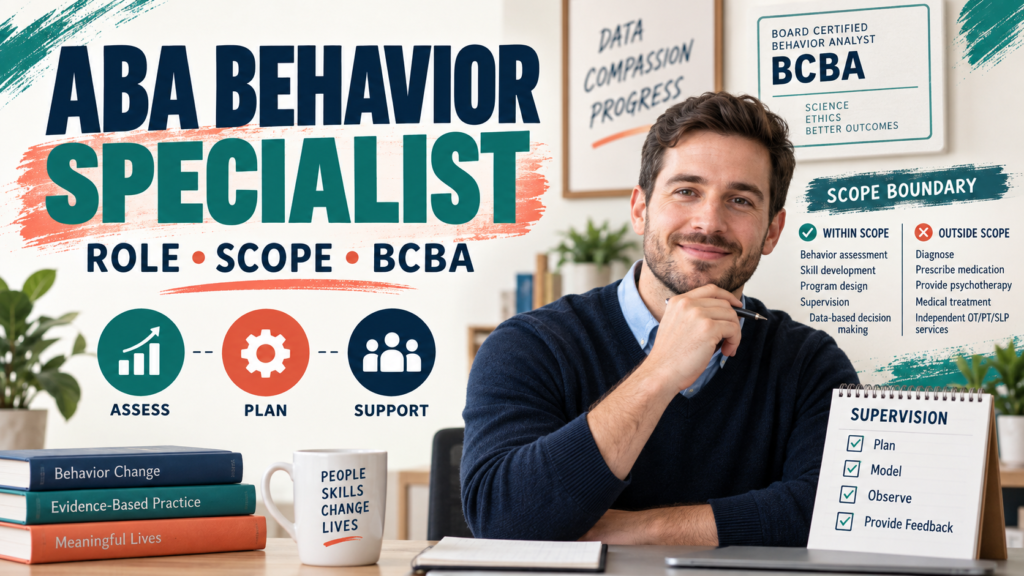
What does aba behavior specialist mean? Usually, it is a broad job title for someone who supports behavior change, skill development, assessment, or implementation in an applied behavior analysis setting. It is not, by itself, a universal BACB credential. The exact duties and authority depend on the person’s education, named credential, local license, employer, setting, and supervision plan.
Table of Contents
- What Is an ABA Behavior Specialist?
- Is Behavior Specialist a BACB Credential?
- What Might a Behavior Specialist Do?
- How Does the Role Compare With BCBA, BCaBA, and RBT?
- What Determines the Person’s Scope?
- What Should a Family or Employer Verify?
- Why Does the Setting Matter?
- How Is This Tested on the BCBA Exam?
- ABA Behavior Specialist Verification Checklist
- Take the Free BCBA Mock Exam
This guide helps families, employers, students, and ABA team members ask the right questions. A title can describe a role, but it cannot prove that a person may independently assess, design treatment, supervise technicians, diagnose, provide another profession’s service, or bill a payer. Verify the role before relying on it. Table of Contents
What Is an ABA Behavior Specialist?
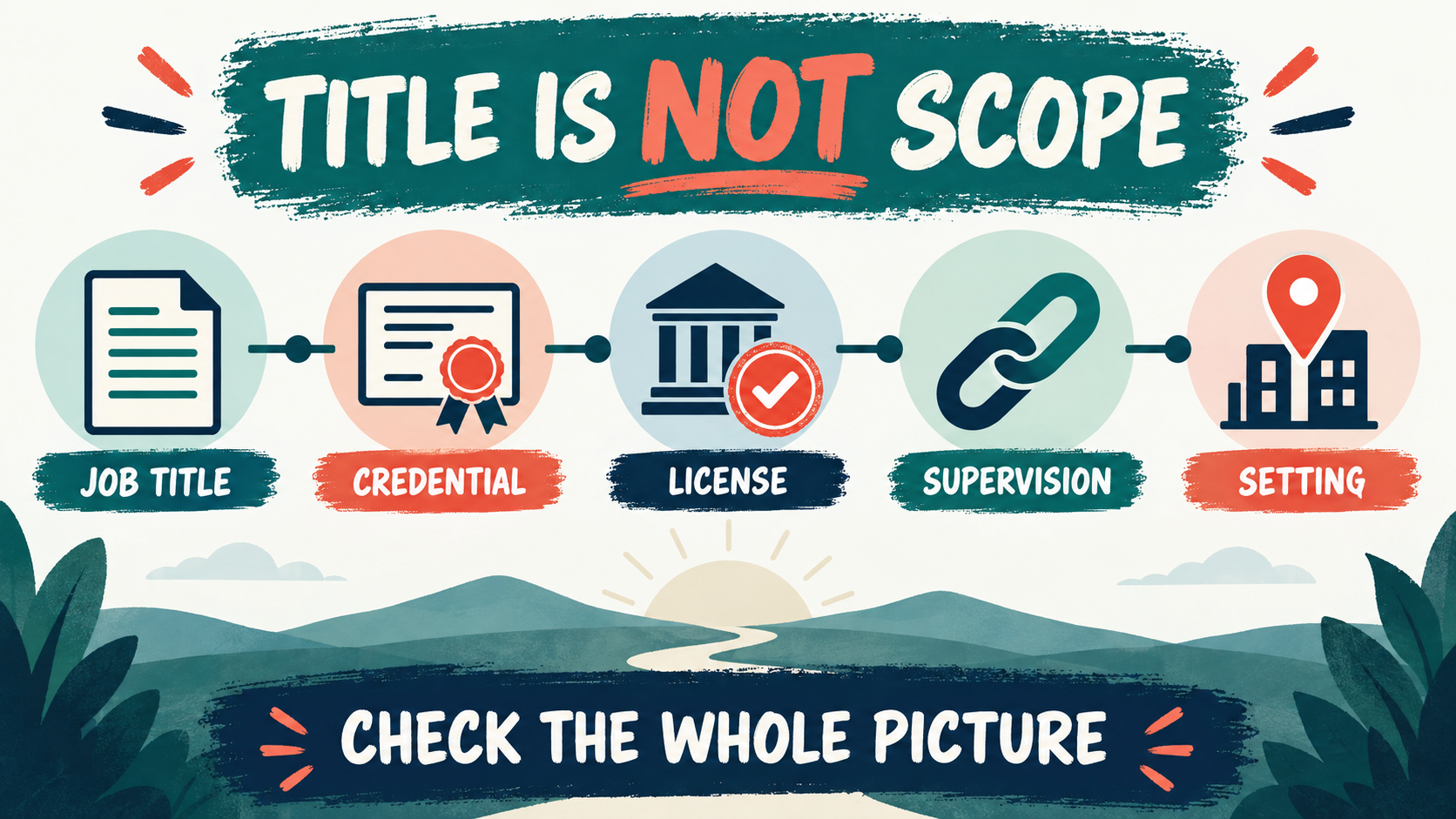
An ABA behavior specialist is often a person whose work involves observing behavior, supporting an intervention, teaching skills, collecting data, coaching caregivers or staff, or helping a qualified clinician carry out a behavior plan. The title may be used in a clinic, school, home-based program, community agency, residential service, or other setting.
The important word is often. “Behavior specialist” is not one nationally uniform job description. One employer may use it for a BCBA who leads clinical programming. Another may use it for a bachelor’s-level team member who implements procedures under supervision. A school district may use it for an education professional with a different credential. The title alone does not answer the questions that matter to a client.
The BACB identifies the BCBA as a graduate-level certification in behavior analysis. That is a named certification with defined requirements. It should not be treated as interchangeable with a broad workplace label. When someone says “I am a behavior specialist,” ask which credential, license, training, and supervisor stand behind the service.
Is Behavior Specialist a BACB Credential?
No. “Behavior specialist” is generally a job title or descriptive label, not one of the BACB credential names. The BACB maintains specific credentials, including BCBA, BCaBA, and RBT. A person may hold one of those credentials and also be called a behavior specialist, but the job title does not establish which credential the person holds.
The distinction protects both the public and the professional. A family should not assume that a behavior specialist can make every clinical decision. An employer should not place a worker into a duty simply because the title sounds advanced. A student should not count time, supervision, or responsibilities toward a certification requirement without checking the applicable current rules and documentation.
The BCaBA and RBT pages are useful examples of why named credentials matter. They describe different levels of training, certification, and supervision. A local behavior-analyst license or employer requirement may add another layer. Certification, licensure, job title, and payer enrollment are separate questions.
What Might a Behavior Specialist Do?
Duties vary, but a behavior specialist may be asked to:
- observe behavior and record data using definitions supplied by the clinical team;
- implement teaching or behavior-support procedures in a home, school, clinic, or community setting;
- practice communication, self-help, social, academic, safety, or daily-living skills;
- help prepare materials, collect caregiver feedback, or organize progress information;
- support staff training or caregiver coaching within the person’s competence and assigned role; and
- bring changes, safety concerns, barriers, or unexpected outcomes to the supervising professional.
Those duties can be clinically meaningful without making the worker the person who independently determines diagnosis, treatment necessity, a behavior-analytic assessment, or a plan’s final clinical decisions. A good team makes the boundary explicit: what the specialist observes, what the specialist implements, what the specialist may recommend, and what must be reviewed or approved by a qualified supervisor.
How Does the Role Compare With BCBA, BCaBA, and RBT?
The following is a general orientation, not a substitute for the current BACB handbook, a state license rule, or an employer’s competency process. The same person can have a broad job title and a named credential, but the credential and jurisdiction should control the role description.
| Label | What it tells you | What it does not tell you |
|---|---|---|
| Behavior specialist | A broad role or employer title connected to behavior support. | The person’s exact credential, independent authority, or permitted duties. |
| BCBA | A named graduate-level BACB certification in behavior analysis. | Every local license, specialty, facility approval, payer contract, or non-ABA profession. |
| BCaBA | A named undergraduate-level BACB certification with a defined supervision relationship. | That the person may practice independently or without the required BCBA oversight. |
| RBT | A paraprofessional BACB certification for work under responsible supervision. | That the person designs the overall treatment plan or supervises the clinical program. |
Use the matrix as a prompt for verification, not as a shortcut. A role can be safe and valuable when the team knows who is responsible for assessment, plan design, supervision, data review, caregiver communication, and escalation.
What Determines the Person’s Scope?
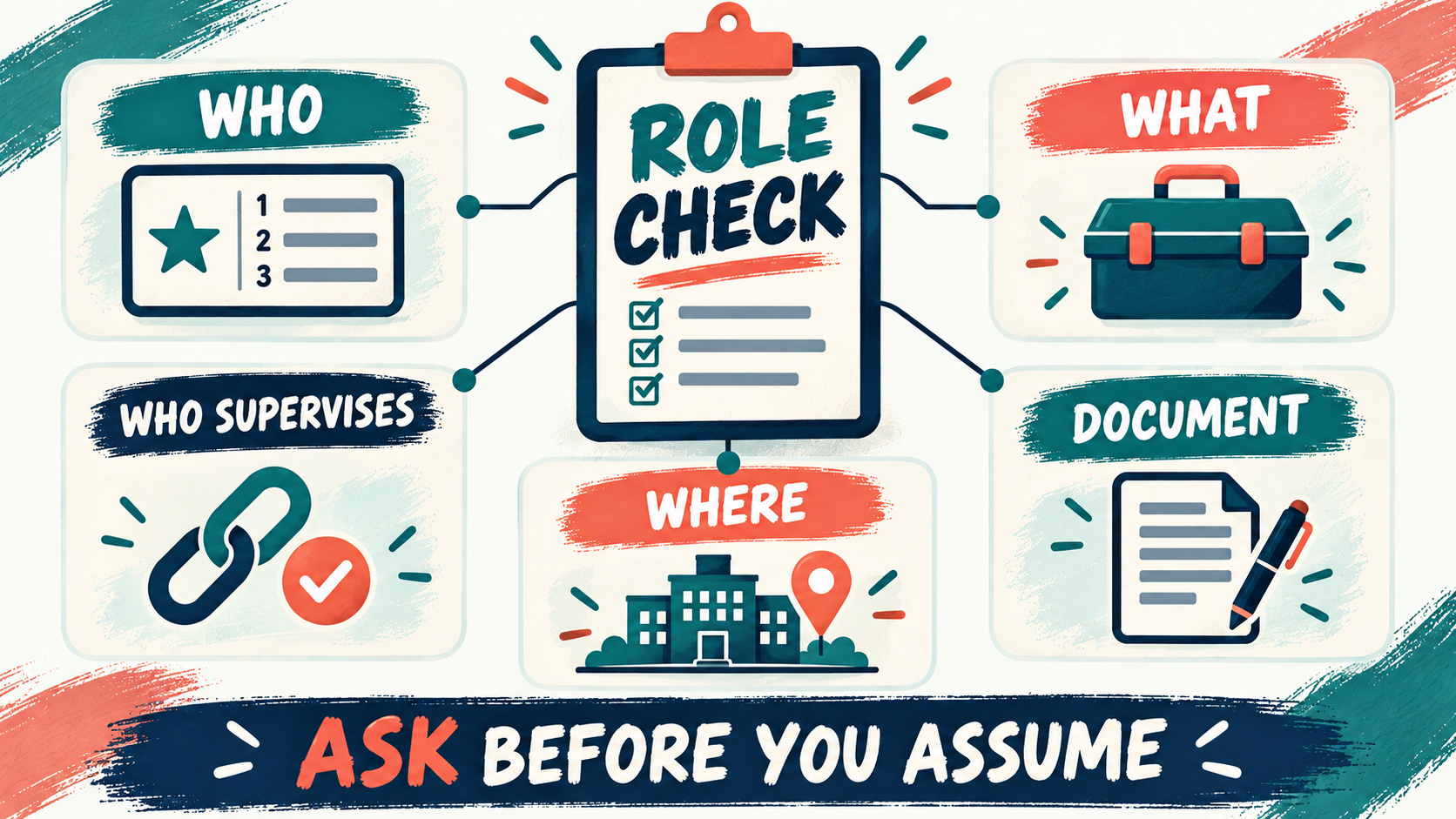
Scope is determined by the intersection of several controls. A person may be well trained for one task but not another, or qualified in one setting but not automatically in every setting. A practical scope check asks:
- Who? What education, competency assessment, named credential, license, and current status does the person have?
- What? Which tasks are assigned: direct implementation, data collection, caregiver coaching, assessment support, plan design, or supervision?
- Who supervises? Who reviews the work, observes performance, answers clinical questions, and accepts responsibility for decisions?
- Where? Does the service occur in a clinic, home, school, community, telehealth, residential, or medical setting with different rules?
- What is documented? Are consent, goals, data, feedback, competency, supervision, incidents, and changes recorded in a way the team can review?
The BACB supervision and training resources help explain why role clarity and oversight matter. A task should not be delegated merely because a supervisor is busy. The team must consider competence, client welfare, the procedure’s risk, the person’s training, and the availability of timely consultation.
What Should a Family or Employer Verify?
Ask for plain answers before services begin or a new worker is assigned. A family can ask who the supervising BCBA is, how often the supervisor observes or reviews the service, how concerns are escalated, and which professional is responsible for the treatment plan. An employer can ask for the same information while also checking the worker’s training, competency evidence, background requirements, documentation duties, and role-specific restrictions. Useful questions include:
- What does this organization mean by “behavior specialist” in this position?
- Which credential or license does the person hold, and where can its current status be verified?
- Which tasks may the person perform independently, and which require direct or ongoing supervision?
- Who writes, approves, changes, and reviews the behavior plan?
- What happens if the person sees a safety concern or a procedure does not work as expected?
- How will the family or client provide consent, feedback, refusal, or a request for a different provider?
Do not treat a polished title, uniform, online profile, or short certificate as proof of authority. The best answer is a consistent role description supported by current records, supervision, and a clear escalation process.
Why Does the Setting Matter?
Words can carry different meanings across states, schools, health plans, employers, and service models. For example, a public education role may be defined by a state staffing rule, while an ABA provider may use the same title for a clinic position. The Pennsylvania education guidance illustrates why a jurisdiction-specific description should not be copied as a national definition.
Setting also changes the practical risk. A behavior specialist implementing a well-defined classroom support procedure may need a different competency check from a worker supporting a crisis plan in a home or community setting. Travel, privacy, caregiver participation, restrictive procedures, emergency response, and payer rules may all change the required safeguards.
How Is This Tested on the BCBA Exam?
On a BCBA-style question, “behavior specialist” is usually a cue to examine role clarity, competence, supervision, scope, documentation, and client welfare. The correct answer is not automatically the most senior-sounding title. Read the facts: who has the credential, who observed the behavior, who is responsible for the plan, what the supervisor knows, and what action protects the client now. When two options seem plausible, ask:
- Is the task within the person’s demonstrated competence and assigned authority?
- Is the supervisor available for the level of risk and complexity?
- Does the action preserve accurate data, informed consent, dignity, and confidentiality?
- Would consultation, correction, additional training, or referral be safer than guessing?
For more scenario practice, the free BCBA mock exam can help you rehearse ethics, supervision, measurement, and professional-judgment decisions. It is a study aid, not official BACB material and not a substitute for the current handbook or test content outline.
ABA Behavior Specialist Verification Checklist
Before relying on a behavior specialist’s work, confirm that:
- the organization has defined the title and the actual duties;
- the worker’s education, competency, credential, and license status match those duties;
- the supervising professional and escalation path are named;
- assessment, treatment-plan, data-review, and supervision responsibilities are assigned clearly;
- the setting’s safety, privacy, consent, and payer requirements have been checked; and
- families, clients, and staff know how to ask questions, report concerns, or request review.
The bottom line is simple: an ABA behavior specialist may be an important member of a behavior-support team, but the title is only the starting point. Check the credential, license, task, supervisor, setting, and documentation together. That is how a broad label becomes a transparent and safer role.
Take the Free BCBA Mock Exam
If you want a low-pressure way to check your recall, use the free practice resource below. Take the Free BCBA Mock Exam



