

A scenario-first guide to comparing credentials, scope, and next steps when you are deciding between a behavior analyst and a psychologist. If you search for behavior analyst vs psychologist, you may be asking a career question, a referral question, or a scope-of-practice question. Those are related, but they are not the same decision. A title alone cannot tell you what a professional is legally allowed, trained, licensed, or competent to do.
Table of Contents
- Behavior analyst vs psychologist: the short answer
- Use a four-step credential and scope check
- Do not collapse job labels into credentials
- Scenario map: what question are you trying to answer?
- What a BCBA credential does—and does not—tell you
- Which path fits your career decision?
- How this comparison helps with BCBA exam preparation
- Behavior analyst vs psychologist FAQ
- Turn the decision into a responsible next step
- Official Sources to Recheck
- Quick Review Checklist
- Take the Free BCBA Mock Exam
The practical answer is this: a BCBA is a graduate-level certification in behavior analysis, while “psychologist” usually refers to a jurisdiction-regulated professional title whose license, specialty, and permitted services vary. Both professionals may evaluate behavior and collaborate on care, but the credentials are not interchangeable.
This article adds a decision workflow to the site’s broader BCBA vs psychologist comparison. Use that page for the general career overview. Use this page when you need to decide what question to ask, what credential to verify, and what boundary to check before choosing a program, making a referral, or planning your BCBA preparation.
Behavior analyst vs psychologist: the short answer
A behavior analyst works from behavior-analytic principles: define observable behavior, measure it, assess relevant environmental variables, design behavior-change procedures, and evaluate the effect of intervention. A BCBA is one specific graduate-level behavior-analysis certification issued by the Behavior Analyst Certification Board (BACB). The job label “behavior analyst” may be used more broadly by employers, so verify the person’s actual certification, license, training, and role.
A psychologist is not one uniform national job description. Psychologists may work in assessment, therapy, research, consultation, education, organizational settings, or other specialties. Their license category and legal scope depend on the jurisdiction and the individual’s education, supervised experience, examinations, competence, population, and setting.
| Question | Behavior analyst / BCBA lens | Psychologist lens |
|---|---|---|
| What is the credential? | BCBA is a graduate-level certification in behavior analysis; other behavior-analyst labels may describe a job or a state credential. | Psychologist is a regulated title tied to a jurisdiction-specific license and specialty. |
| What is the technical center? | Observable behavior, environmental relations, measurement, behavior-change procedures, and data-based decisions. | Varies by specialty; may include psychological testing, mental-health assessment, therapy, consultation, or research. |
| What controls legal scope? | Applicable state or local law, the actual credential, employer rules, competence, and service contract. | The jurisdiction’s psychology license category, specialty, protected activities, competence, and setting. |
| Can one replace the other? | No. BCBA certification does not itself create psychology licensure. | No. Psychology licensure does not automatically demonstrate behavior-analytic certification or competence in every ABA procedure. |
Use a four-step credential and scope check
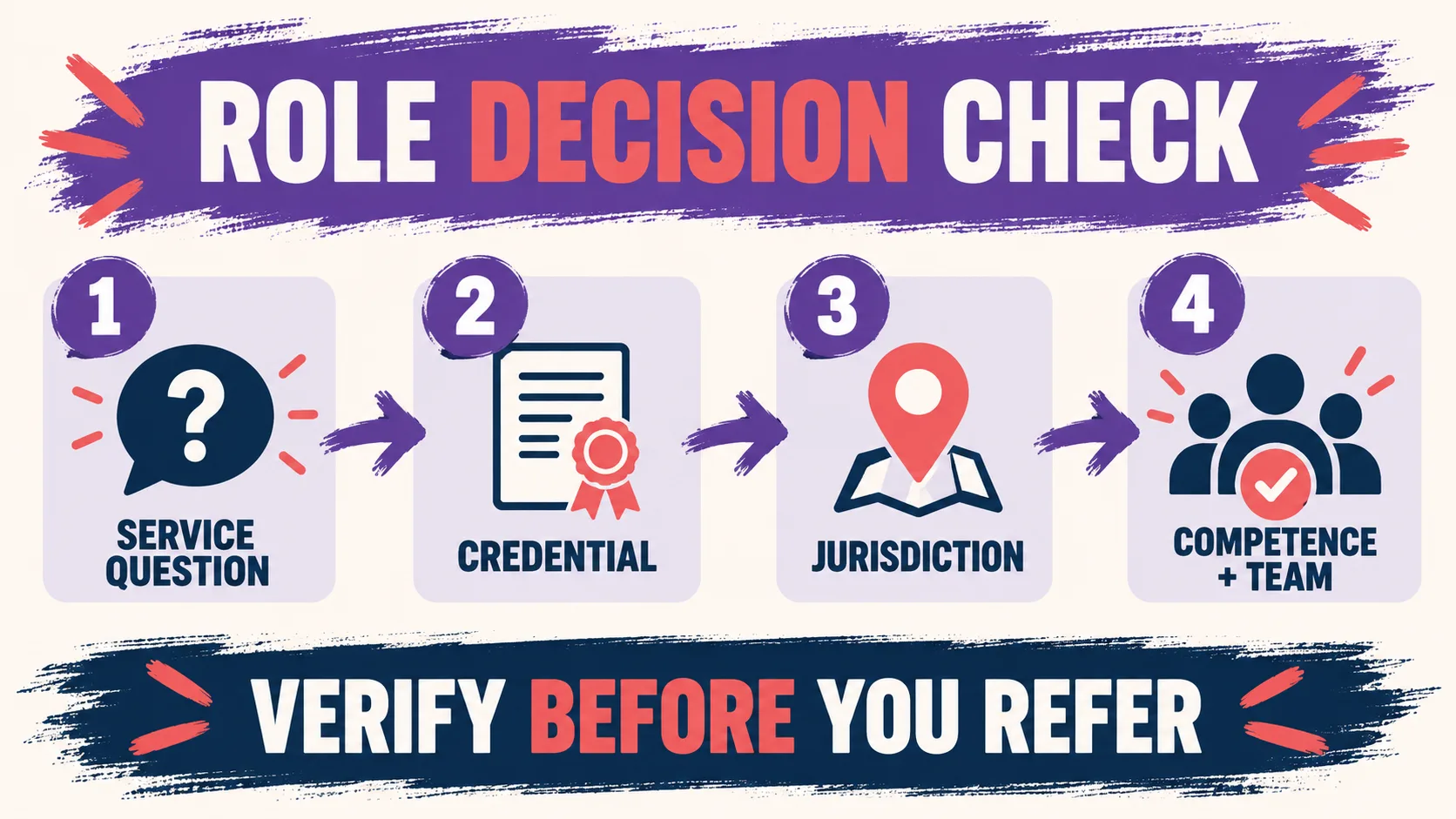
Before you decide between a behavior analyst and a psychologist, run the same four questions. This prevents a common error: choosing a professional because the title sounds familiar even though the service question belongs to a different credential or requires a team.
- Name the service question. Are you asking for a behavior-change plan, psychological testing, a diagnosis, therapy, school eligibility support, staff training, or a combination? Avoid starting with “Which professional is better?”
- Identify the credential. Ask for the exact certification or license, issuing body, current status, and specialty. “Behavior analyst” and “psychologist” are not enough detail for a high-stakes referral.
- Check jurisdiction. Look at the relevant state board, payer rule, employer policy, and consent requirements. A credential can be real while a requested service still falls outside the person’s local authority.
- Check competence and team role. Confirm experience with the population, procedure, setting, language, and risk level. Write down who assesses, who designs intervention, who provides therapy, who supervises implementation, and who signs the report.
The BACB describes BCBAs as independent practitioners who provide behavior-analytic services and may supervise RBTs, BCaBAs, and other professionals implementing those services. The BACB also explains that some assessment or training tasks may be delegated only with appropriate oversight. That is a role-and-oversight statement, not a universal permission to perform every behavioral-health service.
Do not collapse job labels into credentials
“Behavior analyst” can be used in job postings, team charts, or everyday conversation. It may refer to a BCBA, a licensed behavior analyst, a trainee, a behavior specialist, or another professional whose employer uses the label. The safest question is not “Are you a behavior analyst?” but “Which credential do you hold, where is it current, and what service are you responsible for in this setting?”
| Label to verify | What to ask | Why it matters |
|---|---|---|
| Certification | Is the person currently certified by the BACB or another recognized body? | Certification status and maintenance requirements are distinct from an academic degree or job title. |
| License | Does the state require a behavior-analyst or psychology license for the requested service? | A national certification does not erase state licensing rules. |
| Competence | What training and supervised experience match this population, procedure, and risk? | A valid credential is not proof of competence for every specialty or case. |
| Accountability | Who owns the assessment, treatment decision, documentation, and supervision? | Clear accountability protects the client and prevents role confusion. |
Scenario map: what question are you trying to answer?
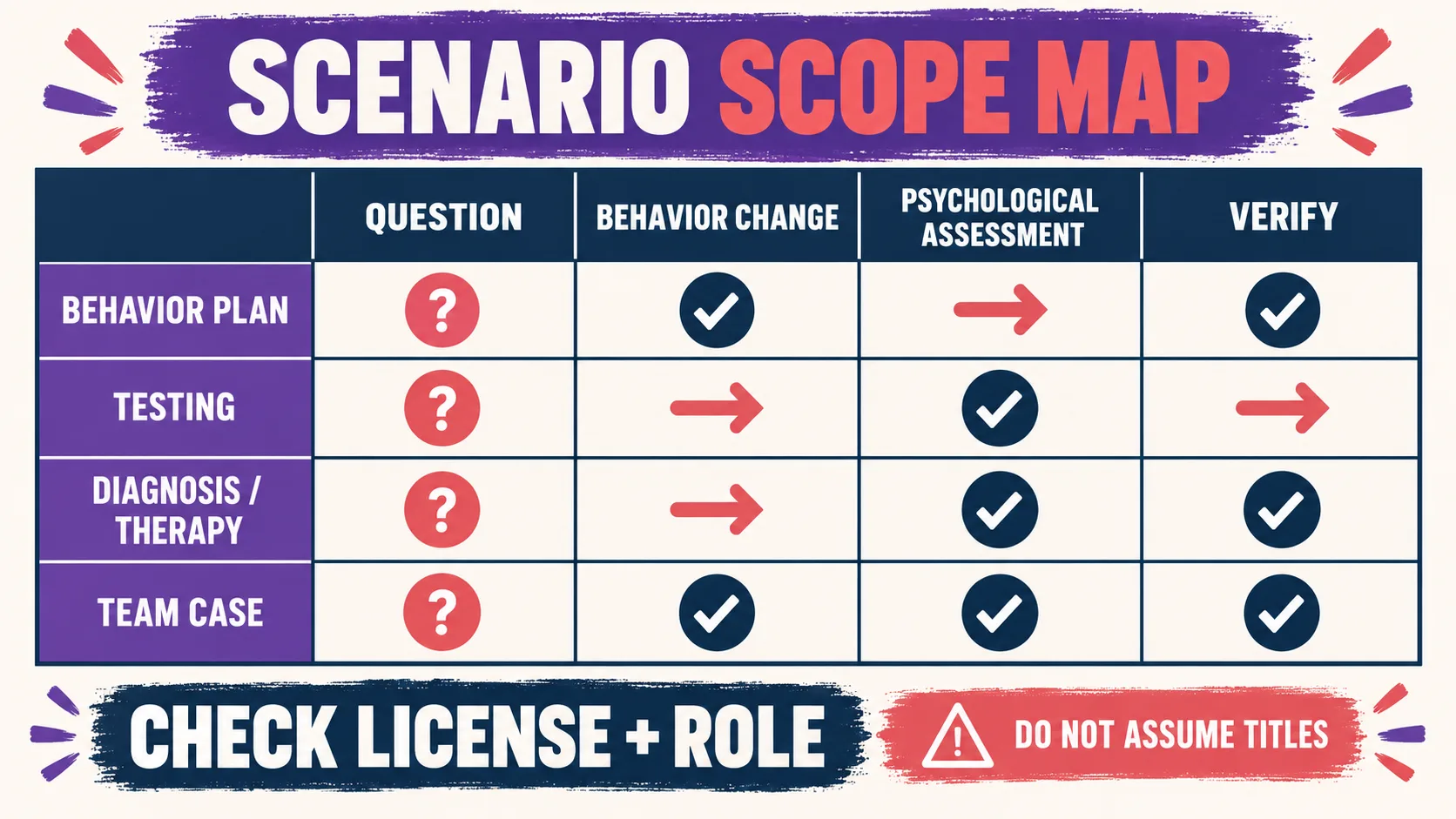
The fastest way to understand the behavior analyst versus psychologist difference is to compare the question being answered. The same client may need both professionals at different points. The matrix below describes typical role boundaries, not a substitute for local law or an individual evaluation.
| Scenario | Behavior-analytic contribution | Psychology contribution | Boundary check |
|---|---|---|---|
| A team needs a measurable behavior-change plan. | Define targets, collect data, analyze relevant variables, select behavior-change procedures, and monitor treatment integrity. | May contribute consultation or a broader assessment when trained and authorized for that service. | Confirm who is qualified to conduct the assessment and approve the plan in that jurisdiction. |
| A family needs psychological or psychoeducational testing. | A BCBA may provide behavior-analytic observations or data relevant to the case. | A qualified psychologist may conduct tests within the license, training, and setting requirements. | Verify the exact license category and test authority; do not infer it from “behavior” in the title. |
| The referral asks for diagnosis or psychotherapy. | The BCBA should stay within behavior-analytic competence and coordinate with the appropriate professional. | A psychologist may address the requested service when the license, specialty, competence, and local rules support it. | Diagnosis and therapy are not automatic consequences of holding a BCBA credential. |
| A complex case needs multiple perspectives. | Contribute observable data, functional hypotheses, intervention design, caregiver or staff training, and outcome monitoring. | Contribute psychological assessment, mental-health treatment, consultation, or another specialty service when qualified. | Document roles, communication, consent, and who makes each decision before services begin. |
Notice the pattern: the choice is driven by the service question, not by a ranking of professions. A BCBA and psychologist may collaborate well precisely because their training emphasizes different forms of assessment and intervention. Collaboration should make the boundaries clearer, not blur them.
What a BCBA credential does—and does not—tell you
The BACB handbook identifies the BCBA as a graduate-level certification in behavior analysis and describes certificants as independent practitioners of behavior-analytic services. It also separates certification from the legal rules that may apply to practice. A BCBA must follow the BACB Ethics Code, applicable law, employer or payer requirements, and personal scope of competence. That means three shortcuts are unsafe:
- “BCBA means psychologist.” It does not. The BCBA is not a psychology license and does not by itself authorize psychology services.
- “Psychologist means behavior analyst.” It does not. Psychology training can include behavior, but the person’s behavior-analytic certification, experience, and competence still need verification.
- “The employer title settles it.” It does not. A job description can assign tasks, but the professional remains accountable to credentials, law, competence, and ethical requirements.
Which path fits your career decision?
If you are selecting graduate training, compare the actual curriculum and supervised experience instead of comparing labels. A BCBA-centered path may fit a learner who wants intensive training in behavior measurement, functional assessment, behavior-change procedures, supervision, and data-based intervention decisions. A psychology path may fit someone whose intended work centers on psychological assessment, therapy, mental-health services, research, or a specialty regulated by a psychology board. Some people pursue more than one credential, but each credential still has its own requirements and boundaries.
| If your priority is… | Compare first | Do not skip |
|---|---|---|
| Behavior-change assessment and intervention | Behavior-analysis curriculum, supervised fieldwork, current BACB pathway, and the population you want to serve. | State licensure, payer rules, ethics requirements, and real-world supervision quality. |
| Psychological testing or therapy | The psychology specialty, degree, supervised hours, license category, and services permitted where you will practice. | Whether the program leads to the license required for your intended service. |
| A collaborative behavioral-health career | How the program teaches referrals, communication, consent, documentation, and interdisciplinary work. | A clear boundary between what you can do independently and what requires another professional. |
How this comparison helps with BCBA exam preparation
For BCBA candidates, the useful exam question is rarely “Which profession is better?” A vignette is more likely to test whether you can identify the target behavior, choose a behavior-analytic assessment or intervention, recognize a scope or ethics boundary, collaborate appropriately, and make a data-based decision. Translate the career comparison into those decision skills.
- Underline the service question in the vignette: behavior change, assessment, diagnosis, therapy, supervision, or referral.
- Separate what is directly observable from what requires a different professional evaluation.
- Check whether the proposed action is within the practitioner’s training, credential, jurisdiction, and competence.
- Choose the least assumptive collaborative action: clarify roles, obtain consent, consult, refer, or collect the needed data.
- Review why each distractor crosses a boundary rather than memorizing a profession-versus-profession slogan.
The current BCBA certification pathway guide can help with the larger eligibility sequence. The official BACB handbook remains the authority for current requirements, and the relevant state board remains the authority for local licensure questions.
Behavior analyst vs psychologist FAQ
Is a behavior analyst the same as a BCBA?: No. BCBA is a specific BACB certification. “Behavior analyst” may be used as a profession or job label, and some jurisdictions use separate behavior-analyst licenses. Verify the person’s exact current credential and scope.
Can a BCBA diagnose a mental-health condition?: Do not assume that a BCBA credential authorizes diagnosis. Diagnosis authority depends on the applicable jurisdiction, license, training, competence, and service context. A BCBA should refer or collaborate when the question is outside behavior-analytic scope.
Can a psychologist design ABA treatment?: A psychologist may have relevant behavior-analysis training, but the answer depends on the person’s actual education, competence, credential, license, role, and setting. A psychology title alone is not proof of competence in every ABA procedure.
Should I become a behavior analyst or psychologist?: Start with the work you want to perform, then compare the program curriculum, supervised experience, credential pathway, local legal requirements, population, setting, and daily tasks. If your goal is BCBA certification and behavior-analytic practice, begin with the current BACB pathway rather than a generic title comparison.
Turn the decision into a responsible next step
Write a one-page decision note before choosing a program or making a referral: the service question, the credential needed, the jurisdiction to verify, the professional’s competence, the team roles, the consent/documentation plan, and the action you will take if the question falls outside scope. This simple sequence is more reliable than choosing based on salary, title familiarity, or one broad comparison chart.
If your next step is BCBA preparation, use the Free BCBA Mock Exam to practice scenario-based behavior-analysis decisions. Review the explanation, identify the scope or credential clue, and record the concept you need to revisit. It is a study resource—not a psychology referral, a license determination, or a guarantee of certification or exam success.
Official Sources to Recheck
Current reference points: the BACB Handbook, the BACB BCBA resource page, the BACB supervision, assessment, training, and oversight page, the BACB task-list page, and the American Psychological Association overview of psychologists. Licensure, protected activities, and requirements vary by jurisdiction; verify current rules with the relevant board. For targeted review, use our behavior analyst vs psychologist practice questions to apply the concept in exam-style scenarios.
Quick Review Checklist
Use this final checklist to turn behavior analyst vs psychologist into exam-ready reasoning. The goal is not to memorize a label in isolation; it is to identify the relevant evidence and explain why the best answer fits the scenario. Key ideas to review:
- State the central definition or decision point for behavior analyst vs psychologist in your own words.
- Identify the detail that makes behavior analyst vs psychologist different from its closest related ABA term.
- Separate the observable facts in a scenario from assumptions that are not supported by the facts.
- Write one example and one nonexample so you can recognize the concept in a new setting.
Exam application checks:
- Ask what the question is actually requesting before comparing the answer choices.
- Mark the antecedent, response, consequence, or other evidence that supports the selected answer.
- Look for a distractor that describes a related process but does not answer the specific question.
Final self-check:
- Explain how you would verify the interpretation with clear observations or data.
- Change one detail in the scenario and decide whether your answer should change.
- Give a one-sentence rationale that a supervisor or study partner could evaluate.
Take the Free BCBA Mock Exam
A useful next step is to apply this idea in a fresh set of BCBA-style practice questions and review the feedback. Take the Free BCBA Mock Exam



