

A practical way to interpret an ABA basic exam score, separate practice percentages from BACB results, and choose your next BCBA study set. If you are searching for an ABA basic exam score, first identify what kind of number you are looking at. Some students mean the percentage shown after a practice set. Others mean the domain breakdown on an official report, the scaled score associated with a BACB examination, or the final pass/fail result. Those numbers answer different questions.
Table of Contents
- ABA basic exam score: what does the phrase mean?
- Practice percentage versus official BACB result
- What the current BCBA exam rules tell you
- How to read one practice score
- Use domain feedback instead of one total
- Use a three-session score trend
- A 68% practice-score example
- Score-review mistakes to avoid
- ABA and BCBA score FAQ
- Turn the result into targeted practice
- Official Sources to Recheck
- Quick Review Checklist
- Take the Free BCBA Mock Exam
Use this rule: treat one practice percentage as a diagnostic starting point, not as a prediction of your official result. Review missed questions, look for a pattern across more than one set, and let that pattern choose your next study action. The BACB controls the official examination and scoring process; a practice platform can help you prepare, but it cannot issue a BACB score or guarantee certification. This guide focuses on score interpretation. For the separate passing-score overview, see the site’s BCBA exam passing-score guide; use this page to choose a next study action.
ABA basic exam score: what does the phrase mean?
“ABA basic exam score” is an informal search phrase, not the name of a single BACB score report. In practice, it usually points to one of four score signals. Naming the signal prevents you from comparing a practice percentage with an official result as if they were measured on the same scale.
| Score signal | What it can tell you | What it cannot prove |
|---|---|---|
| Practice percentage | How many items you answered correctly in that particular practice set. | Your official BACB scaled score or a guaranteed pass. |
| Practice domain breakdown | Where the questions in that set exposed a possible content or reasoning gap. | A complete measure of every task in the BCBA content outline. |
| BACB scaled score | A standardized official score used with the BACB examination process. | A number that can be calculated reliably from a third-party practice percentage. |
| Official pass/fail result | The result of the BACB examination attempt and its official reporting process. | A reason to disclose or reconstruct confidential examination questions. |
So when someone asks, “Is my ABA basic exam score good enough?”, the first follow-up should be: good enough for what decision? If the decision is “what should I study tonight?”, a practice percentage and missed-question review are useful. If the decision is “did I pass the BCBA examination?”, only the official result and score report answer it.
Practice percentage versus official BACB result
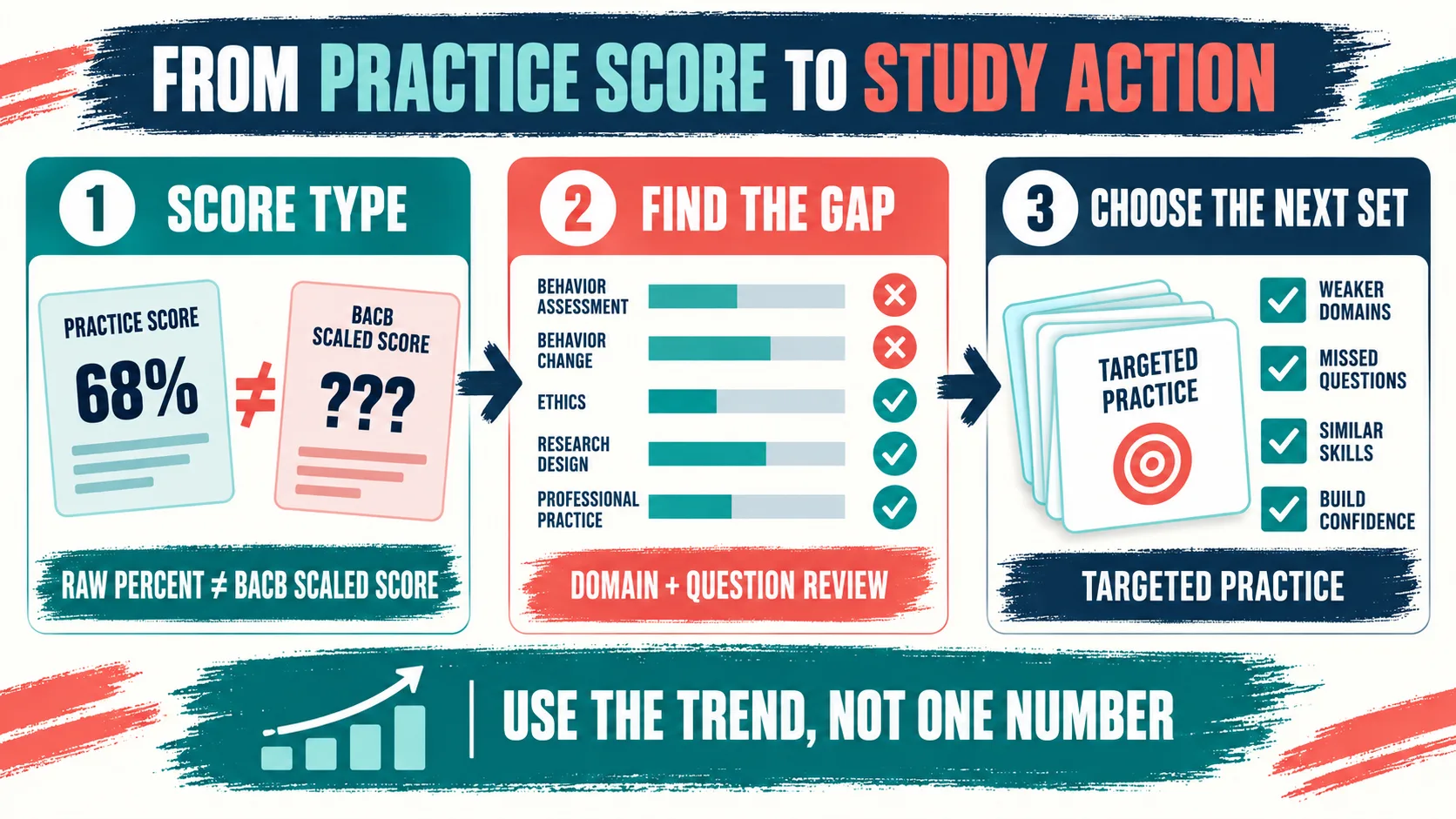
A practice platform normally calculates a raw percentage from the items in its own set. For example, 34 correct answers out of 50 is 68%. That calculation is useful for tracking the set, but it is still a local result tied to the question pool, wording, timing, explanations, and scoring rules of that platform.
The BACB uses multiple examination forms and statistical equating to account for form difficulty. The number correct required can vary by form, and the raw number correct is not reported. Do not convert a practice percentage into an official scaled score with a homemade formula.
Use the distinction in the image as a boundary: practice data can guide your next study action; it cannot recreate the BACB’s scoring process. If a website promises that one raw percentage maps exactly to an official pass/fail outcome, treat that claim cautiously and check the current BACB materials.
What the current BCBA exam rules tell you
The current BCBA Handbook says the examination is offered in English, lasts four hours, and has 185 multiple-choice questions: 175 scored and 10 unscored. Each has four possible answers and one correct answer. These facts help you set practice conditions; they do not make a practice set an official administration.
The Handbook also says that the BCBA examination is pass/fail and that the result is provided after the examination. Candidates can obtain a copy of the result report through the Pearson VUE account. The BACB’s public examination scoring information explains that passing standards are set with a modified Angoff method and that scaled scores allow results from different forms to be compared.
| Official fact | Study implication | Do not infer |
|---|---|---|
| The current exam has 185 questions, with 175 scored and 10 unscored. | Practice with a full-length, timed structure when you are ready. | That every practice platform uses the same item mix or difficulty. |
| Multiple forms are used and equated. | Track patterns across sets rather than reacting to one unusual result. | That you can calculate an exact official pass line from a raw percentage. |
| The BACB does not report the raw number correct. | Review the report and your preparation data without trying to reverse-engineer hidden items. | That a practice score is a BACB score report. |
| A failed candidate receives content-area information to guide study. | Use domain information to choose review priorities, then study the full outline. | That a small task-level sample proves you know or do not know an entire domain. |
Never share or reconstruct real BACB examination questions. A strong score-review workflow uses original practice questions, your own error notes, and public official guidance. It does not rely on recalled secure content.
How to read one practice score
One practice score is most valuable when you treat it as a starting measurement. Review it in five passes rather than staring at the total:
- Label the set. Write the date, source, edition or content-outline alignment, number of items, timing, and whether you completed it under distraction-free conditions.
- Record the calculation. Save correct, incorrect, omitted, and guessed items. If the platform uses a different scoring rule, write that rule beside the percentage.
- Classify each miss. Mark whether the error came from a missing definition, a calculation, a confusing pair of concepts, a reading error, or a decision that changed after you found a better clue.
- Check the domain pattern. Look for repeated weakness across related questions, not one difficult item. A domain with three questions is a prompt for review, not a final judgment.
- Choose one next action. Select a short concept review, a targeted question set, a timed mixed set, or a consultation with a supervisor or instructor. Do not change every part of your study plan after one result.
A useful review note is more specific than “I got this wrong.” Write: “I selected extinction because I focused on the form of the behavior; the maintaining contingency pointed to a different intervention.” That sentence creates a useful error log.
Use domain feedback instead of one total
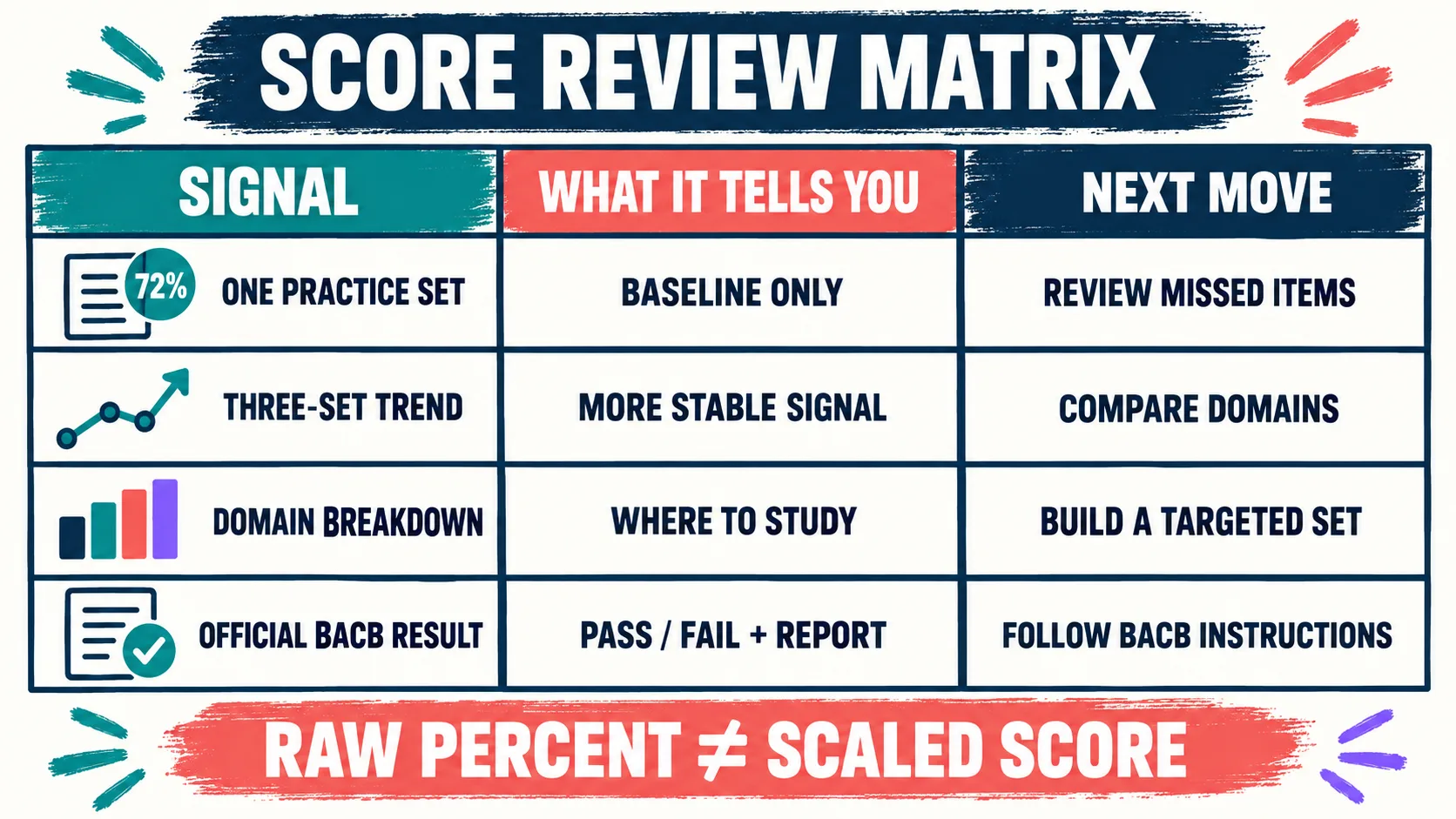
Total percentage can hide the difference between a broad knowledge gap and a small cluster of reasoning errors. If your practice platform provides content-area feedback, compare the domain with the questions you actually missed. If it does not, create your own tags using the current BCBA Test Content Outline and the concept tested in each question.
The BACB says a failing candidate’s report includes the percentage correct and total questions within each primary content area. It cautions that a small task sample may not predict overall understanding. Use the report to aim review, but continue studying the full content.
The matrix above gives a practical hierarchy. One set gives you a baseline. A three-set trend gives a more stable signal. A domain breakdown tells you where to look. The official BACB result tells you the official outcome. Keeping these layers separate is more useful than inventing a single “safe” ABA basic exam score.
Use a three-session score trend
After your baseline, use three different sessions instead of repeating the same questions until the percentage rises. Keep the purpose of each session distinct. This framework is a study heuristic, not a BACB scoring rule.
| Session | Purpose | Record | Next move |
|---|---|---|---|
| 1. Baseline | See your starting pattern without over-preparing the exact items. | Total, timing, domains, confidence, and error types. | Review the highest-frequency reasoning error. |
| 2. Targeted | Practice the concepts that appeared repeatedly in the baseline. | Concept tag, explanation quality, and changed answers. | Write a one-sentence rule and test it with new items. |
| 3. Mixed and timed | Check whether the skill transfers when topics and pacing change. | Trend across sets, time per item, and persistent domain gaps. | Keep the review loop or adjust it with your instructor. |
Keep the question pool fresh enough to test transfer. Repeating the same item can measure explanation memory rather than flexible decision-making. A better trend uses new questions, the same classification system, and a note about test conditions.
A 68% practice-score example
Imagine that your first 50-question practice set produces 34 correct answers, or 68%. That number is not “a 68% BACB score” and does not translate into an official scaled score; it is a baseline for that set.
During review, you find eight misses from confusing measurement choices, six from changing an initially correct answer after overlooking an antecedent, and two from rushing. Build a short measurement-and-vignette set, slow down at the clue, and record whether the same error appears on new items.
If the next sets move to 72% and 77% but measurement remains weak, the trend is encouraging while the domain still needs work. A high total with guessed answers or poor timing also deserves review. Ask whether the result is stable, explainable, and transferable.
Score-review mistakes to avoid
| Mistake | Why it fails | Better move |
|---|---|---|
| Converting a practice percentage into a promised BACB result | The question pool, form, equating, and scoring process are different. | Use the percentage to guide study and reserve pass/fail claims for the official result. |
| Repeating one set until the score rises | The increase may reflect item memory rather than transfer. | Use new items and compare a documented trend. |
| Studying only the lowest tiny domain sample | A few items may not represent the whole task or content area. | Target the pattern while continuing a balanced full-outline review. |
| Chasing recalled secure questions | BACB examination content is confidential and protected. | Use original practice questions and public official guidance. |
ABA and BCBA score FAQ
Is an ABA basic exam score the same as a BCBA scaled score?: No. “ABA basic exam score” is an informal phrase. A practice platform may show a raw percentage, while the BACB uses its own examination forms, scoring, and reporting process. Keep those numbers labeled separately.
Can I calculate my official BACB score from a practice percentage?: No reliable conversion should be assumed. The BACB explains that form difficulty and statistical equating matter, and it does not report the raw number of questions answered correctly. Use practice data for study decisions, not for reverse-engineering an official result.
Should I study only my weakest domain?: No. Use the weakest repeated pattern to choose a priority, but continue reviewing the full current content outline. The BACB cautions that small task-level samples may not predict your overall understanding.
What should I record after every practice set?: Record the date, source, number of items, timing, total result, domain pattern, error type, confidence, and next action. That log lets you compare trends without pretending that different score systems are identical.
Turn the result into targeted practice
A score becomes useful when it changes what you do next. After each set, choose one concept family, write one rule in your own words, complete fresh questions, and explain why the correct answer fits the antecedent, behavior, consequence, measurement, assessment, intervention, or ethical boundary described in the vignette. Then update your trend log.
When you are ready for another clean baseline, try the Free BCBA Mock Exam. Use the result as practice data: review missed questions, tag the underlying concept, and build your next set. It is a study resource, not a BACB score report or a guarantee of certification or exam success.
Official Sources to Recheck
Current reference points: the BACB examination information and scoring page, the 2026 BCBA Handbook, the BACB BCBA examination resource page, and the BCBA Test Content Outline page. Examination requirements, forms, and reporting procedures can change; this article is educational study guidance, not an official BACB score interpretation or a certification decision.
Quick Review Checklist
Use this final checklist to turn aba basic exam score into exam-ready reasoning. The goal is not to memorize a label in isolation; it is to identify the relevant evidence and explain why the best answer fits the scenario. Key ideas to review:
- State the central definition or decision point for aba basic exam score in your own words.
- Identify the detail that makes aba basic exam score different from its closest related ABA term.
- Separate the observable facts in a scenario from assumptions that are not supported by the facts.
- Write one example and one nonexample so you can recognize the concept in a new setting.
Exam application checks:
- Ask what the question is actually requesting before comparing the answer choices.
- Mark the antecedent, response, consequence, or other evidence that supports the selected answer.
- Look for a distractor that describes a related process but does not answer the specific question.
Final self-check:
- Explain how you would verify the interpretation with clear observations or data.
- Change one detail in the scenario and decide whether your answer should change.
- Give a one-sentence rationale that a supervisor or study partner could evaluate.
Take the Free BCBA Mock Exam
A useful next step is to apply this idea in a fresh set of BCBA-style practice questions and review the feedback. Take the Free BCBA Mock Exam



