
Behavior analysis ethics becomes easier to study when you stop treating an ethics scenario as a search for one impressive-sounding rule. A strong answer starts with the client’s welfare, identifies the facts that control the decision, checks competence and consent, protects accurate data and documentation, and uses consultation when the issue exceeds one person’s authority or expertise.
Table of Contents
- Behavior Analysis Ethics: What the Reasoning Is Solving
- Start With the Client and the Facts
- Use a Five-Step Ethics Scenario Workflow
- Compare the Controlling Questions
- Avoid Common Behavior Analysis Ethics Exam Traps
- Practice and Document the Reasoning
- Quick Review Checklist
- Take the Free BCBA Mock Exam
This guide is a scenario framework for BCBA exam preparation. It is not legal advice, a substitute for supervision, or a decision about whether a real person violated the Ethics Code. Use the current BACB ethics resources for the controlling professional standards, then use this sequence to organize your reasoning.
Behavior Analysis Ethics: What the Reasoning Is Solving
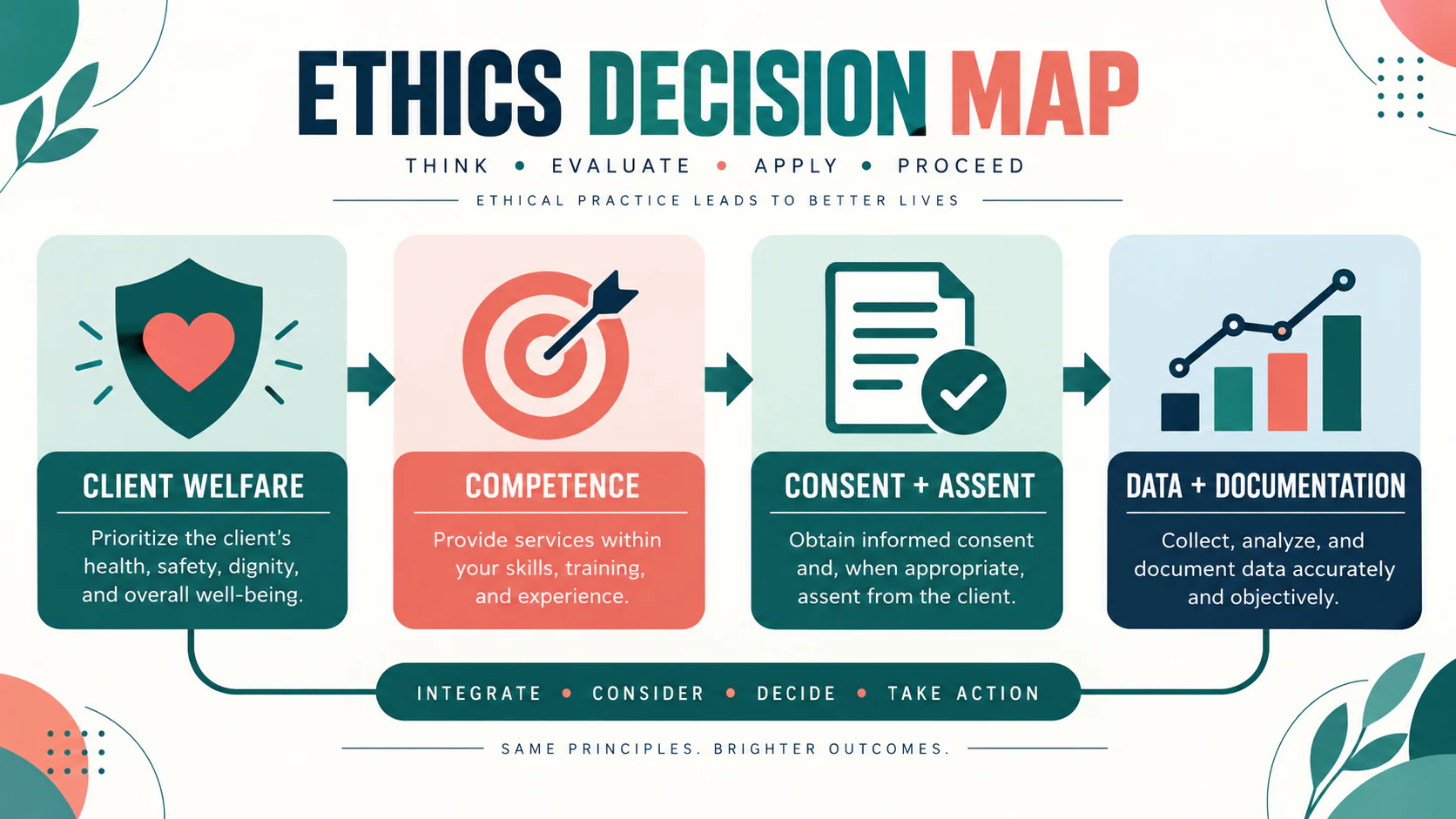
An ethics question is rarely only about whether an action is allowed in the abstract. It may involve client dignity, risk, informed consent, assent when applicable, confidentiality, competence, conflicts of interest, accurate records, cultural responsiveness, supervision, or the use of an intervention that needs more review. The scenario gives you clues about which responsibility is most urgent.
Read the situation in layers. First ask what could harm or deprive the client of a meaningful choice. Next ask whether the professional has the competence, authority, information, and supervision needed for the action. Then ask what must be documented, communicated, or escalated. This keeps a convenient administrative answer from replacing a client-centered one.
The current BACB ethics-information page is the appropriate starting point for the current professional code and related resources. A commercial study guide can help you practice, but it should not be the final authority for a current ethics requirement.
Start With the Client and the Facts
Before choosing an answer, write down four facts from the scenario:
- Who is affected? Identify the client, caregiver, learner, supervisee, colleague, or other stakeholder whose welfare or rights may be involved.
- What happened? Separate an observed event from an assumption about motivation or intent.
- What is at risk now? Look for immediate safety, dignity, privacy, access, coercion, or service-quality concerns.
- What authority is available? Decide whether the professional can act, must consult, or must follow an organizational or regulatory route.
This is also a useful way to avoid overreacting. An ethics scenario may contain an awkward communication problem, a data-quality problem, and a possible policy issue. Do not label the person before you identify what is known. The best next step may be to protect the client, gather missing information, consult a qualified person, and document the decision rather than making a public accusation.
Use a Five-Step Ethics Scenario Workflow
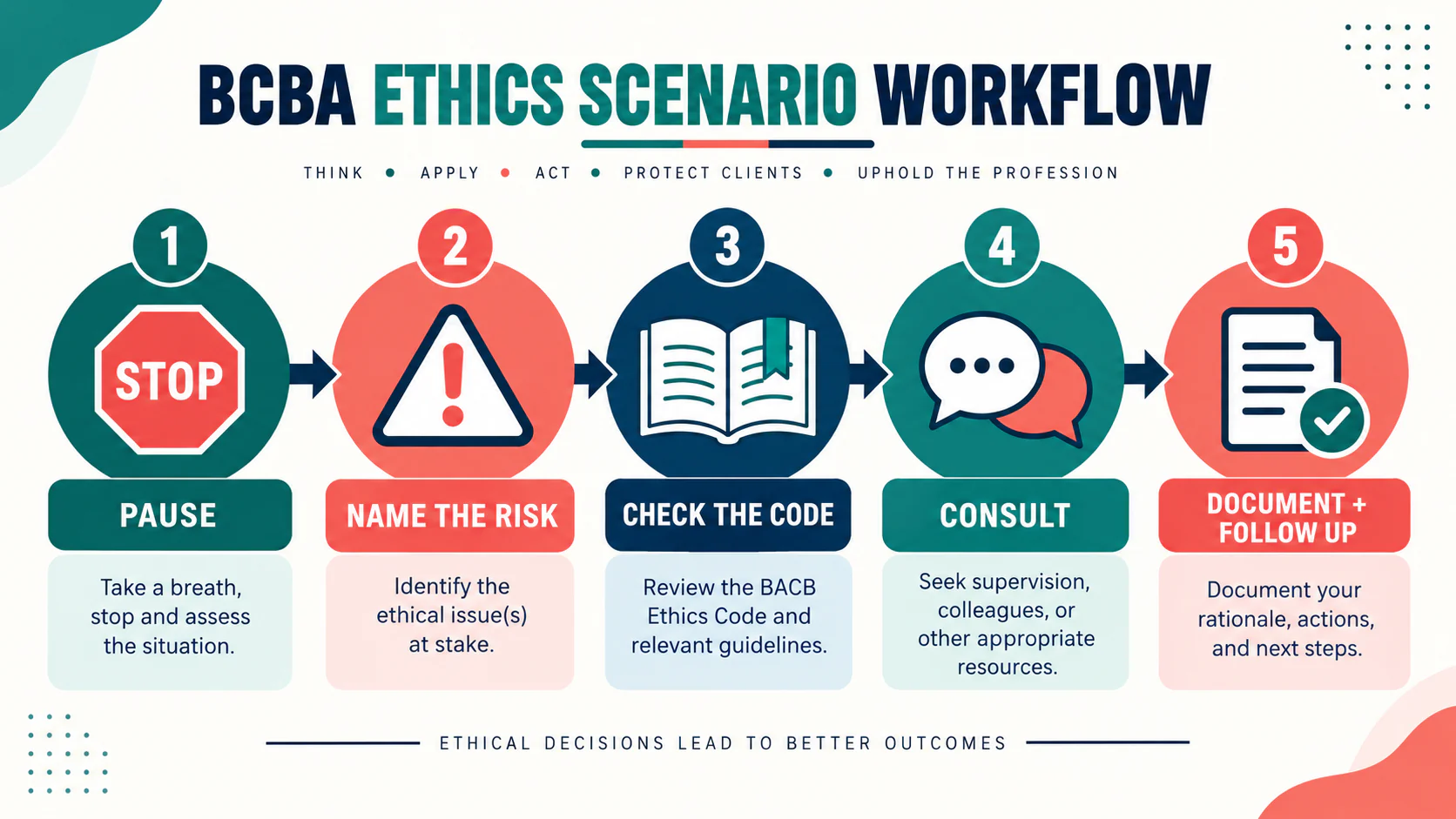
Use the same sequence on practice questions and real professional learning cases:
- Pause: do not implement the questionable action just because it is faster, requested by a powerful stakeholder, or already written in a draft plan.
- Name the risk: state whether the concern involves welfare, dignity, consent, competence, confidentiality, data integrity, conflict, supervision, or another boundary.
- Check the code and policy: use the current BACB Ethics Code, the applicable organization policy, and relevant law or regulation through the right authority. Do not substitute one for the other.
- Consult: ask a qualified supervisor, ethics contact, clinical leader, or other appropriate professional when the facts exceed your role or expertise.
- Document and follow up: record the facts, the consultation, the decision, the communication, and the next review point while protecting confidentiality.
On an exam, the strongest choice often protects the client and starts an appropriate process. “Do nothing,” “keep it secret,” and “immediately punish the colleague” are common distractors because they skip either client protection or responsible fact-finding.
Compare the Controlling Questions
When two answer choices both sound ethical, compare the question each one answers. The table below is a study aid, not a replacement for the current code.
| Scenario clue | First question | Likely next move |
|---|---|---|
| Immediate risk or loss of dignity | How can the client be protected now? | Pause or modify the action, then notify the responsible professional. |
| Unclear skill or role | Does the person have competence and supervision for this task? | Seek supervision, training, or a qualified referral before proceeding. |
| Missing permission or disagreement | What consent, assent, communication, or choice information is missing? | Clarify, obtain or revisit the appropriate authorization, and respect communication. |
| Suspicious record or data | What was actually observed and what must be corrected? | Preserve accuracy, correct transparently, and follow the proper reporting route. |
| Possible conflict | Could the relationship or incentive distort professional judgment? | Disclose, consult, manage, or remove the conflict as appropriate. |
Avoid Common Behavior Analysis Ethics Exam Traps
- Choosing speed over welfare: a supervisor’s deadline does not make an unsupported or harmful procedure acceptable.
- Confusing compliance with consent: quiet behavior is not automatically informed agreement or assent.
- Using a policy as the whole answer: an organization policy may set a process, but client welfare and the current professional code still matter.
- Assuming intent from an error: respond to the record, risk, and corrective process before labeling a person.
- Ignoring competence: wanting to help does not authorize work outside training, scope, or available supervision.
- Making confidentiality public: share information only through an appropriate channel and with the minimum necessary detail.
For each missed question, write the distractor you chose and the fact you ignored. Many ethics errors are not failures to care; they are failures to identify the controlling variable. The review log should say, for example, “I noticed the billing pressure but missed the inaccurate record,” or “I noticed the parent request but missed the learner’s communication of distress.”
Practice and Document the Reasoning
A useful study response is not just the answer letter. Explain why the selected action protects the client, respects the professional boundary, and creates a defensible next step. Then explain why the tempting alternatives are incomplete, premature, or unsafe.
- Underline the fact that creates the ethical concern.
- Name the responsibility involved: welfare, competence, consent, data, privacy, conflict, or supervision.
- Choose the least premature action that protects the client and starts appropriate consultation.
- Identify what you would document and who must be informed.
- Return to the current official BACB ethics resource if the question depends on exact wording.
After this review loop, try the Free BCBA Mock Exam as a diagnostic practice step. Use missed ethics questions to improve your scenario reasoning, not to claim that a practice score predicts certification. In a real case, consult the appropriate supervisor, ethics resource, organization, regulator, or attorney rather than relying on a study article.
What is the first step in a behavior analysis ethics scenario?: Pause and identify who may be affected, what is known, and what risk is present. Protect immediate welfare before trying to resolve every secondary issue. Should I report every uncomfortable interaction?: Not every uncomfortable interaction proves a code violation. Protect the client, preserve facts, consult the appropriate channel, and follow the current code, policy, and applicable reporting process.
How do I study ethics for the BCBA exam?: Practice applying the current Ethics Code to scenarios. For each question, name the client-centered risk, competence or consent issue, data or privacy boundary, consultation step, and documentation requirement. For targeted review, use our behavior analysis ethics practice questions to apply the concept in exam-style scenarios.
Quick Review Checklist
Use this final checklist to turn behavior analysis ethics into exam-ready reasoning. The goal is not to memorize a label in isolation; it is to identify the relevant evidence and explain why the best answer fits the scenario. Key ideas to review:
- State the central definition or decision point for behavior analysis ethics in your own words.
- Identify the detail that makes behavior analysis ethics different from its closest related ABA term.
- Separate the observable facts in a scenario from assumptions that are not supported by the facts.
- Write one example and one nonexample so you can recognize the concept in a new setting.
Exam application checks:
- Ask what the question is actually requesting before comparing the answer choices.
- Mark the antecedent, response, consequence, or other evidence that supports the selected answer.
- Look for a distractor that describes a related process but does not answer the specific question.
Final self-check:
- Explain how you would verify the interpretation with clear observations or data.
- Change one detail in the scenario and decide whether your answer should change.
- Give a one-sentence rationale that a supervisor or study partner could evaluate.
Take the Free BCBA Mock Exam
When you are ready to apply the idea, use the free practice resource below for additional feedback. Take the Free BCBA Mock Exam



