

Short answer: Becoming BCBA certified means meeting the current eligibility requirements set by the Behavior Analyst Certification Board (BACB), submitting a complete application, passing the BCBA examination, and keeping the certification active. A graduate degree, a study course, or a fieldwork placement by itself does not equal BCBA certification.
Table of Contents
- What does becoming BCBA certified mean?
- What are the core steps to become BCBA certified?
- What should you verify at each certification step?
- How should you choose and document your pathway?
- What should candidates know about supervised fieldwork?
- How does the 2027 transition affect your timeline?
- What does the application and examination sequence look like?
- What should you do after passing the BCBA exam?
- What mistakes can delay certification?
- How should you study while building your plan?
- Becoming BCBA certified FAQ
- Take the Free BCBA Mock Exam
The most useful way to plan is to treat certification as a chain of checkpoints: choose an eligible pathway, confirm the education and behavior-analytic coursework, document supervised fieldwork, prepare the application, pass the exam, and understand maintenance requirements. Because BACB requirements and transition dates can change, candidates should verify every checkpoint against the current BACB BCBA resource hub and handbook before making an irreversible decision. Table of Contents
What does becoming BCBA certified mean?
The BCBA is a graduate-level professional certification administered by the BACB. The BACB describes BCBAs as independent practitioners who provide behavior-analytic services and may supervise the work of others within the applicable requirements. “Independent” does not mean that a BCBA can ignore ethics, state law, employer policy, payer rules, or the current BACB requirements.
It is also important to separate certification from licensure. The BACB awards a professional certification; a state may separately regulate the practice of behavior analysis through a license, registration, exemption, or other rule. A person planning a career should check both the BACB requirements and the rules in the state where services will be provided. The official BCBA page is the right starting point for the certification side of that distinction.
Certification is therefore an evidence-and-verification process, not a single purchase. You need an eligible education route, the right coursework, supervised experience documented in the correct way, an application that the BACB can review, and a passing examination result. If one link in the chain is missing, a polished resume or an expensive prep course cannot repair it.
What are the core steps to become BCBA certified?
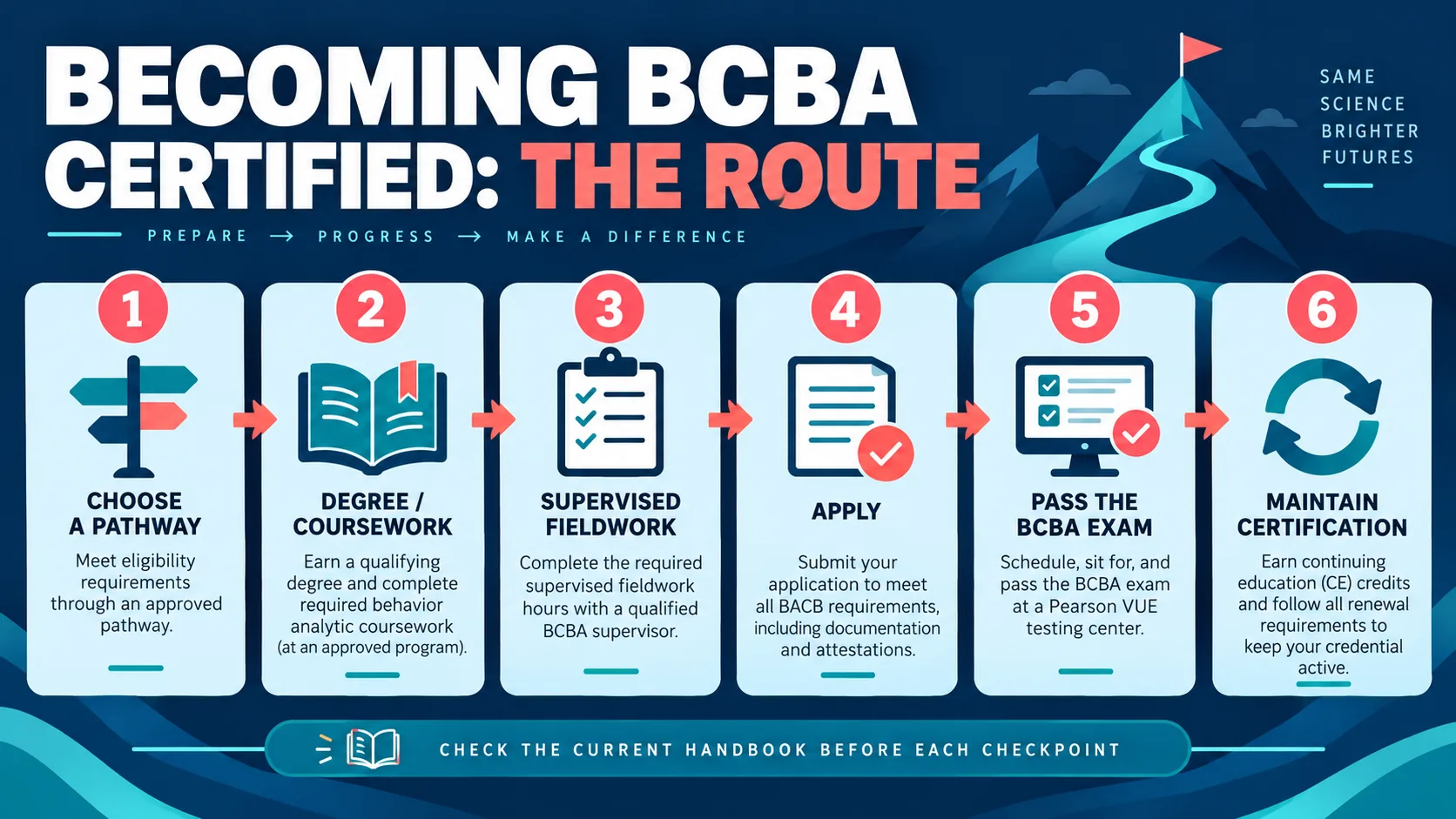
The sequence below is a planning map. It is not a substitute for the current handbook, and it does not promise that a particular university, supervisor, or state will satisfy every requirement. Use it to identify what needs verification before you spend time or money.
- Choose an eligible pathway. Start with the current BACB eligibility routes, then determine which route you can complete with reliable documentation. Do not choose a program only because its marketing uses the words “ABA” or “BCBA.”
- Confirm the degree and coursework. Check the degree level, institution or program status, required behavior-analytic content, and the documents you will eventually need to submit. Save the exact course list and syllabus information while it is easy to obtain.
- Arrange supervised fieldwork. Work with a qualified supervisor and document the experience as it occurs. Waiting until the end to reconstruct dates, supervision contacts, or signatures creates avoidable risk.
- Audit the application file. Confirm that the application, payment, transcripts, forms, attestations, and any other required documents are complete and use the current versions.
- Prepare for and pass the BCBA examination. Once the application is approved and you are eligible, follow the official testing process and use the current BCBA examination content outline to organize study.
- Maintain the certification. After passing, continue to follow ethics, renewal, continuing-education, and other maintenance requirements. Passing the exam is a milestone, not the end of the professional obligation.
What should you verify at each certification step?
A simple verification table can prevent a common planning error: treating an intention as evidence. Write down the source of each answer, the document that proves it, and the date on which you checked it.
| Checkpoint | Evidence to keep | Question to ask | Common risk |
|---|---|---|---|
| Pathway | Current BACB pathway description and your eligibility notes | Does this route still apply on my intended application date? | Using an older pathway page or assuming a transition does not affect you |
| Education | Degree record, transcript, course list, and program documentation | Which requirement does each course or program document satisfy? | Confusing a related degree title with qualifying coursework |
| Fieldwork | Supervision records, forms, dates, signatures, and supervisor details | Can the record be audited without relying on memory? | Backfilling hours or discovering missing attestations late |
| Application | Current forms, payment confirmation, transcript delivery, and correspondence | Has the BACB received every required item in the required format? | Calling a partially submitted file “complete” |
| Examination | Current BCBA Examination Content Outline and a study log | Can I explain and apply each tested domain, not just recognize terms? | Studying from an outdated blueprint or memorizing isolated definitions |
This table is intentionally practical: it tells you what to save, not just what to hope is true. If the official source and a school, supervisor, or forum give different answers, pause and resolve the difference before committing to a pathway. The BACB’s application-processing updates page also explains what the board needs in order to review an application and why current documents matter.
How should you choose and document your pathway?
Begin with the application date you are targeting, not only the date you plan to graduate. Eligibility rules can change during a multi-year degree or fieldwork plan. Open the current BCBA Handbook, identify the route that appears to fit, and write a short “why this route” note that names the degree, coursework source, fieldwork arrangement, and expected application window.
Then ask your school or program for evidence rather than a verbal assurance. Useful records can include the official program name, course titles, syllabi, transcript language, program approval or accreditation information where relevant, and the process for sending official documents. Keep copies in a dated folder. A course that sounds behavioral may not satisfy the exact content requirement, and a program that was acceptable under an older rule may need a different review under a new rule.
Do not assume that the route used by a classmate will be your route. Their degree date, application date, coursework, supervision record, and transition position may be different. A good plan is individualized enough that another person can audit the logic without guessing.
What should candidates know about supervised fieldwork?
Supervised fieldwork is more than accumulating a number in a spreadsheet. It is a documented professional experience connected to the current BACB requirements, a qualified supervisor, the applicable supervision contacts, and the required forms or attestations. The current handbook should control the exact hour, supervision, monthly, and documentation rules for your situation.
- Confirm the supervisor’s qualifications and role before beginning the arrangement.
- Use a consistent log that records dates, activities, supervision, and any required signatures.
- Review the record at regular intervals instead of waiting until the application is nearly due.
- Keep copies of completed forms and correspondence in a secure location.
- Resolve a gap or correction promptly and document what changed.
Good documentation also protects your study time. When you know which requirement each record supports, you can spend exam preparation hours on the content outline instead of searching through old emails for proof that a fieldwork detail was approved.
How does the 2027 transition affect your timeline?
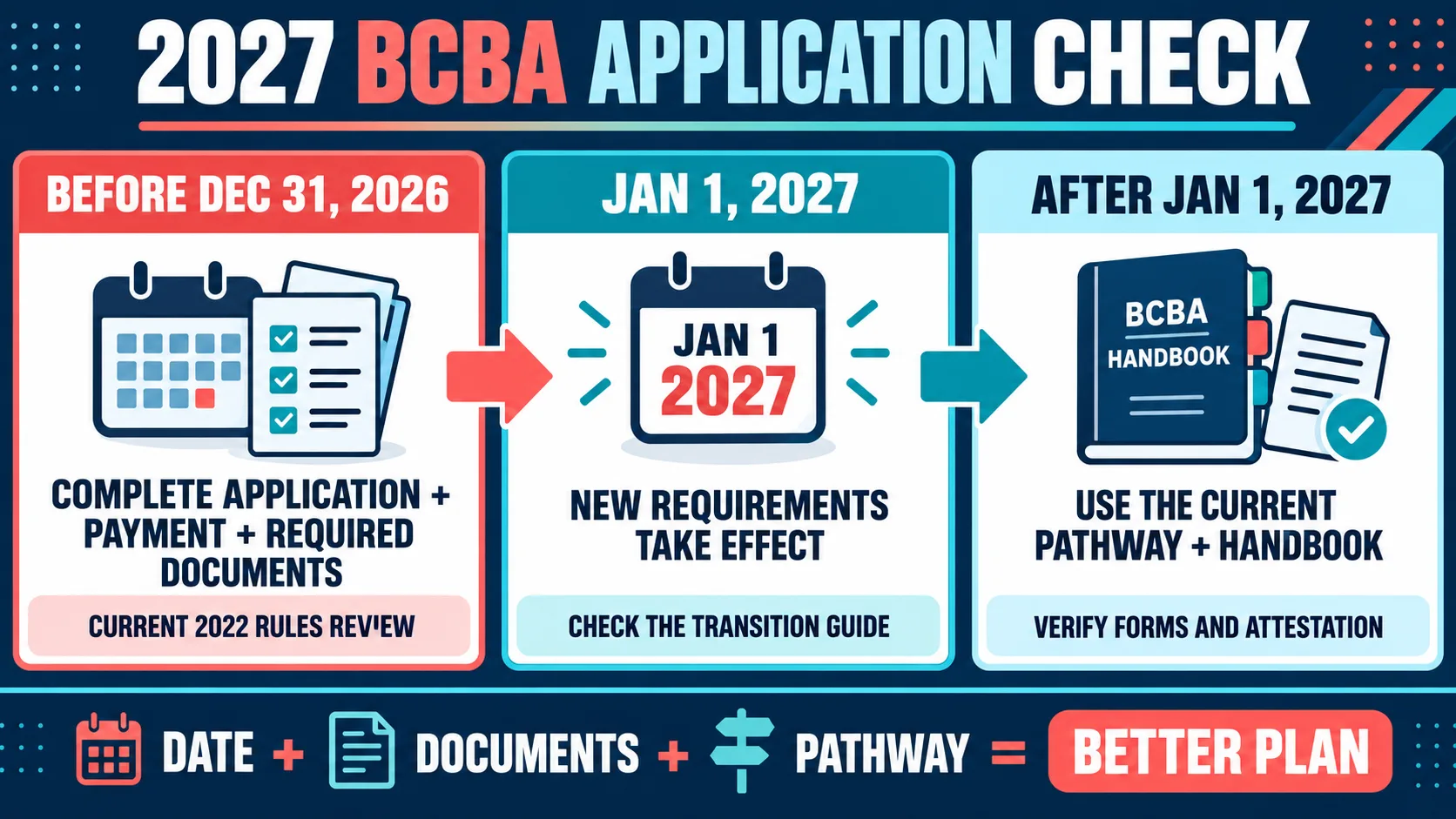
The BACB has announced significant BCBA and BCaBA requirement changes taking effect on January 1, 2027. Its transition announcement says that an application must be complete—including payment and required documents—and received by December 31, 2026 to be reviewed under the current 2022 requirements. That is a receipt-and-completeness checkpoint, not a promise that an incomplete file will be protected by starting it before the deadline.
If your plan crosses the date, compare your situation with the official 2027 transition guides and the BACB upcoming-changes index. Do not build a timeline from a social-media summary. Check which education, fieldwork, application, and attestation rules apply to your intended submission date and whether a transition provision actually covers your circumstances.
A practical decision rule is simple: if you cannot assemble a complete, reviewable file by the stated cutoff, plan around the requirements that will apply after the transition rather than rushing an unreliable application. If you may qualify before the cutoff, create a document checklist now and confirm receipt through the official process. When in doubt about your personal eligibility, use the BACB’s formal channels; the board explains that it cannot pre-decide every individual eligibility question outside its application review.
What does the application and examination sequence look like?
Think of the application and exam as two linked but separate gates. First, the BACB reviews the application and supporting documents. The application-processing information emphasizes payment and the receipt of required official documents, such as transcripts, as part of the review process. A study plan cannot substitute for a missing transcript or an outdated form.
After your application is approved and you are eligible, follow the official examination instructions. The BACB’s examination information explains the relationship between eligibility, authorization, and testing through Pearson VUE. Use that page for current registration and scheduling instructions, and use the BCBA Examination Content Outline to organize study.
Build a final pre-exam checklist that includes eligibility confirmation, authorization or scheduling instructions, identification requirements, test-center logistics, and a realistic review calendar. The exact instructions can change, so verify them close to the appointment rather than relying on a screenshot saved months earlier.
What should you do after passing the BCBA exam?
Passing the examination is a major milestone, but certification maintenance becomes the next operating system for your professional life. Read the current BCBA Handbook and renewal guidance for continuing education, ethics, reporting, deadlines, and any maintenance declarations. Put those dates on a calendar before the first renewal window arrives.
- Save the official certification confirmation and keep your contact information current.
- Track continuing-education activities with provider, date, topic, and documentation.
- Review ethical and practice obligations when your role, employer, or state changes.
- Check the current BACB maintenance rules before signing an attestation.
Also revisit state licensure. A BCBA credential may be necessary for a role but not sufficient to practice in every jurisdiction. Coordinate the national certification record with the state process, employer requirements, and payer rules that apply to your work.
What mistakes can delay certification?
- Starting with a course advertisement: begin with the current BACB requirements and then test the program against them.
- Confusing a degree with eligibility: verify the degree, coursework, pathway, and application-date rules together.
- Reconstructing fieldwork at the end: maintain records and signatures while the experience is happening.
- Using old forms: download the current documents close to submission and compare every version.
- Ignoring the 2027 cutoff: know whether your complete application can actually be received by the transition date.
- Studying without the TCO: organize practice around the current content outline rather than a random list of terms.
- Assuming certification equals licensure: check the state rules where you will practice.
How should you study while building your plan?
Study in parallel with documentation, but keep the jobs separate. Your eligibility folder answers “Am I allowed to apply?” The content outline and practice work answer “Can I perform on the examination?” Mixing them can create false confidence: a high quiz score does not prove that your application file is complete, and a complete file does not prove mastery of the tested domains.
Start with the current TCO, turn each domain into a short explanation-and-application target, and maintain an error log. For every missed item, record the concept, why your choice was attractive, what evidence supports the correct answer, and how you will recognize the distinction in a new scenario. The free BCBA mock exam can be used as independent practice after you have mapped your study plan. It is a study resource, not a claim that its questions reproduce official BACB items.
Bottom line: Becoming BCBA certified is a sequence of verified decisions. Choose the right route, document education and fieldwork as you go, submit a complete and current application, study from the current outline, and plan maintenance before you pass. If your timeline crosses January 1, 2027, let the official transition guidance—not a remembered rule or a forum comment—determine your next checkpoint.
Becoming BCBA certified FAQ
Can I become BCBA certified with a graduate degree alone? No. A degree is one part of an eligibility pathway. You also need the applicable coursework, supervised fieldwork, application review, and examination steps under the current BACB requirements. Is a BCBA certificate the same as a state license? No. The BACB certification and state authorization to practice are separate systems. Check the state rules for the location where you will provide services.
How do I know whether my coursework counts? Compare the course and program documentation with the current BACB pathway and handbook requirements. Keep official records and ask the program for written documentation rather than relying only on a course title.
Can I apply under the current rules before 2027? The BACB’s transition announcement says a complete application, including payment and required documents, must be received by December 31, 2026 to be reviewed under the current 2022 requirements. Confirm the transition guidance for your individual situation.
When should I start studying for the BCBA exam? Start by reading the current BCBA Examination Content Outline and building an error log. A consistent plan that combines retrieval, application scenarios, and review is more useful than waiting until the application process is nearly finished.
What is the safest source for a current requirement? Use the official BACB BCBA page, current handbook, examination information, application-processing updates, and transition resources. If a third-party guide conflicts with those sources, pause and verify before acting.
Sources and further reading: Review the BACB BCBA resource hub, the current BCBA Handbook, the application-processing updates, the examination information, and the 2027 BCBA and BCaBA requirements announcement. Official sources control if a summary or third-party article differs.
Take the Free BCBA Mock Exam
When you are ready to apply the idea, use the free practice resource below for additional feedback. Take the Free BCBA Mock Exam



