

BCBS ABA reimbursement rates are not one national number. The amount can change with the state plan, network, product line, CPT code, modifier, provider credential, place of service, contract, and effective date. That is why a provider, clinic operator, or family member can hear two different “BCBS rates” and both numbers can be accurate. A Blue Cross and Blue Shield plan in one state may publish a clinical policy but keep contracted fees in the provider agreement. Another plan may use a modifier-based payment methodology for one code and exclude government programs or delegated HMO business. This guide shows how to research the right plan without turning a local policy into a universal promise. It is educational information, not a contract, billing guarantee, legal opinion, or member-benefit determination. Table of Contents
Table of Contents
- What Are BCBS ABA Reimbursement Rates?
- Is There One National BCBS ABA Rate?
- How Do You Identify the Right BCBS Plan?
- Why Do Codes and Modifiers Matter?
- What Can a Public BCBS Policy Tell You?
- Where Does the Contract Rate Come From?
- How Should You Use a Rate Benchmark?
- What Belongs on a BCBS Rate Audit?
- What Is a Safe BCBS Rate-Research Workflow?
- How Does This Connect to BCBA Work?
- BCBS ABA Reimbursement Rates FAQ
- Take the Free BCBA Mock Exam
What Are BCBS ABA Reimbursement Rates?
BCBS ABA reimbursement rates are the amounts or payment rules used by a particular Blue Cross and Blue Shield plan for covered applied behavior analysis services. “BCBS” is a family of independent, state-based plans and products, not one fee schedule that applies to every member or provider. A rate may be a contracted fee, a plan allowance, a maximum, a percentage methodology, or an amount adjusted by a code modifier. Before searching for a number, write down the scope:
- Plan: the exact local BCBS company and product line.
- Network: in-network, out-of-network, delegated HMO, or another arrangement.
- Service: the CPT code, descriptor, setting, and whether the service is direct, supervisory, assessment, or caregiver guidance.
- Rendering provider: the credential, modifier, licensure, and provider classification the plan recognizes.
- Effective period: the dates of service and the version of the policy or contract.
Is There One National BCBS ABA Rate?
No. A public BCBS policy may explain coverage, medical necessity, authorization, coding, or documentation while leaving the actual contracted fee to the provider agreement. Even within a single company, employer group, network status, plan product, state mandate, and delegated arrangement can change the payment context.
Do not use a state Medicaid table as a BCBS commercial rate. Do not use a TRICARE maximum allowed amount as a BCBS contract benchmark. Do not assume that a rate reported by one provider applies to every provider in the same city. A useful article can explain how to find and verify the rate; it should not invent a national BCBS number just to make the headline simpler.
How Do You Identify the Right BCBS Plan?
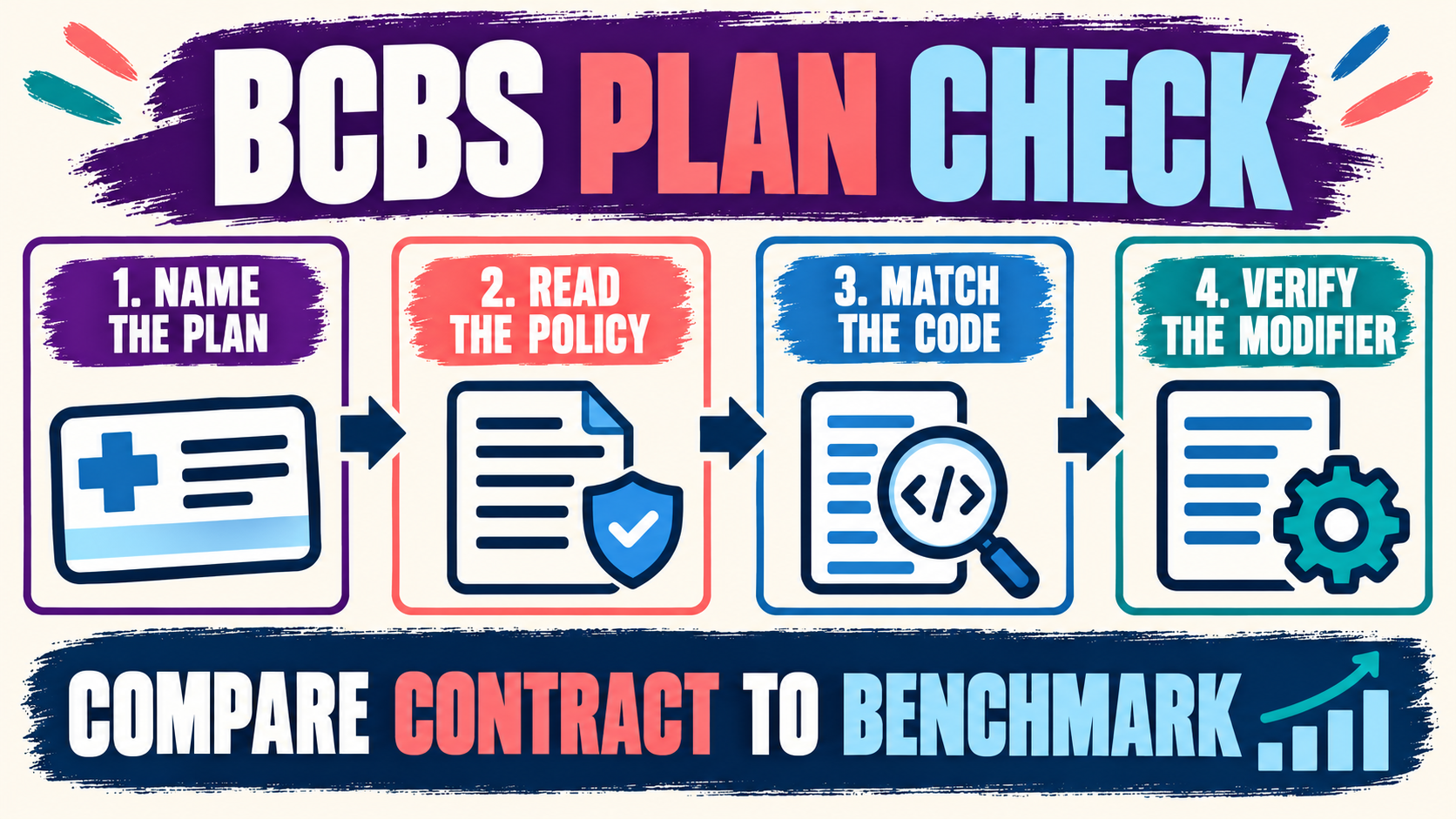
Start with the member’s plan card, provider portal, contract, or plan-specific policy page. The company name alone is often not enough. Look for the state, network, product family, group or employer context, and the channel responsible for authorization and claims.
| Question | What to record | Why it matters |
|---|---|---|
| Which company? | Exact BCBS affiliate, state, and policy owner | Independent plans can publish different policies and schedules. |
| Which product? | Commercial, employer group, individual, Medicare Advantage, Medicaid, FEP, or another product | A policy may explicitly exclude another line of business. |
| Which network? | In-network, out-of-network, delegated HMO, or network partner | The contracted fee and member responsibility can change. |
| Which source? | Policy, provider manual, fee schedule, contract, portal response, or remittance | A coverage rule is not automatically a reimbursement amount. |
If you are researching for a public article, do not publish private contract data. Describe the verification process and link to public plan policy pages where possible. If you are researching for a claim or budget, use the confidential source that actually controls the payment.
Why Do Codes and Modifiers Matter?
ABA services are not one billable event. Assessment, direct treatment, protocol modification, family guidance, and other services can have different codes and requirements. A provider’s credential may also affect the allowed methodology or require a modifier. The code and modifier must match the service actually delivered and the plan’s current coding policy.
For example, a BCBS Illinois provider education page describes a tiered payment methodology for CPT 97153 using modifiers HN, HM, and HO for certain commercial non-HMO members. It explains that the methodology is tied to the rendering provider’s education, credential, or licensure and says the information does not apply to government programs, Illinois Medicaid, or delegated HMO members. Treat that page as a plan-specific example of why modifiers matter—not as a national BCBS rule and not as a current rate for every plan. When you see a rate table, ask:
- Does the line include the full CPT descriptor and unit?
- Does it identify the rendering provider and modifier?
- Does it state whether the rate is a fee, maximum, benchmark, or contract amount?
- Does it say which product lines and networks are included or excluded?
- Does the effective date cover the dates of service you are analyzing?
What Can a Public BCBS Policy Tell You?
A public clinical or coding policy can help you understand coverage conditions, medical-necessity language, authorization expectations, eligible provider types, place-of-service requirements, documentation, and code usage. Those details are useful because a claim can fail even when a headline “rate” looks attractive.
A policy usually cannot tell you the exact contracted amount for every provider. That amount may be in a provider agreement, a plan portal, a confidential fee schedule, or a payer response. Keep the distinction visible:
- Coverage: whether the benefit or service is included under the plan.
- Authorization: what approval, units, period, or clinical documentation is required.
- Allowed amount: the payer’s recognized amount under the applicable arrangement.
- Provider payment: the amount the provider agreement or claim adjudication produces.
- Member cost: deductible, copayment, coinsurance, or out-of-pocket responsibility.
Where Does the Contract Rate Come From?
For an in-network provider, the contract and current payer systems usually matter more than a generic online benchmark. A practice may request a fee schedule or rate review through its provider representative, contracting channel, or portal. The response should be matched to the exact provider entity, network, product, code, unit, modifier, and effective period.
For an out-of-network claim, the plan’s benefit document and the member’s specific benefit design may control a different allowed amount and cost-sharing calculation. For a delegated or managed arrangement, another organization may administer claims. If the answer depends on a contract you cannot see, say so. “BCBS pays $X” is not a safe summary when the real answer is “this provider, plan, network, code, and period use this amount.”
How Should You Use a Rate Benchmark?
A benchmark is useful for asking better questions, not for predicting a guaranteed payment. Public transparency data, published policies, state mandates, or a provider’s anonymized comparison may show that rates vary by code, credential, plan, or market. They do not prove that a payer will offer the same contract to another practice. When comparing a benchmark to your own data, align these fields:
| Comparison field | Do not mix | Safer question |
|---|---|---|
| Plan and state | Different BCBS affiliates or product lines | Is the benchmark for the same company, product, and network? |
| Code and modifier | 97153 without a modifier versus a tiered 97153 line | Does the benchmark describe the same code, provider, and modifier? |
| Unit and date | 15-minute unit versus hourly conversion or different rate years | Are the unit and dates of service identical? |
| Contract status | Public estimate versus executed provider agreement | Which source actually controls the claim? |
What Belongs on a BCBS Rate Audit?
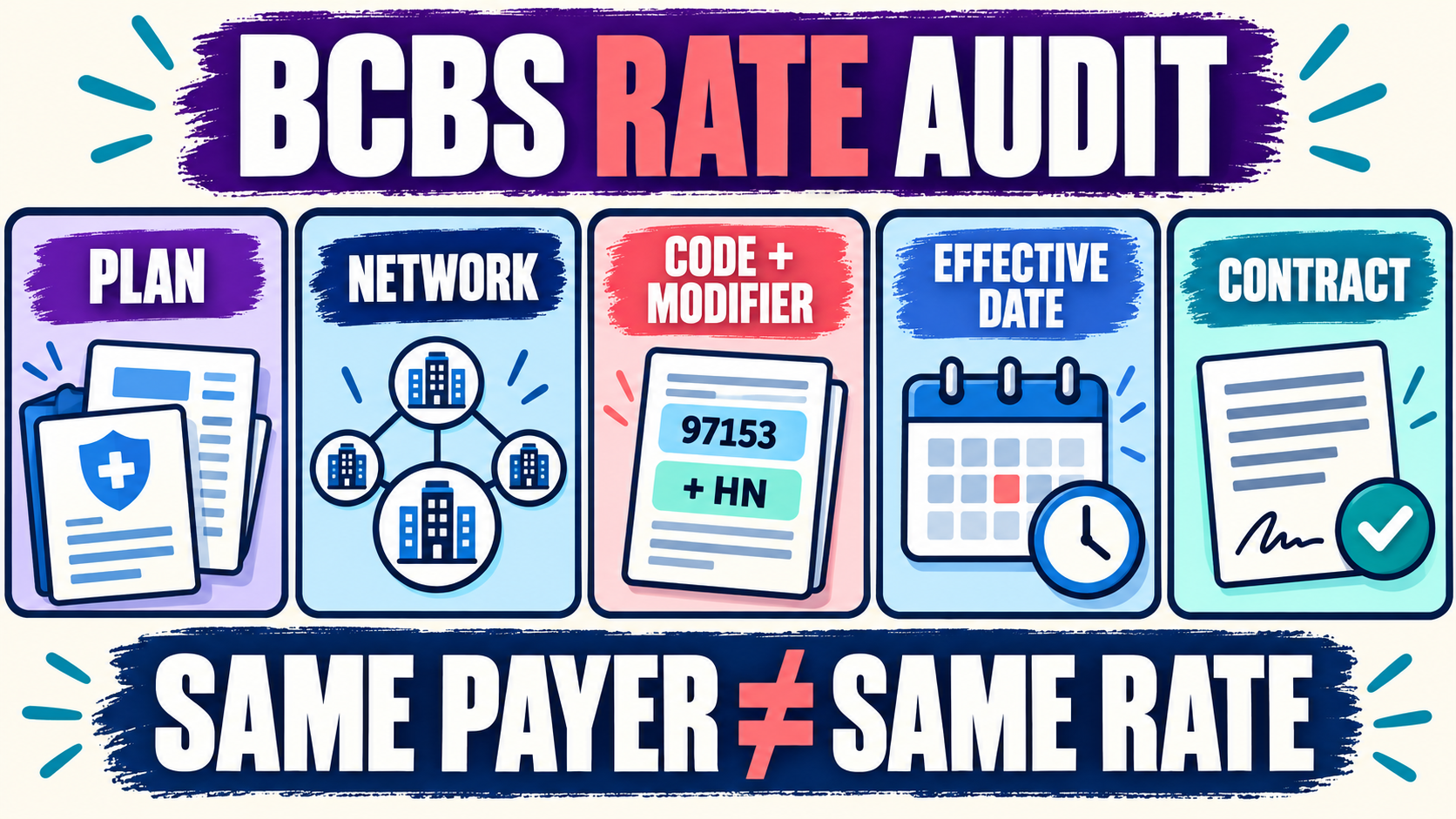
Use the audit image above before using any BCBS ABA rate in a forecast, claim review, article, or negotiation brief. The checklist is deliberately compact so it can expose a missing field quickly.
- Plan: exact BCBS affiliate and product line identified.
- Network: in-network, out-of-network, delegated, or other arrangement recorded.
- Code and modifier: service descriptor, unit, rendering provider, and modifier match.
- Effective date: policy, fee schedule, contract, and dates of service align.
- Contract: the source is labeled as a public benchmark, payer policy, or controlling provider agreement.
If one box is blank, mark the rate as unverified. A transparent “not publicly available—confirm through the provider portal or contract” is more useful than a confident number with no source.
What Is a Safe BCBS Rate-Research Workflow?
- Define the reader’s question: provider payment, member cost, coverage, authorization, or a benchmark?
- Capture plan identity: state, BCBS company, product, network, and claims administrator.
- Locate public rules: open the current ABA clinical, coding, provider, and authorization policies.
- Map the billing line: confirm CPT code, descriptor, unit, place of service, modifier, and provider type.
- Request the controlling amount: use the contract, portal, provider representative, or remittance data when public sources stop.
- Record the date and source: preserve the document title, URL, page, effective period, and access date.
- Escalate uncertainty: ask the payer, billing specialist, compliance lead, or licensed professional rather than filling the gap with another state’s number.
Keep member-facing questions separate from provider-facing questions. A family asking “what will we owe?” needs benefit, deductible, copayment, coinsurance, and out-of-pocket information. A clinic asking “what will we be paid?” needs the provider agreement, allowed amount, code, modifier, authorization, and claim rules. Both should be answered from the correct plan source.
How Does This Connect to BCBA Work?
BCBAs may encounter payer policies while coordinating services, supervising staff, reviewing documentation, or explaining why a plan must be verified. The current BCBA Test Content Outline includes ethical and professional issues, legal and regulatory requirements, collaboration, data-based decisions, intervention implementation, and personnel supervision. A strong exam response distinguishes a payer question from a clinical question and gathers the information that controls the decision.
The BACB ethics information should control ethics-related questions. A reimbursement rate does not justify changing a record, misrepresenting a credential, billing a service that was not delivered, or selecting a goal only because it is easier to reimburse. When payment rules conflict with client needs or the written plan, bring the issue to the appropriate clinical, billing, compliance, and payer contacts.
For scenario practice, BCBS ABA reimbursement rates practice questions can help you rehearse the reasoning pattern: identify the exact plan, locate the controlling source, match the code and modifier, and reject an unsupported national conclusion. A mock score is feedback for study, not a contract interpretation or certification guarantee.
BCBS ABA Reimbursement Rates FAQ
Why can two BCBS plans pay different ABA rates?: BCBS affiliates, states, products, networks, provider contracts, codes, modifiers, and effective dates can differ. The name “BCBS” does not erase those distinctions. Can I use a BCBSIL policy to estimate another BCBS plan’s rate?: Use it as an example of policy structure, not as a universal rate. A plan-specific policy may exclude certain product lines and may describe coding or modifier rules without publishing the contracted fee for every provider.
Where should a provider look for the exact contracted ABA rate?: Start with the executed provider agreement, current fee schedule, payer portal, provider representative, and recent remittance or claim response. Match the result to the exact product, network, code, unit, modifier, provider, and dates of service.
Is a public BCBS ABA policy the same as a reimbursement schedule?: No. A policy may describe coverage, medical necessity, coding, authorization, or documentation. The payment amount may be controlled by a confidential contract or plan-specific schedule.
Bottom line: BCBS ABA reimbursement rates are plan-specific data. Identify the company and product, match the network and code, check modifiers and effective dates, separate benchmarks from contracts, and keep the controlling source attached to every number.
Take the Free BCBA Mock Exam
If you want a low-pressure way to check your recall, use the free practice resource below. Take the Free BCBA Mock Exam



