
What Makes a BCBA Test Question Challenging?
Many candidates find BCBA test questions difficult because they require more than memorizing definitions. You must identify the function of behavior from a brief scenario. The exam rewards systematic thinking and the ability to ignore irrelevant details. Every question typically includes an antecedent, a behavior, and a consequence (ABC). Breaking down each component is essential to choosing the correct answer. The BACB Task List emphasizes analyzing behavior-environment relations, so practice with realistic scenarios is critical.
Table of Contents
- What Makes a BCBA Test Question Challenging?
- 5 BCBA Practice Questions with Detailed Analysis
- Common Traps in BCBA Test Questions and How to Avoid Them
- Quick Checklist for Answering BCBA Test Questions
- Summary: Practice Smart with Realistic BCBA Test Questions
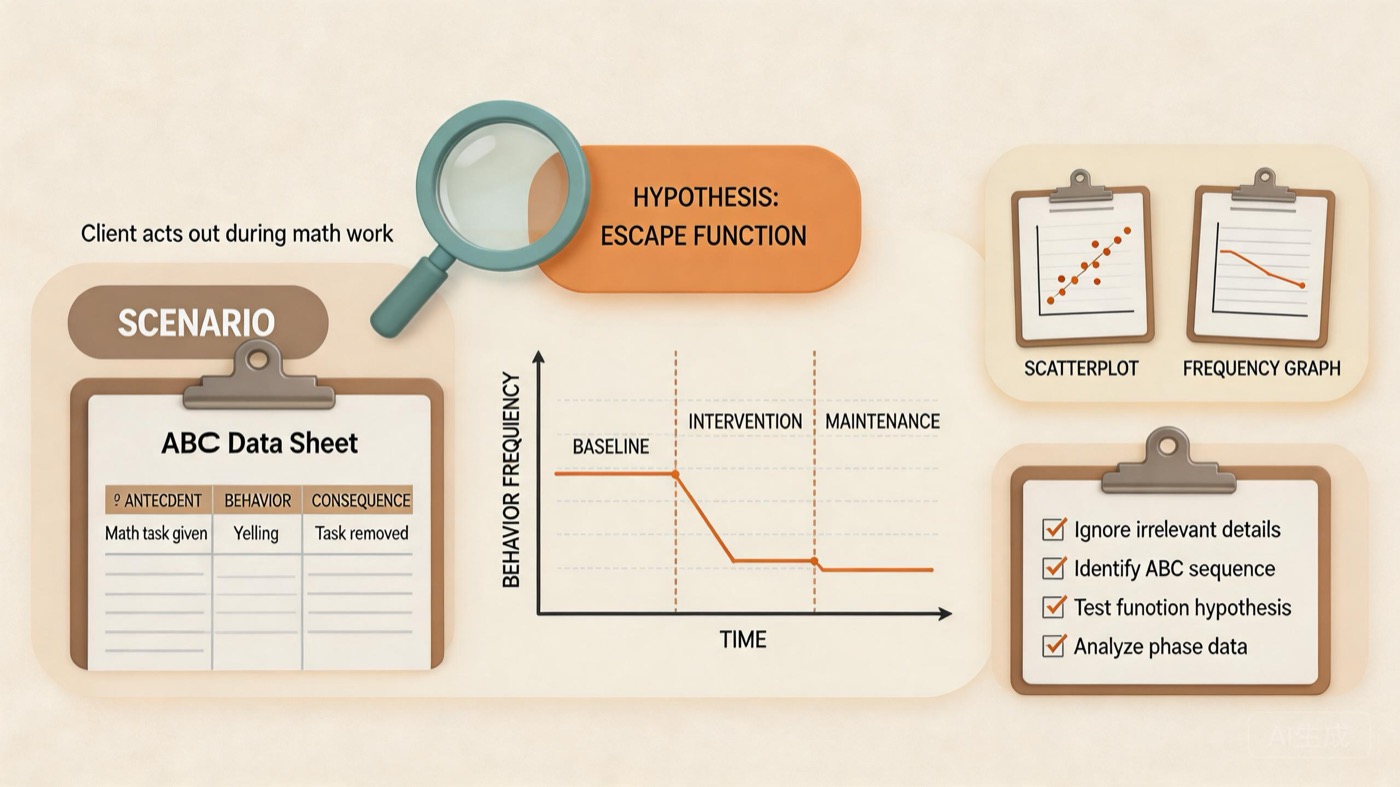
The Role of ABC Analysis in Exam Questions
ABC analysis is the foundation of functional behavior assessment. On the exam, you will read a short vignette and must identify the antecedent that evokes the behavior, the behavior itself, and the consequence that maintains it. The function of behavior is determined by the consequence. For example, if a child screams and is removed from a task, the function is likely escape. If a peer laughs, the function may be attention. Practicing ABC breakdowns trains you to spot these patterns quickly.
For more foundational knowledge, see our guide on the four functions of behavior.
5 BCBA Practice Questions with Detailed Analysis
Question 1: Escape-Maintained Behavior in a Classroom
Scenario: During independent math work, a 7-year-old student throws their pencil and whines. The teacher immediately removes the math worksheet and lets the student take a break. The behavior stops. Identify the function.
- Antecedent: Math worksheet presented (aversive task) Behavior: Throwing pencil and whining Consequence: Worksheet removed, break provided
- Hypothesized function: Escape from demand
- Common trap: Overlooking the establishing operation. The math task was non-preferred, increasing the value of escape. Do not confuse with attention; the teacher removed the task, not added attention.
Question 2: Attention-Maintained Behavior During Group Work
Scenario: In a group home, an adult with developmental disabilities interrupts staff conversations by shouting. Staff turn and say “Please be quiet” and then resume talking. The shouting occurs more frequently when staff are busy. What is the function?
- Antecedent: Staff talking among themselves (attention low) Behavior: Shouting Consequence: Staff turn and speak to the individual (attention delivered)
- Hypothesized function: Attention (positive reinforcement)
- Common trap: Confusing with access to tangibles. The client did not request an item; they interrupted to get social interaction.
Question 3: Automatic Reinforcement in Sensory Play
Scenario: A 4-year-old child with autism sits alone in a corner, flapping their hands in front of their eyes. No one is near, and no demands are placed. What is the likely function?
- Antecedent: Alone, no social stimulation Behavior: Hand flapping Consequence: Visual/kinesthetic sensory input (automatic reinforcement)
- Hypothesized function: Automatic positive reinforcement (sensory stimulation)
- Common trap: Assuming a social function. Since the behavior occurs in isolation, it is maintained by the sensory consequence itself. The BCBA test questions often include “alone” conditions to test this concept.
Learn more about automatic reinforcement in our dedicated guide.
Question 4: Tangible-Maintained Behavior During Transitions
Scenario: A teenager with intellectual disability is asked to give up their tablet for dinner. They scream and grab the tablet tighter. The parent says “Fine, five more minutes” and the teen stops screaming. What function?
- Antecedent: Parent request to relinquish tablet (removal of preferred item) Behavior: Screaming and grabbing Consequence: Continued access to tablet (tangible maintained)
- Hypothesized function: Access to tangible (tablet)
- Common trap: Confusing with escape. Although the teen is asked to do something (transition), the reinforcing consequence is continued access to the item, not escape from the demand. The behavior is maintained by positive reinforcement (access to tangible).
Question 5: Multiply Controlled Behavior in a Clinic
Scenario: In a clinic, a child screams when a therapist arrives (escape from demands) and also screams when the therapist leaves (attention). The screaming occurs in both conditions. What should you consider?
- Condition A: Therapist presents tasks → scream → task removed (escape) Condition B: Therapist leaves → scream → therapist returns (attention)
- Hypothesized function: Multiply controlled (both escape and attention)
- Common trap: Choosing only one function. The BCBA exam requires you to consider that a single behavior can serve multiple functions. Always compare antecedents and consequences across situations.
Common Traps in BCBA Test Questions and How to Avoid Them
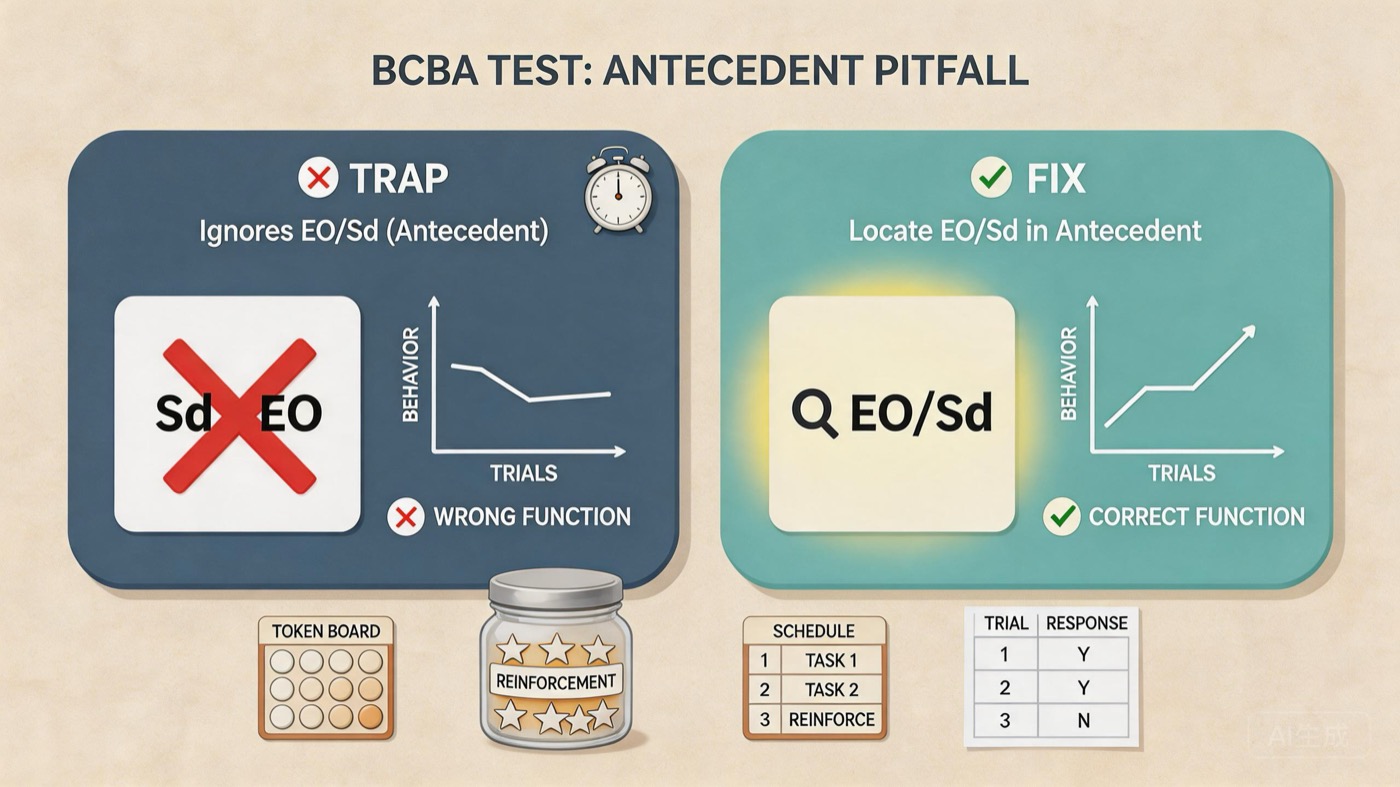
Even experienced practitioners can make errors under exam pressure. Here are frequent pitfalls and strategies to sidestep them.
Overlooking the Antecedent
The antecedent often contains the establishing operation (EO) or discriminative stimulus (Sd). If you ignore it, you may choose the wrong function. For instance, if a task is difficult (EO), escape becomes more reinforcing. Always note what happens right before the behavior.
Confusing Function with Topography
Behaviors that look identical (e.g., screaming) can have different functions. Do not assume that a “tantrum” always means escape. Rely on the consequence, not the form of the behavior. The BCBA test questions frequently use the same topography for different functions to test this distinction.
Failing to Consider Multiple Control
As seen in Question 5, a behavior can be maintained by more than one function. If the scenario presents different antecedents and consequences that both reinforce the behavior, select an answer that acknowledges multiple functions.
Quick Checklist for Answering BCBA Test Questions
Use this checklist during the exam to stay systematic.
- Identify the antecedent: what happened immediately before? Is there an EO or Sd?
- Describe the behavior: be specific (e.g., “screaming,” not “tantrum”).
- Identify the consequence: what changed in the environment? Did something start, stop, or stay? Focus on the maintaining consequence.
- Hypothesize the function: escape, attention, tangible, or automatic.
- Check for multiple control: does the behavior occur under more than one set of antecedents/consequences?
- Eliminate answer choices that describe topography, not function.
For additional practice, see our free BCBA mock exam questions.
Summary: Practice Smart with Realistic BCBA Test Questions
Mastering BCBA test questions requires deliberate practice with real-world scenarios. Always break down each question into ABC components, hypothesize the function, and watch for common traps like confusing topography with function or ignoring the antecedent. Use the checklist above to stay focused. The more you practice analyzing scenarios, the more automatic your analytical skills will become. Pair this guide with systematic study of the BACB Task List and mock exams to maximize your readiness.
External resource: For official BACB guidelines, visit BACB website.
Complete BCBA Exam Prep
Turn this topic into exam-day practice
Practice concepts in context with five full-length 6th Edition mock exams, two bonus practice exams, a 6th Edition study guide, and key-term flashcards—all in one $120 USD package.
Get the $120 All-in-One Prep Pack
Review everything included on the product page before ordering. No pass guarantee is implied.



