
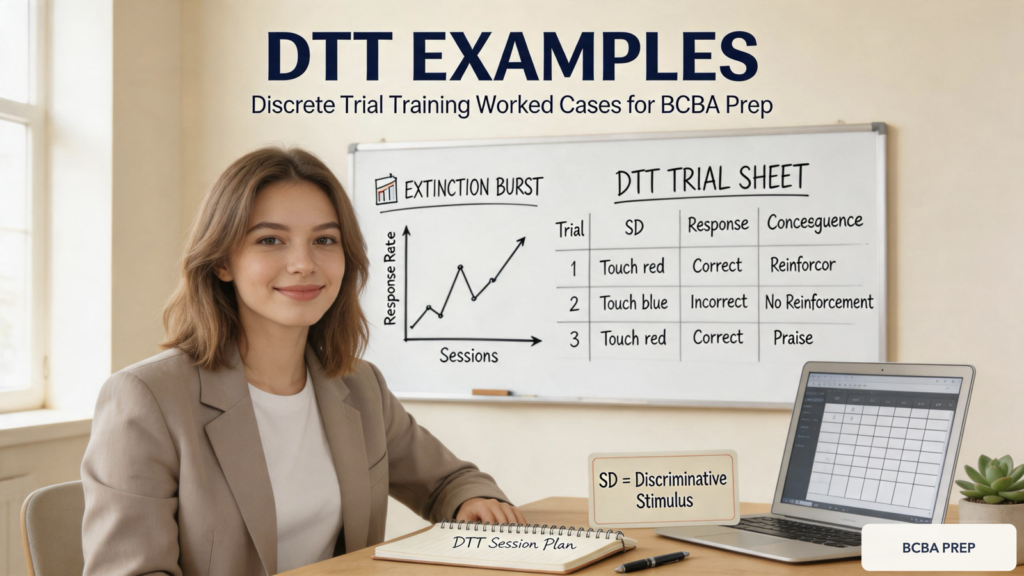
What Is Discrete Trial Training? A Quick Definition for Exam Prep
Discrete Trial Training (DTT) is a structured teaching approach used in Applied Behavior Analysis. Each trial is a clear, isolated unit with a defined beginning and end. Unlike naturalistic teaching, DTT is highly controlled by the instructor, making it ideal for building foundational skills. On the BCBA exam, you may be asked to identify the components of a trial, distinguish DTT from other teaching methods, or analyze data from a DTT session. Understanding the structure deeply will help you answer scenario-based questions confidently.
Table of Contents
- What Is Discrete Trial Training? A Quick Definition for Exam Prep
- DTT Example 1: Teaching a Child to Request a Toy
- DTT Example 2: Teaching a Child to Identify Colors
- DTT Example 3: Teaching a Child to Imitate Motor Actions
- DTT Example 4: Teaching a Child to Match Pictures
- Exam-Ready DTT Checklist
- Summary: How to Use These DTT Examples for Your BCBA Exam
- References
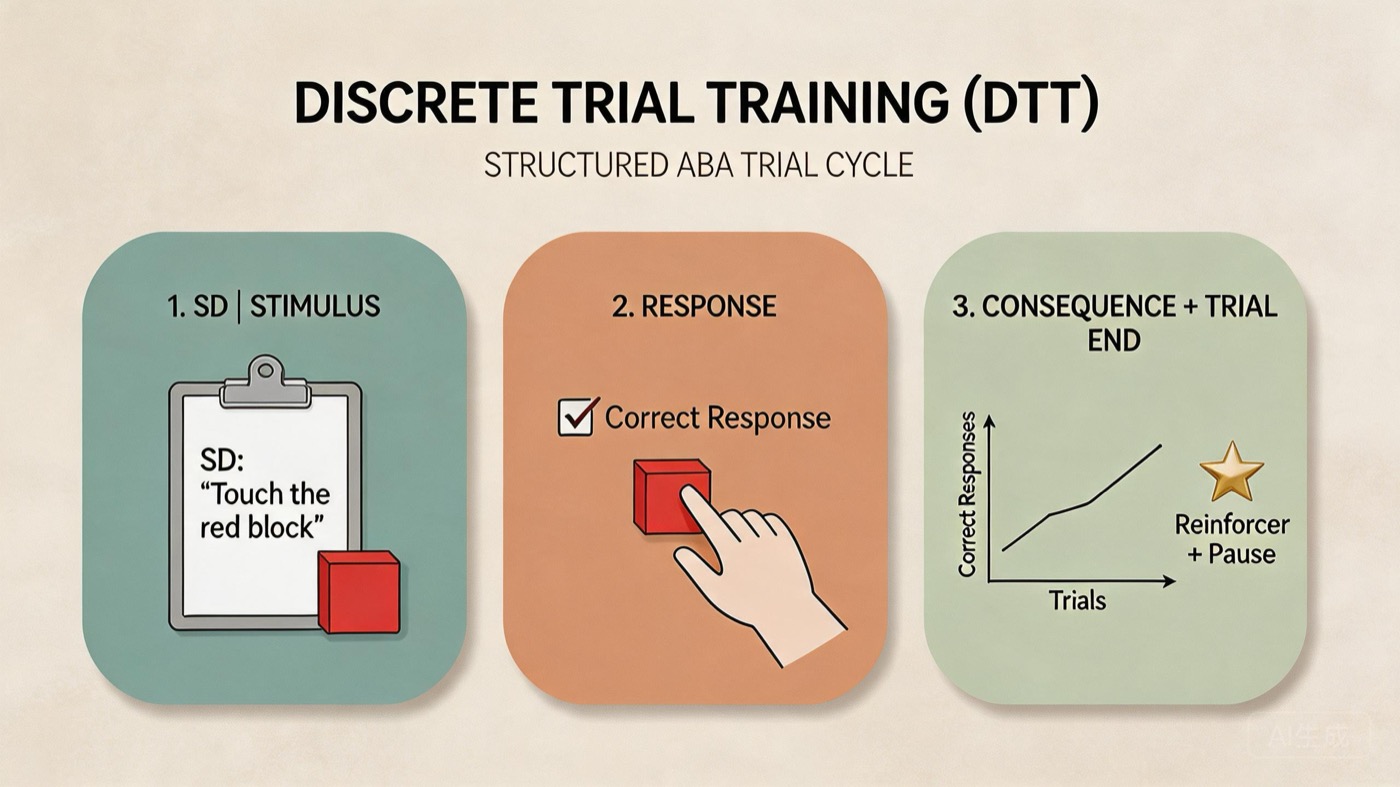
Core Components of a DTT Trial
- SD (discriminative stimulus): the instruction or cue given to the learner.
- Prompt: extra help provided to increase correct responding.
- Response: the learner’s behavior (correct, incorrect, or no response).
- Consequence: reinforcement for correct responses or error correction.
- Inter-trial interval: a brief pause before the next trial.
Each trial is a discrete unit, meaning the SD and consequence are tightly paired. This structure helps learners acquire new skills efficiently. For more background on DTT, see our guide on What Is Discrete Trial Training?
It is important to note that DTT is often contrasted with natural environment teaching (NET). While NET uses naturally occurring opportunities, DTT is contrived and repetitive. Candidates sometimes confuse the two, but the key distinction is that DTT trials are initiated by the instructor and follow a fixed sequence, whereas NET follows the learner’s lead. The exam may present a scenario and ask you to identify which approach is being used. Look for the presence of a clear SD, repeated trials, and a brief inter-trial interval – these are hallmarks of DTT.
DTT Example 1: Teaching a Child to Request a Toy
A common DTT example involves teaching a child to request a preferred toy. The therapist holds the toy out of reach and presents the SD: ‘What do you want?’ The child says ‘toy’ and receives the toy as reinforcement. This example illustrates how DTT can be used for mand training – teaching a child to request desired items. On the exam, you may need to identify the function of the behavior (access to tangibles) or the type of verbal operant (mand).
ABC Breakdown and Hypothesized Function
- Antecedent: therapist holds toy, says ‘What do you want?’
- Behavior: child says ‘toy’.
- Consequence: therapist gives toy.
- Hypothesized function: access to tangibles.
Exam Relevance: Identifying the SD and Prompt Hierarchy
BCBA exam questions often ask you to identify the SD versus a prompt. Here, ‘What do you want?’ is the SD because it signals the availability of reinforcement. If the therapist gestures toward the toy, that gesture is a prompt. A common trap is confusing the SD with the motivating operation (the child’s deprivation of the toy). Motivating operations alter the value of a reinforcer – in this case, the child’s desire for the toy makes the SD effective. But the MO itself is not the SD; it is a motivating variable. The exam may present a scenario where a child is satiated (e.g., just played with the toy) and then the SD is less effective. Recognizing this distinction can help you answer correctly.
DTT Example 2: Teaching a Child to Identify Colors
This example targets receptive identification. The therapist places a red card and a blue card on the table and says ‘Touch red.’ The child touches the red card and receives praise. This is a receptive discrimination task, which is a common target for early intervention. On the exam, you may be asked to identify the sensory modality (visual) or the type of prompting used (e.g., pointing).
Error Correction and Data Collection in DTT
If the child touches blue instead, the therapist uses an error correction procedure: model the correct response (‘This is red’), repeat the trial with a prompt, then transfer the trial without a prompt. Data collection occurs per trial, and mastery is typically set at 80-100% correct over consecutive sessions. It is critical to understand that error correction is not the same as punishment; it is a teaching procedure that includes modeling, prompting, and re-presenting the trial. The exam may ask about the correct sequence of error correction or the rationale behind it. Also, be aware that data collection in DTT often includes separate columns for prompted and unprompted correct responses. If a child needs a prompt to respond correctly, that trial is recorded as a prompted correct, not an independent correct. This distinction matters when calculating mastery criteria.
Common Exam Trap: Assuming DTT Is Only for Expressive Skills
Many candidates mistakenly think DTT is only for expressive language. In reality, DTT is used for receptive, expressive, and imitation skills. The SD and consequence change based on the task. For receptive identification, the SD is ‘Touch ___’ and the correct consequence is delivery of a reinforcer. A common exam trap is to see a receptive task and think it belongs only to naturalistic methods; but DTT is perfectly appropriate for receptive skills, especially when the learner needs many repetitions to discriminate stimuli.
DTT Example 3: Teaching a Child to Imitate Motor Actions
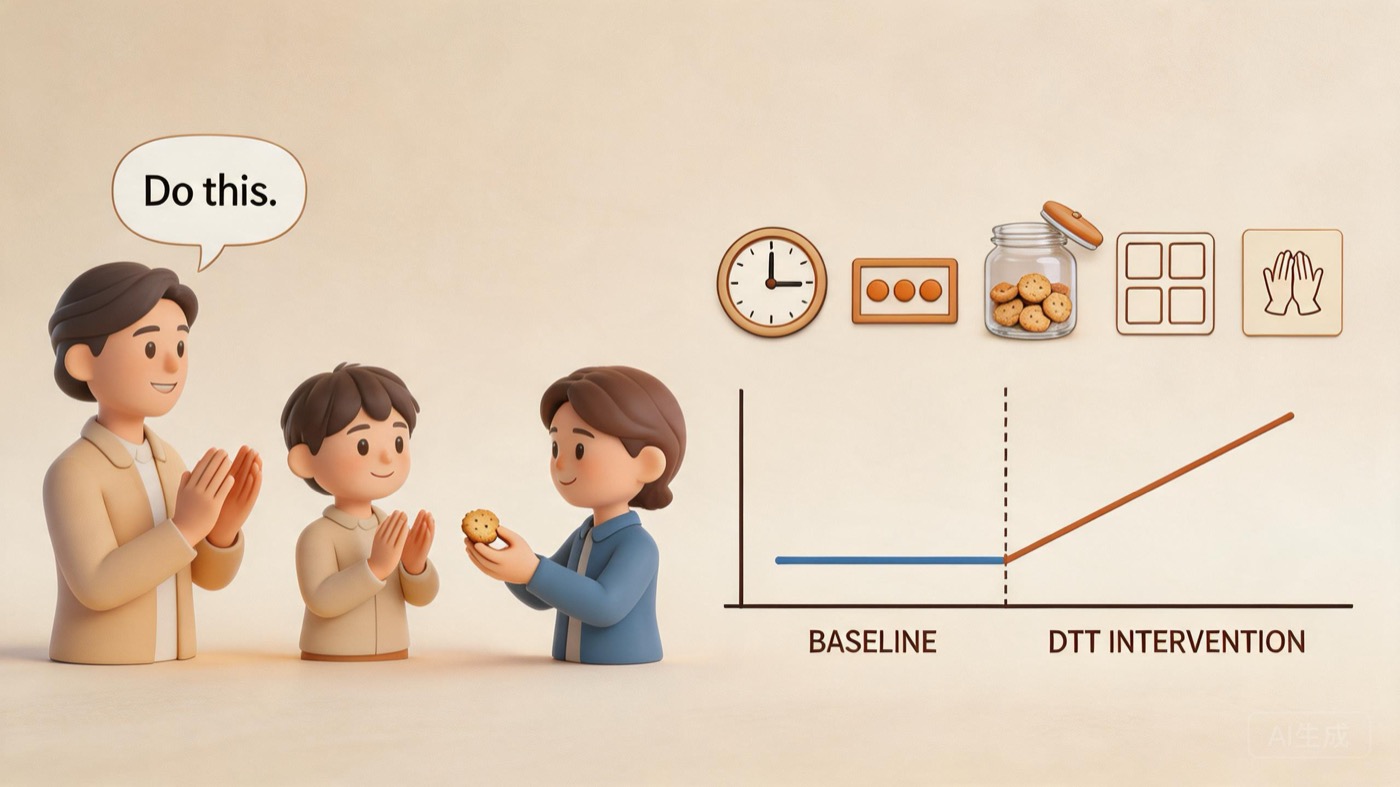
In this example, the therapist models clapping hands and says ‘Do this.’ The child imitates the clap and receives a small edible reinforcer. This demonstrates DTT for imitation skills, a critical prerequisite for observational learning. Imitation is a pivotal skill that can unlock many other learning opportunities. On the exam, you might be asked to identify the appropriate prompt for motor imitation or to distinguish imitation from matching (which involves identical stimuli rather than copying a model).
Reinforcement Schedules in DTT Trials
During acquisition, continuous reinforcement (every correct response is reinforced) is used. As the skill improves, the schedule is thinned to an intermittent schedule to promote maintenance and reduce satiation. Exam questions often ask about the appropriate schedule for acquisition versus maintenance. For example, when first teaching a motor imitation, you would use a fixed ratio (FR1) schedule. Later, you might move to a variable ratio (VR) schedule to build resistance to extinction. Recognizing the difference between thinning for maintenance and thinning for stimulus control can be tricky. Remember: during acquisition, we want high rates of reinforcement to establish the behavior; during maintenance, we want the behavior to persist even when reinforcement is not delivered every time.
DTT Example 4: Teaching a Child to Match Pictures
Matching is another common DTT target. The therapist places a sample picture of a dog on the table and presents two comparison pictures: a dog and a cat. The SD is ‘Match.’ The child places the sample on the matching picture and receives a token. This example shows how DTT can build visual discrimination skills. On the exam, you might be asked to identify the type of matching (identical vs. non-identical) or to analyze a data set to determine if the child has mastered the skill. A common trap is to assume that matching only requires identity matching; but DTT also teaches non-identical and arbitrary matching (e.g., matching a picture of a dog to a real dog). Always check the stimuli presented in the scenario.
Furthermore, consider the use of tokens as conditioned reinforcers. In DTT, tokens can be paired with backup reinforcers to bridge the delay between response and primary reinforcement. The exam may ask about token economies embedded in DTT sessions. For example, after every correct match, the child earns a token; after collecting 5 tokens, they exchange for a preferred toy. This is an effective way to maintain motivation during repetitive DTT blocks.
Exam-Ready DTT Checklist
- Identify the SD: Is it clear and specific? Avoid accidental cues.
- Plan the prompt hierarchy: least-to-most or most-to-least?
- Define the mastery criterion: e.g., 90% correct across 3 sessions.
- Choose reinforcers: use a preference assessment to identify potent items.
- Collect data per trial: track correct, incorrect, and prompted responses.
- Plan for generalization: when to start natural environment training.
- Consider inter-trial interval: keep it brief (1-3 seconds) to maintain momentum but allow the learner to process.
- Document prompt fading: note when you move from most-to-least or least-to-most, and track progress.
Using this checklist can help you systematically evaluate any DTT scenario on the exam. For instance, if a question describes a child who is not responding, check whether the SD is clear, whether the reinforcer is truly preferred, or whether the prompt level is too high (causing prompt dependency) or too low (causing errors).
Summary: How to Use These DTT Examples for Your BCBA Exam
These DTT examples illustrate the core components you need to analyze on the exam. Practice breaking down each trial into SD, response, and consequence. Review the checklist to avoid common traps. For additional study tools, visit our BCBA exam prep guide and try our mock exams. Active recall with worked cases will solidify your understanding. Remember to also consider the ethical use of DTT: ensure that reinforcement is based on a preference assessment, that trials are paced appropriately, and that the learner’s dignity is respected. By mastering these examples, you will be well-prepared for any DTT-related question on the exam.



