

If you are looking for BCBA professional organizations, start by separating three different purposes: building your knowledge base, supporting professional behavior analysis, and finding a local network. No single association has to do all three jobs. A student may want research access and a student membership. A newly certified BCBA may want practical resources and mentorship. An experienced BCBA may prioritize advocacy, specialty communities, conferences, or leadership opportunities.
Table of Contents
- What Are BCBA Professional Organizations?
- How to Choose a BCBA Professional Organization
- ABAI vs APBA vs State Associations
- What Is ABAI Useful For?
- What Is APBA Useful For?
- Why Do State Associations Matter?
- How to Evaluate Membership Benefits
- A Practical Path for Students and New BCBAs
- Professional Organizations and BCBA Ethics
- BCBA Professional Organizations FAQs
- Quick Review Checklist
- Take the Free BCBA Mock Exam
The best choice is therefore not simply the organization with the most familiar name. It is the organization whose mission, member benefits, event calendar, and professional scope match your current task. This guide compares the main national organizations that appear in BCBA searches, explains how state associations fit into the picture, and gives you a practical way to decide where membership is worth your time and money.
What Are BCBA Professional Organizations?
BCBA professional organizations are membership-based groups, associations, or communities that support behavior analysis through research, education, practice resources, advocacy, conferences, networking, or local professional development. Some organizations are broad and international. Others are focused on practitioners, a state, a population, a research area, or a related discipline.
It is important not to confuse a professional organization with the credentialing body. The Behavior Analyst Certification Board establishes certification and ethics requirements for BCBA and BCaBA applicants and certificants. A membership association may help you learn, connect, publish, attend events, or participate in professional advocacy, but joining an association does not award BCBA certification.
| Organization type | Usually helps with | Does not replace |
|---|---|---|
| Research and science association | Journals, conferences, special interest groups, and research networking. | A BACB certification or state license. |
| Practitioner organization | Practice guidance, advocacy, professional community, and continuing education opportunities. | Payer enrollment or legal authority to practice. |
| State or regional association | Local events, state-policy context, peer contacts, and regional referrals. | The state licensing board or BACB Registry. |
How to Choose a BCBA Professional Organization
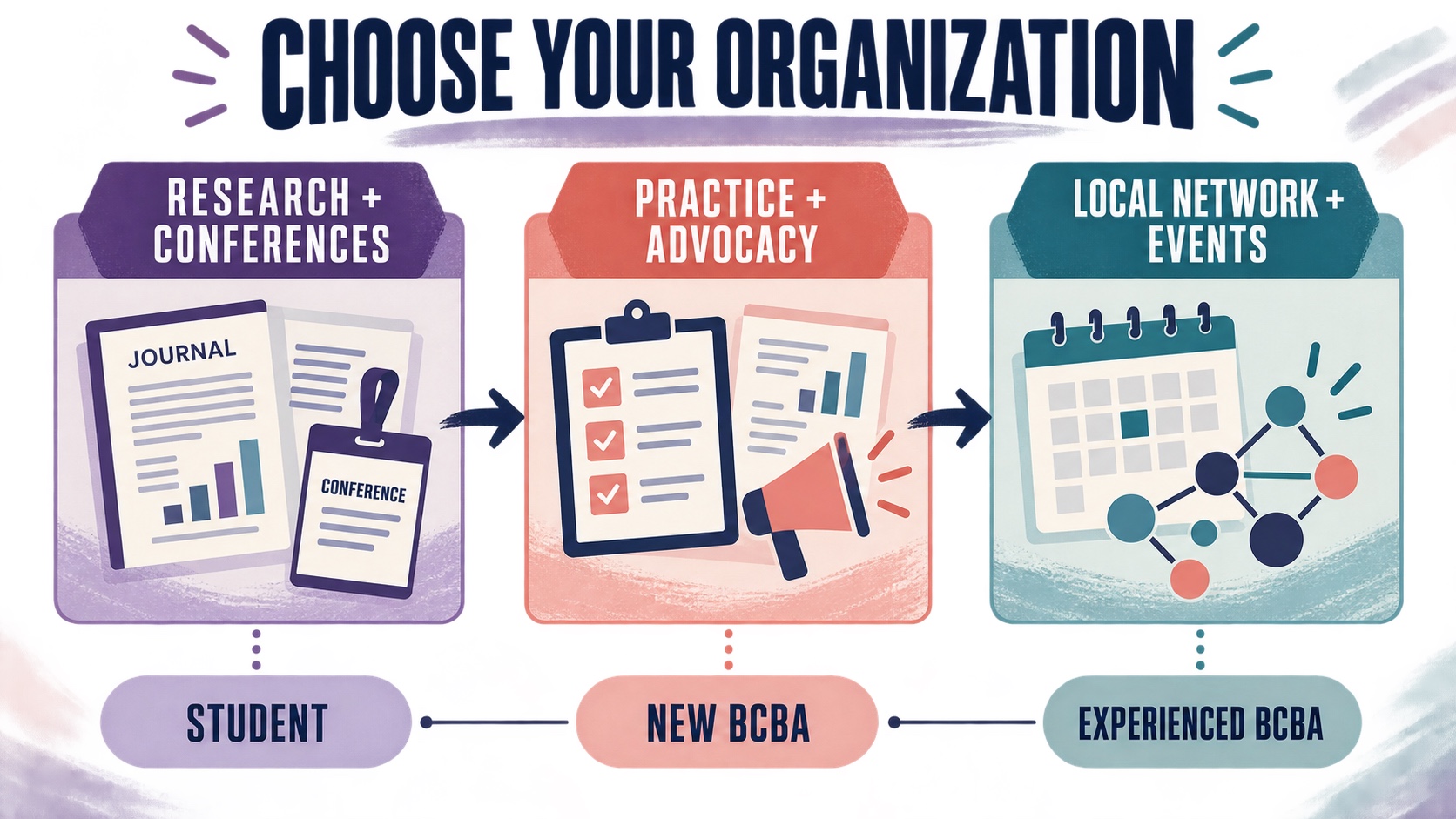
Before paying a membership fee, write down the professional task you want the organization to support during the next six to twelve months. “I want to be more involved” is a reasonable long-term goal, but it is too broad for a useful membership decision. A narrower goal lets you compare organizations on evidence instead of brand recognition.
- Define the outcome. Decide whether you need research access, a conference, a mentor, state-policy information, specialty networking, leadership practice, or a job resource.
- Check the member category. Student, trainee, professional, affiliate, full, and supporting memberships can have different requirements and benefits.
- Compare the actual benefit. Look for current journal access, CE discounts, event discounts, job boards, member directories, special interest groups, or committee access—not vague promises of networking.
- Check the calendar. A membership is more valuable when the organization offers events, webinars, or meetings that you can realistically attend.
- Review the renewal terms. Confirm the membership year, anniversary renewal, automatic renewal, regional pricing, and cancellation rules before entering payment information.
- Confirm professional fit. Ask whether the group primarily serves researchers, practitioners, students, consumers, educators, or a particular state or specialty.
A practical test is to choose one measurable result: attend one event, join one relevant special interest group, read two current articles, meet a potential supervisor, or identify one state-policy resource. If the organization cannot plausibly help with that result, a membership may not be the best next step.
ABAI vs APBA vs State Associations
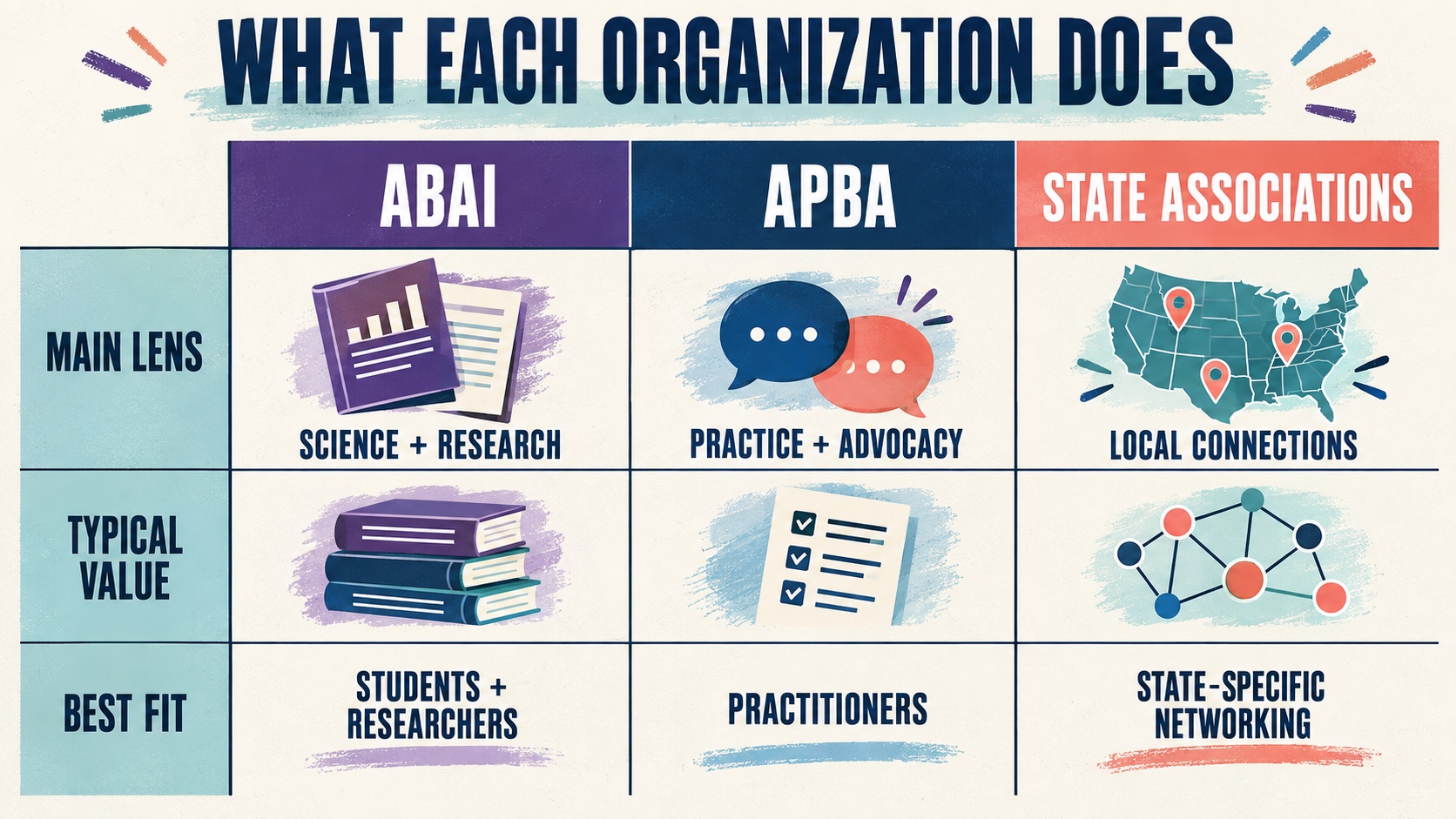
The major categories overlap, but they are not interchangeable. The Association for Behavior Analysis International (ABAI) presents itself as a nonprofit membership organization supporting the science and practice of behavior analysis. The Association of Professional Behavior Analysts (APBA) focuses on the interests of professional practitioners and works with other organizations in the field. State associations usually concentrate on regional relationships, state advocacy, local events, and community-specific information.
| Organization | Main lens | Best starting question |
|---|---|---|
| ABAI | Science, research, education, conferences, journals, and broad behavior-analysis community. | Do I need research, publication, conference, or broad professional-development access? |
| APBA | Professional practice, practitioner community, and behavior-analytic advocacy. | Do I want resources and connections centered on day-to-day professional practice? |
| State association | Local relationships, state regulation, events, and regional behavior-analysis community. | Do I need state-specific information or contacts close to where I practice? |
What Is ABAI Useful For?
ABAI can be a strong fit for students, researchers, educators, and practitioners who want broad exposure to the science and practice of behavior analysis. Its membership page lists access to professional resources, events, journals, continuing education, job information, and a member directory, with benefits varying by membership category. The current benefit comparison should be checked before joining because membership categories and terms can change.
ABAI may be especially useful if your goal is to read research, attend a large conference, join a special interest group, present work, or connect with people outside your immediate employer. It is less useful to view it as a substitute for clinical supervision, certification advice, state legal advice, or a payer credentialing department.
Students should pay attention to whether the student or transitional category provides benefits they will actually use. A lower fee is not automatically a better value if you cannot attend events or access the resources that motivated you to join.
What Is APBA Useful For?
APBA is oriented toward professional behavior analysts and the practice side of the field. Its membership information describes member categories for BACB-certified professionals, professionals without a BACB certificate, students or trainees, and supporting members. The organization also publishes membership information, a code of conduct, regional dues information, and member-benefit material.
APBA may fit a BCBA who wants practitioner-centered professional community, advocacy conversations, conferences, or a way to stay connected to behavior-analytic practice beyond one employer. Newly certified BCBAs should read the current eligibility and renewal details carefully. APBA’s site currently advertises a special first-year promotion for newly credentialed BCBAs and BCaBAs, but promotions are time-sensitive; verify the current terms directly with APBA before relying on them.
Why Do State Associations Matter?
State associations can answer questions that a national organization cannot answer in a sufficiently local way. They may host in-state events, track state legislation, connect members with local colleagues, publish regional information, or provide a setting for peer discussion about licensure and service delivery. Their value depends heavily on the state, the current leadership, and the activity level of the association.
Do not assume a state association is the same thing as the state licensing board. The association is a professional community. The licensing board is the government or regulatory body that controls legal practice requirements. If you need a current license status, scope-of-practice rule, complaint route, or renewal requirement, go to the official state authority. Use the association for context and professional connection, not as the final legal source.
How to Evaluate Membership Benefits
Membership pages often list many benefits, but the decision becomes clearer when you sort them into four buckets:
- Knowledge: journals, newsletters, webinars, research summaries, or CE opportunities.
- Connection: member directories, special interest groups, mentoring, local meetings, or conference communities.
- Career: job boards, leadership roles, presentations, committees, and professional visibility.
- Voice: policy education, advocacy, professional standards, and organized responses to issues affecting practice.
Then compare the annual cost with the one or two benefits you can use immediately. For example, a student who wants conference access may value a discounted event more than a directory. A practitioner who works in a regulated state may value local policy updates more than a national journal. A doctoral student may place more value on special interest groups and publication conversations.
A Practical Path for Students and New BCBAs
If you are still completing coursework or fieldwork, start with the organization that makes your next professional step easier. That might mean a student association, a university chapter, a state association, or a national group with a student category. Attend an open webinar before purchasing an annual membership when possible. You can learn a great deal about the organization’s tone, audience, and practical value from one public event.
After certification, reassess the reason for joining. Your priorities may shift toward supervision, clinical practice, state regulation, continuing education, leadership, or a particular service population. A membership that made sense as a student may not be the best professional investment two years later. Keep your certification information, ethics obligations, and state requirements in their own official systems rather than treating an association directory as proof of current credentials.
Professional Organizations and BCBA Ethics
Professional organizations can support ethical practice by creating opportunities for education, peer discussion, and professional development. They do not replace the current BACB Ethics Code. The BACB states that its Ethics Code for Behavior Analysts applies to BCBA and BCaBA certificants and applicants, and its ethics department handles code-enforcement information. When an association webinar, social-media post, or colleague’s advice conflicts with the current BACB requirements or applicable law, verify the governing source before acting.
Participation should also be purposeful. Joining a professional organization is not the same as endorsing every opinion expressed by an individual member. Use professional communities to ask better questions, locate primary sources, and learn how experienced analysts reason through practice issues. Document your continuing education and professional decisions according to the requirements that actually apply to you.
BCBA Professional Organizations FAQs
What is the best professional organization for a BCBA?: There is no single best organization for every BCBA. ABAI may fit research and broad professional development, APBA may fit practitioner-focused community and advocacy, and a state association may fit local relationships and state-specific information. Choose based on the result you want during the next year.
Is the BACB a professional organization?: The BACB is the credentialing board that administers BCBA, BCaBA, and RBT certification systems and publishes ethics requirements. It should not be treated as interchangeable with a voluntary membership association. Its official pages are the right place for certification and ethics requirements.
Do professional organizations provide BCBA CEUs?: Some organizations or approved providers offer continuing-education opportunities, discounts, or member access to learning resources. Confirm the current activity type, approval status, documentation, and whether it meets your specific renewal needs before counting it.
Should a BCBA join both a national and a state organization?: Possibly. A national membership may provide research, publications, or broad networking, while a state association may provide local events and policy context. Joining both makes sense only when you can use the distinct benefits and the combined cost fits your professional plan.
In short, the strongest BCBA professional organizations strategy is intentional rather than crowded: choose one organization for your immediate goal, verify its current membership terms, and use official BACB and state sources for certification and regulation questions. When you are ready to practice exam concepts alongside your professional development, try the free BCBA mock exam for additional exam-style practice. It is a study resource, not a certification or membership application.
Quick Review Checklist
Use this final checklist to turn bcba professional organizations into exam-ready reasoning. The goal is not to memorize a label in isolation; it is to identify the relevant evidence and explain why the best answer fits the scenario. Key ideas to review:
- State the central definition or decision point for bcba professional organizations in your own words.
- Identify the detail that makes bcba professional organizations different from its closest related ABA term.
- Separate the observable facts in a scenario from assumptions that are not supported by the facts.
- Write one example and one nonexample so you can recognize the concept in a new setting.
Exam application checks:
- Ask what the question is actually requesting before comparing the answer choices.
- Mark the antecedent, response, consequence, or other evidence that supports the selected answer.
- Look for a distractor that describes a related process but does not answer the specific question.
Final self-check:
- Explain how you would verify the interpretation with clear observations or data.
- Change one detail in the scenario and decide whether your answer should change.
- Give a one-sentence rationale that a supervisor or study partner could evaluate.
Take the Free BCBA Mock Exam
If you want a low-pressure way to check your recall, use the free practice resource below. Take the Free BCBA Mock Exam



