
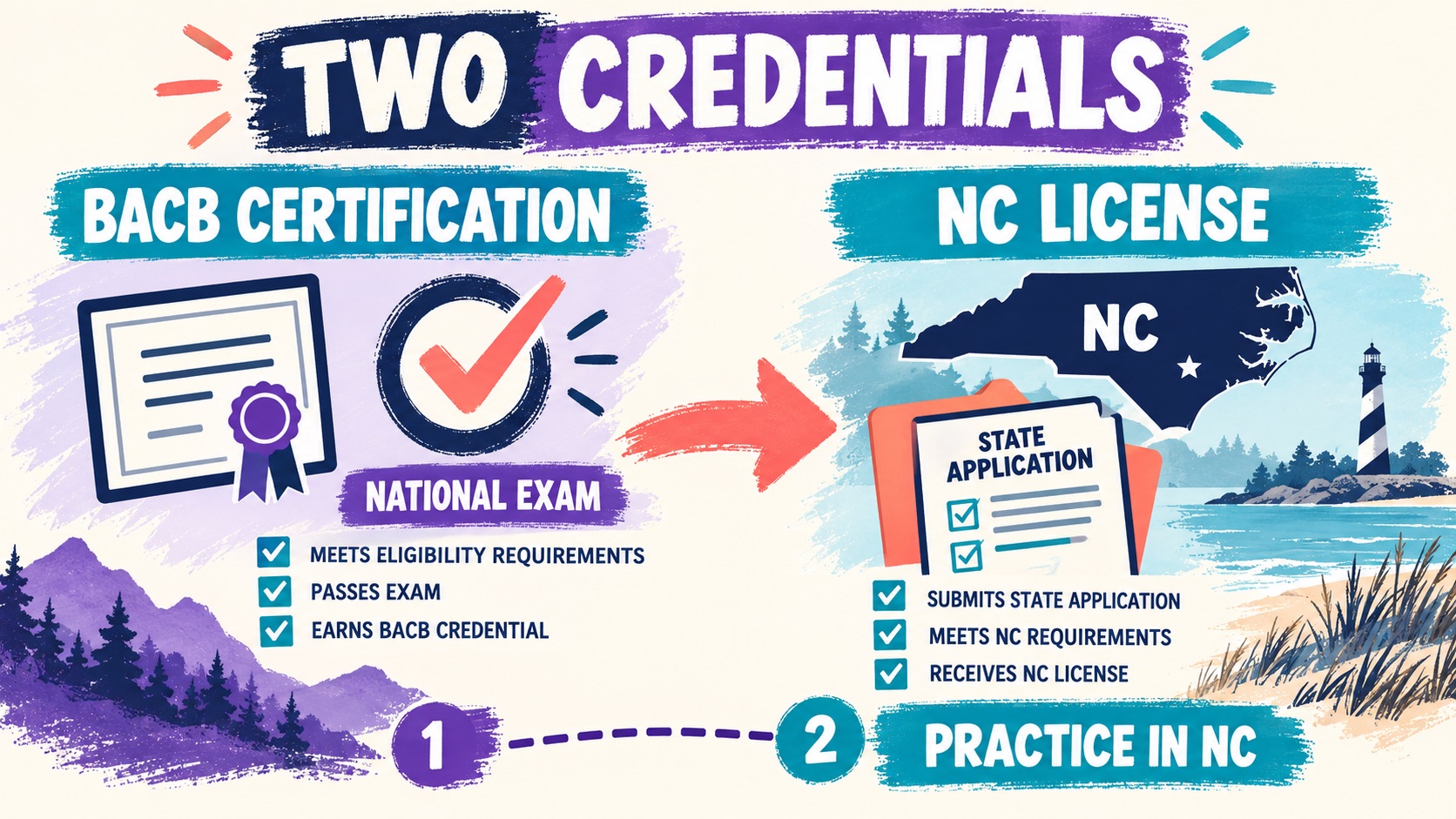
If you are searching for bcba north carolina requirements, the most important point is that North Carolina has two connected but different credentialing steps. First, you need an active national certification, such as BCBA certification from the Behavior Analyst Certification Board (BACB). Second, you may need a North Carolina behavior analyst license before you practice or represent yourself as a licensed behavior analyst in the state. Passing the national exam alone does not automatically issue a North Carolina license.
Table of Contents
- bcba north carolina requirements: what is the short answer?
- Is BCBA certification the same as a North Carolina license?
- What are the North Carolina eligibility requirements?
- Which documents does the application require?
- How do you apply through the licensure portal?
- What changes while you are working toward BCBA certification?
- How long does the license last and how do you renew it?
- Do temporary practice and reciprocity change the process?
- What should candidates recheck for 2027?
- How should you prepare for the BCBA exam?
- Which mistakes delay a North Carolina application?
- BCBA North Carolina Requirements FAQ
- Take the Free BCBA Mock Exam
The North Carolina Behavior Analyst Board’s current application information should control your final checklist. This guide explains the decision path, the state application documents, renewal timing, supervision questions, and the 2027 recheck point. It is educational planning information, not legal, licensing, billing, or employment advice. Requirements and fees can change, so confirm the live Board portal and current BACB handbook before submitting an application. Table of Contents
bcba north carolina requirements: what is the short answer?
For a typical applicant pursuing a North Carolina behavior analyst license, the practical sequence is:
- Meet the BACB or another accepted certifying entity’s national eligibility rules.
- Pass the BCBA examination and keep the national BCBA certification active.
- Confirm that you are at least 18 and that your professional history satisfies North Carolina’s character and fitness requirements.
- Gather the Board’s application, public notice statement, fees, fingerprint materials, background check, references, current certification proof, photograph, and release form.
- Submit the application through the North Carolina Behavior Analyst Licensure Gateway and monitor the checklist for missing items.
- Do not practice or hold yourself out as a North Carolina licensed behavior analyst until the state authorization that applies to your work is active.
The state’s Requirements for Licensure Overview is the best starting point for the current application packet. The Board’s Application Information page then directs applicants to the live portal, where the checklist and upload steps are managed. Use those pages for the current fee and document instructions instead of relying on an old school checklist or a social-media summary.
Is BCBA certification the same as a North Carolina license?
No. They answer different questions:
| Credential | Who controls it? | What it answers | Typical evidence |
|---|---|---|---|
| BCBA certification | BACB or another certifying entity accepted by the state | Have you met the national education, fieldwork, and examination pathway? | Active certification and registry or certificate verification |
| North Carolina license | North Carolina Behavior Analyst Board | Are you authorized under North Carolina’s behavior analyst licensure law? | Active state license, application record, and renewal status |
North Carolina General Statutes Article 43 defines a licensed behavior analyst as someone who is certified by the certifying entity and has been issued an active state license that is not suspended or revoked. That definition is why the two credentials should be planned together but never treated as interchangeable. The official North Carolina Article 43 text is the controlling source for the statutory framework.
What are the North Carolina eligibility requirements?
For a licensed behavior analyst application, North Carolina’s statute and Board materials point to several core requirements. The exact application checklist should be treated as the operational version of the process. 1. Be at least 18 years old: North Carolina General Statute § 90-737 lists age 18 as one of the requirements for licensure as a behavior analyst. This is a state-license condition; it is not a substitute for meeting the certifying entity’s graduate-level eligibility rules.
2. Pass the certifying entity’s BCBA examination: The statute requires the applicant to have passed the certifying entity’s BCBA examination. For BACB candidates, that means completing the applicable national eligibility pathway and passing the current BCBA exam. Keep your exam and certification records organized, but use the current BACB handbook for the national pathway rather than assuming that a state application page describes every national requirement.
3. Maintain active national certification: The state requirement is not simply “passed once.” The applicant must have active status with the certifying entity as a BCBA. The Board’s application page asks for current proof of certification, and the checklist warns that expired certification will not be accepted. If your BACB status changes, review how that affects the state license before providing regulated services.
4. Satisfy character, professional-conduct, and background requirements: North Carolina’s application statute requires evidence of good moral character, professional activity consistent with accepted ethical standards, no practice that would justify denial or discipline, and the required criminal history record. The Board’s process therefore includes fingerprint and background-check steps. Treat a background review as an application component, not as a formality that can be added after the deadline.
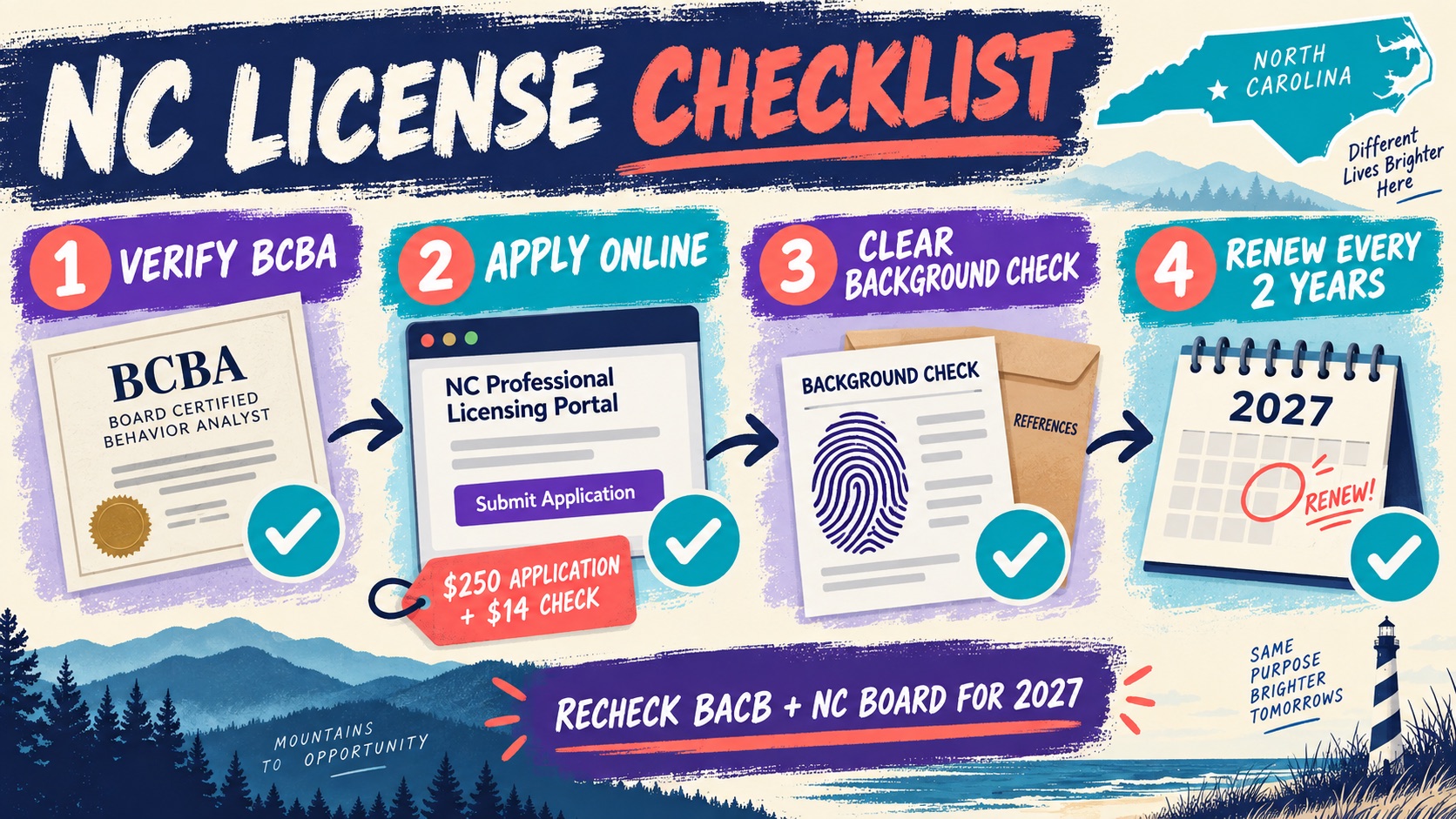
5. Submit the state application and required fees: The current Board overview lists a complete application, a public notice statement, a $250 application fee, and a $14 payment required for the North Carolina Department of Justice criminal-history record check for a behavior analyst application. Because fees are changeable, verify the amount on the live Board page immediately before payment.
Which documents does the application require?
A useful way to prepare is to build a credential folder before you open the portal. The current North Carolina Board overview and checklist identify these categories for a behavior analyst applicant:
- completed state license application;
- completed public notice statement;
- application-fee payment and the criminal-history-check fee;
- completed fingerprint record card and any required North Carolina Department of Justice materials;
- online background-check submission through the Board’s designated process, currently shown with CastleBranch package code “VN90” on the Board page;
- current certificate or proof of certification from an accepted certifying entity, such as BCBA certification from the BACB;
- two statements submitted through the application portal concerning good moral character and professional and ethical standards;
- applicant photograph;
- completed Authority for Release of Information form; and
- proof of current certification uploaded after the application is completed and submitted.
The Board’s checklist FAQ adds an important operational detail: references are not merely names typed into a form. The Board must receive and approve at least two references, and reference links may need to be resent if a person does not respond. The FAQ also says that education verification is checked with proof of current certification and that transcripts do not need to be submitted to the Board office for that checklist item. Always follow the current portal instructions if they differ from an older explanation.
How do you apply through the licensure portal?
The Board’s application instructions describe a straightforward online sequence:
- Open the North Carolina Behavior Analyst Licensure Gateway.
- Create an account if you are a first-time user, then complete the registration pages.
- Log in and open the behavior analyst application from the Applications menu.
- Complete each page, submit the application, and pay the required fees.
- Return to the portal to view the upload checklist and submit additional documents.
- Ask your references to complete their electronic statements and monitor the checklist for receipt.
- Respond to Board requests and save confirmation numbers, dates, and copies of every upload.
The Board manually reviews portal, mail, email, and background-check submissions. A checklist that still says “missing” may mean review is pending rather than that a document was rejected, so keep dated proof of each submission.
What changes while you are working toward BCBA certification?
A candidate who is still earning national certification has a different question from a person applying for a full state license. North Carolina’s FAQ says that if you are obtaining supervision hours while working with patients in North Carolina, supervision must come from a current licensee of the Board, an instructor in a certifying-entity-approved course sequence, or a qualified faculty member. The statute also contains exemptions for defined university coursework and for experience consistent with the certifying entity’s requirements when the activities are supervised by a licensed behavior analyst.
Confirm the supervisor and setting before counting hours. “Supervised by a BCBA” may not answer the North Carolina question if the supervisor lacks the authorization required for the activity. Get the arrangement confirmed in writing.
How long does the license last and how do you renew it?
Under Article 43, a North Carolina behavior analyst license is granted for two years. The Board’s current License Renewal Information page says the renewal link appears in the license portal 60 days before expiration, and the only way to renew is through that portal. The Board says a complete renewal is valid for two years from the date it is approved. The behavior analyst renewal checklist currently includes:
- completion and submission of the renewal form;
- the $200 renewal fee listed by the Board;
- evidence of active BCBA or QBA certification; and
- any current certification evidence needed to verify continuing-education completion.
The statute also ties renewal to continuing education required by the certifying entity and active certification. The Board explains that submitting current certification proof is the verification of completion of the continuing education required for renewal. Put the license expiration date, certification expiration date, and the portal’s 60-day renewal window on separate calendar reminders. A state license can be current while national certification is expiring, or the reverse, so track both.
Do temporary practice and reciprocity change the process?
They may, but they are not automatic shortcuts. Article 43 separately addresses temporary licensure and reciprocity. Temporary licensure is described for an actively licensed or certified out-of-state behavior analyst providing services for a limited, Board-approved period; it is not indefinite permission to practice in North Carolina. If you are moving, covering an assignment, providing telehealth, or joining a multi-state organization, ask the Board which pathway applies before seeing clients. Confirm the location, duration, out-of-state credential, and any separate payer rule.
What should candidates recheck for 2027?
The BACB has published substantial changes to BCBA eligibility and maintenance requirements beginning January 1, 2027. The official 2027 BCBA Requirements page describes two eligibility pathways, updated coursework and fieldwork expectations, and the current examination requirement. The BACB also lists 2027 changes to degree, coursework, supervised fieldwork, continuing education, and ongoing supervision requirements on its Recent and Upcoming Changes page. For a North Carolina candidate, the practical lesson is not that the state application disappears or automatically changes. Instead, recheck both source sets before you submit:
- BACB: the current handbook, eligibility pathway, fieldwork forms, exam content outline, certification status, and transition guidance.
- North Carolina: the Board’s application checklist, accepted certification proof, background-check instructions, fees, references, renewal page, and any updated state rules.
How should you prepare for the BCBA exam?
A focused study loop is more useful than repeatedly taking untimed quizzes:
- Take a timed diagnostic aligned with the current BACB content outline.
- Classify every miss as a concept, discrimination, application, ethics, calculation, or pacing error.
- Write a one-sentence reason the best answer is better than the distractors.
- Review the source concept, then retest it in a new scenario.
- Keep a score history so you can see whether accuracy and pacing improve together.
Our free BCBA mock exam can be used as a practice checkpoint before you finalize your application timeline. It is a study resource, not BACB certification, a North Carolina license, legal advice, or a promise of a passing score. Once your exam preparation is stable, return to the state checklist and finish the administrative steps separately.
Which mistakes delay a North Carolina application?
- Assuming a BCBA certificate automatically creates a North Carolina license.
- Applying with expired national certification or uploading an old certificate.
- Waiting to start fingerprint and background-check steps until the last week.
- Entering references who do not monitor the email address used in the portal.
- Ignoring the Board checklist because a payment confirmation was received.
- Using a different legal name or address across BACB, Board, fingerprint, and reference records.
- Assuming electronic fingerprints are available from every state.
- Counting supervision hours without confirming the North Carolina supervisor and setting requirements.
- Confusing temporary authorization or reciprocity with a full active license.
- Relying on a pre-2027 national checklist after the BACB transition begins.
BCBA North Carolina Requirements FAQ
Can I work in North Carolina with BCBA certification but no state license?: Do not assume that you can. Article 43 generally prohibits an individual who is not licensed under the Article from practicing behavior analysis or holding themselves out publicly as practicing behavior analysis, subject to statutory exemptions. Confirm the exact exemption or authorization with the North Carolina Board before providing services.
Does North Carolina accept a BCBA certificate from the BACB?: Yes. The Board’s current requirements page lists current BCBA certification from the BACB as accepted certification evidence, while the statute also recognizes the certifying-entity framework. The Board currently lists QABA alternatives as well, so read the live checklist for the credential you hold.
How often do I renew a North Carolina behavior analyst license?: The license period is two years. The Board’s renewal page says the renewal link appears in the portal 60 days before expiration. Track the exact expiration date in your account because a complete renewal is approved for two years from its approval date.
Where should I verify the current checklist?: Start with the North Carolina Behavior Analyst Board requirements page, then use the Licensure Gateway for your personal application checklist. For national certification, use the current BACB BCBA resources and the 2027 requirements page. Those sources should outrank a third-party checklist if the instructions differ.
In short, the safest way to approach bcba north carolina requirements is to build two checklists: one for active national certification and one for North Carolina state licensure. Keep the records separate, verify the live Board portal before payment, and recheck both systems as the 2027 BACB transition approaches.
Take the Free BCBA Mock Exam
When you are ready to apply the idea, use the free practice resource below for additional feedback. Take the Free BCBA Mock Exam



