
BCBA Charlottesville is a local-service search, not just a request for a BCBA definition. A family may be looking for a provider, an insurance-network option, an in-home or clinic setting, or a professional who can serve Charlottesville and nearby Albemarle County. The best next step is a verification conversation—not a ranking based on a search result.
Table of Contents
- What Does BCBA Charlottesville Usually Mean?
- How Do You Check a BCBA’s Credential and Virginia License?
- How Should You Compare Charlottesville Providers?
- What Should You Ask About Insurance and Cost?
- Which Service Setting May Fit Your Routine?
- What Should You Know About Supervision?
- What Questions Should You Ask Before Starting?
- Charlottesville BCBA Comparison Snapshot
- Where Does BCBA Exam Preparation Fit?
- BCBA Charlottesville FAQ
- Take the Free BCBA Mock Exam
This guide explains how to compare local services, check Virginia credentials, ask about insurance and supervision, and decide whether a provider’s setting fits your goals. Local availability changes, so confirm every current detail directly. This is educational information, not a clinical recommendation, diagnosis, legal opinion, or guarantee of treatment outcomes. Table of Contents
What Does BCBA Charlottesville Usually Mean?
The query can represent several local tasks: finding a Board Certified Behavior Analyst, locating ABA services for a child or adult, checking whether a provider serves Charlottesville or Albemarle, or confirming whether a plan accepts a particular insurance network. A provider’s page may mention “Charlottesville” while serving a wider area, and a directory may list an office without showing whether it is accepting new clients today. Start by deciding what you actually need:
- Clinical service: assessment, behavior-analytic treatment, caregiver support, consultation, or supervision.
- Setting: home, clinic, school, community, telehealth, or a combination.
- Coverage: private insurance, Medicaid plan, self-pay, employer benefit, or another funding source.
- Logistics: location, schedule, language access, transportation, waitlist, and communication format.
Search results from local organizations and payer directories are useful leads, not independent proof of quality. The decision should be based on your goals, the provider’s current credentials and availability, the service model, and the terms of your coverage.
How Do You Check a BCBA’s Credential and Virginia License?
Virginia treats behavior analysis as a regulated profession. The Virginia Board of Medicine’s behavior-analyst application page directs applicants to the state laws and regulations and asks for verification of BACB certification. The BACB’s BCBA overview explains the national certification context; the Virginia board’s regulated-profession page then links to the applicable state rules.
For a local provider, verify the exact person and role rather than relying on a logo or an office name. Ask whether the person is currently a BCBA, whether the Virginia license is active when a license is required for the role, who will supervise direct-care staff, and whether the person you meet is the clinician responsible for assessment and plan decisions.
A company may employ BCBAs, BCaBAs, RBTs, behavior technicians, and administrative staff. Those roles are not interchangeable. The person who performs the assessment, writes or oversees the behavior plan, supervises implementation, and communicates with caregivers should be clear. Use the official Virginia Administrative Code for current rules and ask the provider or board about questions that depend on your specific service arrangement. Directory listings are not a substitute for credential verification.
How Should You Compare Charlottesville Providers?
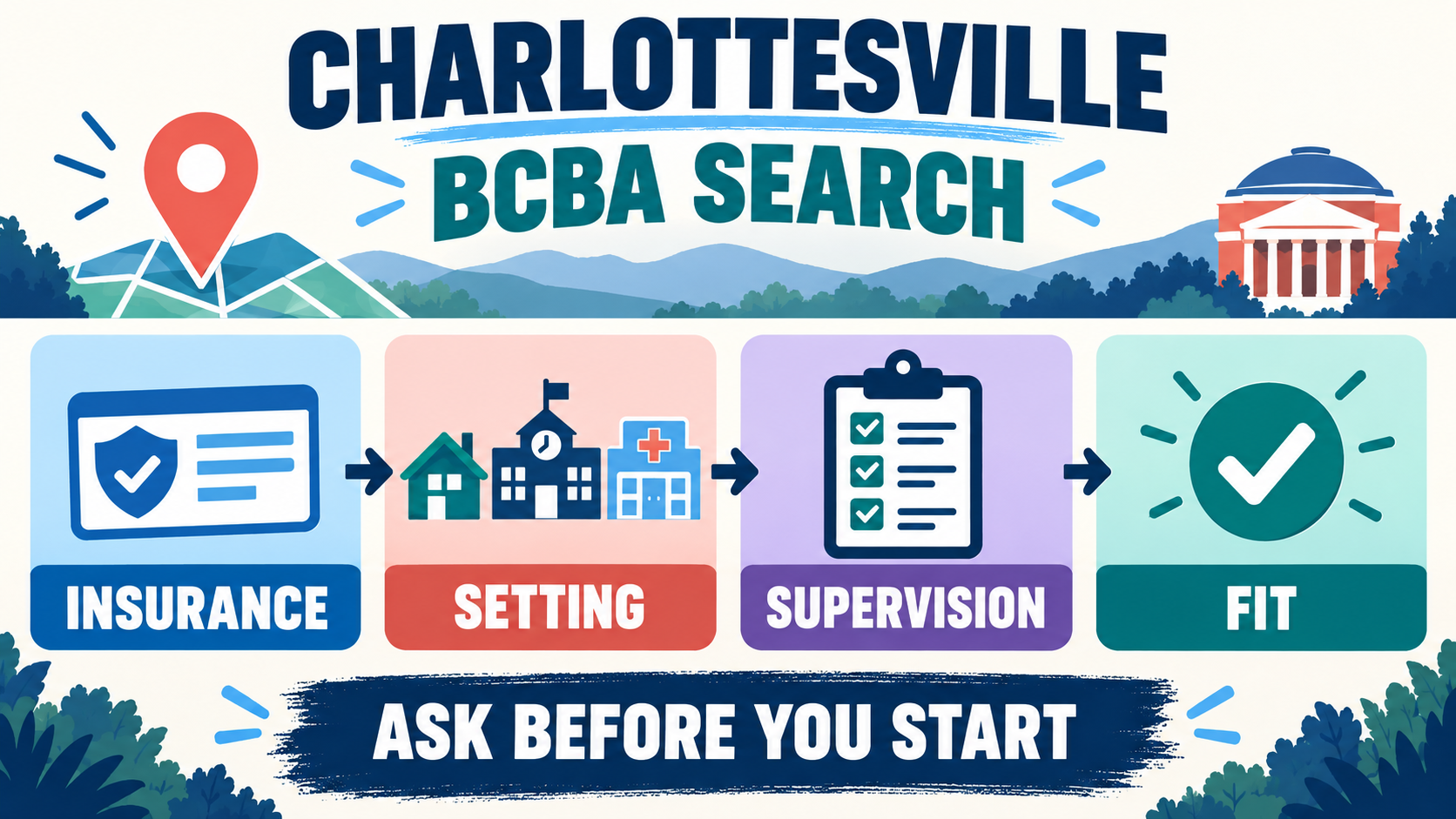
Compare providers on the same dimensions so a polished website does not become the only deciding factor. A local page may highlight a convenient office or a broad service area; another may offer home-based care or a shorter intake process. Those differences matter only in relation to your family’s priorities and the provider’s actual capacity.
- Goals: Can the provider explain how assessment connects to measurable, meaningful goals?
- Access: Does the provider currently serve your location, age group, schedule, language, and support needs?
- Setting: Will services occur where the relevant routines happen, or is a clinic setting a better fit?
- Caregiver partnership: How are caregivers included in decision-making, training, feedback, and review?
- Data and review: How will progress, barriers, treatment integrity, and changes to the plan be discussed?
Do not use a single testimonial, star rating, or “evidence-based” label as a complete evaluation. Ask what the first appointment includes, what information the provider needs, and how you can raise a concern or request a change.
What Should You Ask About Insurance and Cost?
Insurance directories can help you find leads, but they can be incomplete or out of date. A listing does not necessarily mean that the provider is accepting new clients, that your exact plan covers the service, or that the listed office can serve your location. Before scheduling, call both the provider and the payer. Ask:
- Is the provider in-network for my exact plan and product, not just the insurer’s name?
- Is the service authorized for the client’s age, diagnosis, setting, and requested hours?
- Are assessment, caregiver training, supervision, telehealth, and direct services covered differently?
- What deductible, copay, coinsurance, limits, or prior-authorization steps apply?
- Who submits claims and authorizations, and what happens if the payer changes the requested hours?
Ask for the answer in writing when possible. The payer directory examples that appear for Charlottesville include license fields, hours, and provider information, but the directory itself advises members to verify benefits. Treat the directory as a starting point and the payer’s current response as the coverage check.
Which Service Setting May Fit Your Routine?
In-home services can make it possible to observe routines such as getting ready, meals, transitions, play, or community outings. Clinic services may provide predictable materials, staff, and peer opportunities. School or community consultation may be important when the goal involves participation in those settings. Telehealth can be useful for consultation or caregiver coaching when it is clinically appropriate and permitted.
Ask how the provider decides on a setting. A location should support the goals—not simply reflect what is easiest to schedule. Discuss privacy, sensory conditions, travel time, caregiver participation, school coordination, and what happens when a learner’s needs change.
Local provider pages often describe a service area that includes Charlottesville and surrounding counties. Confirm whether “serves Charlottesville” means in-home visits inside the city, a clinic address, telehealth, or an intake-only service area. Ask about the expected travel radius and whether travel affects scheduling or authorization.
What Should You Know About Supervision?
Supervision is a quality and role question, not just a line on a staff page. Ask who observes sessions, reviews data, trains technicians, communicates with caregivers, and updates the plan. If a BCBA is responsible for oversight but rarely has contact with the learner or family, ask how clinical decisions are made and how concerns are escalated. Useful questions include:
- How often will the BCBA observe or meet with the learner and caregiver?
- What training and feedback do direct-care staff receive?
- How are data reviewed, and how quickly can goals be changed when the plan is not a good fit?
- How do staff protect assent, communication, dignity, privacy, and the learner’s ability to pause or refuse?
- Who is the contact for urgent concerns, schedule changes, or a request for a second conversation?
What Questions Should You Ask Before Starting?
Bring a short written list to the intake call. You do not need to choose a provider during the first conversation. A clear answer—or a clear explanation of what the provider cannot yet know—can tell you more than a general promise.
- What information do you need before deciding whether you can serve us?
- What would the assessment measure, and how would we participate?
- Which goals would be considered meaningful for this learner and routine?
- Who would work directly with us, and who would supervise the service?
- How do you handle communication access, sensory needs, assent, and changes in preference?
- What is the current waitlist, start process, cancellation policy, and expected schedule?
- Which insurance documents or authorizations are still pending?
- How do we review progress and request changes if the plan is not working?
Charlottesville BCBA Comparison Snapshot
Use this bordered table as a neutral call-notes template. It does not rank any local provider.
| Dimension | What to verify | Your notes |
|---|---|---|
| Credential and license | BCBA status, Virginia license when applicable, responsible clinician, and supervision roles. | Write the name, role, and verification date. |
| Location and setting | Charlottesville or Albemarle coverage, home/clinic/school/community/telehealth, travel limits. | Record the actual service address and format. |
| Insurance | Exact plan, network status, authorization, deductible, and claim contact. | Save the payer call reference or written response. |
| Fit and communication | Goals, language access, caregiver role, assent, data review, and complaint process. | Note what felt clear, respectful, and workable. |
Where Does BCBA Exam Preparation Fit?
If you are searching for a BCBA in Charlottesville because you are studying for certification, keep exam preparation separate from choosing a local provider. A mock exam can help a candidate practice measurement, assessment, ethics, supervision, and behavior-change scenarios; it cannot verify a clinician’s local availability or decide what services a family needs.
Our free BCBA mock exam is an independent study aid, not official BACB material and not a provider referral. Families seeking care should use the Virginia Board of Medicine, payer, employer, and provider contacts for current service questions.
BCBA Charlottesville FAQ
How do I find a BCBA near Charlottesville? Start with official credential and licensure checks, then use local provider pages and payer directories as leads. Confirm that the person or organization currently serves your location, accepts your plan, and has capacity. Does a provider-directory listing guarantee availability? No. Listings can lag behind changes in network status, staff, locations, hours, or waitlists. Call the provider and payer directly. Is a BCBA automatically licensed in Virginia? Do not assume. Virginia has official behavior-analyst licensure rules and an application process. Verify the current person and role through the relevant official sources.
Should I choose home or clinic ABA services? It depends on the learner’s goals, routines, access needs, family preferences, travel, and the provider’s clinical plan. Ask how the setting supports meaningful generalization rather than choosing from a label alone.
What is the safest next step? Make a short list of providers, verify credential/license and insurance details, ask the same questions of each, and choose the conversation that gives you the clearest, most respectful, and most workable plan. Recheck details before services begin.
Take the Free BCBA Mock Exam
If you want a low-pressure way to check your recall, use the free practice resource below. Take the Free BCBA Mock Exam



