
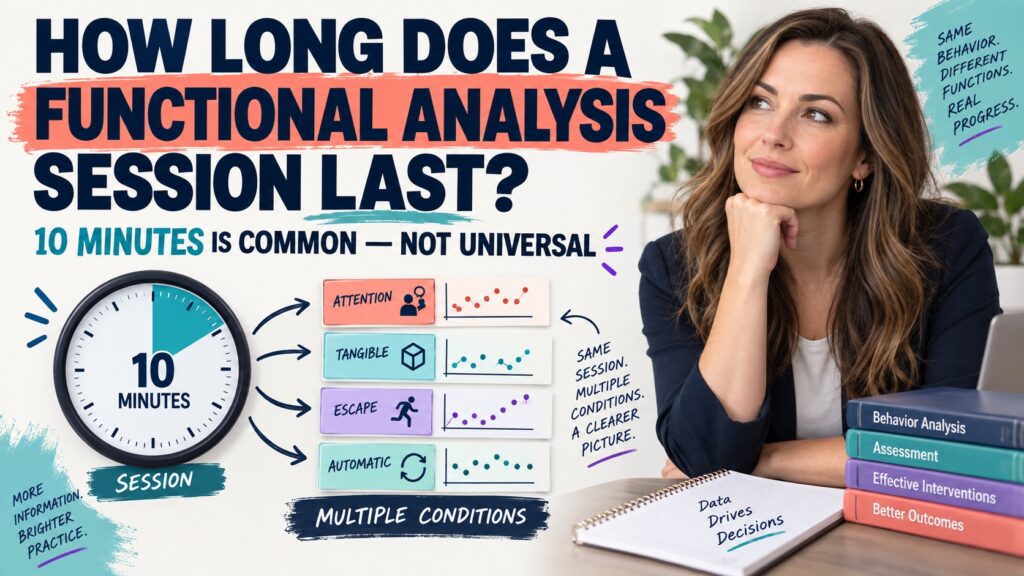
The phrase typically a functional analysis session lasts is a common BCBA study prompt. In many standard behavior-analytic examples, a functional analysis session lasts about 5 to 10 minutes per condition. If a BCBA exam question gives “1 minute, 10 minutes, or 1 hour” as the choices, 10 minutes is often the intended answer. That is a study convention, not a universal rule for every functional analysis (FA).
Table of Contents
- Typically a Functional Analysis Session Lasts: What Is the Short Answer?
- What is the difference between a session and a full FA?
- Why is 10 minutes a common answer?
- How do FA formats change session length?
- What happens during a session?
- Why do safety and stopping rules matter?
- How should you answer the BCBA exam question?
- Functional analysis session-length FAQ
- Quick Review Checklist
- Take the Free BCBA Mock Exam
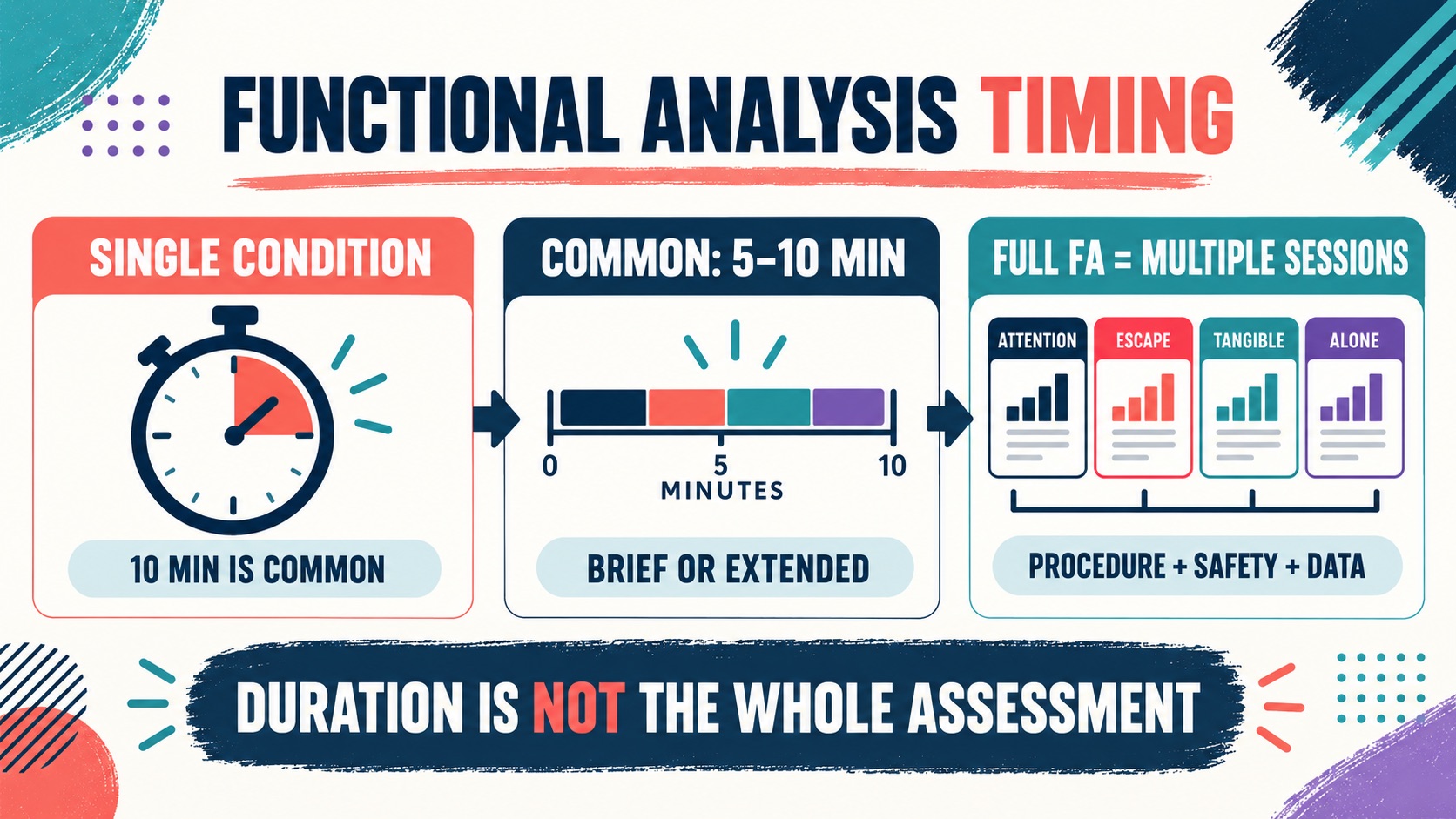
Session duration depends on the FA model, the target behavior, the data system, safety plan, termination rule, and whether the assessment is brief, extended, trial-based, latency-based, or synthesized. A complete FA also includes multiple conditions and usually multiple sessions. Therefore, “10 minutes” can describe one session or condition; it does not mean that the entire functional analysis is finished in 10 minutes.
This guide gives the exam-ready answer and the evidence-based nuance. It explains why 5- and 10-minute sessions are common, how to distinguish a session from an assessment, and how to avoid choosing a duration by memorization when the vignette gives more specific procedural information. Table of Contents
Typically a Functional Analysis Session Lasts: What Is the Short Answer?
For a conventional multielement FA, a session is commonly taught as 10 minutes per condition. In real research and practice, 5-minute sessions are also common, and some analyses use 15 minutes, shorter probes, a first-response termination rule, or a different arrangement altogether. The best answer is therefore two-layered:
- Exam layer: choose 10 minutes when the question uses the familiar 1-minute/10-minute/1-hour options and gives no special procedural details.
- Practice layer: follow the written FA protocol, safety plan, measurement system, and clinical decision-making requirements. Duration must fit the assessment design.
Do not confuse a common duration with a definition. The defining feature of an experimental FA is the systematic manipulation and comparison of environmental conditions to test hypotheses about behavioral function. The clock helps organize the procedure; it does not establish function by itself.
What is the difference between a session and a full FA?
A session is one period of data collection under a specified condition or sequence. A functional analysis is the broader assessment that may include attention, escape, tangible, alone, play/control, or other conditions, depending on the design. The analyst compares responding across conditions and across repeated data points.
| Phrase | Meaning | Common mistake |
|---|---|---|
| One FA session | One defined period of observation or one condition in the assessment. | Treating one session as enough evidence to identify function. |
| One condition | A programmed environmental arrangement, such as attention, escape, tangible, alone, or control/play. | Assuming every FA uses the same four conditions or labels. |
| Full FA | A repeated comparison of conditions that generates enough data to evaluate a functional relation. | Thinking that “10 minutes” describes the entire assessment. |
Why is 10 minutes a common answer?
Ten-minute sessions became familiar in many standard multielement FA examples because they provide a manageable period for arranging contingencies, observing responding, and comparing rates across conditions. A study question often simplifies this into a single fact: “Typically, a functional analysis session lasts 10 minutes.” That wording is useful for test preparation only when the question does not specify another model.
The research record is more varied. A 2023 Journal of Applied Behavior Analysis review of four decades of functional-analysis research reported that 5-minute sessions were the most common category in the reviewed studies, followed by 10-minute sessions. The review also found 15-minute and other durations, along with studies that did not clearly report session duration.
A 2021 JABA comparison evaluated 5- and 10-minute session durations and found the same identified function for the participants in that study. That result does not prove that every 5-minute FA is equivalent to every 10-minute FA. It shows why duration should be interpreted in relation to the design, target behavior, data quality, and repeated condition comparisons.
How do FA formats change session length?
The question becomes easier when the assessment format is identified first. A traditional multielement FA may use repeated condition sessions, while other formats deliberately shorten or reorganize exposure.
| Format | Timing implication | What to remember |
|---|---|---|
| Standard multielement FA | Often uses repeated sessions of several minutes per condition; 5 or 10 minutes are common conventions. | Compare responding across conditions, not one isolated clock value. |
| Brief FA | Uses shorter exposure or fewer sessions to reduce time and response effort. | Efficiency may come with interpretation limits; the design must still support a defensible comparison. |
| Trial-based or latency FA | May use short trials or end after a response/latency criterion rather than a fixed 10-minute block. | Look for the explicit stopping rule in the vignette. |
| Synthesized or individualized FA | May combine contingencies or arrange conditions differently for the case. | Do not force a standard-session answer onto a clearly described individualized design. |
What happens during a session?
Before data collection begins, the analyst defines the target behavior, identifies the condition, prepares materials, specifies the programmed antecedent and consequence, and establishes the measurement system. During the session, the team records the target response and the relevant time or trial information. Afterward, the value of the session comes from how its data fit with the other conditions and sessions.
For many problem behaviors, frequency or rate is used because the condition may last a defined number of minutes. Other measures, such as latency or percentage of intervals, may be appropriate for a particular design. The data system should be selected before interpreting the graph. A longer session does not repair an invalid operational definition or an unreliable measurement procedure. A practical review asks:
- Was the condition implemented as written?
- Were the programmed consequences delivered consistently?
- Was the target behavior measured reliably and in the same way across conditions?
- Were there enough opportunities or responses to interpret the pattern?
- Does the graph show a meaningful separation or relation across conditions?
Why do safety and stopping rules matter?
Functional analysis can involve arranging conditions that may evoke problem behavior. The session duration must therefore be subordinate to safety, informed consent, competence, and the written protocol. A condition may end early if a safety threshold is reached, if a latency rule is met, or if the assessment design specifies a different stopping criterion.
The clinical application review by Iwata and Dozier explains that FA methodology can be adapted to clinical situations, while the BACB Ethics Code provides the broader professional context for competence, risk management, informed consent, and data-based evaluation. The correct duration is never a reason to continue an unsafe condition.
How should you answer the BCBA exam question?
If the question is exactly the common fill-in format—“Typically, a functional analysis session lasts: A. 1 minute, B. 10 minutes, C. 1 hour”—select 10 minutes. Then keep the nuance in your study notes: the answer describes a common session convention, not the total duration of the assessment or a universal clinical rule. If the vignette gives more information, use that information instead:
- Identify whether the question describes a standard, brief, trial-based, latency, or synthesized FA.
- Look for a stated session duration, trial length, first-response rule, or safety stopping rule.
- Separate the duration of one condition from the number of sessions needed for a comparison.
- Choose the answer that protects data quality and safety rather than the answer with the biggest or smallest number.
For applied practice identifying functional-analysis concepts, use the free BCBA mock exam as an unofficial study checkpoint. It is not a clinical assessment tool and does not replace supervision, professional judgment, or a written protocol.
Functional analysis session-length FAQ
Is a functional analysis session always 10 minutes?: No. Ten minutes is a common exam answer and research convention, but 5-minute, 15-minute, shorter trial-based, latency-based, and other formats also appear in the literature and in practice. Does the entire functional analysis last 10 minutes?: No. A full FA normally involves multiple conditions and repeated data points. Ten minutes may describe one condition or session within that broader assessment.
What is the most common session length in research?: Recent review data show that 5-minute sessions were the most common category, with 10-minute sessions also frequently reported. The precise answer depends on how the review defines and counts a session.
What should I remember for the BCBA exam?: Remember “10 minutes” for the familiar multiple-choice item, but do not confuse memorized duration with functional analysis methodology. The design, condition, measurement, safety rule, and repeated comparison matter more than the clock alone.
The safest summary is this: typically, a functional analysis session lasts about 5 to 10 minutes in many standard arrangements, with 10 minutes often expected by a basic exam question. A defensible analyst then looks beyond the number to the assessment format, data, safety, and evidence needed to identify a functional relation. For targeted review, use our typically a functional analysis session lasts practice questions to apply the concept in exam-style scenarios.
Quick Review Checklist
Use this final checklist to turn typically a functional analysis session lasts into exam-ready reasoning. The goal is not to memorize a label in isolation; it is to identify the relevant evidence and explain why the best answer fits the scenario. Key ideas to review:
- State the central definition or decision point for typically a functional analysis session lasts in your own words.
- Identify the detail that makes typically a functional analysis session lasts different from its closest related ABA term.
- Separate the observable facts in a scenario from assumptions that are not supported by the facts.
- Write one example and one nonexample so you can recognize the concept in a new setting.
Exam application checks:
- Ask what the question is actually requesting before comparing the answer choices.
- Mark the antecedent, response, consequence, or other evidence that supports the selected answer.
- Look for a distractor that describes a related process but does not answer the specific question.
Final self-check:
- Explain how you would verify the interpretation with clear observations or data.
- Change one detail in the scenario and decide whether your answer should change.
- Give a one-sentence rationale that a supervisor or study partner could evaluate.
Take the Free BCBA Mock Exam
When you are ready to apply the idea, use the free practice resource below for additional feedback. Take the Free BCBA Mock Exam



