
If you are searching for BCBA certification in India, the first question is not which exam-prep course to buy. It is whether the Behavior Analyst Certification Board (BACB) currently accepts new certification applications from people who reside in India. As of the current BACB international guidance, the authorized-country list names the United States, Canada, and Australia; India is not listed.
Table of Contents
- BCBA certification in India: what is the short answer?
- What does “BCBA certification in India” actually mean?
- Why does BACB jurisdiction matter?
- What happens in different India-related scenarios?
- What would the BCBA route require if you are eligible?
- How do the 2027 requirements affect an India-based plan?
- Can you study for the BCBA exam in India?
- What can you do while the jurisdiction question is unresolved?
- What should you verify before spending money?
- Which India certification mistakes cause problems?
- BCBA certification in India FAQ
- Take the Free BCBA Mock Exam
That means a person who lives in India should not assume that an Indian degree, an online course, or a testing appointment can create a new BCBA certification. The BACB credential is subject to jurisdictional residence as well as education, supervised fieldwork, application, and examination requirements. This guide explains the current answer, distinguishes residence from where your degree was earned, and gives you a recheck plan for the 2027 transition. It is educational planning information, not immigration, licensing, legal, admissions, or clinical advice. Table of Contents
BCBA certification in India: what is the short answer?
At the time of this review, a person residing in India should not treat a new BCBA application as available. The BACB’s International Development & Support page currently says that it accepts certification applications from residents of the United States, Canada, and Australia. India is not included in that current authorized-country list.
This answer is about current BACB jurisdiction, not the quality of Indian universities, behavior-analytic training, or the demand for evidence-based practice. A person may study behavior analysis in India, work in a local role permitted by local rules, or prepare for a future application. But coursework and preparation do not allow someone to claim an active BCBA certification that the BACB has not issued. Before you pay for a program, separate these questions:
- Where do I reside for BACB jurisdiction purposes?
- Does the BACB currently accept new applications from that residence?
- Where was my degree or coursework completed, and does the applicable pathway accept it?
- Can I obtain supervised fieldwork that meets the current rules?
- What local law, employer policy, or professional title rule applies in the place where I work?
What does “BCBA certification in India” actually mean?
The phrase is used for several different intentions. A searcher might be asking whether the BACB credential is available to an India resident, whether an Indian university offers ABA coursework, whether an international student can study online, or whether a person can work in India after becoming certified elsewhere.
- BACB certification: the national professional credential issued by the BACB after applicable eligibility requirements and the BCBA examination are completed.
- Indian behavior-analysis education: a degree, certificate, workshop, or course that may teach relevant knowledge but does not automatically issue the BACB credential.
- Residence: the jurisdictional fact the BACB uses when deciding whether a new certification application is available. It is not automatically the same as citizenship or the location of a university.
- Local practice permission: the legal, employer, institutional, or professional rules that control what a person may call themselves and what services they may provide in India or another country.
The BACB’s international FAQ explains that an active certificant may be affected by country rules even when practicing or consulting elsewhere, and it warns candidates to follow applicable requirements. Do not use the words “BCBA certification in India” to imply that an India-based course or private organization has authority to award the BACB credential.
Why does BACB jurisdiction matter?
The BACB has a defined international focus. Its current international page is the controlling starting point for new applicants, and the list can change as national professional infrastructure and local regulation develop. The fact that an online class can be accessed from India does not change the country in which the applicant resides. Use this distinction:
- Course location: where the institution or instructor is located.
- Study location: where you log in or complete assignments.
- Degree location: where the university awarded your degree.
- Residence for application: the jurisdiction the BACB verifies through the address in your account and application.
A person could earn a degree outside the United States and later reside in an authorized country; the degree’s origin is not, by itself, the same as the applicant’s current residence. The reverse is also true: an online program based in an authorized country does not, by itself, make a resident of India eligible to submit a new BACB application.
What happens in different India-related scenarios?
The correct next step depends on the facts. The table below is a routing tool, not a substitute for a formal BACB application or a local legal opinion.
| Scenario | What the current BACB information suggests | What to verify before acting |
|---|---|---|
| You reside in India and want a new BCBA application | India is not on the current authorized-country list. | The latest BACB international page and a direct response to any unusual residence or status facts. |
| You study online with a university in an authorized country but live in India | Online access does not automatically change application jurisdiction. | BACB residency rule, program contact, coursework attestation, fieldwork setting, and future eligibility. |
| You earned a degree in India but now reside in an authorized country | Degree location and current residence are separate questions. | Degree equivalency, pathway recognition, transcripts, and the handbook requirements for the application date. |
| You already hold a BCBA and now live outside an authorized country | Maintenance and continued use may depend on the BACB’s current rules and local law. | Current maintenance guidance, renewal status, local professional rules, and any change in residence. |
If your situation involves a visa, dual residence, relocation, an existing credential, or a lapsed certification, use the BACB contact process rather than guessing from a social-media answer. Keep the response with your application records.
What would the BCBA route require if you are eligible?
If you reside in an authorized country and want to plan a future BCBA application, the national route still requires more than exam preparation. The current BACB handbook and 2027 requirements should be read together. Beginning January 1, 2027, the BACB describes two main pathways:
- Pathway 1: a qualifying master’s or doctoral degree from an accredited or recognized behavior-analysis program plus supervised fieldwork.
- Pathway 2: a qualifying master’s degree, behavior-analytic coursework, and supervised fieldwork.
Both pathways lead to a certification application and BCBA examination. Your university may provide a degree or coursework, while an employer or supervisor provides access to fieldwork. Before choosing a program, ask how it documents the exact pathway, whether a designated Pathway 2 Program Contact can submit the required attestation, and which catalog year applies. Keep a file containing:
- degree conferral records and official transcripts;
- course titles, credits, syllabi, and coursework-attestation information;
- program accreditation or recognition evidence where the pathway requires it;
- supervisor qualifications, contract, client setting, and fieldwork log;
- the application-date version of the BACB handbook and forms; and
- the local rule governing practice in the country or province where services occur.
How do the 2027 requirements affect an India-based plan?
The 2027 BCBA Requirements take effect January 1, 2027. They change eligibility and maintenance details, but they do not turn India into an authorized country. Jurisdiction must be checked first; only then does it make sense to map coursework and fieldwork to the 2027 set. For an eligible applicant, the 2027 overview lists:
- 2,000 hours for Supervised Fieldwork or 1,500 hours for Concentrated Supervised Fieldwork;
- 5% or 7.5% supervision per supervisory period, depending on fieldwork type;
- a minimum of 20 and maximum of 160 fieldwork hours per supervisory period;
- 60 or 90 cumulative minutes of trainee-with-client observation per supervisory period;
- at least 50% of supervised hours as individual supervision; and
- at least 60% of total supervised fieldwork hours in unrestricted activities.
International applicants should also note the BACB’s later dates. The current international page says Pathway 2 Program Contacts must be affiliated with an institution in a country within the BACB’s jurisdiction beginning January 1, 2028. It also describes a January 1, 2029 degree-equivalency change for Pathway 1 applicants educated outside the United States. These dates are reasons to save the official page and recheck it, not reasons to assume an India-based program is currently sufficient. Read the 2027 transition guidance and the current BACB transition announcement before planning an application date. Requirements and jurisdiction are separate gates.
Can you study for the BCBA exam in India?
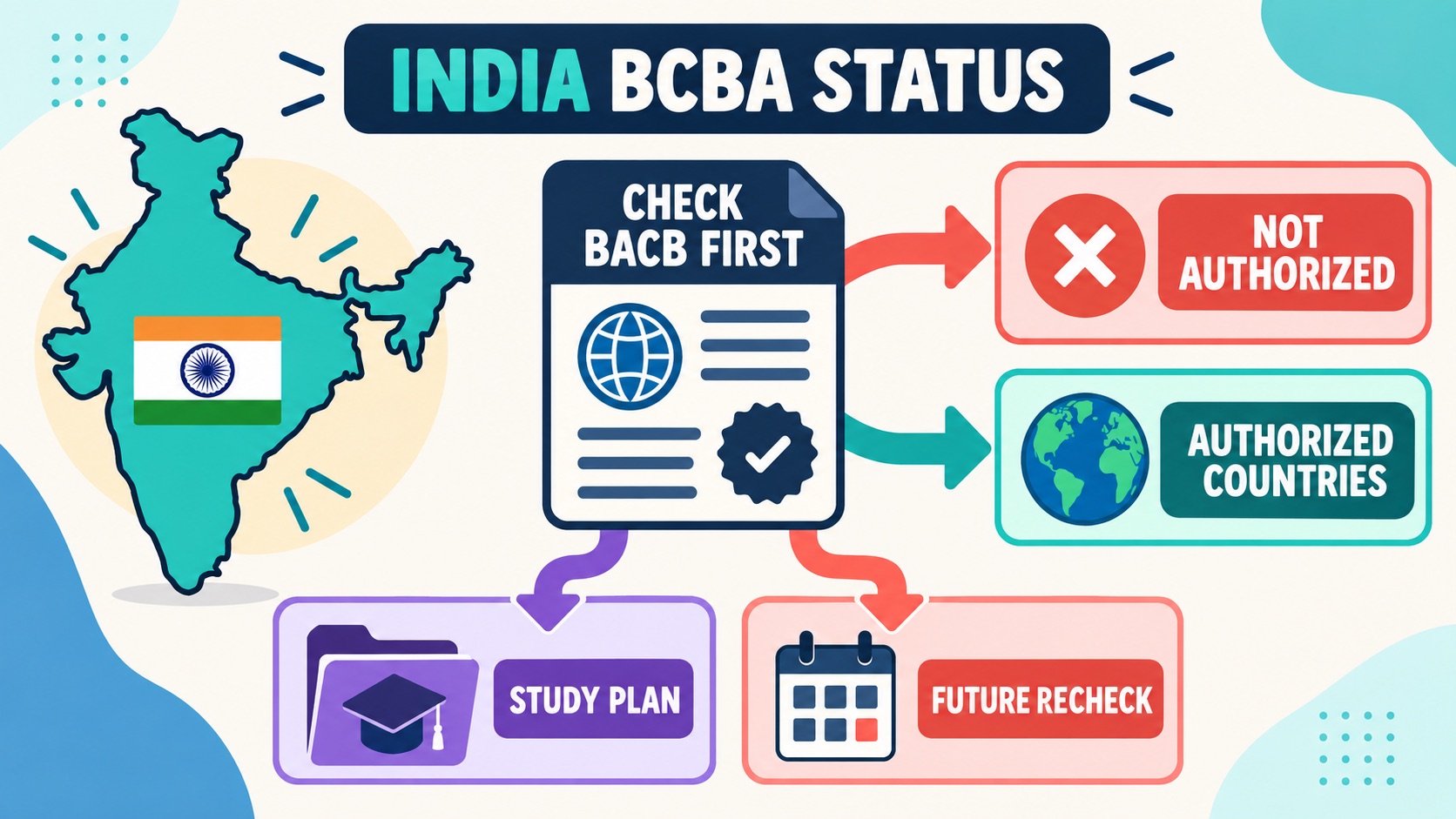
You can study behavior analysis and practice BCBA-style questions from India, but study access is not certification access. A preparation product can help with definitions, application, ethics, measurement, and pacing; it cannot change the BACB’s residence rule, issue an application approval, create supervised fieldwork, or authorize the BCBA title. Be especially careful with advertisements that use phrases such as “BCBA course in India,” “international BCBA certificate,” or “online BCBA certification.” Ask:
- Is the provider a university or an independent course seller?
- Which authority awards the credential?
- Does the program explain current BACB jurisdiction rather than only list exam topics?
- Who will submit coursework attestation, if a future Pathway 2 application requires it?
- Where will real-client fieldwork and qualified supervision occur?
- What local professional title can you lawfully use after completing the course?
Do not schedule a high-stakes examination merely because a provider says you are ready. The BACB’s examination information page explains the application-approval and scheduling sequence. A testing appointment cannot cure an unavailable jurisdiction or incomplete eligibility record.
What can you do while the jurisdiction question is unresolved?
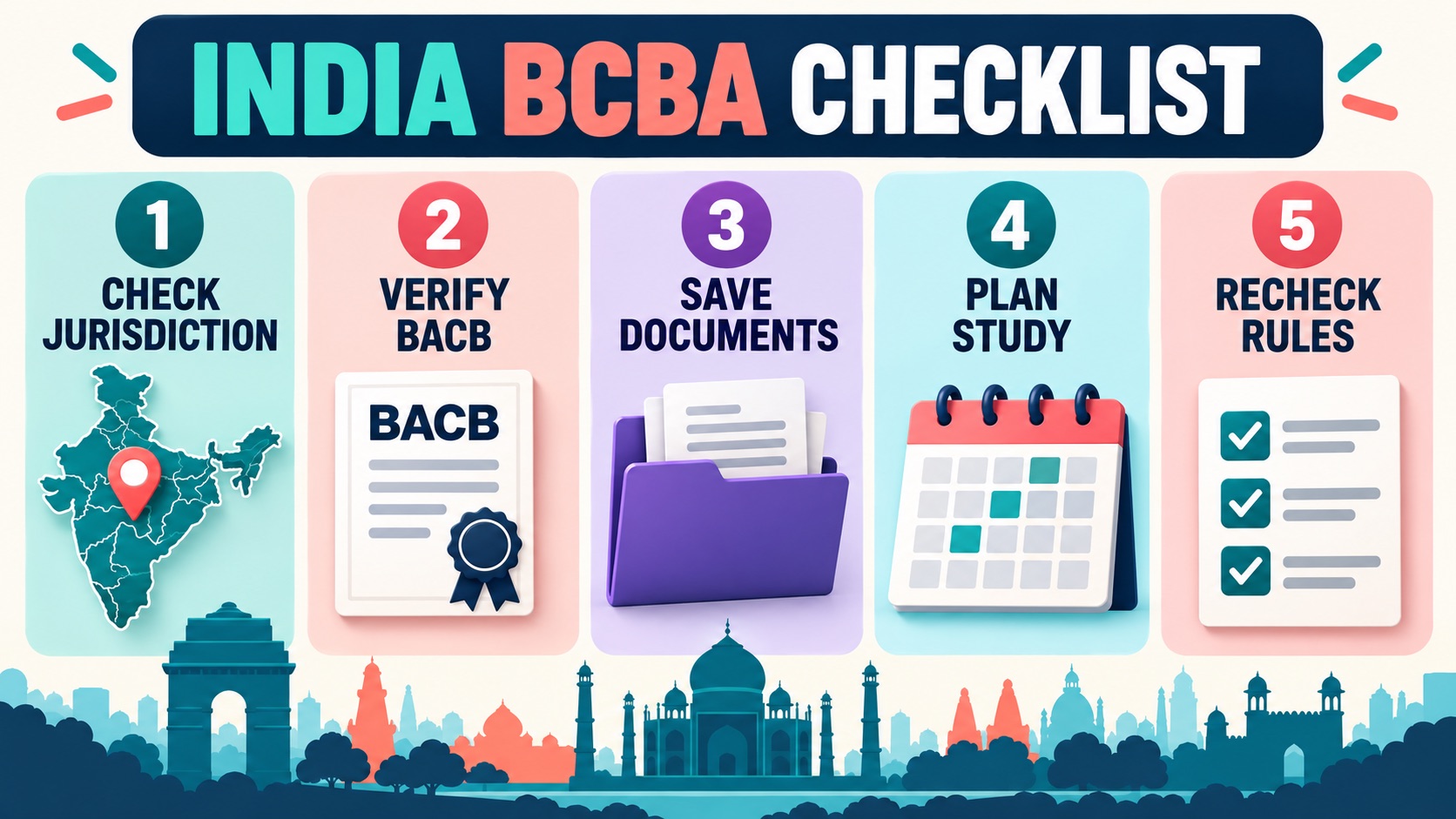
A negative current eligibility answer does not mean you have no productive next step. It means the next step should not be marketed as automatic BCBA certification.
- Build knowledge: study behavior-analytic concepts, research methods, ethics, assessment, intervention, measurement, and data interpretation.
- Compare education carefully: ask institutions how their degree or coursework would be documented if you later reside in an authorized country.
- Track jurisdiction updates: review the BACB international page and change timeline on a planned schedule.
- Learn local rules: identify the Indian employer, institution, or professional body that governs the work you want to perform.
- Protect your title: do not represent yourself as a BCBA unless the BACB has issued and maintained that certification.
- Plan future relocation only with proper advice: if you move, confirm residence, education, fieldwork, degree-equivalency, and immigration questions separately.
For some readers, the right goal may be an Indian academic or professional pathway rather than a BACB credential. For others, the goal may be a future application after a lawful move to an authorized country. The website or course provider should explain which problem it solves.
What should you verify before spending money?
- Verify jurisdiction: open the current BACB international page and confirm whether your actual residence is listed.
- Verify the credential: identify who awards the certificate and whether it is the BACB BCBA credential or an academic completion certificate.
- Verify the route: map degree, coursework, attestation, fieldwork, application, and examination to the correct handbook.
- Verify fieldwork: identify the client setting, qualified supervisor, observation, feedback, privacy, and documentation plan.
- Verify transition dates: recheck the 2027 requirements, 2028 Pathway 2 contact rule, and 2029 degree-equivalency information.
- Verify local practice: ask the employer or relevant Indian authority what work and title are permitted after the program.
- Verify claims: be skeptical of “guaranteed certification,” “BACB-approved India certificate,” and similar promises without current official evidence.
- Verify the date: save the page, URL, and date because international rules can change.
Which India certification mistakes cause problems?
- Assuming an online provider can bypass the BACB’s authorized-country rule.
- Confusing an academic certificate with an active BCBA credential.
- Confusing citizenship or university location with the residence verified by the BACB.
- Believing an Indian course automatically includes BACB-qualifying fieldwork.
- Ignoring the 2027 coursework and pathway transition.
- Missing the 2028 Pathway 2 program-contact jurisdiction requirement.
- Using the BCBA title before the BACB issues certification.
- Paying for an exam appointment before confirming application eligibility.
- Relying on an old page that lists countries whose status has changed.
BCBA certification in India FAQ
Can I become a BCBA while living in India?: The BACB’s current international page lists the United States, Canada, and Australia as authorized countries for new certification applications; India is not listed. Check the current page and contact the BACB for unusual residence or existing-certification facts before treating a new application as available.
Can an online US university give me BCBA certification from India?: A university may offer coursework or a degree, but it does not issue the BACB credential. Online access also does not automatically change your residence jurisdiction. Verify the BACB rule, program-contact status, fieldwork, and application route.
Can I take the BCBA exam from India?: Exam preparation can happen anywhere, but examination scheduling follows BACB eligibility and application approval. A testing appointment cannot replace an eligible residence, education, fieldwork, or approved application.
What if I earned my degree in India but now live in the United States, Canada, or Australia?: Degree location and residence are separate questions. If you reside in an authorized country, ask how the applicable pathway treats your degree, transcripts, equivalency, coursework, and fieldwork. Do not assume either automatic acceptance or automatic rejection.
Will the 2027 BACB change make India eligible?: No. The 2027 requirements change certification eligibility and maintenance details for eligible applicants; they do not themselves add India to the authorized-country list. Recheck the current international page for future updates.
In short, BCBA certification in India is currently a jurisdiction question before it is a coursework or exam question. India is not on the BACB’s current authorized-country list for new certification applications. Study can still be useful, but protect your money and professional title by separating education, future eligibility, local practice, and the credential itself. Recheck the BACB directly before making a new application plan.
Take the Free BCBA Mock Exam
When you are ready to apply the idea, use the free practice resource below for additional feedback. Take the Free BCBA Mock Exam



