
If you are researching BCBA certification Canada, begin with two separate questions: can a person who resides in Canada apply for BACB certification, and what authorization is needed to practice in the province where services will occur? The Behavior Analyst Certification Board (BACB) currently lists Canada among the countries from which it accepts certification applications, but Ontario has a separate 2026 change that affects new BCBA and BCBA-D applications.
Table of Contents
- BCBA certification Canada: what is the short answer?
- What does BCBA certification mean in Canada?
- Can every Canadian resident apply through the BACB?
- What does the Canadian BCBA pathway require?
- What changes for Canadian applicants in 2027?
- What is the Ontario BCBA certification change?
- Does BCBA certification create a provincial license?
- Where can a Canadian candidate take the BCBA exam?
- What should you verify before applying?
- Which Canada certification mistakes cause delays?
- How should Canadian candidates use exam practice?
- BCBA certification Canada FAQ
- Take the Free BCBA Mock Exam
BCBA certification is a national credential administered by the BACB. It is not the same as a provincial license, employer credentialing decision, immigration permission, or a university degree. A Canadian applicant must also plan the applicable degree, behavior-analytic coursework, supervised fieldwork, application, examination, and local practice rules. This guide organizes those decisions using current BACB sources and highlights what to recheck before you apply. It is educational planning information, not legal, licensing, immigration, or clinical advice. Table of Contents
BCBA certification Canada: what is the short answer?
For most Canadian residents outside Ontario, the BACB’s current international guidance says Canada is an authorized country for certification applications. That does not make the process automatic. You still need to meet the BCBA eligibility route that applies to your application date, document the education and supervised fieldwork requirements, submit the application, and pass the examination.
Ontario requires a separate warning. The BACB’s current international and change-timeline materials state that Ontario residents can no longer apply for BCBA or BCBA-D certification as of the 2026 Ontario transition date, while people who already hold those certifications can maintain them under the applicable rules. Because the effective-date language appears across transition materials, an Ontario applicant should confirm the current status directly with the BACB before relying on an older page. The practical route is therefore:
- Identify your province of residence and the location where you will provide services.
- Check whether the BACB currently accepts new applications from that jurisdiction.
- Map your degree, coursework, supervised fieldwork, and documentation to the applicable BCBA handbook.
- Review provincial regulation, employer credentialing, privacy, and title-use rules separately.
- Apply and schedule the examination only after the BACB approves your eligibility.
What does BCBA certification mean in Canada?
The phrase can describe several different goals. A candidate may want the BACB credential for employment, a province may regulate behavior-analytic services separately, or a university may advertise coursework that supports an application. Keeping the labels separate prevents a costly planning error.
- BACB certification: a professional credential issued by the Behavior Analyst Certification Board after the applicable eligibility requirements and exam are met.
- Canadian residence: the country or province where you reside for BACB jurisdiction purposes. Canada is not one uniform practice-regulation answer; Ontario has a special BACB transition.
- Provincial authorization: a license, registration, title restriction, employer requirement, or other provincial rule that may apply to the services you provide.
- Education program: a degree or coursework route that may supply part of BCBA eligibility. Completing a program does not itself issue the BCBA credential.
The BACB’s International Development & Support page is the right starting point for country and province changes. The page also explains that international rules can change as local regulation develops. Pair it with the current BCBA Handbook and your province’s official regulator or employer requirements.
Can every Canadian resident apply through the BACB?
No. “Canada” is the country-level answer, but the BACB’s international rules include a province-specific Ontario exception. Use the following as a routing table, then verify the current official page on the day you plan to submit.
| Residence or status | BACB planning question | What to verify next |
|---|---|---|
| Canadian resident outside Ontario | Is Canada still listed as an authorized country on the current BACB page? | Current handbook, eligibility route, province-specific practice rules, and application date. |
| Ontario resident seeking a new BCBA or BCBA-D application | Does the Ontario transition prevent a new application on the intended date? | BACB international page, Ontario change notice, and direct BACB confirmation before paying or submitting. |
| Existing Ontario BCBA or BCBA-D certificant | Which maintenance, renewal, and local-practice rules continue to apply? | Current BACB maintenance guidance and Ontario regulator or employer requirements. |
| Candidate with a degree or coursework outside the BACB jurisdiction | Will the education route and program contact satisfy the application-date rules? | 2027 pathway rules, 2028 program-contact jurisdiction, 2029 degree-equivalency change, and transcript evidence. |
This is a decision map, not a guarantee of eligibility. The BACB says it cannot determine whether a specific degree, coursework set, or training experience meets certification requirements outside a formal application review. Treat general program marketing as a lead, not as a final determination.
What does the Canadian BCBA pathway require?
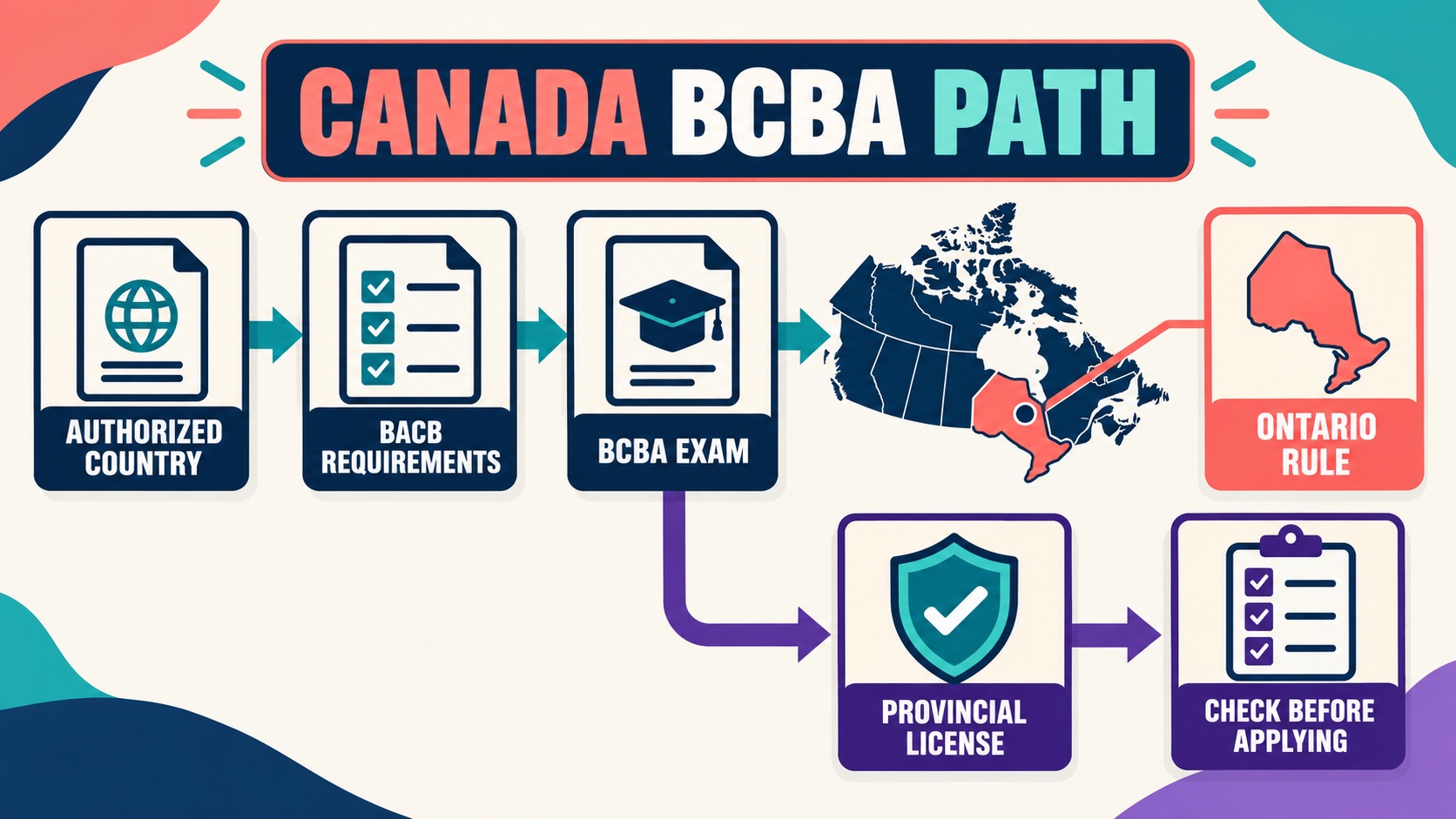
The country does not remove the core certification components. The applicable BACB handbook controls the exact rules, but a candidate should expect to coordinate a qualifying graduate degree, behavior-analytic coursework, supervised fieldwork, the application, and the examination.
The 2027 BACB overview describes two eligibility pathways. Pathway 1 connects a qualifying degree from an accredited or recognized behavior-analysis program with practical fieldwork. Pathway 2 connects a qualifying master’s degree with behavior-analytic coursework and practical fieldwork. Both routes still lead to the application and BCBA examination. Your Canadian university or college may supply one component without supplying all of them. When reviewing an education plan, save:
- the program name, degree level, institution, and catalog year;
- course titles, credits, syllabi, transcripts, and any required coursework attestation;
- the program’s accreditation or recognition status for the relevant pathway;
- the supervisor’s qualifications, contract, and fieldwork documentation plan;
- the dates and version of the BACB handbook used for your records; and
- the provincial or employer rule that determines whether you may provide services.
Do not treat supervised fieldwork as a paperwork afterthought. The supervisor, client setting, activity mix, observation, feedback, and monthly records must fit the rules that apply to your application. If supervision is remote, verify the client connection, consent, privacy, service jurisdiction, and supervisor licensing questions separately.
What changes for Canadian applicants in 2027?
The BACB’s 2027 BCBA Requirements take effect January 1, 2027. A Canadian candidate who is studying in 2026 but applying in 2027 should plan against the new set, not simply copy a 2022 checklist. The current 2027 overview lists:
- 2,000 hours for Supervised Fieldwork or 1,500 hours for Concentrated Supervised Fieldwork;
- 5% or 7.5% supervision per supervisory period, depending on the fieldwork type;
- a minimum of 20 and maximum of 160 fieldwork hours per supervisory period;
- 60 or 90 cumulative minutes of trainee-with-client observation per supervisory period;
- at least 50% of supervised hours as individual supervision; and
- at least 60% of total supervised fieldwork hours in unrestricted activities.
There are also later international changes worth recording. The BACB’s current international page says Pathway 2 program contacts must be affiliated with an institution in a country within the BACB’s jurisdiction beginning January 1, 2028. It also lists a January 1, 2029 degree-equivalency change for Pathway 1 applicants educated outside the United States. These dates matter if your program, degree, or attestation crosses an international boundary.
Use the official 2027 transition announcement and the transition guidance to decide which forms and application date apply. The examination content is a separate question from the eligibility transition; do not assume that a requirements change automatically means the exam blueprint changed.
What is the Ontario BCBA certification change?
Ontario is the most important Canada-specific exception in the current BACB materials. The BACB’s international guidance and change timeline state that Ontario residents will no longer be able to apply for BCBA or BCBA-D certification after the 2026 transition date, while existing BCBA and BCBA-D certificants may maintain their certification under the applicable rules.
If you live in Ontario and are planning a new application, do not rely on a Canadian university page or an old forum answer. Check the current BACB notice, contact the BACB if your facts are unusual, and confirm what provincial practice rules apply. If you are moving between provinces, keep evidence of your residence and application timeline; a move can change which jurisdictional question must be answered.
Ontario’s certification rule and Ontario’s practice regulation are not identical questions. Even someone who holds a BACB credential must check the current provincial framework, employer requirements, title use, supervision rules, and privacy obligations. A national credential can support a professional plan without answering every local practice question.
Does BCBA certification create a provincial license?
No. Provincial authorization can involve a regulator, employer, payer, school system, or other local rule. The exact answer depends on where services are provided, what title is used, the setting, and the population served. A Canadian candidate should identify the service province separately from the province of residence. Before accepting work, ask:
- Does the province regulate behavior analysts or restrict a professional title?
- Does the employer require a current BCBA certificate, a provincial registration, or both?
- Are there rules for remote supervision, client consent, records, and cross-province services?
- Does the payer or school system use its own credentialing checklist?
- Which local authority should answer a practice or title question?
Start with the official BACB international page, then open the provincial regulator or employer source that applies to your service location. Keep the date and URL in your professional file. “Eligible to apply for BCBA certification” is not the same statement as “authorized to practice independently in every Canadian province.”
Where can a Canadian candidate take the BCBA exam?
After the BACB approves your certification application, the examination is scheduled through Pearson VUE under the BACB’s process. The BACB’s examination information page says testing sites are authorized in Canada, although availability and scheduling are handled through the testing system. Check the current handbook for application approval, identification, rescheduling, security, and retake rules.
Exam logistics should be planned after eligibility, not used as proof that you are eligible. A nearby testing site does not replace coursework or fieldwork. Conversely, a candidate who has a strong fieldwork record can still benefit from a structured diagnostic and application practice before scheduling.
What should you verify before applying?
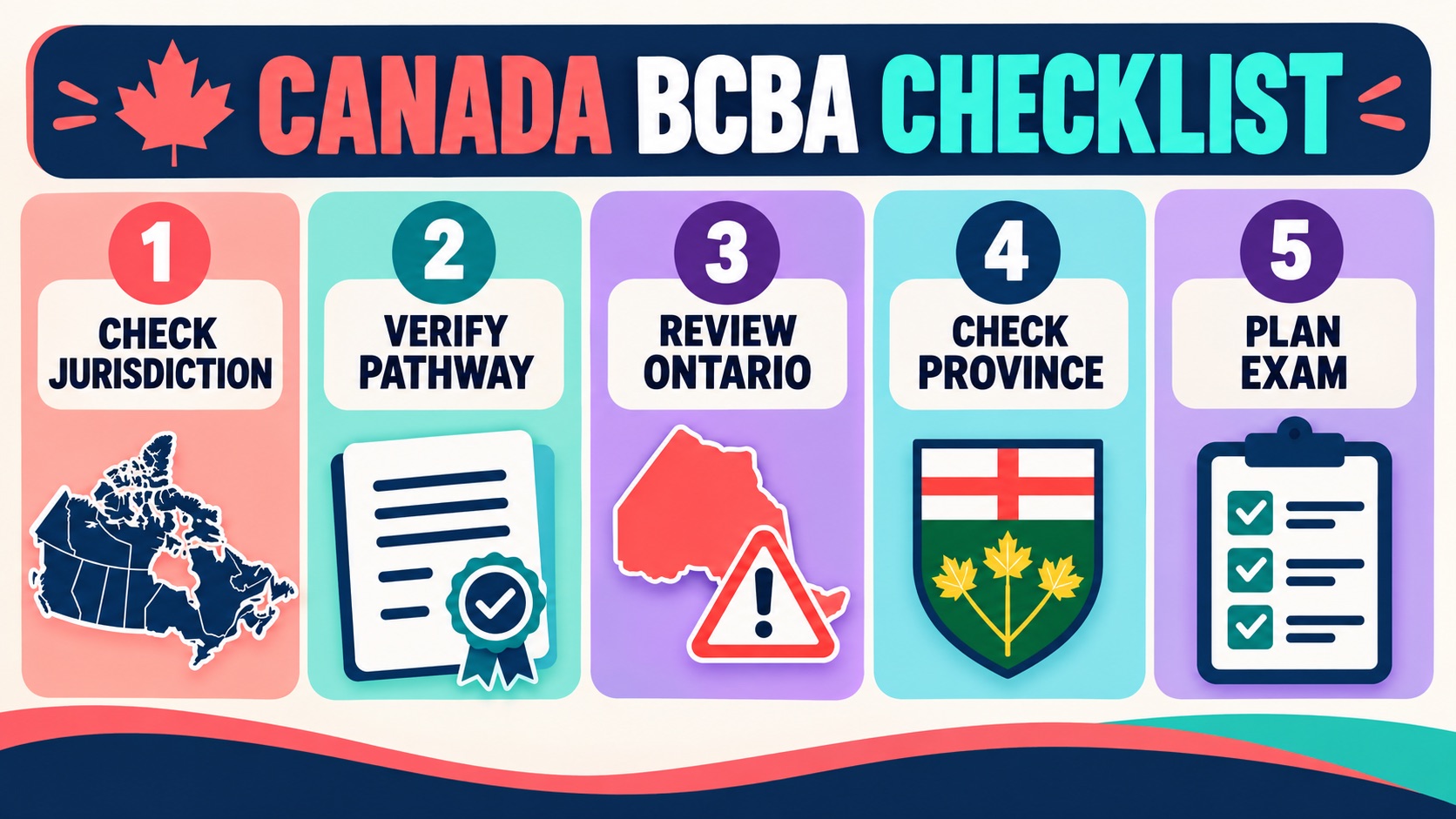
- Check jurisdiction: record your residence, service province, and intended application date. Flag Ontario immediately if it is relevant.
- Check the route: decide whether your plan uses Pathway 1 or Pathway 2 under the requirements that will apply when you apply.
- Check the education file: collect degree records, coursework, syllabi, transcripts, accreditation or recognition evidence, and attestations.
- Check fieldwork: confirm a qualified supervisor, real-client setting, activity classification, observation, feedback, and monthly record process.
- Check international dates: if a program contact or degree is outside the BACB jurisdiction, review the 2028 and 2029 changes.
- Check provincial practice: identify the local regulator, title rule, employer requirement, and remote-service condition.
- Check the exam: use the current BACB handbook and examination page before paying, scheduling, or relying on an old testing-center list.
- Check every source date: save a PDF or link and record when you verified the rule.
Which Canada certification mistakes cause delays?
- Using “Canada” as if every province has the same BACB application rule.
- Missing the Ontario-specific restriction on new BCBA or BCBA-D applications.
- Confusing a university degree or course sequence with BACB certification.
- Assuming a Canadian program automatically supplies supervised fieldwork.
- Ignoring the 2027 pathway, fieldwork, form, or coursework changes.
- Overlooking the 2028 program-contact and 2029 degree-equivalency international dates.
- Assuming a BACB credential is the same as provincial licensure or employer approval.
- Scheduling the examination before the BACB approves the certification application.
- Relying on an old Ontario, Australia, UK, or forum answer after the official rule changed.
How should Canadian candidates use exam practice?
Exam preparation is the last gate in a larger plan. A mock exam cannot replace a degree, coursework attestation, supervised fieldwork, an approved application, or provincial authorization. It can help you test whether you can apply concepts under time pressure after the eligibility record is organized. Use a measured loop:
- Take a timed diagnostic aligned with the current BCBA Test Content Outline.
- Sort misses into concept, application, ethics, calculation, and pacing errors.
- Review why each distractor fails and connect the correction to a source concept.
- Retest the same skill in a new scenario, then record whether the error changed.
Our free BCBA mock exam can be a study checkpoint while you organize a Canadian certification plan. It is not BACB certification, provincial licensing advice, immigration advice, supervision, or a guarantee of a passing result.
BCBA certification Canada FAQ
Can Canadian residents apply for BCBA certification?: The BACB currently lists Canada as an authorized country for certification applications, but Ontario has a separate restriction on new BCBA and BCBA-D applications after the 2026 transition. Check the current BACB international page for your province and application date.
Can an Ontario resident start a new BCBA application?: Do not assume so. The current BACB materials state that Ontario residents can no longer apply for BCBA or BCBA-D certification after the 2026 transition date. Confirm directly with the BACB if your residence, application, or existing certification status is unusual.
Is BCBA certification the same as a Canadian provincial license?: No. The BACB credential is national and the province may have separate practice, title, employer, payer, privacy, or registration rules. Check the province where services will occur.
What changes in 2027 for a Canadian BCBA applicant?: The BACB changes eligibility and maintenance requirements on January 1, 2027, including pathways, fieldwork figures, supervision, observations, forms, and documentation. Later international changes affect Pathway 2 program contacts in 2028 and certain degree-equivalency questions in 2029.
Can I take the BCBA exam in Canada?: The BACB authorizes testing sites in Canada, but you must first meet the applicable eligibility requirements, receive an approved determination, and schedule through the current examination process. Site availability is not a substitute for eligibility.
In short, BCBA certification Canada is a jurisdiction-and-documentation question before it is an exam question. Confirm Canada or Ontario status, map the correct BACB pathway, preserve education and fieldwork evidence, check provincial practice rules, and recheck the 2027 transition before you submit. That sequence gives you a defensible plan without turning a national credential into a promise of automatic local authorization.
Take the Free BCBA Mock Exam
When you are ready to apply the idea, use the free practice resource below for additional feedback. Take the Free BCBA Mock Exam



