
If you are searching for BCBA certification Rutgers, the most important clarification is that Rutgers University does not award the BCBA credential itself. Rutgers offers graduate degrees and ABA coursework that may support the academic portion of a BCBA application; the Behavior Analyst Certification Board (BACB) controls certification eligibility, the application, and the examination.
Table of Contents
- BCBA certification Rutgers: what is the short answer?
- Which Rutgers program options should you compare?
- How does Rutgers coursework fit BACB eligibility?
- Does Rutgers include all BCBA fieldwork?
- What changed for Pathway 2 in 2026?
- What should Rutgers students recheck for 2027?
- Does a Rutgers program create a state license?
- What should you verify before enrolling?
- Which Rutgers BCBA planning mistakes are common?
- When should you add BCBA exam practice?
- BCBA certification Rutgers FAQ
- Take the Free BCBA Mock Exam
Rutgers has more than one relevant academic route. Its Ed.M. in Special Education with an Applied Behavior Analysis sequence is a 36-credit degree that includes special-education and ABA coursework, while Rutgers GSAPP also describes a stand-alone ABA certificate and master’s programs built around a seven-course ABA sequence. The school pages state that additional requirements remain, including an extra course in some routes and supervised fieldwork outside the program. This guide maps those pieces and flags where current BACB 2026/2027 rules require a fresh verification. It is educational planning information, not admissions, licensing, legal, or clinical advice. Table of Contents
BCBA certification Rutgers: what is the short answer?
Rutgers can provide a graduate degree and/or behavior-analytic coursework that supports a BCBA plan, but completing a Rutgers program does not automatically make you a BCBA. You must still satisfy the BACB requirements that apply to your application date, complete qualifying supervised fieldwork, submit an approvable application, and pass the BCBA examination.
The Rutgers Ed.M. ABA Sequence page describes a 36-credit master’s program with 15 credits of special-education core courses, 18 credits of ABA core courses, and a 3-credit elective. It says the sequence provides six of seven courses connected to BCBA exam coursework, while an additional personnel-supervision course is needed for the academic exam-eligibility requirement and is not currently included in that degree program. It also says additional fieldwork experience is required.
The Rutgers GSAPP pages describe a separate Certificate in ABA and other graduate programs. The school’s current program information says the ABA coursework is verified toward academic requirements but that a graduate degree, supervised experience, and a passing examination are still needed. So the short answer is: Rutgers may solve part of your education plan; it does not replace the BACB application or fieldwork plan.
Which Rutgers program options should you compare?
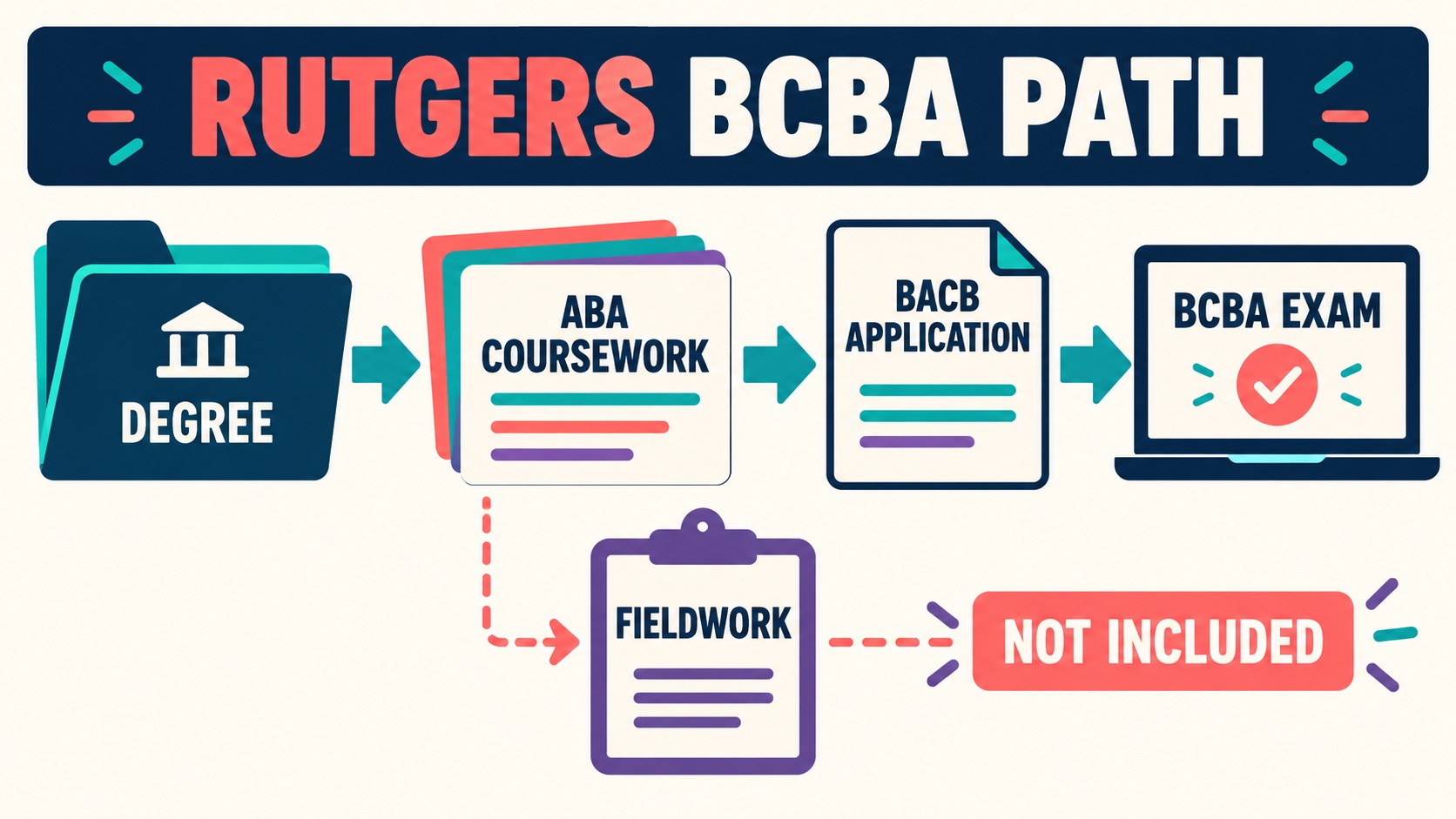
Choose based on the requirement you are missing, not only on the word “certification.” A person who already has a qualifying master’s degree may compare the stand-alone certificate; a person who still needs the degree may compare a master’s route. A teacher may find the Ed.M. ABA sequence attractive because it combines special education and ABA, while another candidate may need a different degree structure.
| Rutgers route to investigate | What the Rutgers pages describe | What remains separate | Best comparison question |
|---|---|---|---|
| Ed.M. in Special Education with ABA sequence | 36-credit graduate degree with special-education core, ABA core, elective, and six of seven ABA courses described for exam preparation. | The seventh academic course, supervised fieldwork, BACB application, examination, and any state license. | Do I need a master’s degree plus special-education preparation, and how will I complete the missing course? |
| Stand-alone Certificate in ABA | A graduate ABA coursework route; Rutgers says a stand-alone certificate applicant must already have a master’s degree. | Current Pathway 2 attestation, fieldwork, application, examination, and state requirements. | Does the current program have an authorized Pathway 2 Program Contact for my application year? |
| MABA, MAP-ABA, or another graduate ABA route | Graduate study with ABA coursework; Rutgers describes these programs as meeting academic coursework requirements toward a BACB credential. | Qualifying degree details, current coursework attestation, fieldwork, exam, and local licensure. | Which exact degree and course sequence will appear on the transcript and attestation? |
The table is a comparison tool, not an admissions ranking. Ask Rutgers which route is currently offered, what format applies, whether courses are in person or hybrid, and what the current catalog says for your intended start date.
How does Rutgers coursework fit BACB eligibility?
Rutgers coursework is an academic component, not the entire credential. The current Rutgers pages use language such as “coursework required to sit for the BCBA exam” and “verified toward coursework requirements.” Read that wording literally: it addresses academic preparation or eligibility, not an automatic exam approval or certification.
For the Ed.M. ABA sequence, Rutgers identifies six ABA core courses in the degree and names an additional seventh course, Personnel Supervision and Management in ABA, as needed for the academic exam-eligibility requirement. The Rutgers catalog entry gives the same planning warning and says the extra course and experience requirements are not currently included in that degree program.
For a stand-alone certificate, Rutgers’ current admissions page says an applicant must already hold a master’s degree and submit application materials such as a transcript, personal statement, resume, and recommendation. That is a different starting point from a master’s route. Save the exact program page and ask:
- Which courses count toward the current BACB coursework categories?
- Is there an active Pathway 2 Program Contact who can attest to the coursework?
- Which course, if any, is outside the degree or certificate plan?
- Will the transcript show the course titles and credits required by the application-date rules?
- Does the program’s older reference to the 5th Edition Task List need a current 2027 mapping?
Do not rely on a screenshot of an older course list. Coursework must be evaluated against the BACB rules in effect when you apply, and the institution must be able to provide the required documentation.
Does Rutgers include all BCBA fieldwork?
Do not assume it does. The current Rutgers GSAPP information says the program encourages students to obtain ABA-related fieldwork but does not place students or guarantee completion of all BACB fieldwork hours. The Ed.M. page similarly says additional fieldwork experience requirements remain. Before enrolling, build a separate fieldwork file:
- supervisor name, active BCBA status, and applicable supervision training;
- client setting, employer, service jurisdiction, and access to real clients;
- supervision contract, observation, feedback, and meeting schedule;
- restricted or unrestricted activity classification under the current rules;
- monthly and final verification forms for the application version; and
- privacy, consent, remote-delivery, and state-license checks where relevant.
A Rutgers course can teach you how to analyze behavior, design interventions, or interpret data. It does not automatically create a compliant fieldwork record. Ask who will supervise you, where the client work will occur, how records will be reviewed, and what happens if you change employers or supervisors.
What changed for Pathway 2 in 2026?
The BACB changed how Pathway 2 coursework is documented after ABAI discontinued its Verified Course Sequence system. The BACB’s university training guidance says that a designated Pathway 2 Program Contact reviews coursework and, when appropriate, submits a coursework attestation to the BACB.
This matters for a Rutgers candidate because an older page saying that ABAI verified a course sequence may not answer the current documentation question. Ask the program whether it has an active Pathway 2 Program Contact, whether that person will attest to your completed sequence, and how your transcripts will be sent. The current BACB handbook requires official transcripts and the applicable attestation for the Pathway 2 route.
If your program or course record was completed under an earlier system, save the date of any attestation and ask the BACB how the transition applies. The safest evidence is a current written answer from the institution plus the current handbook—not a generic claim that the university was once a verified course sequence.
What should Rutgers students recheck for 2027?
The 2027 BCBA Requirements take effect January 1, 2027. Rutgers pages that reference the 5th Edition Task List or older ABAI verification should be reconciled with the BACB’s current 2027 coursework and attestation rules. The 2027 Pathway 2 coursework overview includes:
- 45 instructional hours in Basic Principles of Behavior in one freestanding course;
- 45 hours in Theory and Philosophy in Behavior Analysis in one freestanding course;
- 45 hours in Research Methods in Behavior Analysis in one freestanding course;
- 90 hours in Behavior Assessment and Intervention across two freestanding courses;
- 45 hours in Organizational Behavior Management in one freestanding course;
- 45 hours in Ethics in Behavior Analysis in one freestanding course; and
- 315 total instructional hours, with the other degree, fieldwork, application, and exam requirements still separate.
Also recheck the 2027 fieldwork rules: 2,000 hours for Supervised Fieldwork or 1,500 for Concentrated Supervised Fieldwork, supervision percentages, observation minutes, individual supervision, unrestricted activities, and new forms. The BACB transition announcement says a complete application received by December 31, 2026 is evaluated under the current requirements; later applications need the new set.
Does a Rutgers program create a state license?
No. Rutgers’ professional-licensure disclosure explains how its ABA programs relate to national certification and state requirements, but the academic program is not the same as a New Jersey or another state license. Your answer depends on the state where services will occur, the title you use, the employer, the population, and the rules in force when you apply. Before choosing a Rutgers route, identify:
- whether your intended state requires a separate behavior-analyst license;
- whether a graduate certificate is treated differently from a master’s degree;
- whether the state accepts the exact Rutgers program and course sequence;
- whether remote supervision or cross-state service adds a license condition; and
- which state board or employer should confirm the current answer.
“Rutgers coursework is verified toward BCBA academic requirements” is not the same as “you will automatically be licensed.” Keep the state source and date with your academic records.
What should you verify before enrolling?
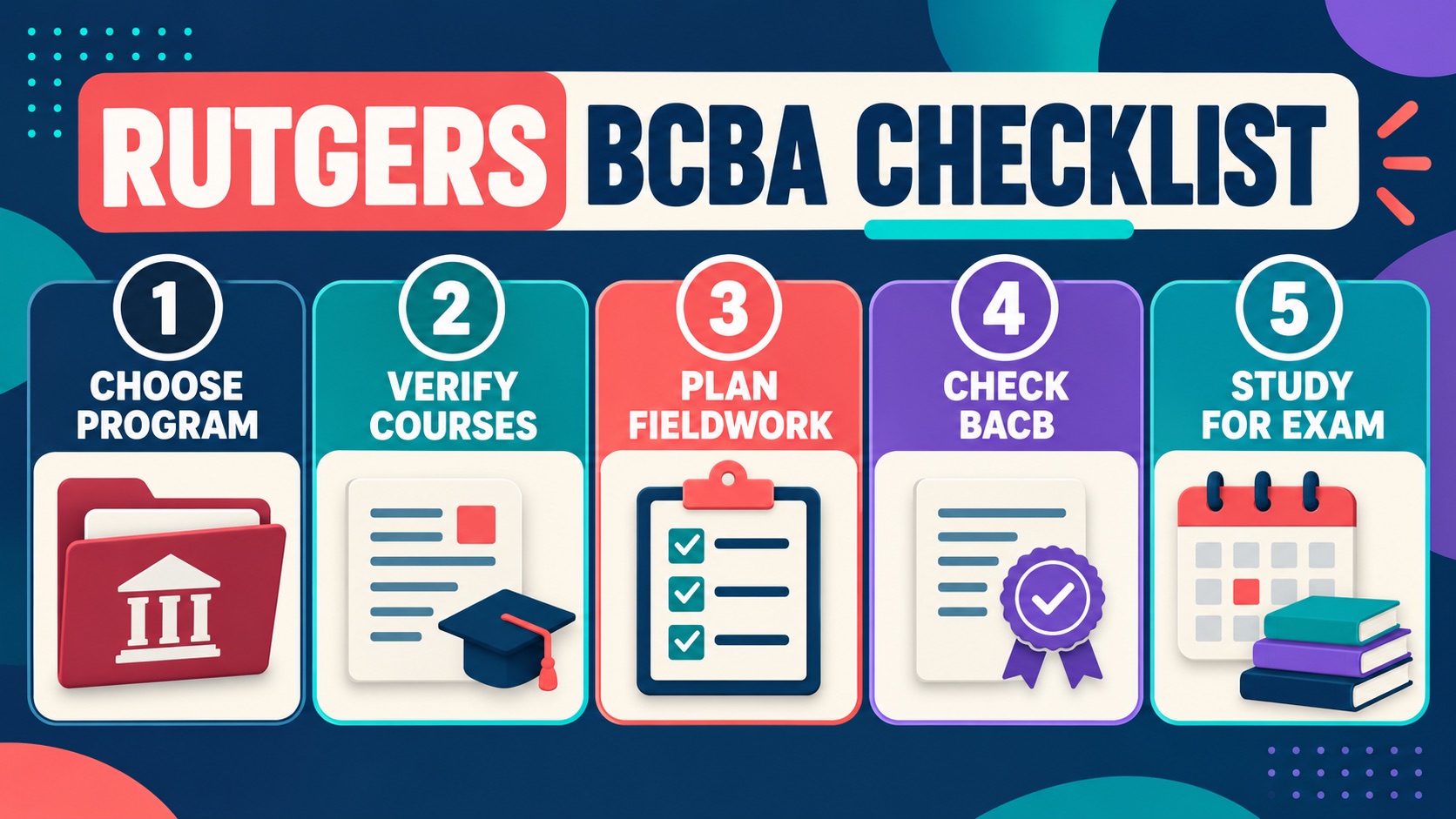
- Choose the exact program: record Ed.M., certificate, MABA, MAP-ABA, or another route, plus campus, format, catalog year, and credits.
- Map the coursework: list every ABA course, identify the extra seventh course where applicable, and compare current content with the 2027 BACB categories.
- Verify attestation: ask for the current Pathway 2 Program Contact and how the institution will submit the coursework attestation.
- Plan fieldwork: find the supervisor, client setting, schedule, forms, privacy process, and hour-tracking system before counting time.
- Check the degree rule: confirm whether your existing or planned graduate degree meets the pathway you intend to use.
- Check state authorization: compare Rutgers’ disclosure with the state board and employer where you plan to work.
- Check transition dates: decide which requirement version and form set apply to your application date.
- Save written evidence: keep program pages, catalog entries, course descriptions, transcripts, and answers from admissions or the program contact.
Which Rutgers BCBA planning mistakes are common?
- Calling a Rutgers degree or certificate the BCBA certification itself.
- Assuming six ABA courses in the Ed.M. automatically equal the full academic requirement.
- Forgetting the additional seventh course described by Rutgers.
- Assuming Rutgers places or guarantees all supervised fieldwork hours.
- Relying on a 5th Edition Task List or old VCS statement without checking the current BACB attestation system.
- Ignoring the 2027 freestanding-course and content-hour requirements.
- Reading a professional-licensure disclosure as a personal license guarantee.
- Changing programs or transferring coursework without collecting every transcript and course record.
- Scheduling the BCBA exam before the BACB approves the complete application.
When should you add BCBA exam practice?
Exam practice is useful after you understand the education and fieldwork plan, not as a substitute for either. Rutgers coursework can build conceptual knowledge; a diagnostic can show whether you can discriminate and apply that knowledge under time pressure. Neither one replaces the BACB application or supervised experience. Use a measured loop:
- Take a timed diagnostic aligned with the current BCBA Test Content Outline.
- Sort missed questions into concept, application, ethics, calculation, and pacing errors.
- Review why each distractor fails and connect the correction to the course concept.
- Retest the same skill in a new scenario and log whether the error changed.
Our free BCBA mock exam can be a study checkpoint while you compare Rutgers options and build your fieldwork plan. It is not Rutgers admissions advice, BACB certification, supervision, state licensing advice, or a guarantee of a passing result.
BCBA certification Rutgers FAQ
Does Rutgers issue the BCBA certification?: No. Rutgers offers academic degrees and ABA coursework. The BACB determines eligibility, approves applications, and administers the national examination. Does the Rutgers Ed.M. ABA sequence include all BCBA coursework?: The current Rutgers Ed.M. page describes six of seven ABA courses in the degree and identifies an additional personnel-supervision course needed for the academic exam-eligibility requirement. Verify the current course map and BACB 2027 requirements for your start and application dates.
Does Rutgers include supervised fieldwork?: Do not assume so. Rutgers pages say students must meet additional fieldwork requirements and that the program does not place or guarantee completion of all BACB fieldwork hours. Plan supervision and real-client experience separately.
Is the Rutgers ABA certificate enough for a BCBA application?: Rutgers says a stand-alone certificate applicant must already have a master’s degree. You still need the current Pathway 2 documentation, supervised fieldwork, an approvable application, and the exam. Confirm the active program-contact and attestation process.
What is the biggest 2027 Rutgers check?: Compare Rutgers’ current course and catalog language with the BACB’s 2027 content-hour, freestanding-course, attestation, fieldwork, and form requirements. Older references to the 5th Edition Task List or ABAI verification should not be treated as the final application rule.
In short, Rutgers can be a strong academic component of a BCBA plan, but “BCBA certification Rutgers” is not a one-click credential. Choose the exact program, verify the missing coursework, confirm the current BACB attestation route, secure fieldwork independently, check state authorization, and only then use exam practice as the final preparation step.
Take the Free BCBA Mock Exam
When you are ready to apply the idea, use the free practice resource below for additional feedback. Take the Free BCBA Mock Exam



