
A practical, source-aware way to evaluate BAS-style BCBA exam preparation, use mock exams, and turn missed questions into your next study block If you searched for BAS BCBA exam prep, you are probably trying to answer two questions at once: “Is this preparation resource a good fit for me?” and “What should I do with the questions I miss?” Those are useful questions, but the acronym needs a boundary. In current search results, BAS commonly refers to Behavior Analyst Supervisor, a third-party BCBA preparation provider. BAS is not the Behavior Analyst Certification Board (BACB), and a commercial preparation product is not an official BACB requirement or endorsement.
Table of Contents
- What Does BAS BCBA Exam Prep Mean?
- Start With the TCO, Not the Brand
- What a Serious Prep Resource Should Include
- A Resource-Comparison Checklist
- Use Practice Questions as Diagnosis
- Build a Baseline-to-Review Study Loop
- BAS Prep Decision Table
- A Four-Week Implementation Plan
- Common BCBA Prep Mistakes
- Choose Your Next Practice Action
- Quick Review Checklist
- Take the Free BCBA Mock Exam
The best way to evaluate any prep system—including BAS, a university resource, a study guide, or a mock-exam platform—is to inspect the learning evidence rather than the marketing promise. Does it map to the current BCBA 6th Edition Test Content Outline? Do its explanations show why distractors are wrong? Can you track errors by skill? Does it tell you when its materials were updated? This guide gives you a reusable framework and a study loop. It does not rank BAS, claim affiliation, or guarantee a score.
Source note: Use the current BACB Handbook and TCO for certification and examination facts. Treat third-party preparation products as study aids. Never use a practice question as evidence that you have seen a protected live exam item.
What Does BAS BCBA Exam Prep Mean?
In the context of this query, BAS is a third-party preparation brand associated with BCBA study materials, video instruction, domain practice, and mock exams. The exact package, access terms, update schedule, and support options can change, so verify them on the provider’s current page before buying or relying on a feature. The useful SEO question is not “Is BAS magically the best?” It is “What evidence should I expect from a BCBA preparation system, and how will I know whether it is helping?”
A preparation resource should help you perform the type of reasoning the exam requires: read a scenario precisely, identify the relevant behavior-analytic principle, discriminate between plausible answers, check measurement and function, and respect ethical and professional boundaries. It should not encourage memorizing a vendor’s wording as if that wording were BACB policy. Keep three layers separate:
- Official requirements: BACB eligibility, application, examination, and candidate rules.
- Study instruction: explanations, videos, flashcards, concept reviews, and examples produced by a third party.
- Readiness evidence: your performance on original practice questions, timed sets, and full-length simulations.
Start With the TCO, Not the Brand
Before comparing BAS with another provider, open the current 6th Edition TCO. It organizes the exam content into nine domains and describes the tasks and knowledge expected at entry-level BCBA practice. The outline is not a vendor study plan, but it is the best scope check: a product that cannot tell you what part of the TCO it addresses is difficult to audit.
Map a resource in two directions. First, check coverage: does it touch the domains and tasks that you need? Second, check depth: does it ask you to apply concepts to scenarios, or does it only provide short definitions? A colorful list of terms may help with recall, but a candidate who misses questions because of stimulus control, measurement selection, function, or ethics needs discriminations and worked reasoning—not just more vocabulary.
Also check the date. BACB requirements and handbooks can change, and the 2027 transition makes old checklists especially risky. The BACB 2027 requirements page should be the authority for eligibility planning. A prep product can explain a study strategy, but it cannot decide which eligibility route applies to your transcript or fieldwork.
What a Serious Prep Resource Should Include
Whether you are reviewing BAS or another BCBA exam-prep option, look for six practical signals.
- Current scope: the resource identifies the TCO edition and explains when its content was last reviewed.
- Scenario practice: questions require you to choose a measurement, intervention, assessment step, or ethical response in context.
- Useful rationales: explanations identify the clue that supports the best answer and explain why the distractors fail.
- Error visibility: you can record the domain, task, error type, and correction instead of seeing only a percentage.
- Multiple practice modes: targeted drills, mixed sets, and timed simulations serve different stages of preparation.
- Honest boundaries: the provider does not promise certification, claim access to live items, or imply BACB endorsement without evidence.
Features matter only when they change your behavior. A large question bank is not automatically valuable if you repeat the same easy items. A video library is not automatically useful if you watch passively and never test transfer. The resource should make it easier to identify a weak discrimination, practice it, and see whether the error rate changes later.
A Resource-Comparison Checklist
Do not compare programs by price or question count alone. Write down the questions below and ask the provider—or ask yourself, if you are reviewing a resource you already own—where the evidence is visible. The goal is a decision you can defend, not a perfect prediction.
| Feature to check | Learner need | Verification question |
|---|---|---|
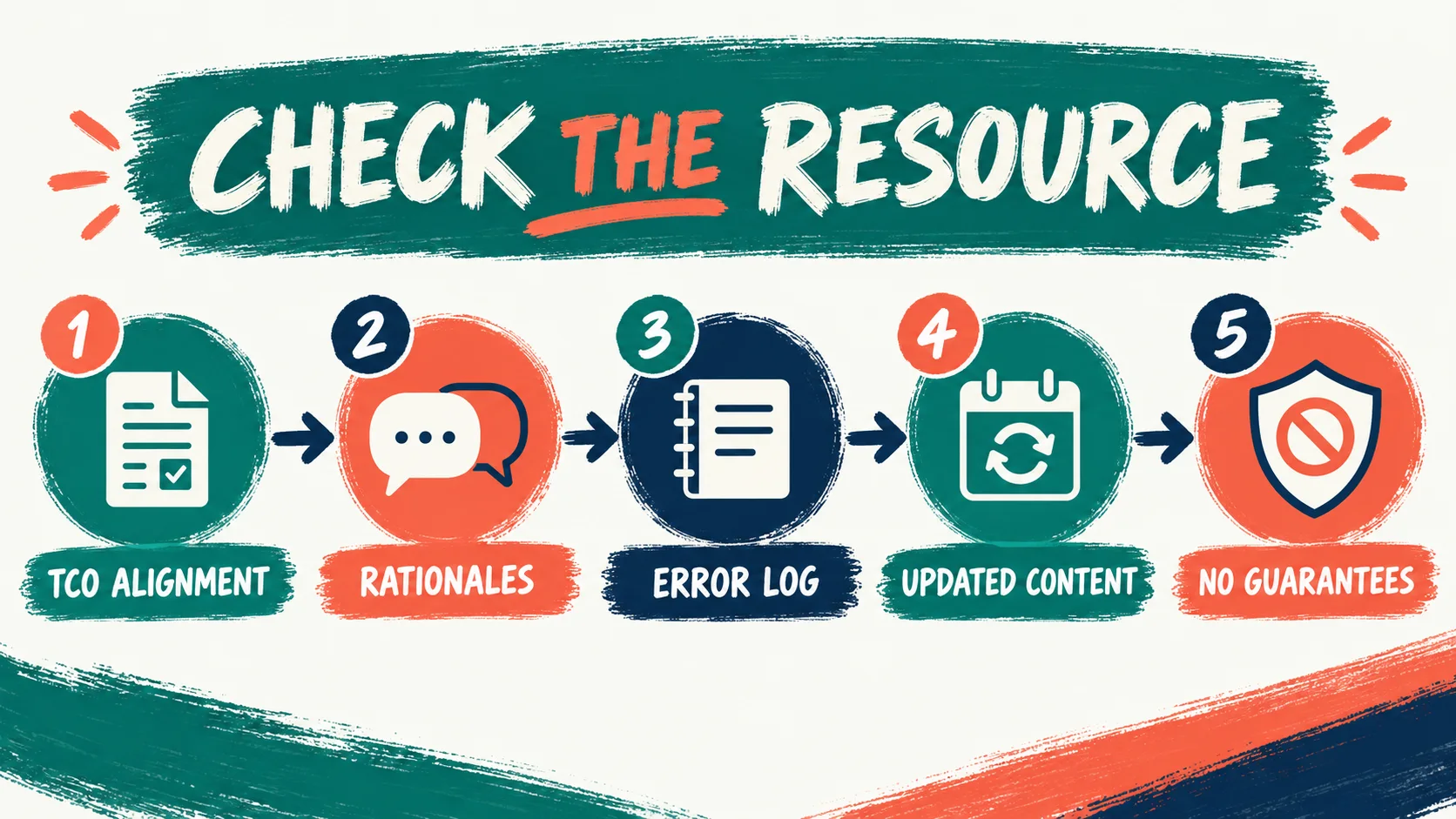
| TCO alignment | Know what each lesson or question is meant to develop | Does the product name the current TCO edition and task connection? |
| Rationales | Turn a wrong answer into a usable rule | Does the explanation address the correct answer and the tempting distractors? |
| Error tracking | Find patterns instead of chasing random topics | Can you export, tag, or otherwise review your missed-question history? |
| Update policy | Avoid studying requirements or terminology that no longer apply | When were the lessons, forms, and practice sets last reviewed? |
| Simulation quality | Practice pacing and decision-making under a realistic time limit | Can you take a fresh timed set and review it without seeing repeated answers? |
Use Practice Questions as Diagnosis
A practice set is most useful when it explains the next action. After each missed question, classify the error before reading more content. Was it a knowledge error, where you did not know the definition? A discrimination error, where you confused two plausible concepts? A stimulus-control error, where you ignored the part of the scenario that should control your answer? A measurement or ethics error, where the selected answer skipped a required safeguard?
Write a short correction in your own words. For example: “I selected frequency because I noticed repeated responses, but the question asks how long the response lasted; duration is the better measure.” That sentence is more valuable than circling the correct letter. Then create one new example and one non-example. If you cannot do that, the concept is not yet fluent.
Do not treat a BAS mock score—or any vendor’s score—as a pass prediction. Scores depend on item difficulty, overlap with previous practice, timing, guessing, and the conditions of the attempt. Use a fresh set to test transfer, compare performance by domain, and watch whether the same error category returns.
Build a Baseline-to-Review Study Loop
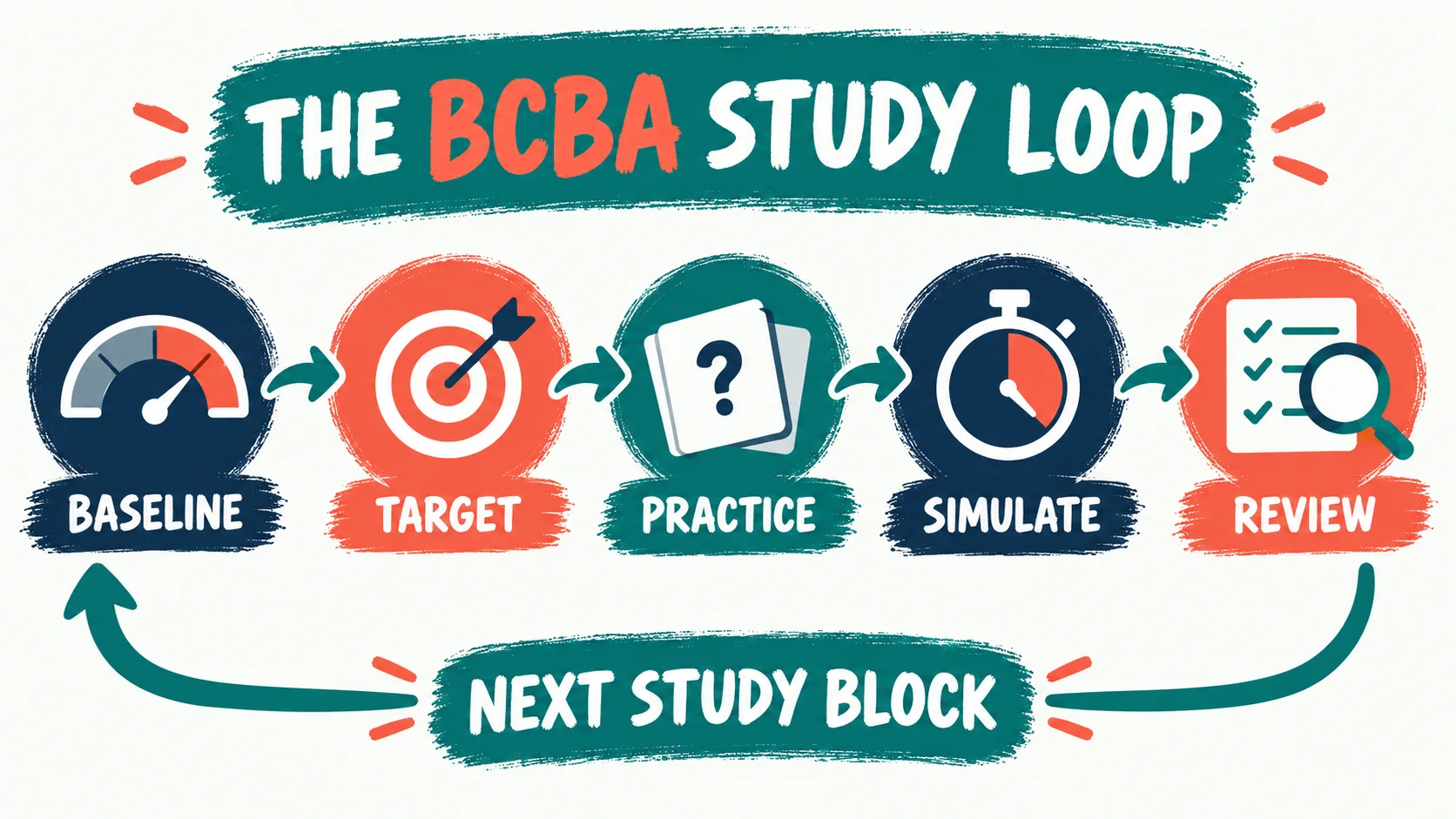
A reliable BCBA study loop has five stages. Baseline means taking a mixed or diagnostic set before you redesign your plan. Target means choosing the smallest set of skills that explains a meaningful share of your errors. Practice means using short, focused scenarios with written rationales. Simulate means taking a timed, mixed set with fresh items. Review means classifying errors and choosing the next study block.
Keep the loop small enough to repeat. If your first mock reveals weaknesses in measurement, ethics, and assessment, do not try to “finish all three domains” in one evening. Choose one discrimination, such as continuous versus discontinuous measurement, and define what a correct decision would look like. Then return to mixed practice to see whether the skill transfers when the question no longer announces the topic.
The BCBA exam question guide can help you slow down the wording and identify common traps. The 6th Edition Quick Study Guide can serve as a compact review layer. Use either as part of the loop, not as a substitute for checking the current BACB sources.
BAS Prep Decision Table
Use this table after a diagnostic set. It keeps your decision tied to observable evidence rather than anxiety or a single score.
| What you observe | Likely next step | What to record |
|---|---|---|
| Errors cluster in one concept and you cannot explain the rule | Review the concept, create examples, then complete a short targeted set | Concept, correct rule, example, non-example |
| You know the terms but miss the scenario cue | Practice discrimination and underline the controlling facts before answering | Missed cue, tempting distractor, decision rule |
| Accuracy is acceptable untimed but drops sharply under time pressure | Add short timed blocks before attempting another full simulation | Time per item, skipped items, changed answers, fatigue point |
| The same error returns after review | Use a new example and ask for feedback from a qualified instructor or supervisor | Repeated error category and the exact correction attempted |
A Four-Week Implementation Plan
Week 1 — Baseline and inventory: take a fresh mixed set, save your result, and tag every miss by TCO domain and error type. Do not rebuild your entire study plan from one score. Week 2 — Targeted repair: select two high-frequency error categories. Review the relevant concept, complete short sets, and write a correction for every miss. If the resource offers domain mini-mocks, use them to test one skill at a time.
Week 3 — Transfer: mix your repaired topics with previously strong topics. Add a modest time limit, but keep enough time to write rationales. The question is whether you can recognize the skill when the topic label disappears.
Week 4 — Simulation and review: take a fresh timed simulation, compare it with the baseline, and inspect the error pattern rather than celebrating or fearing the total score. Decide whether the next block should be content review, discrimination practice, pacing, or an ethics-and-scope check.
Common BCBA Prep Mistakes
- Confusing BAS with BACB: a prep provider teaches; the BACB controls certification requirements and examination policy.
- Counting questions instead of learning: volume without rationales and error review can create false confidence.
- Repeating familiar mocks: remembered answers do not show transfer to a new scenario.
- Ignoring update dates: an old TCO reference or eligibility checklist can send your preparation in the wrong direction.
- Studying only definitions: the exam asks for applied decisions, not just vocabulary recognition.
- Using a score as a promise: practice performance is evidence for the next decision, not a guarantee of certification.
Choose Your Next Practice Action
If you are deciding whether BAS BCBA exam prep—or any other resource—belongs in your plan, start with the current BACB scope, then inspect the resource’s explanations, error tracking, update policy, and simulation design. After that, take a fresh baseline and let the error pattern choose your next study block.
When you are ready, use the Free BCBA Mock Exam to establish that baseline. It is a practice tool, not BACB guidance and not a prediction of your result. Review the explanations, classify your errors, and leave the session with one concrete next block instead of a vague instruction to “study harder.” Official sources to recheck: BACB Handbook, BCBA 6th Edition Test Content Outline, and Pearson VUE BACB examination information.
Quick Review Checklist
Use this final checklist to turn bas bcba exam prep into exam-ready reasoning. The goal is not to memorize a label in isolation; it is to identify the relevant evidence and explain why the best answer fits the scenario. Key ideas to review:
- State the central definition or decision point for bas bcba exam prep in your own words.
- Identify the detail that makes bas bcba exam prep different from its closest related ABA term.
- Separate the observable facts in a scenario from assumptions that are not supported by the facts.
- Write one example and one nonexample so you can recognize the concept in a new setting.
Exam application checks:
- Ask what the question is actually requesting before comparing the answer choices.
- Mark the antecedent, response, consequence, or other evidence that supports the selected answer.
- Look for a distractor that describes a related process but does not answer the specific question.
Final self-check:
- Explain how you would verify the interpretation with clear observations or data.
- Change one detail in the scenario and decide whether your answer should change.
- Give a one-sentence rationale that a supervisor or study partner could evaluate.
Take the Free BCBA Mock Exam
A useful next step is to apply this idea in a fresh set of BCBA-style practice questions and review the feedback. Take the Free BCBA Mock Exam



