

BACB unrestricted hours are supervised fieldwork hours spent on activities that more closely represent the work a BCBA performs after certification. The key is the activity itself, not the trainee’s job title, whether the shift is paid, or whether the task happens inside an ABA clinic.
Table of Contents
- BACB Unrestricted Hours: The Short Answer
- Calculate the 60% Rule Before the Month Ends
- Classify Activities by What You Actually Do
- Build a Monthly Documentation Trail
- 2027 Transition Notes: Verify the Form and Pathway
- Common Unrestricted-Hour Mistakes and FAQ
- Sources for Further Study
For BCBA fieldwork, the central planning rule is that at least 60% of overall supervised fieldwork must be unrestricted. That percentage is a cumulative fieldwork requirement, so a trainee should monitor the running total instead of waiting until the final month. The current BACB Handbook and the official 2027 requirements document remain the controlling sources for eligibility, forms, and dates.
BACB Unrestricted Hours: The Short Answer
Unrestricted activities are activities related to real clients’ care that are commonly performed by a BCBA or BCaBA, such as conducting client observations and analyzing data, developing or revising behavior programs, training caregivers or staff on behavior-analytic procedures, and meeting with clients about behavior-analytic services. The BACB describes these activities as the work trainees should practice most because they prepare them for professional responsibilities after certification.
Restricted activities generally involve directly implementing therapeutic or instructional procedures with a client. That does not mean every client-facing task is restricted. For example, collecting data as part of a behavior assessment may be treated differently from collecting routine treatment data, depending on the purpose and context. The category is not decided by a job title or by whether the activity feels clinical. It must be connected to the current requirements and reviewed with the qualified supervisor.
| Rule question | Working answer | What to verify |
|---|---|---|
| What is unrestricted? | Client-linked behavior-analytic work that is more representative of BCBA-level responsibilities. | Purpose, client connection, supervisor agreement, and current handbook language. |
| How much is required? | At least 60% of overall supervised fieldwork for BCBA fieldwork. | Calculate against the total eligible fieldwork, not only one type of activity. |
| Is there a maximum? | The BACB describes unrestricted activities as having no maximum limit for the category. | Other fieldwork, supervision, documentation, and pathway requirements still apply. |
| Who decides a gray area? | The trainee and qualified supervisor must evaluate whether the activity meets all requirements. | Do not rely on a software label, employer title, or internet list alone. |
Calculate the 60% Rule Before the Month Ends
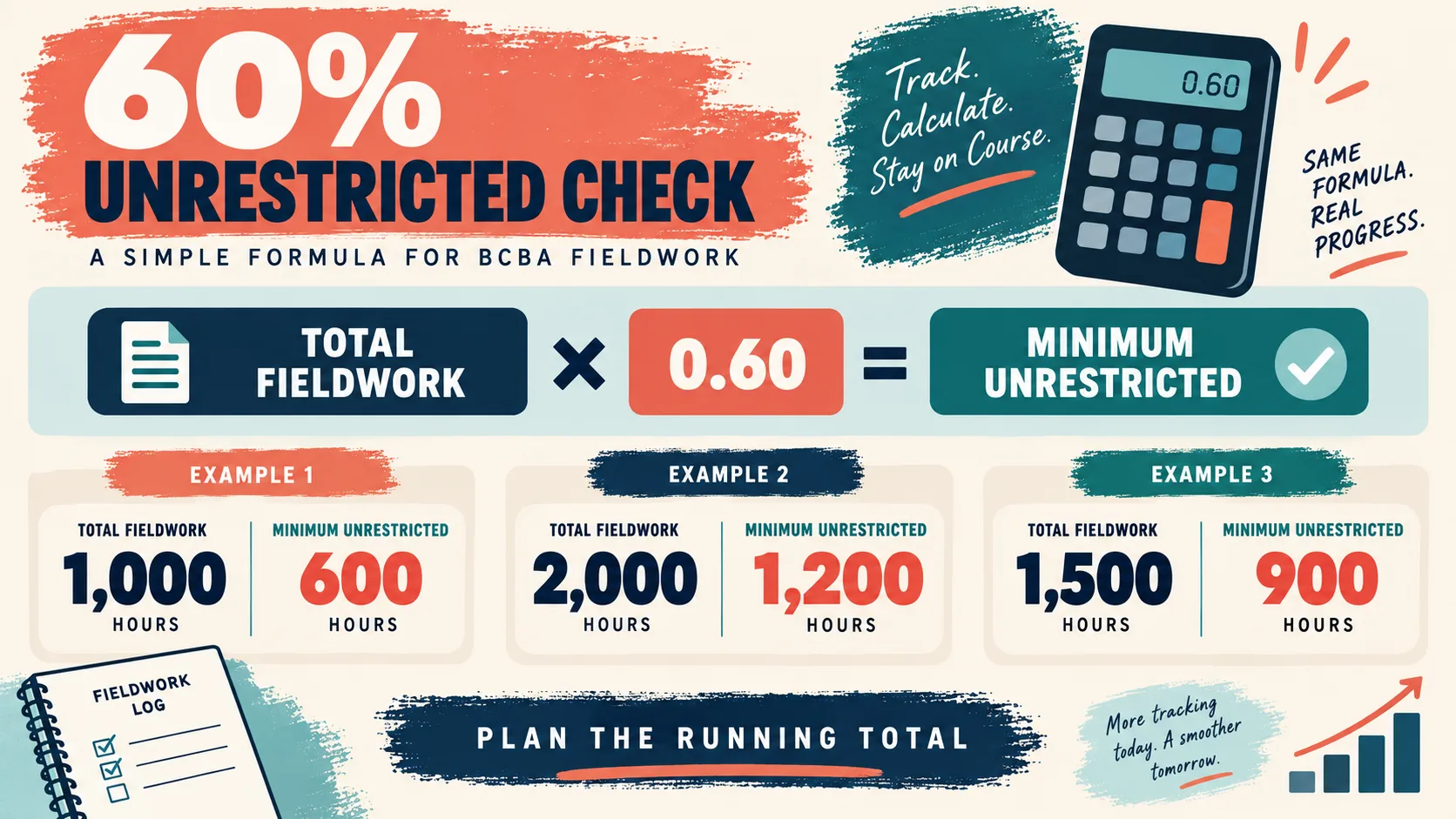
The basic calculation is: Total supervised fieldwork hours × 0.60 = minimum unrestricted hours. For example, if a trainee has 100 hours in a running total, at least 60 should be unrestricted. If the total reaches 1,000 hours, the minimum is 600 unrestricted hours. If the total reaches 2,000 hours, the minimum is 1,200 unrestricted hours. These are planning calculations, not permission to count a particular activity without supervisor review.
| Eligible fieldwork total | 60% minimum unrestricted | Planning check |
|---|---|---|
| 100 hours | 60 hours | A small early sample; review the ratio frequently. |
| 500 hours | 300 hours | Do not wait until the final quarter to correct a gap. |
| 1,000 hours | 600 hours | Keep separate totals by activity and by fieldwork type. |
| 2,000 hours | 1,200 hours | Confirm the total-hour pathway and all other requirements. |
A common mistake is to calculate 60% separately for every month and assume the month is invalid if the ratio is temporarily below the target. The BACB describes the rule as a percentage of overall supervised fieldwork, but monthly documentation and supervision requirements still matter. A trainee should use each monthly review to identify the running ratio, projected gap, and next opportunities for client-linked BCBA-level activities.
Do not apply the concentrated-fieldwork multiplier to the 60% formula as if it creates extra activity hours. The BACB documentation FAQ explains that concentrated hours may have a multiplier for estimating progress toward the total requirement, but forms should record the actual hours accrued and clearly indicate the fieldwork type. The supervisor should guide the calculation.
Classify Activities by What You Actually Do
Use the activity’s purpose and behavior-analytic content as the starting point. “I am an RBT,” “I am paid,” or “I work in a clinic” does not answer the classification question. The same setting can contain restricted implementation, unrestricted assessment work, supervision, and activities that should not be counted at all.
| Activity pattern | Likely classification question | Documentation note |
|---|---|---|
| Analyze client data and graph progress | Is the analysis tied to a current client’s programming or assessment decision? | Record the client link, data source, analysis, and resulting decision. |
| Write or revise a behavior program | Does the program address a real client need and use behavior-analytic reasoning? | Keep the program version, date, feedback, and supervisor review. |
| Train caregivers or staff | Is the training about a client’s behavior-analytic program or service? | Note audience, program, training activity, and feedback received. |
| Directly implement an existing procedure | Is the main task delivery of therapy or instruction to the client? | Often restricted; keep the exact task and let the supervisor classify it. |
| Read unrelated articles or complete generic training | Is the activity linked to a current client and supervised fieldwork objective? | Do not count simply because the material is about ABA. |
There are gray areas. Data collection can be restricted when it is routine implementation of a treatment program, but it may be part of an assessment or analysis activity in another context. An intake interview, literature review, or caregiver meeting should be described precisely and linked to a current client’s care. The safer habit is to document the actual behavior-analytic work and ask the supervisor before counting it, rather than trying to make a vague label sound unrestricted.
Build a Monthly Documentation Trail
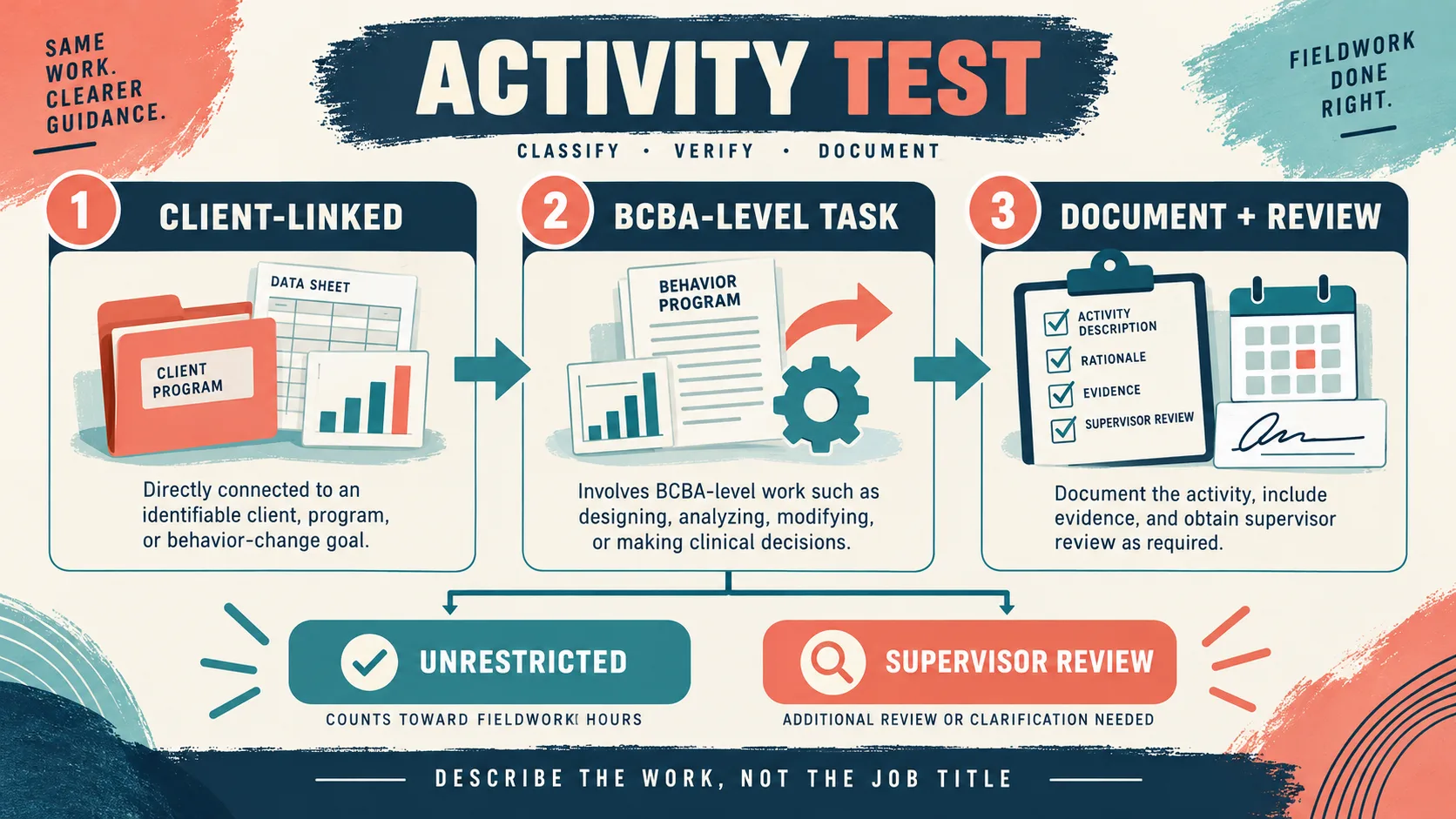
A good log lets another qualified person reconstruct what happened. It should distinguish total hours, unrestricted hours, restricted hours, supervision, observations, client-linked activities, and the fieldwork type used for that month. The exact form and signature process depend on the pathway and application timing, so keep the current BACB form version with your local documentation system.
At the beginning of the month, confirm the supervision contract, the setting, the responsible supervisor if more than one supervisor is involved, and the opportunities available for unrestricted work. During the month, record activities close to when they occur instead of relying on memory. At the end of the month, compare the unrestricted running total with 60%, confirm supervision and observation requirements, and ask the supervisor to review anything ambiguous before the form is finalized.
- Activity: describe what you did, not just “worked with client.”
- Client connection: identify the current case, program, assessment, or service decision involved.
- Time: record actual hours and separate activity categories.
- Supervision: preserve meetings, feedback, individual/group status, and observation details.
- Evidence: retain drafts, graphs, program revisions, training notes, and other materials that support the entry.
| Monthly audit item | Question to answer | If the answer is unclear |
|---|---|---|
| 60% running ratio | Does unrestricted time meet the minimum against total eligible hours? | Plan additional eligible opportunities with the supervisor early. |
| Activity description | Could another person understand the client-linked behavior-analytic work? | Rewrite vague entries before signing. |
| Supervision and observation | Were the monthly percentage, individual/group, contacts, and observation requirements met? | Adjust eligible hours according to the handbook and supervisor guidance. |
| Form and signatures | Is the correct form version complete and signed by the responsible people? | Do not submit an unsupported or backdated correction. |
2027 Transition Notes: Verify the Form and Pathway
The BACB’s official 2027 requirements document states that at least 60% of total supervised fieldwork must be unrestricted. It also shows pathway-specific changes, including a 20-to-160-hour monthly range for the 2027 supervised fieldwork overview, updated supervision and observation requirements, and new monthly and final fieldwork verification forms for people applying after January 1, 2027. The document should be read together with the current BCBA Handbook rather than summarized from an old blog post. Before relying on a 2027 calculation, verify:
- Which eligibility pathway and application timing apply to your fieldwork.
- Which Monthly and Final Fieldwork Verification Form version is required.
- Whether the recorded activities, supervision, observations, and signatures satisfy the current handbook.
Do not assume that a 2027 form change changes the definition of unrestricted activity. The transition affects which pathway and documentation rules apply to the applicant. The activity classification still needs to be connected to client care, behavior-analytic work, supervision, and the applicable handbook. If your fieldwork spans the transition, ask the supervisor which form and pathway apply to each period.
The BACB’s documentation FAQ also warns against confusing actual hours with a planning multiplier for concentrated fieldwork. Keep actual hours on the official form, maintain the fieldwork type in your personal records, and use any calculation aid only to estimate progress. No spreadsheet, app, employer policy, or third-party guide can guarantee that an activity will be accepted by the BACB.
Common Unrestricted-Hour Mistakes and FAQ
Do paid hours automatically count as unrestricted?: No. Payment status does not classify the activity. A paid shift can contain restricted implementation, unrestricted client-linked analysis, supervision, or non-countable tasks. Document the work itself and review it with the supervisor.
Do all hours working with a client count as restricted?: No. Direct implementation is often restricted, but client observation, assessment, data analysis, caregiver training, or program development may be unrestricted when they meet the applicable requirements. The purpose and content of the activity matter.
Can I count reading as unrestricted?: Reading or research unrelated to current clients should not be assumed to count. A literature review tied to a current client’s programming may be considered differently, but the trainee should document the connection and obtain supervisor review.
Do I need exactly 60% unrestricted each month?: The BACB describes the BCBA requirement as at least 60% of overall supervised fieldwork, while monthly supervision and documentation requirements still apply. Monitor the cumulative ratio and follow the current handbook and supervisor guidance for any monthly adjustment.
Where can I confirm the current rule?: Use the current BACB Handbook, the official 2027 BCBA Requirements document when relevant, and the BACB’s documentation guidance. For scenario practice on fieldwork rules, the Take the Free BCBA Mock Exam can help identify whether the gap is rule recall or application. It is a practice diagnostic, not a guarantee of passing.
Sources for Further Study
- Behavior Analyst Certification Board: BCBA Handbook
- Behavior Analyst Certification Board: 2027 BCBA Requirements
- Behavior Analyst Certification Board: Documenting Fieldwork
- Behavior Analyst Certification Board: Fieldwork—Getting It Right
- Behavior Analyst Certification Board: FAQs for RBTs Pursuing BCBA or BCaBA Certification
This article is for educational and BCBA exam-preparation purposes. Fieldwork eligibility and activity classification should be confirmed with a qualified supervisor using the current BACB requirements, forms, documentation rules, client needs, and applicable professional standards.



