

An ABA glossary is most useful when it helps you make the next correct decision, not when it gives you a long alphabetical list to memorize. In a BCBA-style scenario, the important question is often whether you can identify the behavior, read the contingency, interpret the effect of a consequence, or choose the right measurement and teaching support.
Table of Contents
- ABA Glossary: Start With the Decision
- Read the ABC Contingency Before Choosing a Procedure
- Separate Reinforcement, Punishment, and Motivation
- Use Measurement Terms to Describe Performance
- Use Teaching, Prompting, and Generalization Terms Precisely
- Know Role, Credential, and Exam-Source Language
- A Four-Step Glossary Workflow for BCBA Questions
- Common ABA Glossary Traps and FAQ
- Sources for Further Study
This decision-first glossary groups high-yield terms by the job they do. Use it as a quick reference for study, then verify exam-specific language against the current BACB task list and handbook. The goal is not to replace a complete professional glossary; it is to make related terms easier to compare when a question gives you a short vignette and asks what happens next.
ABA Glossary: Start With the Decision
When a term appears in a question, first ask what kind of information it gives you. Some terms describe the events surrounding behavior. Some describe the future effect of a consequence. Others tell you how to measure a response, how to arrange instruction, or whether performance has transferred to a new context. Sorting the term by function prevents a familiar word from pulling you toward the wrong answer.
| Decision job | Terms to recognize | First question to ask |
|---|---|---|
| Describe the situation | Antecedent, behavior, consequence, three-term contingency, function | What happened before, what was observable, and what followed? |
| Identify the effect | Reinforcement, punishment, extinction, motivating operation | Did the future frequency of the behavior increase, decrease, or remain unclear? |
| Describe performance | Operational definition, baseline, frequency, duration, latency, IOA | What exactly is being counted, timed, or compared? |
| Plan teaching | Prompt, fading, shaping, task analysis, DTT, NET | What support creates a correct response and how will independence develop? |
| Judge transfer | Generalization, maintenance, stimulus control, mastery | Does the skill occur with relevant changes in people, places, materials, or time? |
This map also explains why two terms that sound related may belong to different answers. “Baseline” describes when data are collected, while “frequency” describes one way behavior is measured. “Prompt” describes added help, while “SD” describes an antecedent that signals reinforcement is available. “Function” describes the outcome that maintains behavior, while “topography” would describe what the behavior looks like.
Read the ABC Contingency Before Choosing a Procedure
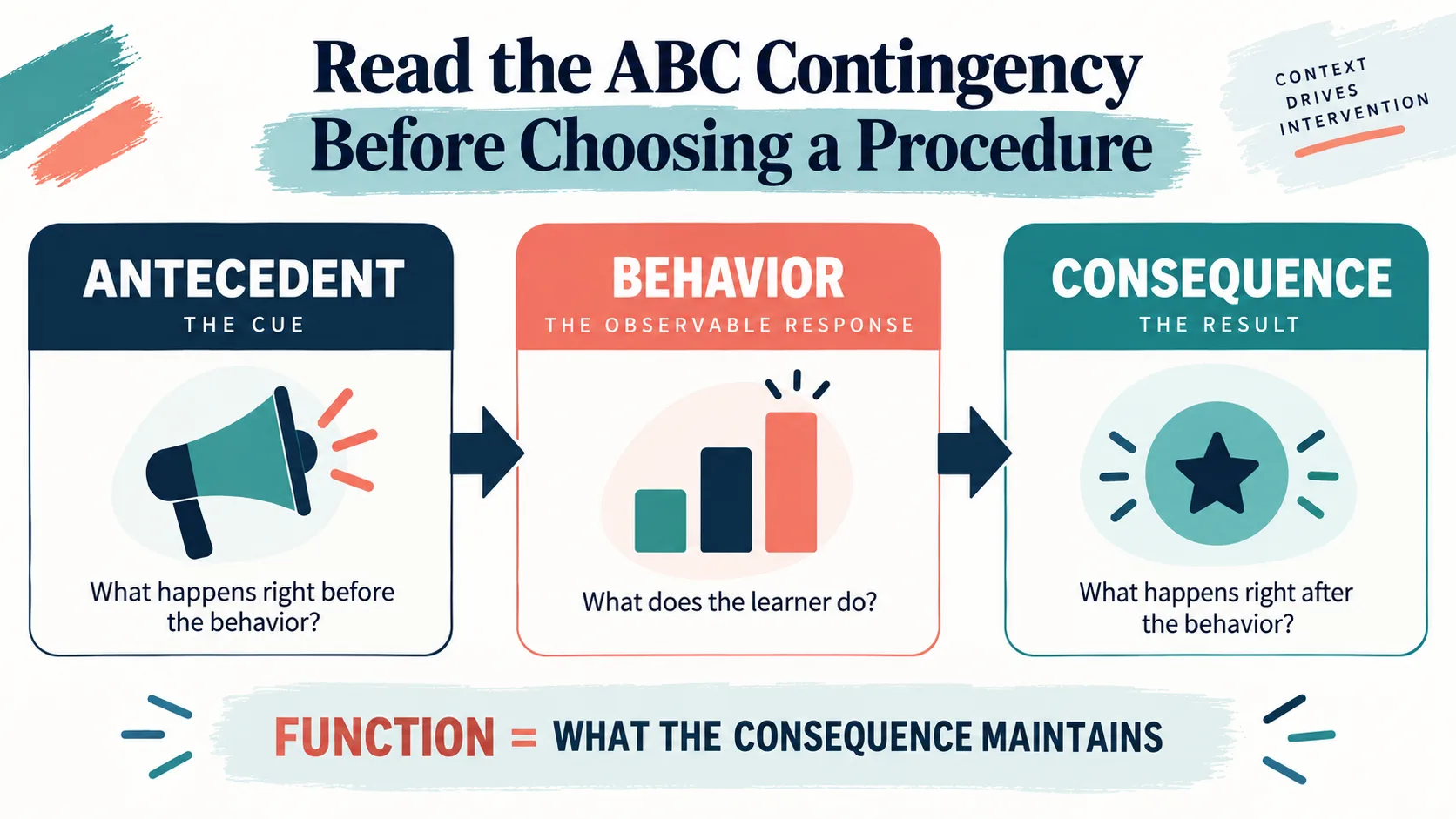
The ABC sequence means antecedent, behavior, and consequence. The antecedent is an event or condition that occurs before the response. The behavior is the observable, measurable response. The consequence follows the response and may alter what happens in the future. Together, these events form a three-term contingency.
For example, a teacher says, “Put the blocks away” (antecedent), the student places the blocks in the bin (behavior), and the teacher provides praise plus access to a preferred activity (consequence). The definition of reinforcement is not based on whether praise seems pleasant. The consequence is reinforcement only if the relevant behavior becomes more likely in comparable future conditions.
Function is the relation between behavior and the outcome that has maintained it, such as attention, escape, access to tangibles or activities, or automatic consequences. The same topography can have different functions. A learner may push materials away to escape a difficult demand, while another learner may push materials to obtain attention. A procedure chosen only from the appearance of the response can therefore miss the functional relation.
When a question gives you an ABC example, do not jump straight to the intervention label. First locate the observable response, separate the immediate consequence from the long-term effect, and decide whether the information is descriptive or experimental. An ABC observation can suggest a hypothesis about function; it does not automatically prove function the way a functional analysis is designed to do.
Separate Reinforcement, Punishment, and Motivation
The most common glossary error is treating “positive” as good and “negative” as bad. In behavior analysis, positive means something is added and negative means something is removed. Reinforcement means the future behavior increases; punishment means the future behavior decreases. The labels depend on observable change, not on the practitioner’s intention or whether the event sounds pleasant.
| Term | Definition by effect | Example of the decision rule |
|---|---|---|
| Positive reinforcement | A stimulus is added after behavior and the behavior increases later. | Praise follows asking for help, and asking for help increases. |
| Negative reinforcement | A stimulus is removed or postponed after behavior and the behavior increases later. | A break follows an appropriate request, and requesting a break increases. |
| Positive punishment | A stimulus is added after behavior and the behavior decreases later. | A planned corrective consequence is added and the defined response decreases. |
| Negative punishment | A stimulus is removed after behavior and the behavior decreases later. | Access to a specified reinforcer is lost and the response decreases. |
| Extinction | The reinforcement previously maintaining a behavior is no longer delivered. | Identify the old reinforcer before predicting an extinction effect. |
| Motivating operation | A condition changes the value of a consequence and the current likelihood of behavior that has produced it. | Ask what makes the consequence more or less valuable right now. |
An establishing operation increases the value of a consequence and evokes behavior that has produced it. An abolishing operation decreases that value and may reduce the behavior. An MO is not the same as a reinforcer: the MO changes the current value of the consequence, while the reinforcer is a consequence defined by its effect on behavior.
This distinction helps with everyday examples. Hunger may increase the value of food, but food is not automatically a reinforcer for every response. A consequence earns the label only when the relevant behavior changes. Likewise, removing a demand can be negative reinforcement if the appropriate behavior increases, but it is not negative reinforcement merely because the demand ended.
Use Measurement Terms to Describe Performance
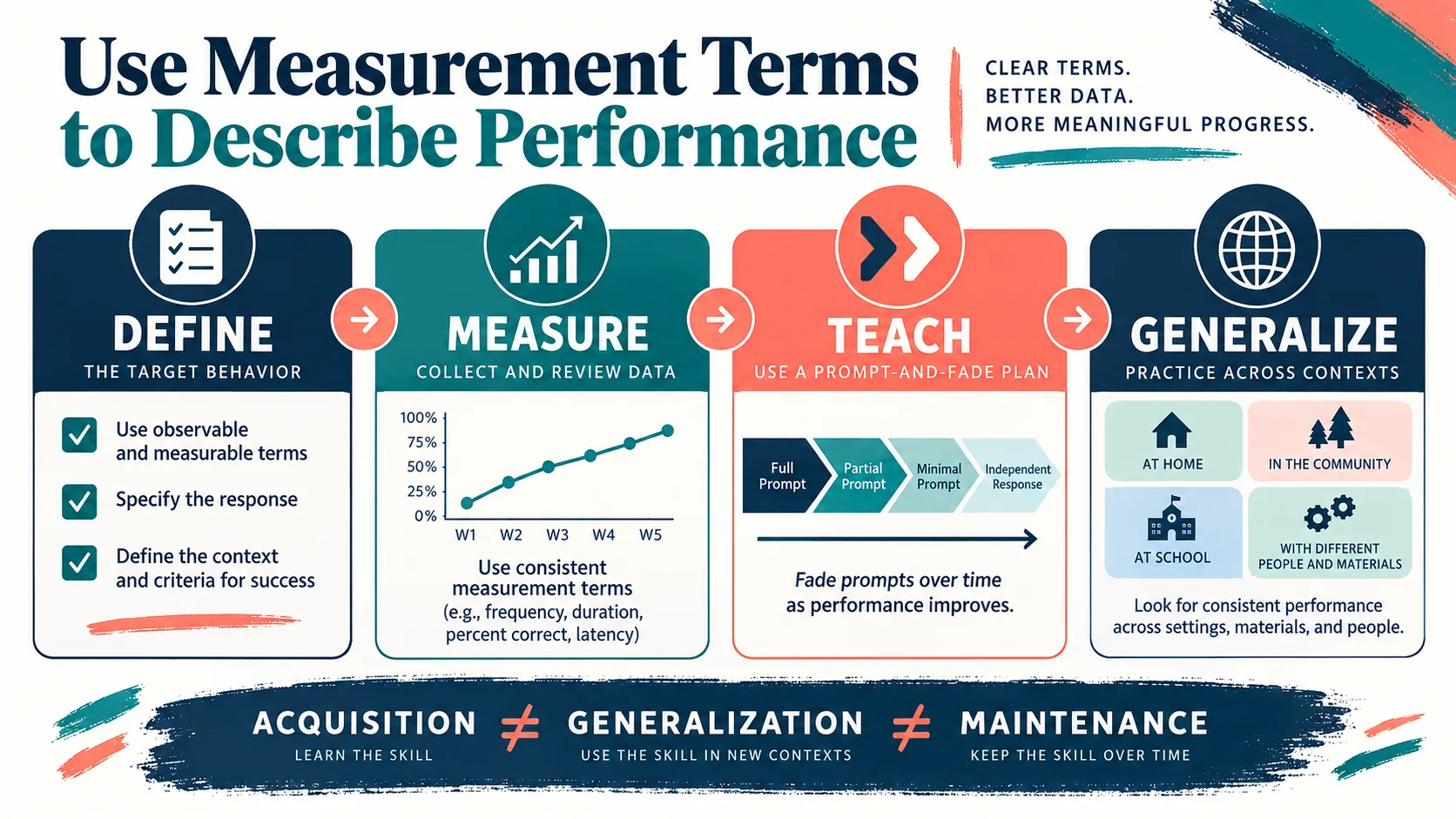
Measurement terms tell you how behavior is represented in data. Start with an operational definition: a description that is observable, measurable, and clear enough for different observers to identify examples and nonexamples. “Was disrespectful” is too vague unless the team defines the responses that count. “Said ‘no’ above conversational volume within three seconds of a task demand” is more observable, though the final definition still needs context and examples.
| Measurement term | What it captures | Typical trap |
|---|---|---|
| Frequency | The count of responses in an observation period. | Comparing raw counts when observation periods differ. |
| Rate | Responses per standardized unit of time. | Calling two counts equal when the observation durations are unequal. |
| Duration | The total time a behavior occurs or continues. | Using frequency for a behavior whose clinical importance is how long it lasts. |
| Latency | The time between an antecedent or instruction and the start of the response. | Confusing the start delay with the time spent responding. |
| Baseline | Pre-intervention performance used as a comparison point. | Treating baseline as a measurement dimension rather than the phase of data collection. |
| IOA | Agreement between independent observers who score the same events. | Assuming high agreement proves that the definition is valid or that treatment worked. |
Discontinuous measures include partial-interval, whole-interval, and momentary time sampling. They can be efficient, but each changes what the data mean. For example, partial-interval recording can overestimate the proportion of time a behavior occurred, while whole-interval recording can underestimate it. The correct choice depends on the target, observation constraints, and decision the team needs to make.
Interobserver agreement is about measurement consistency, not treatment effectiveness. A team may agree perfectly while using a poor definition, and a treatment may produce a meaningful change even when the data system needs improvement. BCBA questions often test whether you can keep reliability, validity, and outcome effects conceptually separate.
Use Teaching, Prompting, and Generalization Terms Precisely
A prompt is an added stimulus that increases the likelihood of a correct response. Prompt fading reduces that added support so the intended stimulus controls the behavior. A prompt hierarchy is not a universal ranking of “good” and “bad” prompts; it is a planned sequence that should fit the learner, the target, and the risk of prompt dependence.
Shaping reinforces successive approximations toward a target response. Task analysis breaks a complex skill into smaller steps, which can then be taught through chaining. Discrete trial teaching uses clearly bounded teaching opportunities, while natural environment teaching embeds instruction in naturally occurring activities, motivation, materials, and consequences. These terms describe teaching arrangements, not the entire ABA service model.
Stimulus control means that the presence or absence of a stimulus reliably changes the likelihood of a response. Generalization means the learned response occurs under relevant new conditions, such as with another person, material, place, or instruction. Maintenance means the response continues over time after the original teaching arrangement or support changes. A learner can show acquisition without yet showing generalization or maintenance.
When a scenario says that accuracy is high only with one instructor or one set of cards, do not automatically call the skill mastered. Ask whether the controlling stimulus is the intended cue, whether prompts remain, and whether the team has probed relevant changes. The useful glossary term is the one that points to the next testable decision.
Know Role, Credential, and Exam-Source Language
Glossary terms also describe professional roles. A BCBA is a Board Certified Behavior Analyst credentialed by the BACB. A BCaBA is a Board Certified Assistant Behavior Analyst, and an RBT is a Registered Behavior Technician. The exact responsibilities, supervision requirements, and use of certification marks depend on current BACB materials and applicable rules.
The BACB’s current handbook includes an official glossary for certification language, while the BACB’s behavior-analysis overview explains that examination content is tied to the applicable task lists. That is why a third-party glossary should be treated as a study aid rather than the final authority for current eligibility, policy, or exam administration questions. For study purposes, separate three kinds of statements:
- Concept definition: what a behavior-analytic term means by its observable relation or effect.
- Exam scope: what the current BACB task list or handbook says candidates should know or follow.
- Practice guidance: an example or study strategy that is not itself an official BACB policy.
A Four-Step Glossary Workflow for BCBA Questions
Use this workflow when a question contains several familiar terms and the answer choices all sound plausible:
- Underline the response. Write what the person actually did in observable language. Ignore inferred labels until the response is clear.
- Map before and after. Identify the antecedent and immediate consequence. Then ask whether the consequence changed future responding or whether the question only gives descriptive data.
- Classify the decision. Is the question asking about function, effect, measurement, prompting, stimulus control, generalization, or professional scope?
- Choose the narrowest accurate term. Do not choose “reinforcement” because something pleasant happened, “mastery” because one trial was correct, or “generalization” because the skill was practiced twice.
After choosing an answer, check whether it fits the time order. A motivating operation changes the value of a consequence before the response. A consequence follows the response. Baseline occurs before intervention. Maintenance is evaluated after teaching or support changes. Many exam distractors use a correct term in the wrong position in the sequence. Fast error check:
- Ask whether the term describes an event, an effect, a measurement, a teaching support, or a transfer outcome.
- Match the term to the evidence actually provided instead of assuming an unmeasured function or treatment effect.
- Explain why the closest related term does not answer the exact question being asked.
For targeted terminology drills and scenario practice, the Take the Free BCBA Mock Exam resource can help you identify whether the gap is vocabulary recognition or application. It is a practice diagnostic, not a guarantee of passing and not a substitute for current BACB materials.
Common ABA Glossary Traps and FAQ
Is an ABA glossary the same as the BACB glossary?: No. A general ABA glossary may explain behavior-analytic concepts, while the BACB handbook contains official certification and policy terminology. Use the current BACB handbook and task list for official exam and credential language.
What does ABA stand for?: ABA stands for applied behavior analysis. In study questions, the word “applied” points to behavior change that matters in the lives of people and communities, but the correct answer still depends on the specific behavior-analytic concept being tested.
Are positive and negative the same as good and bad?: No. Positive means a stimulus is added; negative means a stimulus is removed. Reinforcement and punishment are defined by whether the future behavior increases or decreases.
Is every consequence reinforcement?: No. A consequence is reinforcement only when the relevant future behavior increases. If the behavior decreases, the consequence may function as punishment. If the effect is unknown, the safest description is the observable event and the data needed to evaluate it.
What is the difference between a prompt and an SD?: An SD is an antecedent that signals reinforcement is available for a particular response. A prompt is added support that helps evoke the response. The teaching plan should fade prompts so the intended stimulus, rather than the extra help, controls the behavior.
What should I verify before using an ABA glossary for exam study?: Check the current BACB task-list hub, handbook, and examination materials that apply to your exam date. Policies, terminology resources, and exam outlines can change, so a third-party glossary should not be treated as a current policy document.
Sources for Further Study
- Behavior Analyst Certification Board: About Behavior Analysis
- Behavior Analyst Certification Board: BCBA Handbook and official glossary
- Behavior Analyst Certification Board: Task Lists for BACB Certifications
- ABA Degree: ABA Terms and Definitions
- BxScribe: Plain-Language ABA Terminology
This article is for educational and BCBA exam-preparation purposes. Professional decisions should use current official requirements, individualized assessment information, learner preferences, safety requirements, social validity, and qualified supervision.



