
ABC narrative event sampling is a descriptive observation method for recording what happens before, during, and after a defined behavior when the event occurs. It gives the observer a short, factual story of the event instead of a score at every clock interval. For BCBA candidates, the important distinction is that ABC narrative event sampling helps generate hypotheses about context and possible function; it does not, by itself, establish a functional relation.
Table of Contents
- In This Guide
- ABC Narrative Event Sampling: What It Means
- When Event Sampling Fits the Observation Question
- How to Record an Objective A-B-C Sample
- How to Improve the Quality of the Narrative
- Descriptive Observation Versus Functional Analysis
- How BCBA Questions Test This Method
- Common Mistakes With ABC Narrative Event Sampling
- ABC Narrative Event Sampling FAQ
- Take the Free BCBA Mock Exam
This guide explains when to use the method, how to write an objective A-B-C record, how it differs from time sampling and functional analysis, and how exam questions may test its strengths and limits. A real observation plan must follow the supervising BCBA’s instructions, privacy procedures, client rights, and setting-specific requirements.
In This Guide
ABC Narrative Event Sampling: What It Means
In ABC narrative event sampling, the observer first defines the event of interest. Each time that event occurs, the observer records a brief description of the antecedent, the observable behavior, and the immediate consequence. “A” is what happened immediately before, “B” is what the person did, and “C” is what happened immediately after. The record should include enough context to support later analysis without turning the observer into a storyteller who fills gaps with assumptions.
The method is useful when the team needs to understand behavior in context. For example, a record might show that an instruction was presented, the learner pushed the worksheet away and said “break,” and the instructor removed the worksheet. That entry describes a sequence. It does not prove that escape maintained the behavior, because the same pattern must be compared across multiple observations and considered with other assessment information.
Event sampling is different from writing a general session summary. A session note may summarize progress across an hour. An ABC narrative event sample is tied to a defined event and its surrounding environmental events. The observer should record when the event happened, where it happened, who was involved when relevant, and what the plan says is important to interpret.
When Event Sampling Fits the Observation Question
Choose the method based on the question, not because the form is familiar. ABC narrative event sampling is often useful when the behavior is relatively infrequent, important to understand in context, or difficult to represent with a simple tally alone. If the behavior happens continuously or at a very high rate, writing a narrative for every occurrence may be impractical and may reduce the accuracy of observation.
| Observation question | Often-considered method | Why |
|---|---|---|
| What typically happens before and after a specific event? | ABC narrative event sampling | It preserves the sequence and context around selected occurrences. |
| How often does the target response occur? | Frequency or event recording | A count or rate is more efficient when the primary question is quantity. |
| Is the behavior occurring at particular times or activities? | Time sampling or scatterplot | Fixed time blocks can reveal temporal patterns without a full narrative each time. |
| Does a specific condition produce a change in behavior? | Functional analysis or another experimental design | The question requires planned manipulation and comparison, not description alone. |
These methods can be combined. An analyst might use ABC narratives to develop a hypothesis, then collect frequency or rate data to quantify the target, and later use an experimental assessment when safe and necessary. One form should not be forced to answer every question.
How to Record an Objective A-B-C Sample
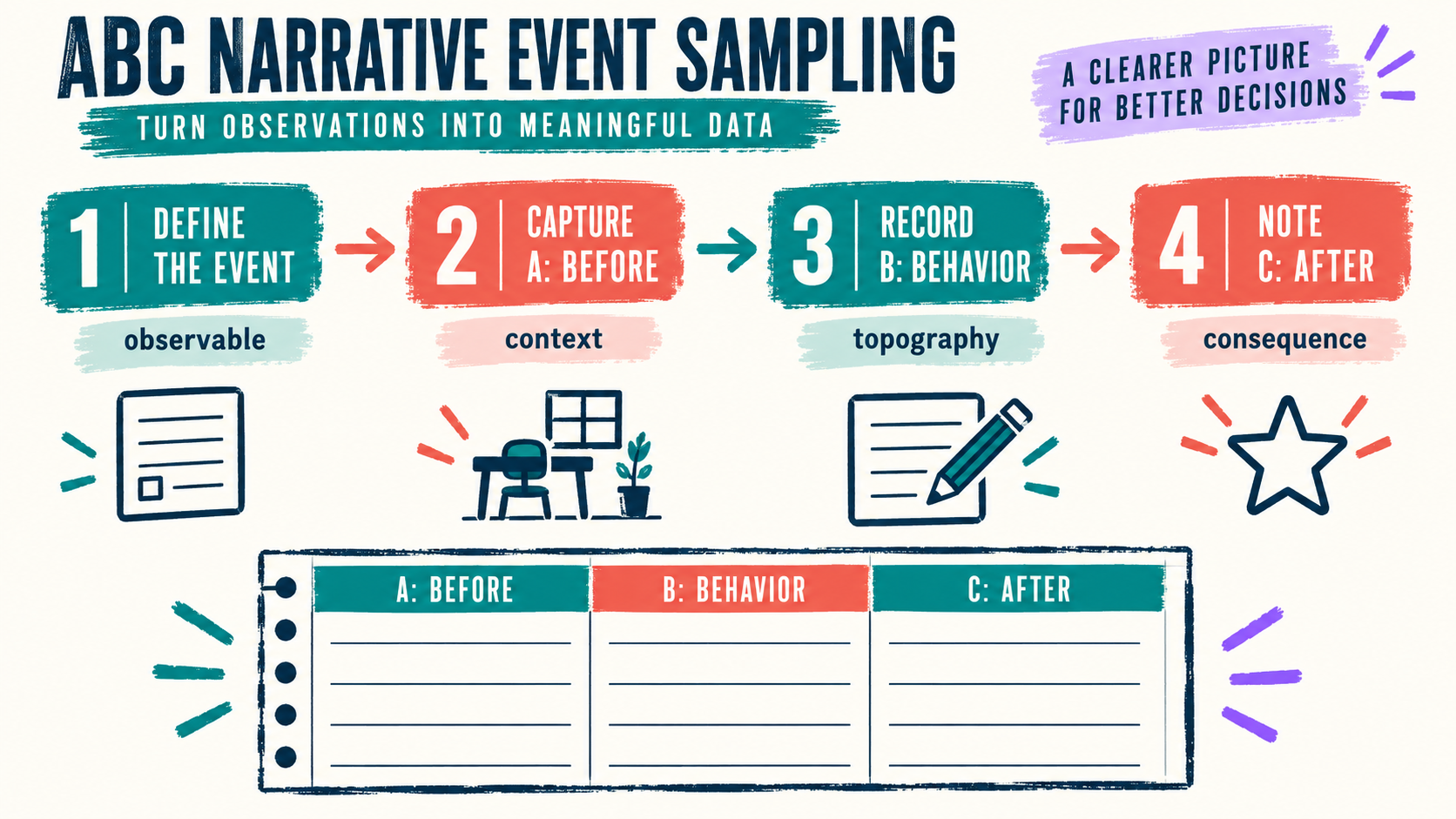
Use the same sequence for each event. A consistent routine makes the notes easier to compare:
- Confirm the target event: Apply the operational definition. Do not write an ABC narrative for a vague impression such as “was upset” unless the plan defines how that state is observed.
- Record the antecedent: Describe the instruction, activity, material, interaction, transition, delay, or other event that occurred immediately before the response. Include only relevant setting events when the plan asks for them.
- Record the behavior: Describe the topography in observable language. Include words, movements, contact with objects, duration, or intensity only when those features are part of the definition and can be recorded accurately.
- Record the consequence: Describe what happened immediately after the response, including changes in demands, attention, access, activity, or physical arrangement. Do not label the consequence as “reinforcement” simply because it followed the response.
- Add time and context: Note the date, time, setting, observer, and any required context fields. Keep the record focused enough that the next observer can understand it.
For example, an objective entry might read: “At 10:14 during independent math, the teacher placed a worksheet on the desk and said, ‘Start problem one.’ The learner pushed the worksheet approximately 20 centimeters away and said, ‘No math.’ The teacher said, ‘Take a two-minute break,’ and removed the worksheet.” The entry leaves room for later analysis without pretending to know the learner’s private motivation.
How to Improve the Quality of the Narrative
A narrative is not automatically high quality because it is detailed. Strong ABC notes are brief, specific, and repeatable. If two trained observers read the entry, they should be able to identify the same antecedent, response, and consequence. Use direct quotes when exact language matters, and avoid adjectives that hide the behavior.
| Weak wording | Problem | More useful wording |
|---|---|---|
| “He was noncompliant.” | The label does not show the response topography. | “After the instruction, he placed both hands under the table and did not begin within 30 seconds.” |
| “She wanted attention.” | It states an inferred function rather than an observation. | “She called the technician’s name three times; the technician looked at her and responded.” |
| “The teacher reinforced the behavior.” | It assumes the effect of the consequence without testing it. | “The worksheet was removed and the learner returned to the preferred activity.” |
When multiple ABC samples are collected, summarize patterns carefully. You might count how many events followed a demand, how often attention followed the response, or whether the same sequence occurred in more than one setting. These summaries can suggest a hypothesis, but they should not erase exceptions or convert a descriptive correlation into a confirmed function.
Descriptive Observation Versus Functional Analysis
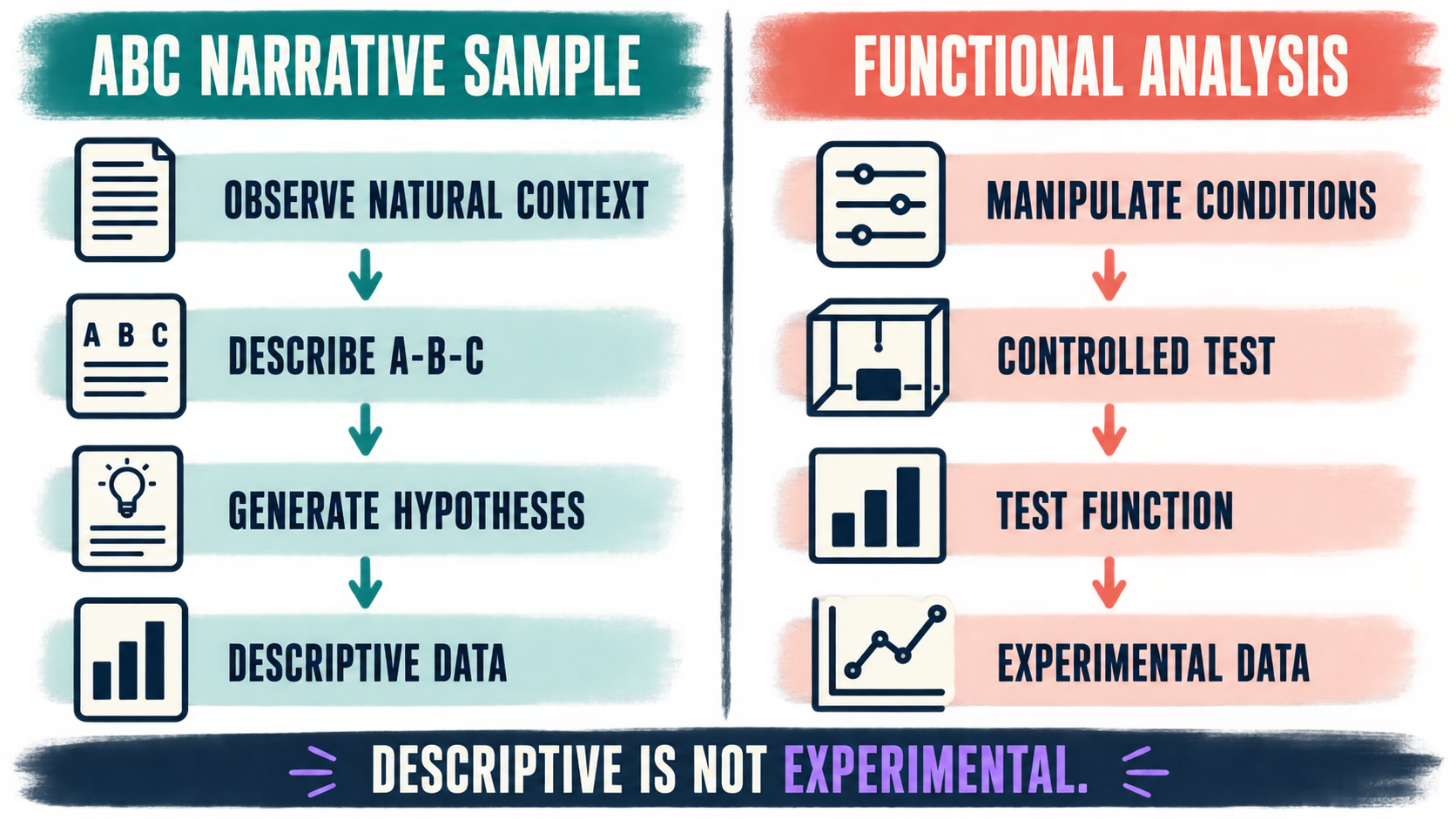
ABC narrative event sampling is descriptive. The observer watches naturally occurring events and records them. A functional analysis is experimental: the analyst systematically arranges conditions to test whether a particular consequence produces a reliable change in behavior. The methods answer different questions and carry different procedures, risks, and training requirements.
A BCBA exam question may describe an observer documenting that a demand preceded aggression and that the demand was removed afterward. The safest conclusion is that the record is consistent with a possible escape-related pattern that needs further assessment. The answer should not say the function has been proven unless the scenario includes an appropriate experimental demonstration or other evidence that supports that conclusion.
- Descriptive: Observe, record, summarize, and generate a testable hypothesis.
- Experimental: Manipulate a condition systematically and compare behavior across conditions.
- Ethical boundary: Do not arrange a dangerous consequence or remove an essential support merely to complete a textbook-style ABC sequence.
- Data boundary: Narrative detail adds context, but it does not automatically provide a frequency, rate, or experimental control measure.
How BCBA Questions Test This Method
When the stem says the observer records what happens immediately before and after a target event in the natural environment, identify ABC narrative event sampling. Then check what the question asks you to conclude. If it asks for a possible function or hypothesis, descriptive data may be appropriate. If it asks which condition causes the behavior, the scenario must include stronger experimental evidence. Common contrasts include event sampling versus time sampling, narrative ABC recording versus frequency recording, and descriptive assessment versus functional analysis. Use the target event and the sampling rule to distinguish them:
- Event sampling: Record when the defined event occurs.
- Time sampling: Observe or score at planned time points or intervals.
- Frequency recording: Count occurrences, usually with a defined observation period.
- ABC narrative: Add descriptive information about the sequence and context around selected events.
Use the current BACB BCBA Test Content Outline as the authority for exam scope, then practice explaining why a measure fits the question. A perfect-looking note is not the best answer if it uses a vague definition or claims more than the data can support.
Common Mistakes With ABC Narrative Event Sampling
- Recording every feeling as a fact: “Frustrated” or “wanted escape” may be an interpretation unless defined and observable in the plan.
- Skipping the consequence: An ABC record needs the immediate event after the behavior, not only the trigger.
- Writing a whole-session story: Event sampling focuses on the defined event and relevant surrounding context.
- Confusing sequence with function: A repeated A-B-C pattern can support a hypothesis, but it does not automatically prove why the behavior occurs.
- Using narrative when continuous recording is needed: If the team must know exact frequency, duration, or rate, add the appropriate direct measure.
- Using a copied form without a plan: A template should follow the operational definition, observation schedule, privacy rules, and supervisor instructions.
ABC Narrative Event Sampling FAQ
What is ABC narrative event sampling used for?: It is used to document the context around selected occurrences of a defined behavior: what happened before, what the person did, and what happened after. The information can help develop a hypothesis for further assessment.
Is ABC narrative event sampling a functional analysis?: No. It is a descriptive observation method. It does not systematically manipulate conditions, so it cannot by itself demonstrate that a consequence caused the behavior to occur.
What is the difference between event sampling and time sampling?: Event sampling is triggered by the occurrence of a defined event. Time sampling is triggered by planned time points or intervals. The best method depends on whether the team needs context around events or an estimate of behavior across time.
How many ABC samples are enough?: There is no universal number. The supervising analyst should determine the sampling plan based on the behavior, setting, safety, variability, and decision question. A few vivid examples should not outweigh a larger pattern that points in another direction.
When you can separate observable description from interpretation, ABC narrative event sampling becomes a powerful BCBA study topic rather than a memorized acronym. For more practice distinguishing descriptive methods from functional assessment scenarios, try the free BCBA mock exam.
Take the Free BCBA Mock Exam
If you want a low-pressure way to check your recall, use the free practice resource below. Take the Free BCBA Mock Exam



