
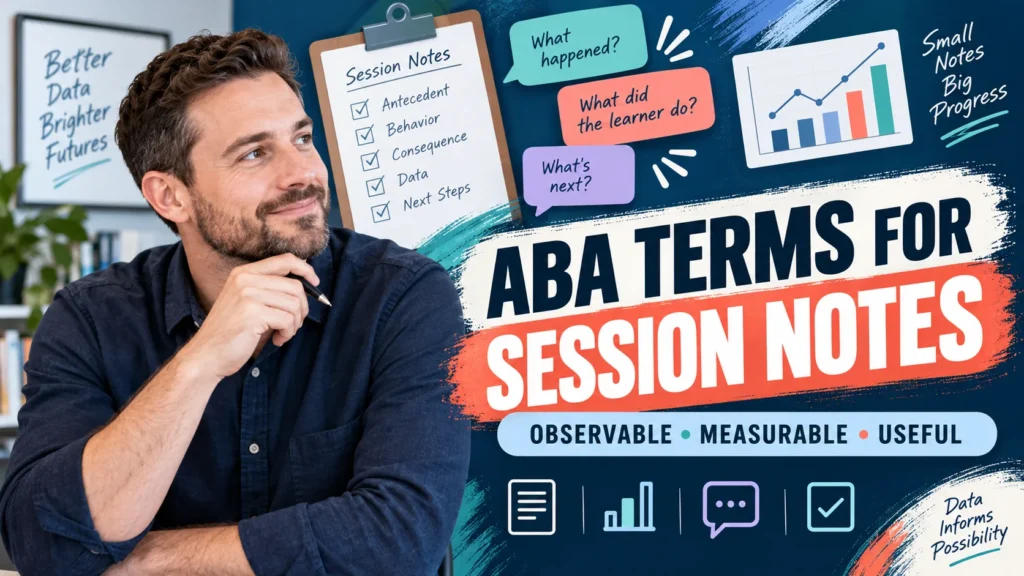
ABA terms for session notes should help another qualified reader understand what happened, what was measured, how the client responded, and what comes next. The best terms are not the most technical-sounding ones. They are the terms that make the note observable, measurable, connected to the plan, and honest about what the writer actually saw.
Table of Contents
- What ABA Terms for Session Notes Should Accomplish
- Start With Observable and Measurable Language
- Build the Note Around Five Anchors
- Use Terms That Match Data and Procedures
- Swap Vague Phrases for Defensible Wording
- Connect Terms to Context, Privacy, and the Plan
- FAQ: Terms, Examples, and Fieldwork Records
- Sources for Further Study
- Quick Review Checklist
This guide focuses on vocabulary, not a replacement for your employer’s note template, payer rules, privacy policy, or supervisor direction. It also separates an everyday ABA session note from BCBA fieldwork documentation: related records may overlap, but one does not automatically satisfy the other.
What ABA Terms for Session Notes Should Accomplish
A session note is a professional record, not a diary and not a list of impressive-sounding labels. A reader should be able to identify the setting, the target or skill, the procedure used, the measurement, the client’s response, and the next action. If a term hides the observation, replace it with a description that another person could verify.
| Term or phrase | What it helps describe | Note-level question |
|---|---|---|
| Antecedent | What occurred immediately before the response or teaching opportunity. | What event, instruction, or change set the context? |
| Operational definition | A description that identifies what counts and what does not count. | Could two trained observers recognize the same response? |
| Prompt | Assistance used to evoke a target response, with the type or level specified when relevant. | What help was provided, and did the learner respond independently? |
| Reinforcer | A consequence selected and evaluated because it increases future responding under similar conditions. | What consequence followed, and what evidence supports its use? |
| Client response | The observable action, communication, or change following the procedure. | What did the client do, say, select, complete, or refuse? |
| Generalization | Using a skill across people, materials, settings, or examples beyond teaching conditions. | Where else was the skill observed, and what changed? |
These terms should serve the note, not replace it. “Used prompting” is incomplete without the prompt type or the response. “Reinforced behavior” is incomplete without the consequence and the target behavior. Technical vocabulary becomes useful only when it is tied to an observable event.
Start With Observable and Measurable Language
Objective language answers “what could a second reader see, hear, count, time, or verify?” It avoids inferring private states unless the note clearly labels the information as a report from the client or caregiver. For example, write “the client stated, ‘I am tired’” rather than “the client was tired,” unless the latter is an approved clinical shorthand supported by the record.
- Describe the action: “placed the cup on the shelf” is clearer than “followed directions well.”
- Add a measurement: include frequency, duration, latency, percentage, trial count, or another approved measure when available.
- Name the context: identify the instruction, task, setting, material, or transition that matters to interpretation.
- Separate observation from report: distinguish what you saw from what a caregiver, client, or teacher reported.
- Connect to the plan: use the program or target name approved by the supervising clinician rather than inventing a new label.
Build the Note Around Five Anchors
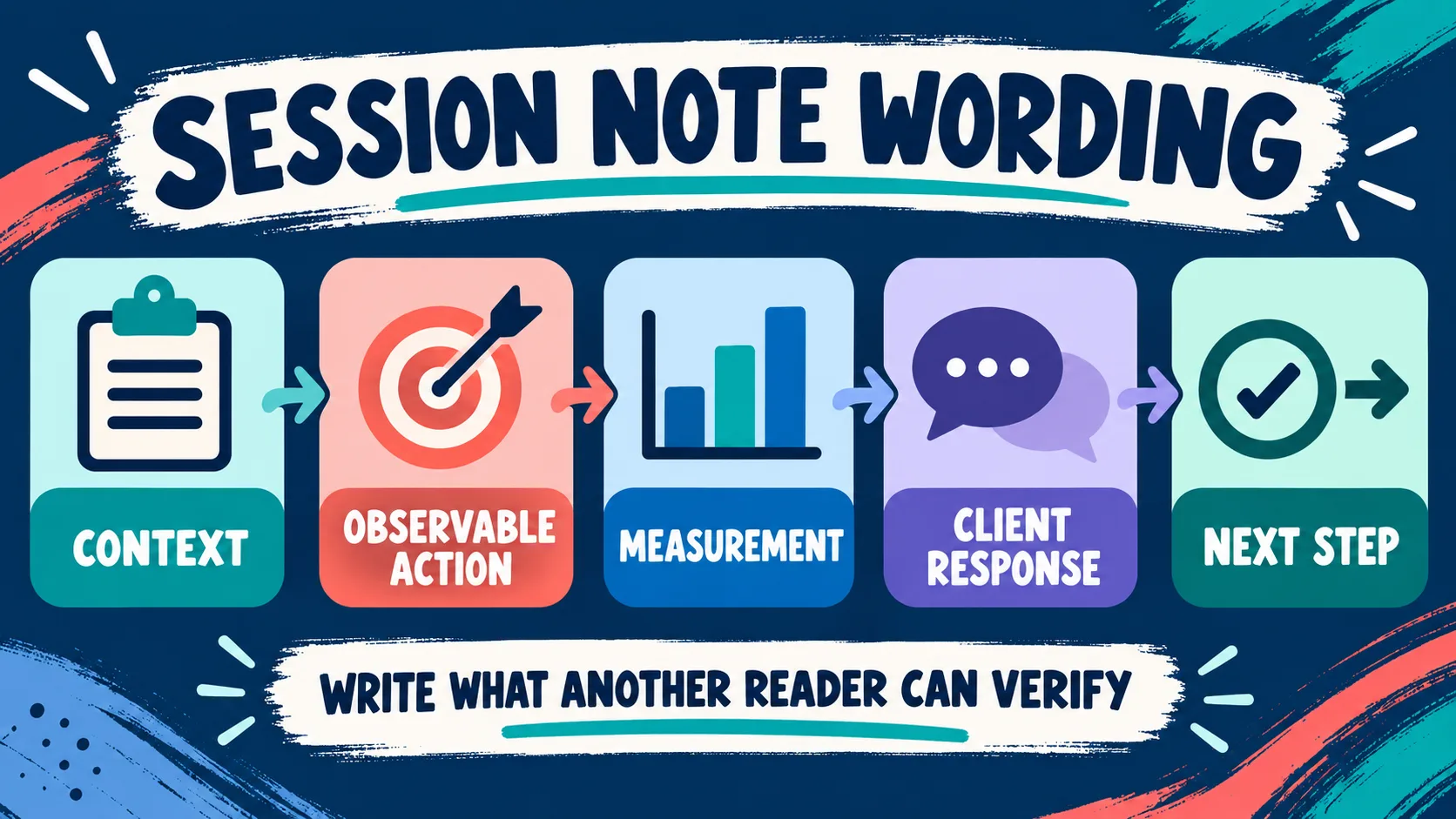
A reliable sentence structure keeps terms from floating away from the event they describe. Use five anchors, then adapt them to the approved template:
- Context: What activity, instruction, transition, or environment was present?
- Observable action: What did the client or technician do that another reader could identify?
- Measurement: What number, duration, rate, latency, or percentage summarizes the response?
- Client response: What changed after the prompt, intervention, or consequence?
- Next step: What will continue, be reviewed, or be discussed with the supervisor?
For example, instead of “The client had a good session,” a note might say: “During the transition from tablet time to table work, the client followed the visual schedule after one gestural prompt and completed 8 of 10 matching trials independently; the technician recorded two verbal protests and will review the transition data with the supervisor.” The exact wording must match the client’s plan and your role, but the structure makes the evidence visible.
Use Terms That Match Data and Procedures
Do not use a measurement term simply because it sounds clinical. Use the measure that the program defines and record the event consistently. A note may mention several data concepts, but each should connect to the target and collection method.
| Data term | Use it when the record contains | Avoid saying |
|---|---|---|
| Frequency | A count of discrete responses in a defined period. | “Often” or “rarely” without a time frame. |
| Duration | How long the defined response lasted. | “A long time” without start and stop rules. |
| Latency | The time between an instruction or event and the response. | “Responded quickly” without a measured interval. |
| Percentage correct | Trials with a defined correct response divided by total scored trials. | “Mastered” based on one strong session. |
| Prompt level | The prompt hierarchy or assistance level approved for the program. | “Needed help” without identifying the help. |
When you report a change, include the comparison that makes the statement meaningful: “independent requests increased from 2 to 4 across the same 30-minute activity” is more reviewable than “communication improved.” If a graph or data sheet contains the detail, summarize it accurately and point the reader to the approved record.
Swap Vague Phrases for Defensible Wording
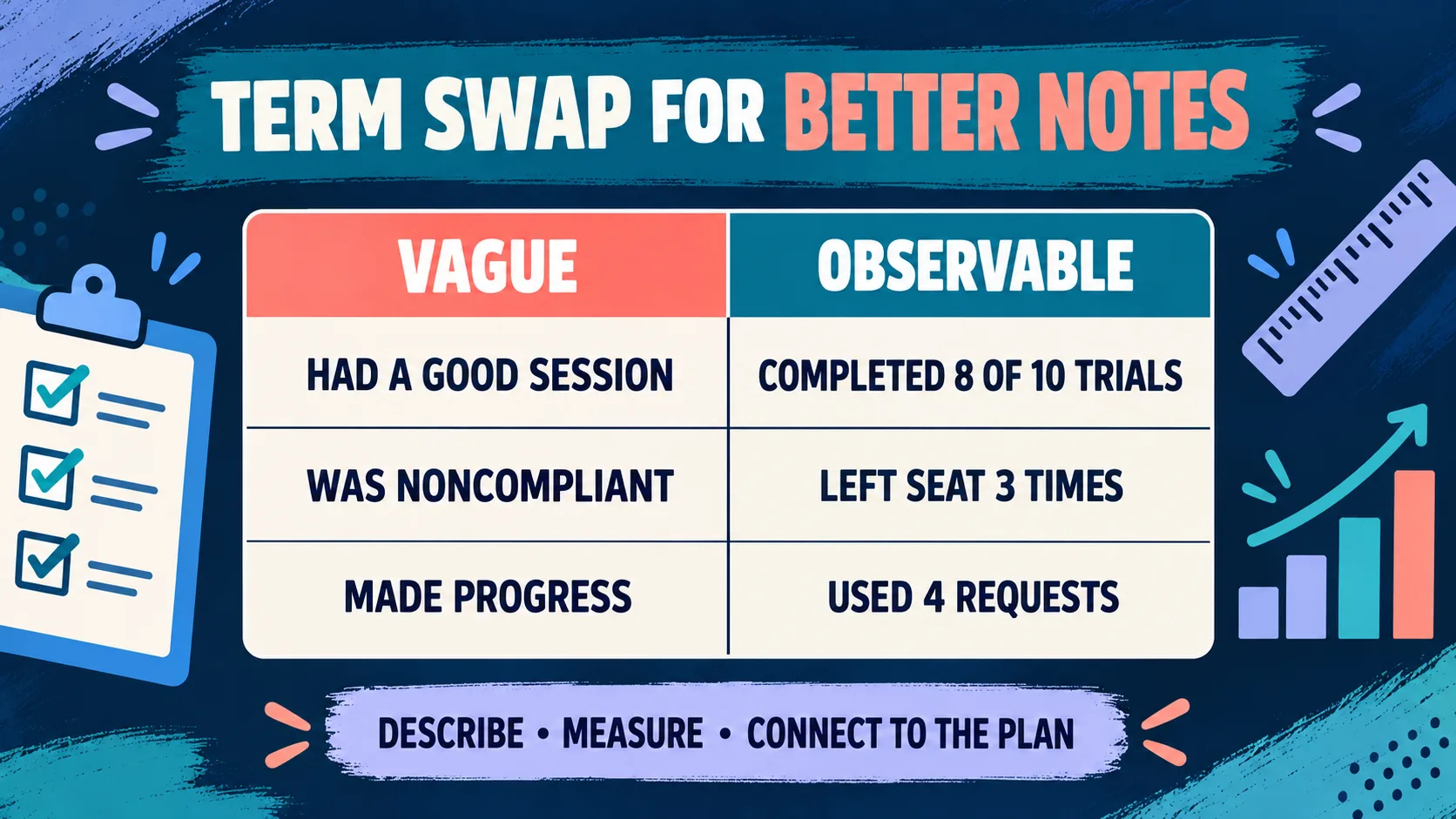
Vague phrases are tempting because they are fast. They can also hide the observation, the definition, or the measurement a supervisor needs to review. The goal is not to make every note long; it is to make the important claim checkable.
| Vague | More observable | What was added |
|---|---|---|
| Had a good session. | Completed 8 of 10 planned matching trials with one gestural prompt. | Task, count, and prompt level. |
| Was noncompliant. | Pushed the worksheet away and did not begin within 30 seconds of the instruction. | Observable action and latency. |
| Made progress. | Used four independent requests during the 20-minute play routine, compared with two last session. | Response, time frame, and comparison. |
| Was upset. | Cried for 2 minutes and covered ears after the vacuum started. | Defined response, duration, and context. |
Connect Terms to Context, Privacy, and the Plan
Good terminology is also selective. Include enough context for the note to be useful, but do not copy unnecessary identifying information into a field that does not need it. Follow your organization’s privacy, security, consent, and payer requirements. Avoid labels that imply a diagnosis, intent, emotion, or clinical conclusion you are not authorized or qualified to make.
Use the exact program names and definitions supplied by the supervising clinician. If a target changes, document the change through the approved process rather than silently changing the meaning of the term in your note. A note should align with the treatment plan, data sheet, and supervisor communication; it should not create a second unofficial plan.
If you are documenting BCBA fieldwork, use the current BACB resources for the required fieldwork records. The BACB explains that fieldwork documentation can include session details, supervision contacts, observations, activity categories, and summaries of supervision. A regular service note may support understanding, but it does not automatically replace a required fieldwork log or verification form.
FAQ: Terms, Examples, and Fieldwork Records
What are the most useful ABA terms for session notes?: Start with terms that connect an event to evidence: antecedent or context, operational definition, prompt, independent response, frequency, duration, latency, percentage correct, reinforcement, generalization, client response, and next step. Use only the terms that match the actual program and data.
Is “noncompliant” an objective ABA term?: It may be an approved program label in a specific plan, but by itself it does not tell the reader what happened. Add the observable response, the instruction or context, and the time or count when relevant. If the plan uses a defined term, follow the supervisor’s definition and document the behavior consistently.
Can I write that a client was anxious, motivated, or upset?: Be careful. If the client or caregiver reported a feeling, label it as a report. If you observed crying, leaving, covering ears, or another defined response, describe that behavior and its context. Do not present an inference as if it were directly observed.
Are session notes the same as BCBA fieldwork documentation?: No. They can overlap, but fieldwork records have their own current requirements and verification process. Use the BACB handbook and your supervision contract to decide what must be recorded for fieldwork, and use your employer or payer template for service notes.
For additional BCBA exam practice, you can Take the Free BCBA Mock Exam and practice distinguishing observable wording from unsupported interpretation. It is a study resource, not a substitute for supervision, policy, or clinical judgment.
Sources for Further Study
- BACB: Documenting Fieldwork—Helpful Answers to Your FAQs
- BACB: Ethics Codes
- BACB: BCBA fieldwork resources
- BCBA Mock Exam: How Do You Write Session Notes in ABA?
- BCBA Mock Exam: Objective Session Notes Example ABA
This article is for educational purposes. Follow your supervisor, employer, payer, privacy, and current BACB requirements when creating or submitting documentation.
Quick Review Checklist
Use this final checklist to turn aba terms for session notes into exam-ready reasoning. The goal is not to memorize a label in isolation; it is to identify the relevant evidence and explain why the best answer fits the scenario. Key ideas to review:
- State the central definition or decision point for aba terms for session notes in your own words.
- Identify the detail that makes aba terms for session notes different from its closest related ABA term.
- Separate the observable facts in a scenario from assumptions that are not supported by the facts.
- Write one example and one nonexample so you can recognize the concept in a new setting.
Exam application checks:
- Ask what the question is actually requesting before comparing the answer choices.
- Mark the antecedent, response, consequence, or other evidence that supports the selected answer.
- Look for a distractor that describes a related process but does not answer the specific question.
Final self-check:
- Explain how you would verify the interpretation with clear observations or data.
- Change one detail in the scenario and decide whether your answer should change.
- Give a one-sentence rationale that a supervisor or study partner could evaluate.



