

ABA 40-hour training usually means the 40-hour training requirement for people pursuing Registered Behavior Technician (RBT) certification. If you searched for the exact phrase aba 40 hour training, this is the distinction to start with: it is not a BCBA degree, a BCBA fieldwork program, or a guarantee that you will receive any credential. In 2026, the course must match the current RBT 2026 requirements if you are applying under that standard.
Table of Contents
- What “aba 40 hour training” Usually Means
- The 2026 Requirements That Actually Count
- The Eight Curriculum Areas
- How to Vet a 40-Hour Training Provider
- Audit the Certificate Before You Submit It
- Training Is One Step, Not the Whole RBT Credential
- FAQ: Online Courses, Timing, and BCBA Confusion
- Sources for Further Study
- Quick Review Checklist
Use this guide to understand what the training includes, how long it can take, how to check a provider before paying, what the certificate should show, and what you still need after the course. The BACB handbook and current requirements document control; a course advertisement cannot replace them.
What “aba 40 hour training” Usually Means
When someone searches for “ABA 40-hour training,” they are often looking for the entry-level training required before applying for RBT certification. The RBT is a paraprofessional credential. RBTs deliver behavior-analytic services under the direction and close supervision of an RBT Supervisor or Requirements Coordinator; completing a course does not let a person independently practice as a BCBA.
| Question | 40-hour RBT training | What it does not prove |
|---|---|---|
| Purpose | A core training requirement for new RBT applicants. | That the learner is already an RBT or BCBA. |
| Evidence | A compliant course and a completed training certificate. | That the applicant has passed the competency assessment or exam. |
| Next step | Complete the remaining eligibility and application steps. | A guaranteed application approval or job placement. |
If your goal is the BCBA credential, do not select a course merely because its title contains “ABA.” The BCBA route involves graduate-level education, supervised fieldwork, an application, and the BCBA examination. This page is about the RBT training phrase that appears in the search query.
The 2026 Requirements That Actually Count
The current BACB requirements say the trainee must complete at least 40 hours covering the required curriculum in no fewer than 5 days and no more than 180 days. The start and end dates are included in the day count. The minimum durations across the named sections total 38 hours; the remaining 2 hours may be added to sections by the trainer.
The course may be in person, online, or a combination. However, it must include behavioral skills training components such as instruction, modeling with examples and nonexamples, role-play with feedback, quizzes, interactive activities, or instructor-led discussion. Assigned reading by itself cannot be counted as part of the 40 hours.
The responsible trainer must be an active BCaBA, BCBA, or BCBA-D who has completed the 8-hour supervision training. A responsible trainer may delegate portions to assistant trainers who hold an RBT certification or higher. The trainer and assistants cannot be related to, subordinate to, or employed by the trainee during the training period. A provider also needs to operate within BACB jurisdiction.
The Eight Curriculum Areas
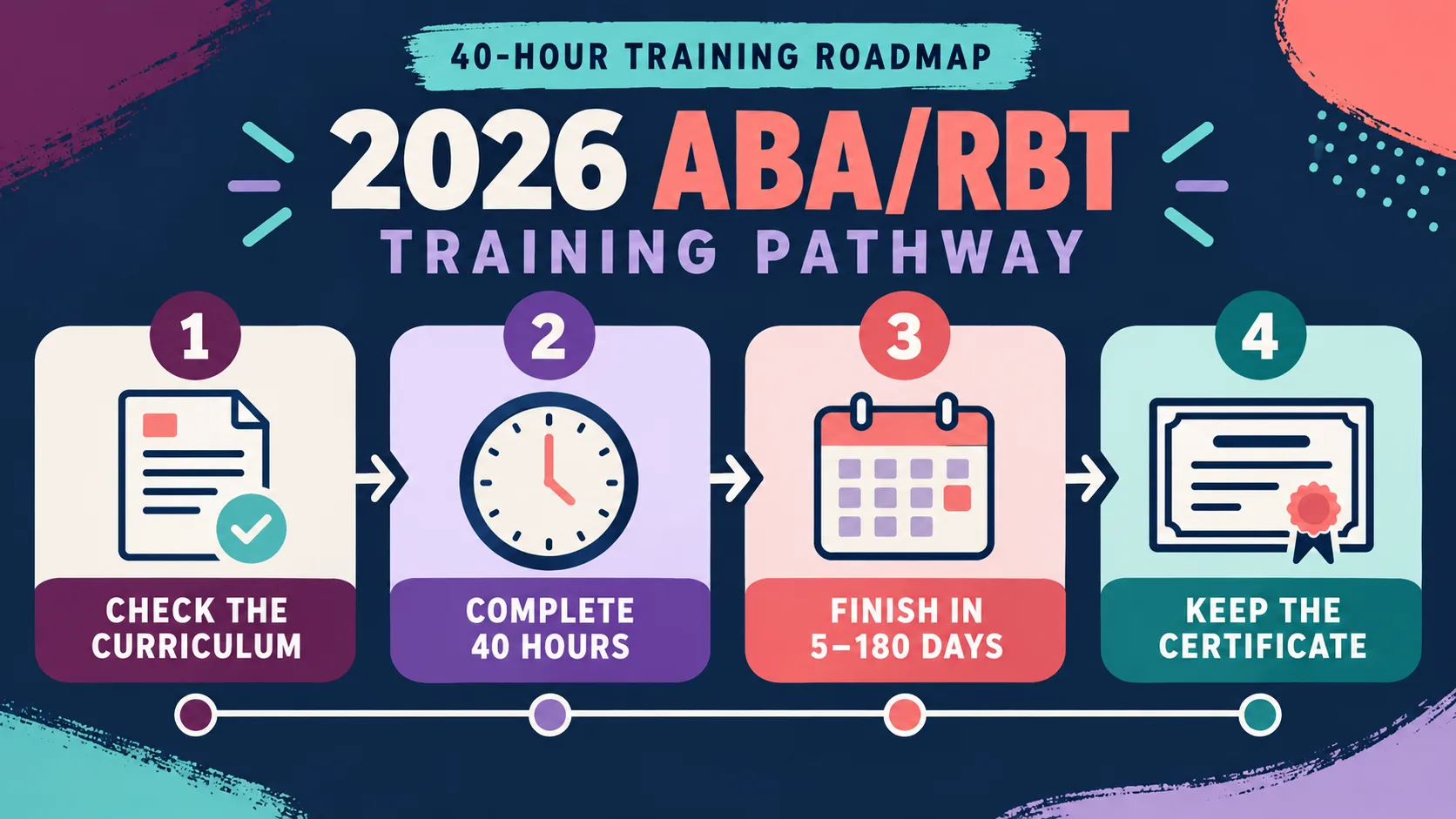
A credible course should show how its lessons map to the current outline rather than simply saying “40 hours of ABA.” These are the minimum section durations:
| Area | Minimum time | What it should cover |
|---|---|---|
| Introduction to ABA | 2 hours | Three-term contingency, reinforcement, functions, verbal behavior, and intervention phases. |
| Preparing for service delivery | 1 hour | Reviewing documentation, preparing the environment, rapport, and assent. |
| Data collection and graphing | 3 hours | Operational definitions, measurement, calculations, displays, and reporting changes. |
| Assisting with behavior assessments | 3 hours | Skill-based, preference, and functional assessment support. |
| Behavior-change interventions | 20 hours | Teaching, prompting, shaping, differential reinforcement, extinction, generalization, and crisis intervention. |
| Documentation and reporting | 3 hours | Confidential, objective, timely service documentation and supervisor communication. |
| Ethics and professionalism | 5 hours | RBT Ethics Code, dignity, cultural responsiveness, boundaries, and public statements. |
| Next steps in certification | 1 hour | Application, examination, supervision, ethics, self-reporting, and recertification. |
The most important quality signal is not a flashy dashboard. It is a clear connection between the course modules, the required content, active instruction, and a certificate that can be checked later.
How to Vet a 40-Hour Training Provider
Before paying, ask the provider for enough information to make a yes-or-no decision. The BACB does not provide the training, issue course certificates, or recommend a particular program. That means the responsibility for checking the course sits with the learner.
- Ask which standard applies. Confirm that the course is designed for the 2026 RBT requirements if your application is under that standard.
- Request the curriculum map. Look for all eight areas and the minimum durations, not just a total-hour number.
- Check how learning is delivered. A course made only of readings or passive slides is not enough by itself.
- Identify the responsible trainer. Ask for the person’s certification type and confirmation of the 8-hour supervision training.
- Confirm the time window. The schedule must fit the 5-day minimum and 180-day maximum.
Audit the Certificate Before You Submit It
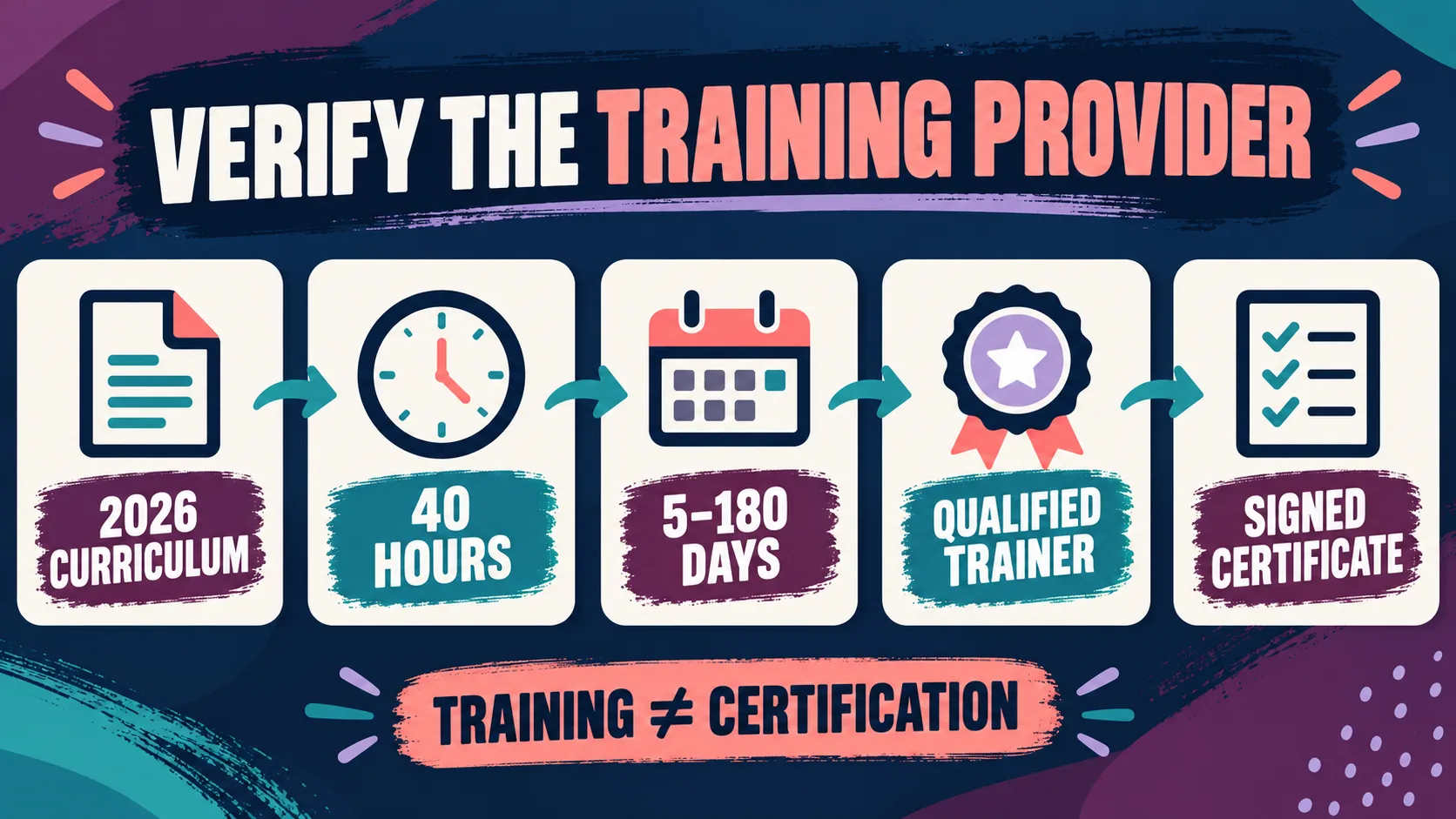
Do not wait until the application screen to discover that a certificate is missing key information. The current certificate requirements call for a single document that identifies the trainee and the training period, records the time completed, identifies the responsible trainer, and includes the required independence statement.
| Certificate check | Evidence to find | Why it matters |
|---|---|---|
| Trainee identity | Name and BACB ID, if available. | Connects the document to the applicant record. |
| Dates and time | Start date, end date, and actual training time. | Shows the 40-hour minimum and the permitted date window. |
| Trainer information | Responsible trainer name, certification number, signature or company branding, and assistants when applicable. | Makes the responsible person and training record identifiable. |
| Required statement | The course is designed to meet the 2026 RBT training eligibility requirement and is offered independent of the BACB. | Prevents the course from implying that the BACB operates or endorses it. |
The responsible trainer must retain training documentation for at least 7 years. Keep your own copy too, along with the syllabus, completion messages, payment record, and any correction issued by the provider. If a provider refuses to fix an obvious error, pause before submitting the certificate.
Training Is One Step, Not the Whole RBT Credential
After the training, an applicant still needs to meet the other eligibility requirements. The current handbook lists age, high-school-level education or equivalent, criminal background and abuse registry checks, the initial competency assessment, the certification application, and the examination. The initial competency assessment must occur after the training and no more than 90 days before submitting the application.
The 40-hour course also does not replace ongoing supervision. Once certified, an RBT works under the required supervision and must follow the applicable ethics and recertification rules. If a job advertisement says “complete our training and you are certified,” treat that as a warning sign and compare the promise with the official handbook.
FAQ: Online Courses, Timing, and BCBA Confusion
Can I complete the ABA 40-hour training online?: Yes, the current requirements allow online delivery, but the course still needs the required curriculum, time window, behavioral skills training components, qualified oversight, and certificate. Online does not mean self-paced reading alone automatically counts.
Can I finish it in five days?: Five days is the minimum number of days, not a suggestion to skip content. The full 40 hours must be delivered across the current curriculum, and the start and end dates are included in the day count. Does the course make me a BCBA?: No. It is generally an RBT training requirement. The BCBA path has different education, fieldwork, application, and examination requirements. Is the certificate enough to apply?: No. It is one document in the RBT application. You still need the other eligibility items, the current initial competency assessment, an application, approval, and the RBT examination.
If you are separately preparing for the BCBA route, the Take the Free BCBA Mock Exam can help you practice exam-style concepts. It is a study resource, not a substitute for RBT training, the official handbook, or a guarantee of certification.
Sources for Further Study
- BACB: RBT 2026 40-Hour Training Requirements and Curriculum Outline
- BACB: Registered Behavior Technician Handbook
- BACB: RBT application and resource hub
- BACB: Supervision, Assessment, Training, and Oversight
- BCBA Mock Exam: 40-hour training requirements overview
This article is educational and current as of October 2026. Always confirm the version of the BACB handbook and training requirements that applies when you submit your application. For targeted review, use our aba 40 hour training practice questions to apply the concept in exam-style scenarios.
Quick Review Checklist
Use this final checklist to turn aba 40 hour training into exam-ready reasoning. The goal is not to memorize a label in isolation; it is to identify the relevant evidence and explain why the best answer fits the scenario. Key ideas to review:
- State the central definition or decision point for aba 40 hour training in your own words.
- Identify the detail that makes aba 40 hour training different from its closest related ABA term.
- Separate the observable facts in a scenario from assumptions that are not supported by the facts.
- Write one example and one nonexample so you can recognize the concept in a new setting.
Exam application checks:
- Ask what the question is actually requesting before comparing the answer choices.
- Mark the antecedent, response, consequence, or other evidence that supports the selected answer.
- Look for a distractor that describes a related process but does not answer the specific question.
Final self-check:
- Explain how you would verify the interpretation with clear observations or data.
- Change one detail in the scenario and decide whether your answer should change.
- Give a one-sentence rationale that a supervisor or study partner could evaluate.



