

If you searched for ABA techniques for parents, you probably want something more useful than a long list of behavior terms. You want to know what to try during a real routine, how to choose a strategy without guessing at the reason for behavior, and how to tell whether the support is helping. The safest starting point is not “Which technique works for every child?” It is “What skill or routine are we teaching, what is the likely function, and what support fits this family?”
Table of Contents
- ABA techniques for parents: the short answer
- Start with the goal and likely function
- A parent-friendly ABA technique toolkit
- Use a coaching loop instead of a technique list
- Plan for independence: prompt, fade, and generalize
- Check generalization and maintenance
- Safety, assent, and professional boundaries
- A simple caregiver data sheet
- Common mistakes
- FAQ
- Sources for Further Study
- Take the Free BCBA Mock Exam
This guide turns common ABA concepts into a parent-friendly coaching process. It covers reinforcement, antecedent supports, functional communication, prompting and fading, task analysis, generalization, and simple measurement. It is educational information—not an individualized behavior plan. A qualified behavior analyst should assess the situation, involve the relevant stakeholders, explain the plan, and help the family make informed choices before a strategy is used as treatment.
The BACB Ethics Code places client welfare, dignity, self-determination, informed choice, stakeholder involvement, competence, and risk reduction at the center of professional practice. That matters for parent coaching: a strategy should be understandable, respectful, practical in the family’s context, and reviewed when the response is not improving. The BACB Ethics Codes page and the current Ethics Code for Behavior Analysts are the appropriate authority for professional standards.
ABA techniques for parents: the short answer
ABA techniques for parents are structured ways to teach useful skills and make everyday routines more predictable. The most transferable techniques are usually not “tricks.” They are small changes to what happens before a behavior, how a new response is taught, what consequence makes that response worth repeating, and how support is gradually reduced. A practical parent-coaching sequence is:
- Define one observable goal: for example, “asks for a break using a card or words” is clearer than “has fewer meltdowns.”
- Look at the context: note what happens before, what the learner does, and what happens immediately after.
- Choose one low-risk support: offer a choice, change the cue, teach a communication response, reinforce a useful approximation, or break a routine into steps.
- Practice with coaching: model the strategy, let the caregiver rehearse it, and give specific feedback.
- Measure a small signal: record opportunities, independent responses, prompt level, or successful transitions rather than relying only on memory.
Start with the goal and likely function
Behavior happens in context. A child who leaves a table may be avoiding a difficult task, seeking attention, trying to access a preferred item, or communicating discomfort. The same topography can have different functions, so a generic response can easily miss the need. Parents can describe patterns; a qualified professional should complete or guide assessment and treatment decisions.
| Parent goal | Question to observe | Possible starting support | What to measure |
|---|---|---|---|
| Communication | What does the learner currently do to request, reject, or ask for help? | Teach an accessible request or break response and honor it when safe. | Independent requests and prompt level |
| Transitions | What changes when the routine shifts, and what warning is available? | Use a predictable cue, visual sequence, choice, or brief transition rehearsal. | Successful transitions out of total opportunities |
| Independence | Which step is missing, confusing, or too effortful? | Use task analysis, a model, a prompt, and reinforcement for completed steps. | Steps completed independently |
| Safety | What immediate risk is present, and what prevention plan already exists? | Follow the qualified professional’s written safety plan; reduce triggers and teach an alternative when appropriate. | Risk events and response fidelity |
This table is a conversation starter, not a diagnostic tool. A parent’s observation does not by itself establish function or authorize a restrictive intervention.
A parent-friendly ABA technique toolkit
Reinforcement: Make the useful response worth repeating. Identify what the learner actually values in that moment, deliver it soon after the target response, and describe what earned it. Reinforcement is not the same as bribery; it is a consequence that increases the future likelihood of a behavior. Preferences can change, so observe rather than assuming that one reward will always work.
Antecedent supports: Adjust what happens before a routine becomes difficult. A first-then board, a visual sequence, a timer, a clear choice, a smaller task, or a brief preview can reduce uncertainty. Offer choices that are real and manageable, such as choosing the order of two tasks or the materials to use. Do not use a visual schedule as a demand to ignore communication or distress.
Functional communication: Teach a practical way to request help, attention, a break, more time, or a preferred item. The response may be speech, a sign, a card, a device, or another accessible form. Reinforce the communication response consistently when it is safe to do so, and ensure the learner has a way to reject or pause an activity. Communication should expand autonomy rather than merely make compliance easier.
Prompting and fading: Give only the support needed for a successful response, then plan how to reduce it. A prompt can be a gesture, visual cue, model, verbal cue, or other planned assistance. A professional should help choose the prompt hierarchy and timing because too much help can create prompt dependence, while too little can create repeated failure.
Task analysis and chaining: Break a complex routine into observable steps, teach the steps in a logical order, and reinforce progress. For a morning routine, the steps might include finding clothes, dressing, putting pajamas away, and moving to breakfast. A task analysis should fit the learner’s motor, communication, sensory, cultural, and environmental context; it is not a demand to complete every step immediately. Before practice, check:
- one observable goal
- one routine to practice
- one agreed support
- one small measure
- one safety stop rule
Use a coaching loop instead of a technique list
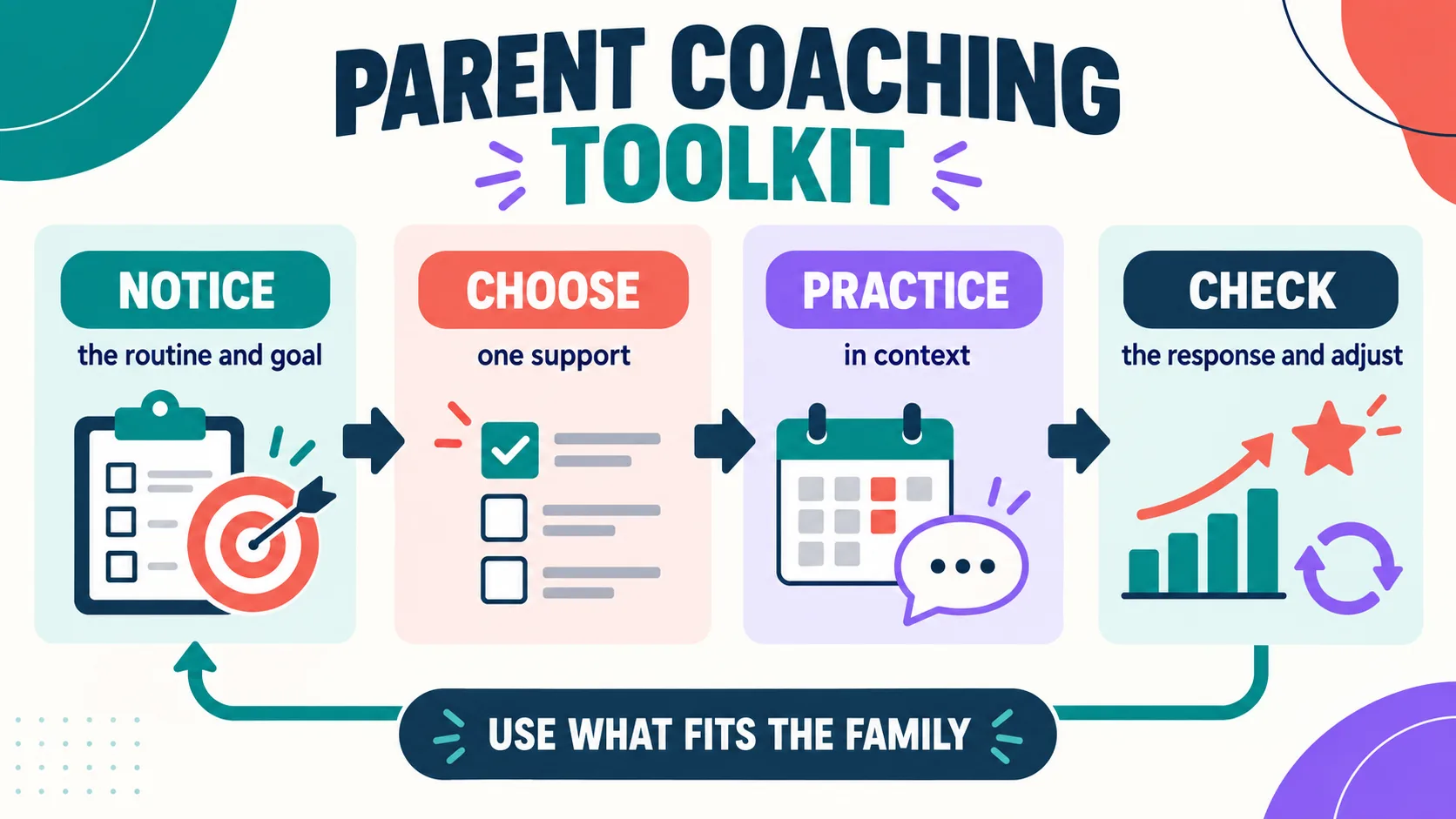
Caregiver coaching works best when the family can connect one strategy to one routine. Start with a routine the caregiver wants to improve, not a worksheet chosen without context. A useful loop is notice → choose → practice → check:
- Notice: describe the routine, the goal, the current response, and the likely barrier without blame.
- Choose: select one support that is feasible, socially acceptable, and consistent with the supervised plan.
- Practice: the coach explains, models, and rehearses the strategy with the caregiver in the actual or a simulated setting.
- Check: review the learner’s response, the caregiver’s experience, and the data. Keep, adjust, or stop the strategy based on evidence and safety.
Instructions alone are often not enough for a new routine. A coaching session can use behavioral skills training principles—clear instructions, a model, rehearsal, and feedback—while adapting the language and pacing to the caregiver. Research on caregiver-implemented interventions includes prompting, reinforcement, and task analysis, but reviews also emphasize that outcomes vary across interventions, learners, and families. The PubMed review of caregiver-implemented interventions and the Journal of Applied Behavior Analysis telehealth parent-training study are useful starting points for further reading.
Plan for independence: prompt, fade, and generalize
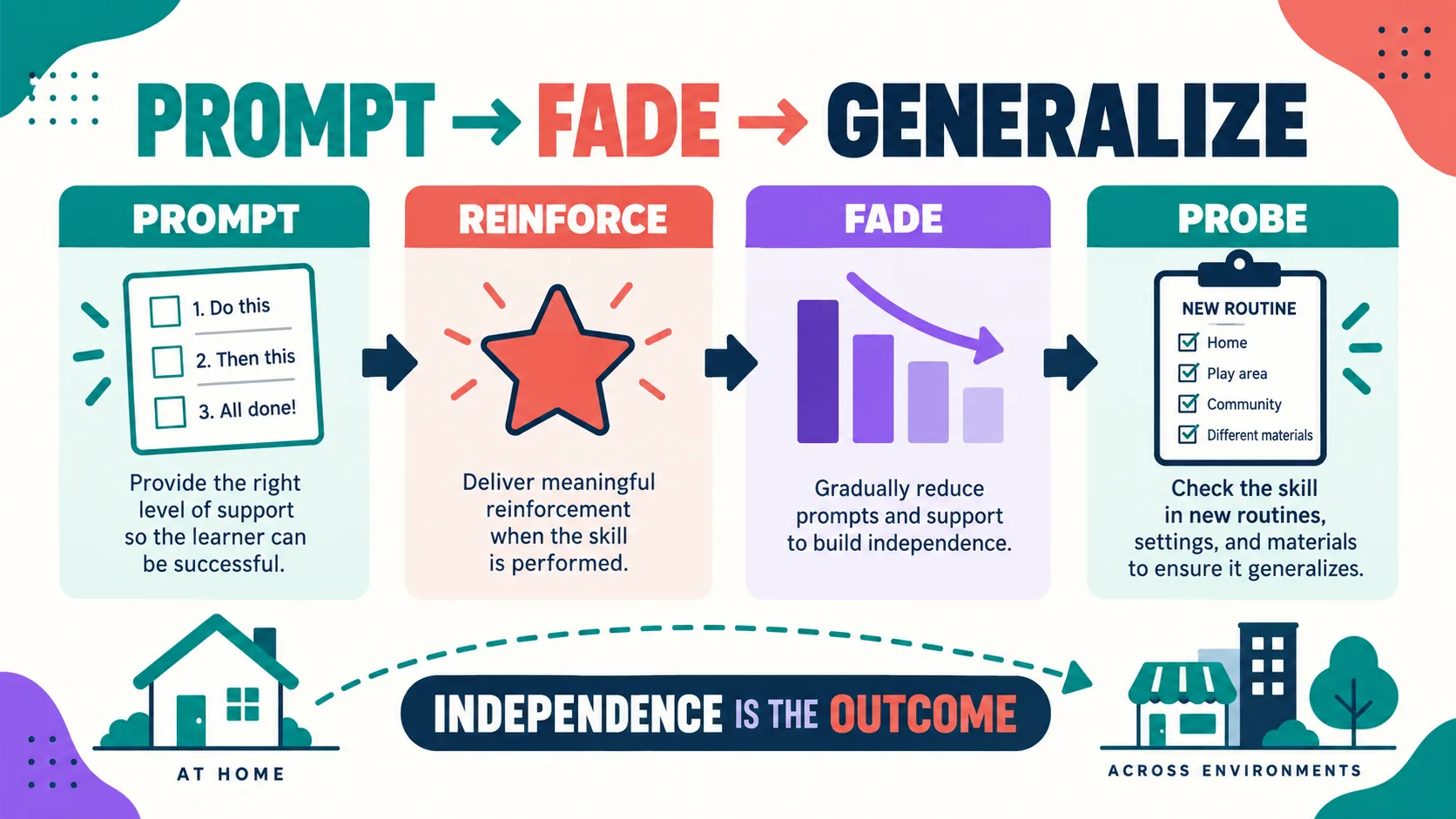
Prompting is a bridge, not the destination. Before teaching begins, decide what independent responding will look like and what evidence will tell you it is time to reduce help. Keep the cue, materials, and expected response clear; then change one support at a time when the learner is successful. A qualified professional should set the prompt-fading plan when the skill is part of treatment.
Generalization means the skill appears with different people, materials, places, cues, or routines. Teach a small variation after the original response is stable, then probe the new context rather than assuming that transfer happened. Maintenance means the skill continues after coaching becomes less frequent. Track both; a skill that works only during a practice session is not yet a finished outcome.
Check generalization and maintenance
Caregiver training research has repeatedly raised an important practical issue: a caregiver may perform a strategy in training but use it differently in another room, at another time, or under time pressure. Plan for transfer deliberately. The following comparison keeps the question concrete:
| Training context | New context to probe | Check | If it does not transfer |
|---|---|---|---|
| One caregiver gives a visual cue at home | A second caregiver uses the same cue in a different room | Independent response and prompt level | Model the cue again and simplify the materials |
| Practice during a calm morning | Try a weekend or evening transition | Successful opportunities out of total opportunities | Reduce task size, add a preview, or revisit the function |
| One preferred item is used as reinforcement | A naturally occurring activity follows the response | Response after reinforcement changes | Update the preference check and vary reinforcement thoughtfully |
Safety, assent, and professional boundaries
Parent education should never turn into a do-it-yourself instruction manual for high-risk procedures. Do not start extinction, response cost, punishment, restraint, crisis procedures, or physical prompting from a generic article. These procedures can have side effects and require individualized assessment, consent, training, monitoring, and a least-restrictive, safety-focused rationale when they are clinically considered.
Pay attention to assent and communication. The BACB defines assent as vocal or nonvocal behavior that can indicate willingness to participate when an individual cannot provide informed consent, and its core principles emphasize dignity, respect, privacy, and self-determination. A learner turning away, communicating “no,” escalating distress, or showing a new safety risk is information to evaluate—not a reason to intensify demands automatically.
Pause and contact the qualified professional responsible for the plan if there is injury risk, rapid escalation, regression, medication or health concern, suspected abuse, or a strategy that produces distress. For immediate danger, use appropriate emergency or crisis resources in your location. This article does not replace a BCBA assessment, a service agreement, a caregiver-training session, or a written safety plan.
A simple caregiver data sheet
Keep measurement small enough that it can happen during real life. A short record can capture whether a support is worth continuing without turning the family’s day into a research lab.
| Date / routine | Cue or support | Learner response | Next adjustment |
|---|---|---|---|
| When and where did it happen? | What was offered before the response? | Independent, prompted, refused, or unsafe? | Keep, simplify, pause, or ask for review |
Use consistent definitions and share the pattern—not identifiable client details—with the supervising team according to the service agreement.
Common mistakes
- Collecting techniques instead of defining a goal: a list of strategies cannot tell you what to do during one routine.
- Assuming topography equals function: the same behavior can serve different needs in different contexts.
- Using rewards without checking preferences: reinforcement only works when the consequence matters to the learner.
- Prompting forever: decide how independence will be checked and how support will be faded.
- Measuring only the adult’s compliance: also monitor learner choice, communication, distress, safety, and meaningful outcomes.
- Assuming generalization: probe a new person, material, place, or time and record what happens.
- Copying a restrictive procedure from the internet: pause and obtain qualified assessment, training, consent, and monitoring.
FAQ
What are the best ABA techniques for parents?: There is no single best technique for every family. Common starting points include reinforcement, antecedent supports, functional communication, task analysis, prompting and fading, and planned generalization. The best choice is the one that matches the observable goal and function, is feasible for the family, protects dignity and safety, and is reviewed with qualified professional support.
Can parents use ABA techniques without a BCBA?: Parents can use everyday supports such as clear routines, choices, encouragement, and accessible communication, but a general article cannot determine an individualized function or treatment plan. For challenging behavior, safety concerns, or formal ABA services, work with a qualified professional and follow the applicable service and consent requirements.
How can parents know whether an ABA technique is working?: Choose one small outcome and record it consistently: independent requests, successful transitions, steps completed, prompt level, or safe opportunities. Compare the pattern across similar routines, look for side effects, and review the data with the qualified professional. A single good day or difficult day is not enough evidence by itself.
Where can I learn more about parent training?: For the broad parent-training overview on this site, visit ABA Therapy Parent Training. It is a separate resource and remains distinct from this strategy-selector article. If you are studying for certification while learning the terminology, the Free BCBA Mock Exam is a study activity, not clinical guidance or a substitute for supervision.
Sources for Further Study
- Behavior Analyst Certification Board: Ethics Codes
- BACB: Ethics Code for Behavior Analysts
- PubMed: systematic review of caregiver-implemented interventions
- PubMed: parent training and generalization research
- Journal of Applied Behavior Analysis: telehealth general case parent training
- JAMA Pediatrics: parent training and child language development systematic review
- Review of parent-delivered instruction and prompting considerations
This article is for general education and exam-study context. It is not individualized medical, behavioral, legal, or clinical advice; it is not affiliated with or endorsed by the BACB; and it does not replace assessment, informed consent, assent, supervision, a written behavior plan, or emergency support.
Take the Free BCBA Mock Exam
When you are ready to apply the idea, use the free practice resource below for additional feedback. Take the Free BCBA Mock Exam



