

An ABA supervisor is not one universal job title. The right supervisor depends on whether you are accruing BCBA or BCaBA fieldwork, receiving ongoing RBT or BCaBA oversight, or seeking consulting support. If you are searching for an ABA supervisor, begin with the supervision context before comparing personalities, prices, or meeting platforms. A supervisor who is a good fit for a BCBA trainee may not be the right person for ongoing RBT oversight, and a directory listing does not by itself confirm the training, documentation, feedback, or state-licensure fit that your situation requires.
Table of Contents
- ABA Supervisor: Start With the Supervision Context
- Check the Fieldwork Supervisor Gate
- Verify Training, Contract, and Records
- Run a Supervisor Fit Audit
- Treat Remote Supervision and Licensure Separately
- Connect Supervision Concepts to BCBA Exam Preparation
- Use a 30-Day Selection Plan
- FAQ About an ABA Supervisor
- Take the Free BCBA Mock Exam
ABA Supervisor: Start With the Supervision Context
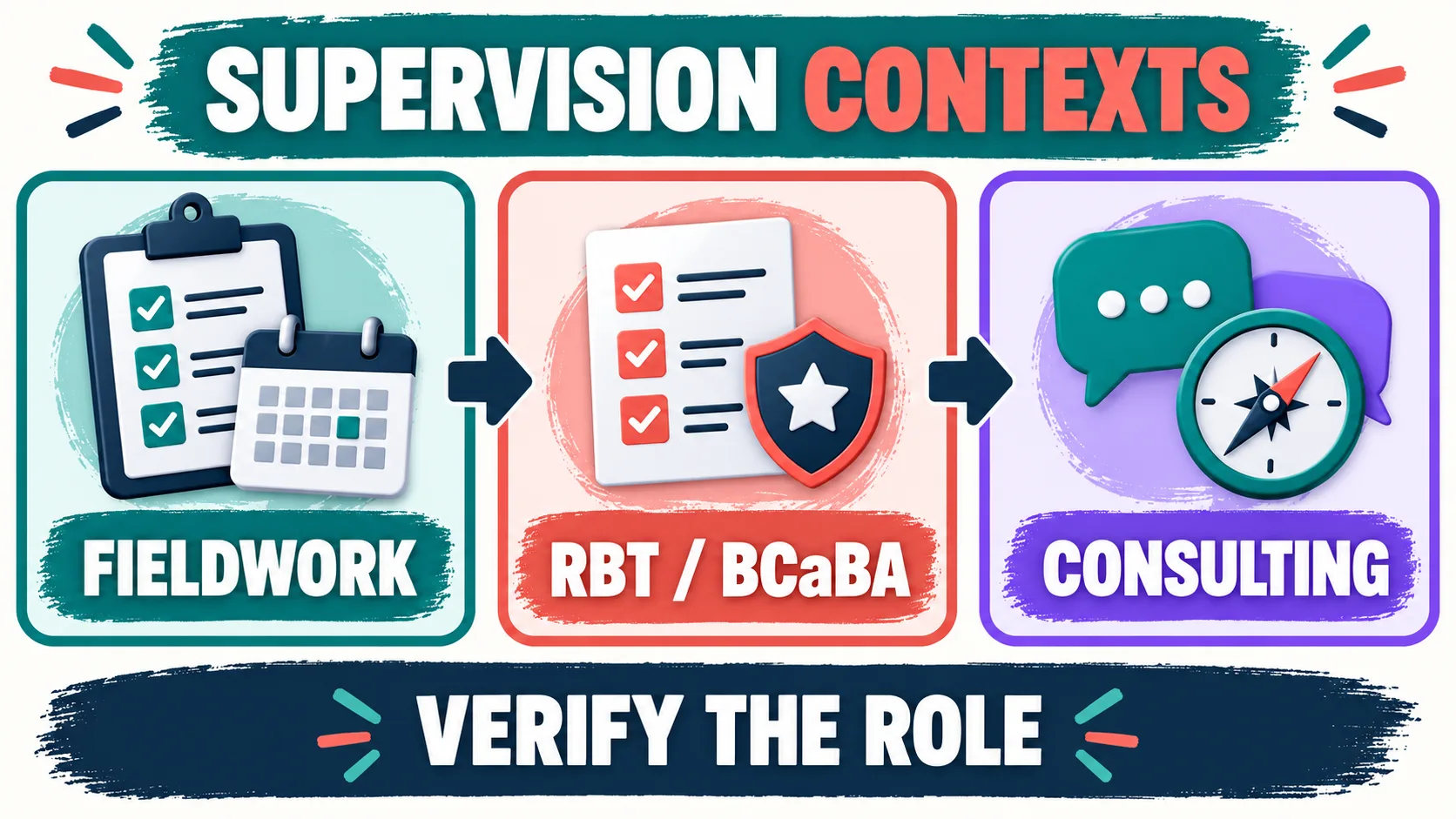
The Behavior Analyst Certification Board separates supervision, assessment, training, and oversight into several roles. That distinction is the most important first step because the responsible person, handbook, forms, and training expectations can change with the supervisee and the purpose of the relationship.
| Supervision context | Who is being supported? | What to verify first |
|---|---|---|
| Future-certificant fieldwork | A trainee accruing supervised fieldwork toward BCBA or BCaBA certification. | Active qualification, 8-hour supervision training, eligible fieldwork, contract, contacts, observations, and monthly records. |
| Ongoing service oversight | An RBT or BCaBA who requires ongoing supervision while providing services. | The relevant handbook, supervision percentage or contacts, responsible certificant, training, and service-setting expectations. |
| Consulting supervision | A newer BCBA or supervisor seeking qualified consultation and professional support. | The consulting supervisor’s qualifications, scope, cadence, feedback method, and any first-year or handbook-specific requirement. |
This table is a decision map, not a replacement for the current handbook. If someone advertises “ABA supervision” without asking who you are, what credential you are pursuing, and which activities you will perform, that is a reason to slow down. A good first conversation should make the supervision task more specific, not more vague.
Check the Fieldwork Supervisor Gate
For a BCBA or BCaBA trainee, fieldwork supervision is tied to certification eligibility. The BACB’s Fieldwork Checklist for BCBA and BCaBA Supervisors asks supervisors to confirm their active certification, supervision training, the trainee’s coursework and fieldwork eligibility, and the quality of the supervision arrangement. Before you begin, ask the prospective supervisor to explain how the relationship will work in practice. At minimum, you should be able to identify:
- Who is responsible: if several supervisors are involved, who owns the contract, reviews the records, and signs the applicable verification?
- What counts as fieldwork: which activities are acceptable, which are unrestricted, and how will you distinguish fieldwork from ordinary job duties?
- How contact occurs: what meetings, real-time contacts, client observations, and feedback opportunities are planned for each supervisory period?
- How data are tracked: where will you record hours, activities, supervision, observations, signatures, and corrections?
- What happens when something changes: how will a missed meeting, supervisor absence, client change, or form error be documented and repaired?
The trainee is still responsible for maintaining evidence that fieldwork meets the applicable requirements. A supervisor’s confidence or a company’s internal spreadsheet does not make an otherwise incomplete record compliant. The strongest relationship makes the requirements visible early, while there is still time to correct a problem.
Verify Training, Contract, and Records
The BACB’s supervision-and-training overview states that supervisors who oversee fieldwork trainees, or current BCaBA and RBT certificants who require ongoing supervision, must complete an 8-hour supervision training based on the Supervisor Training Curriculum Outline (2.0) before providing that supervision. Confirm the date and documentation rather than accepting “I have supervised for years” as an answer.
| Item | Question to ask | Evidence to retain |
|---|---|---|
| Role and credential | Which role are you providing, and which credential or license supports it? | Current registry or credential information and the applicable handbook reference. |
| 8-hour training | When did you complete the required supervision training, and where is it documented? | Training record, completion date, and account-upload or provider evidence when applicable. |
| Written contract | What are our responsibilities, meeting expectations, fees, cancellation rules, and documentation process? | Signed contract that names the role, scope, cadence, records, and escalation process. |
| Records and retention | Who reviews forms each month and how are corrections handled? | Monthly logs, verification forms, meeting notes, feedback, and a secure retention plan. |
Do not confuse a supervision contract with a service agreement or a job description. A service agreement may explain payment and scheduling, while the supervision contract should explain the professional relationship, responsibilities, and documentation needed for the applicable role. If the documents conflict, resolve the conflict before counting hours or representing that a requirement has been met.
Run a Supervisor Fit Audit
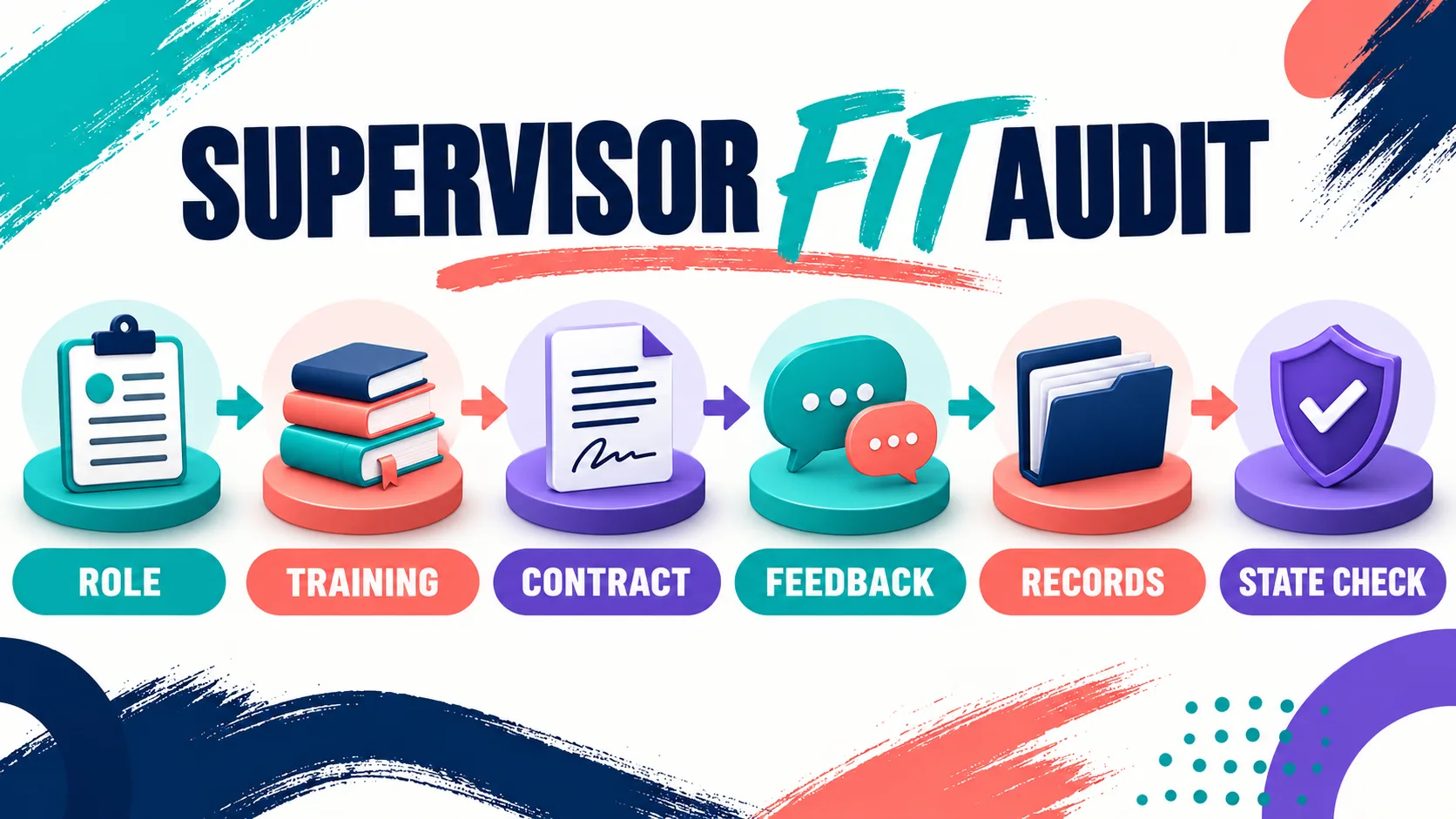
Once the role is clear, evaluate fit like you would evaluate any high-consequence professional relationship. “Nice,” “popular,” or “available on weekends” may matter, but they are not enough. The supervisor needs to be able to observe your work, give specific feedback, protect client and trainee welfare, and maintain a reliable documentation system.
- Experience fit: has the supervisor worked with the population, setting, behavior-analytic activities, and credential pathway you need?
- Feedback fit: will you receive written or otherwise retrievable feedback tied to observable performance and professional development?
- Availability fit: does the cadence allow the required contacts, observations, questions, and urgent consultation that the setting may need?
- Ethics fit: how does the supervisor handle boundaries, confidentiality, conflicts of interest, cultural responsiveness, and concerns about services?
- Documentation fit: can you see the workflow for logging hours, reviewing records, signing forms, and correcting errors?
| Green flag | Warning sign | Follow-up question |
|---|---|---|
| Explains the exact role and points to the current handbook. | Uses “all supervision is the same” language. | Which handbook section and supervision context apply to me? |
| Reviews a sample tracking and feedback process before you sign. | Promises that a spreadsheet or payment automatically makes hours count. | Who checks each supervisory period and what happens if an entry is wrong? |
| Discusses client connection, observation, privacy, and boundaries. | Offers simulated activities as a substitute for actual client-related requirements. | How will observation and real-time feedback occur in my setting? |
If a supervisor cannot answer a question immediately, that is not automatically a rejection. The important signal is whether they identify the uncertainty, consult the correct source, and give you a documented answer before the relationship begins. Avoid making a high-stakes decision from a sales call alone.
Treat Remote Supervision and Licensure Separately
Remote supervision may be workable in some circumstances, but “online” does not erase the need for real clients, appropriate observation, effective feedback, secure communication, and compliance with the applicable handbook. The BACB’s fieldwork guidance also cautions that remote arrangements can interact with state licensure rules. A supervisor who is licensed or authorized in one state may not satisfy the rules that apply where services are delivered. Ask two separate questions:
- Does this arrangement meet the BACB supervision requirements for my credential and activity?
- Does this arrangement meet the licensing, employer, payer, and client-consent requirements where services occur?
The answer to the first question does not automatically answer the second. Check the current state authority, employer policy, and client privacy expectations before you rely on remote supervision as your plan.
Connect Supervision Concepts to BCBA Exam Preparation
Supervision is also a recurring BCBA exam reasoning task. The exam may present a supervisor, trainee, RBT, BCaBA, or client-service situation and ask you to identify the responsible role, the ethical concern, the documentation problem, or the next best action. Learn the principle before you memorize a number: identify who is being supervised, what service or credential goal is involved, what evidence is required, and which source controls.
- Read the stem for the supervision context before choosing an answer.
- Separate fieldwork requirements from ongoing service supervision.
- Look for missing contracts, observations, feedback, training, or documentation.
- Choose the answer that protects the client, supervisee, and integrity of the record.
After your supervision concepts are organized, a targeted BCBA mock exam can help you test application under time pressure. Use missed questions as a diagnostic by labeling the error: role confusion, rule recall, ethics, documentation, or scenario application. Practice questions supplement supervision; they do not authorize anyone to supervise or certify your fieldwork.
Use a 30-Day Selection Plan
If you have not committed to an ABA supervisor, use a month to turn a vague search into a documented decision. The goal is not to select the person who responds fastest. It is to select a relationship whose role, evidence, feedback, and boundaries are clear enough to support your actual work.
| Days | Action | Decision record |
|---|---|---|
| 1–7 | Name the credential, supervisee role, setting, clients, and state rules that apply. | One-sentence supervision task and source list. |
| 8–14 | Interview two or three candidates about training, experience, cadence, observation, feedback, and fees. | Comparable fit-audit notes, not just impressions. |
| 15–21 | Review the contract and tracking workflow; confirm who signs and retains records. | Written questions resolved before signing. |
| 22–30 | Start the relationship only after the role, documents, schedule, and escalation plan are clear. | Signed agreement and first supervisory-period checklist. |
FAQ About an ABA Supervisor
What does an ABA supervisor do?: An ABA supervisor may supervise future BCBA or BCaBA certificants completing fieldwork, oversee ongoing services for RBTs or BCaBAs, assess or train staff, or provide consulting support to another BCBA. The exact responsibility depends on the role and the governing handbook.
Does every ABA supervisor need 8-hour supervision training?: The BACB states that supervisors overseeing fieldwork trainees and current BCaBA or RBT certificants who require ongoing supervision must complete the applicable 8-hour supervision training before providing that supervision. Verify the current official guidance for the exact role instead of relying on a generic title.
Can an RBT supervise a BCBA trainee?: No. RBT supervision and BCBA or BCaBA fieldwork supervision are different relationships with different qualification and documentation requirements. Use the relevant BACB handbook and role matrix when evaluating who can supervise a particular activity.
Can ABA supervision be completely remote?: Some remote components may be permitted, but the arrangement still has to meet the applicable BACB, state, employer, client-consent, privacy, and observation requirements. Remote delivery should be checked as a specific plan, not assumed from the fact that video meetings are available.
Sources checked for this guide include the BACB supervision-and-training role matrix, fieldwork supervisor checklist, current handbook resources, Supervisor Training Curriculum Outline (2.0), and BACB guidance on remote fieldwork and documentation. Requirements can change, so verify the current official materials for your situation.
Take the Free BCBA Mock Exam
When you are ready to apply the idea, use the free practice resource below for additional feedback. Take the Free BCBA Mock Exam



