

A 40 hour ABA training course is not judged by its title or a provider’s sales page alone. Before you enroll, verify the current BACB curriculum, the training window, the responsible trainer, the learning activities, the completion record, and what remains after the course.
Table of Contents
- What to Check Before You Buy a 40 hour ABA training course
- Use a Course-Selection Scorecard
- Build a Completion Plan That Fits the Rule
- Check Provider Access, Refund, and Record Policies
- What the Certificate Proves—and What It Does Not
- Turn Training Into Study Evidence
- Common Course-Selection Traps
- Frequently Asked Questions
- Sources and Verification Notes
- Take the Free BCBA Mock Exam
Many people search for a 40 hour ABA training course because they want to start the Registered Behavior Technician (RBT) pathway. The course can be an important eligibility step, but “40 hours” is not a complete quality check. A course also needs to fit the current requirements, be completed inside the allowed date window, identify the responsible trainer, and give you documentation you can use for the next step.
This guide is a neutral buying and completion framework. It does not rank providers, promise certification, or replace the current BACB RBT Handbook. Use the official BACB materials as the authority, then use the questions below to compare a course’s actual offer with your schedule, budget, learning needs, and application plan.
What to Check Before You Buy a 40 hour ABA training course
The official BACB document is the first filter. The current RBT 2026 40-Hour Training Requirements and Curriculum Outline says the training must cover the required curriculum, total at least 40 hours, and be completed in no fewer than 5 days and no more than 180 days. It also describes acceptable delivery components, responsible-trainer duties, and documentation. A provider’s phrase “40-hour course” is not enough unless its current course details line up with that source.
| Requirement to audit | Question for the provider | Evidence to save |
|---|---|---|
| Current curriculum | Which BACB 2026 curriculum outline does this course use, and when was the course last updated? | Course outline, version or update date, and the provider’s written answer. |
| Duration window | How are the 40 hours scheduled, and how does the platform record the start and end dates? | Enrollment date, completion log, and the final training certificate. |
| Learning activities | Does the course include instruction, examples, practice, feedback, quizzes, or discussion rather than only assigned reading? | Module list, activity record, quiz history, and any role-play or feedback record. |
| Responsible trainer | Who designed and oversees the training, and what qualification and supervision-training information is provided? | Responsible trainer’s name, qualification, and the documentation naming that person. |
One detail matters for planning: the BACB outline describes section minimums that total 38 hours, with 2 unallocated hours that can be added to a section to reach 40. Do not treat a provider’s “40 hours” as permission to skip required content. Ask how the course maps its lessons and activities to the current outline, then keep the answer with your enrollment record.
Use a Course-Selection Scorecard
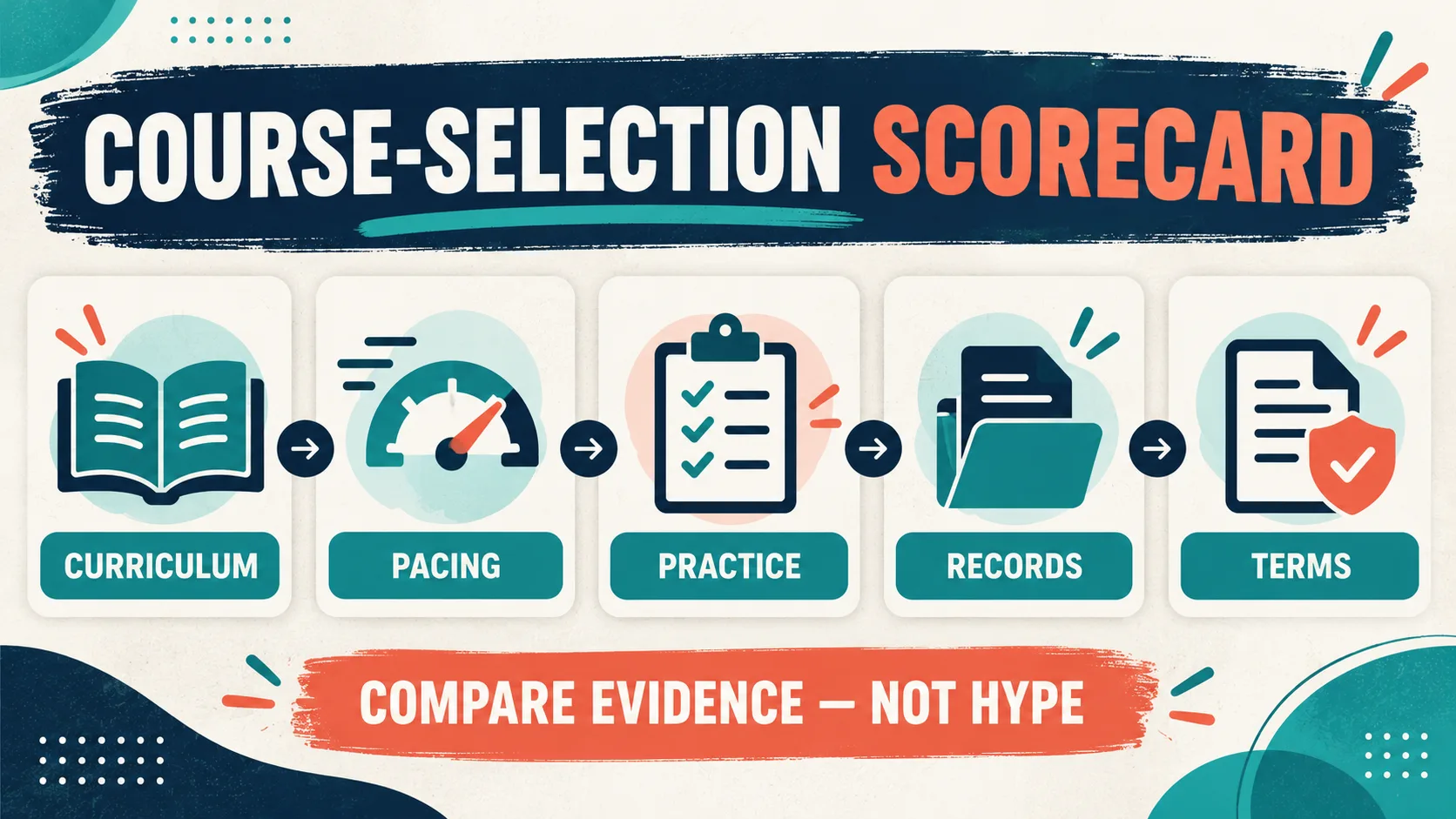
Once a course passes the official-rule check, compare it on practical fit. Price and speed are visible, but they are not the only variables. A low-cost course can be a poor fit if access expires before you finish, while a more expensive course may still be a poor fit if it does not clearly identify the responsible trainer or provide a usable completion record.
Give each candidate a simple score from 0 to 2 for every category: 0 means the answer is missing, 1 means you need clarification, and 2 means the provider gives a clear answer tied to the current requirement. Keep the provider’s evidence beside the score; a number without a source becomes another marketing impression.
| Scorecard category | A strong answer includes | Warning sign |
|---|---|---|
| Requirement fit | A current curriculum map and a plain explanation of the training window. | Only a badge, slogan, or old task-list reference with no update date. |
| Learning design | Examples, practice, feedback, quizzes, or interactive activities that match the course content. | Forty hours are presented as passive video or reading with no progress record. |
| Access and pacing | Clear access length, support hours, start/end tracking, and a realistic completion plan. | An automatic subscription or access expiration is hard to find. |
| Record quality | Certificate fields, responsible-trainer information, and a way to correct an error. | The provider cannot explain what the certificate says or how a lost record is replaced. |
| Cost and cancellation | Total cost, trial terms, refund policy, renewal charges, and payment timing are visible before checkout. | The advertised price excludes required support or renews without a clear reminder. |
Do not use a provider’s pass-rate claim as a guarantee for your result. The BACB publishes pass-rate information as reporting context, but a course’s marketing page and a certification decision are not the same evidence. Compare what is verifiable: curriculum, activities, records, access, and support.
Build a Completion Plan That Fits the Rule
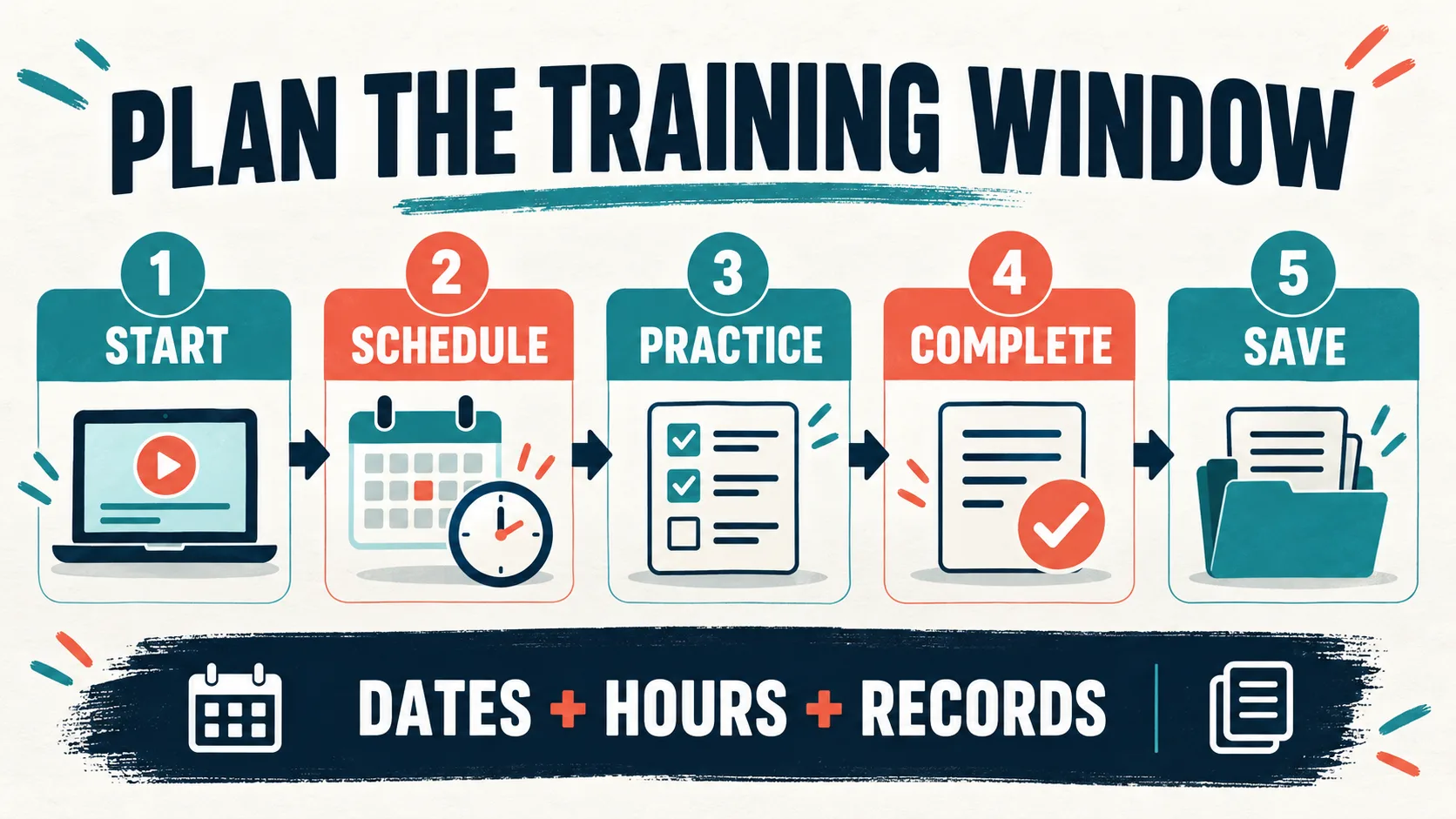
The legal or administrative window is not the same as your best learning schedule. The official 2026 outline sets a minimum of 5 days and a maximum of 180 days. Within that window, choose a plan that leaves room for retrieval, practice, and correction instead of forcing every hour into a single weekend.
For example, a five-day intensive plan might use eight scheduled hours per day, including the provider’s required learning activities. A four-week plan could use about ten hours per week, while an eight-week plan could use about five hours per week. These are planning examples, not a promise that every provider structures hours identically. Record the provider’s actual start date, end date, module duration, and completion evidence.
- Set the dates: write the actual start date and a target completion date inside the allowed window.
- Divide the modules: distribute the required sections by week, keeping difficult topics away from the last day.
- Protect practice time: reserve time for examples, quizzes, role-play, feedback, and review instead of counting only screen time.
- Check progress weekly: compare the provider’s dashboard with your own log and resolve missing activity promptly.
- Close the record: download the certificate, review the name and dates, and save the course outline and completion evidence together.
If illness, work, or access problems interrupt the plan, contact the provider before the end date becomes urgent. Ask how a pause, extension, incomplete module, or subscription cancellation affects the recorded training dates. Do not silently restart or combine records unless the provider explains how the resulting certificate remains accurate.
Check Provider Access, Refund, and Record Policies
Two courses can both advertise 40 hours while giving you very different buying conditions. Read the checkout page, terms, FAQ, and support policy before payment. Save a PDF or screenshot of the terms you relied on, because a course page can change after enrollment.
- Access: How long can you view the modules, and does access end after a calendar period or after completion?
- Progress: Does the platform record watched instruction, quizzes, activities, and the date each requirement was completed?
- Support: Who answers a content, technical, or certificate question, and how quickly?
- Payment: Is the price one-time, weekly, monthly, or automatically renewing?
- Refunds: What happens after you open content, complete a module, or miss a cancellation deadline?
- Records: Can you download the completion certificate and recover it if your account closes?
These questions are not a demand for a provider to promise certification. They are a way to make the commercial terms and evidence chain visible. If the provider avoids a direct question about the current curriculum or certificate fields, pause before paying and return to the official BACB document.
What the Certificate Proves—and What It Does Not
A completed course certificate is evidence that the provider records your completion of its training. It does not automatically make you an RBT, grant permission to practice independently, replace the initial competency assessment, or guarantee that an application will be accepted. The BACB handbook and current application materials determine the remaining steps.
Keep the certificate with the course outline, responsible-trainer information, enrollment dates, activity record, and payment receipt. If a future application asks for a direct document or a specific attestation, follow that instruction rather than uploading a marketing badge. When your name, dates, or course version is wrong, ask the provider to correct the record before you move forward.
Turn Training Into Study Evidence
Completion is easier to use when you convert it into a small study record. After each module, write one concept you can define, one example you can recognize, one question you still have, and one official source you should revisit. This makes the course more than a clock and gives you a list of topics to review before an assessment.
If your long-term plan includes BCBA certification, keep the RBT training in its proper place. It can build foundational exposure to behavior analysis, but it does not replace BCBA coursework, supervised fieldwork, application requirements, or the BCBA examination. For candidates who are ready to diagnose broader BCBA study gaps, the free BCBA Mock Exam can be used as practice and feedback—not as a substitute for current BACB rules.
Common Course-Selection Traps
Use this last check before checkout. A course can look polished and still leave an important question unanswered.
- Old version by a new title: the page uses “2026” in a banner but does not show a current curriculum map or update date.
- Certificate confusion: “certificate of completion” is presented as if it were the RBT credential.
- Speed over fit: an intensive promise leaves no time for practice, troubleshooting, or a missed module.
- Hidden access limits: a trial, subscription, or auto-renewal is not understood until after payment.
- Marketing as evidence: rankings, testimonials, or pass-rate claims replace direct verification of the actual curriculum and record.
- No next-step plan: the learner finishes the course but has not checked the competency assessment, application timing, or current handbook.
Frequently Asked Questions
How many days can a 40 hour ABA training course take?: The BACB 2026 training outline states that the training must be completed in no fewer than 5 days and no more than 180 days. Confirm the current official document and record the provider’s start and end dates rather than relying on a generic calendar promise.
Can an online course count?: The current outline allows in-person and/or online formats, but the course still has to meet the curriculum, duration, delivery, trainer, and documentation requirements. Ask how online activities, practice, feedback, and progress records satisfy the provider’s current design.
Does finishing the 40-hour course make me an RBT?: No. The course is one part of the RBT pathway. Review the current RBT Handbook and application resources for the remaining competency, application, examination, supervision, and maintenance steps that apply to you.
What should appear on my training record?: Follow the current BACB and provider instructions. As a practical record, keep the certificate, course outline or version, responsible-trainer information, start and end dates, activity evidence, and any correction or support messages.
Should I choose the fastest course?: Choose a schedule you can complete accurately inside the allowed window. A fast plan may fit someone with uninterrupted time, while a paced plan may provide more room for practice and review. Compare evidence and terms rather than speed alone.
Sources and Verification Notes
This article uses the current BACB 2026 RBT training outline and handbook as the authority for the training rule. Provider pages are examples of the kinds of information a buyer may compare; they are not endorsements, rankings, or guarantees. Requirements, course versions, prices, access terms, and application instructions can change, so verify the official BACB source and the provider’s live terms before enrolling.
- BACB RBT 2026 40-Hour Training Requirements and Curriculum Outline.
- BACB Registered Behavior Technician Handbook.
- BACB RBT application resources.
- BACB supervision, assessment, training, and oversight.
- BACB RBT provider pass-rate reporting context.
- ABA Technologies / Florida Tech RBT Essentials provider example.
For targeted review, use our 40 hour aba training course practice questions to apply the concept in exam-style scenarios.
Take the Free BCBA Mock Exam
A useful next step is to apply this idea in a fresh set of BCBA-style practice questions and review the feedback. Take the Free BCBA Mock Exam



