

Antecedent strategies in ABA represent a proactive approach to behavior management that focuses on preventing challenging behaviors before they occur. These interventions target the events or conditions that precede behavior, making them fundamentally different from consequence-based strategies that respond to behavior after it happens.
Table of Contents
- Antecedent Strategies ABA: What Are Antecedent Strategies in ABA?
- Linking Function to Intervention: Antecedent Strategies in Action
- Antecedent Strategies on the BCBA Exam: Common Traps and Tips
- Your Antecedent Intervention Selection Checklist
- Summary and Key Takeaways for Exam Success
Antecedent Strategies ABA: What Are Antecedent Strategies in ABA?
Antecedent strategies operate within the three-term contingency framework of applied behavior analysis. They specifically target the antecedent component—the events that occur immediately before a behavior. This proactive approach emphasizes prevention rather than reaction.
The Proactive Shift: Prevention Over Reaction
The philosophical advantage of antecedent interventions lies in their preventative nature. Instead of waiting for challenging behavior to occur and then implementing consequences, antecedent strategies modify the environment or conditions to reduce the likelihood of problem behavior. This approach contrasts sharply with reactive strategies that respond to behavior after it happens.
Two critical antecedent concepts include setting events—distant environmental factors that influence behavior—and discriminative stimuli (S^D)—specific cues that signal the availability of reinforcement. Understanding these concepts is essential for effective intervention design.
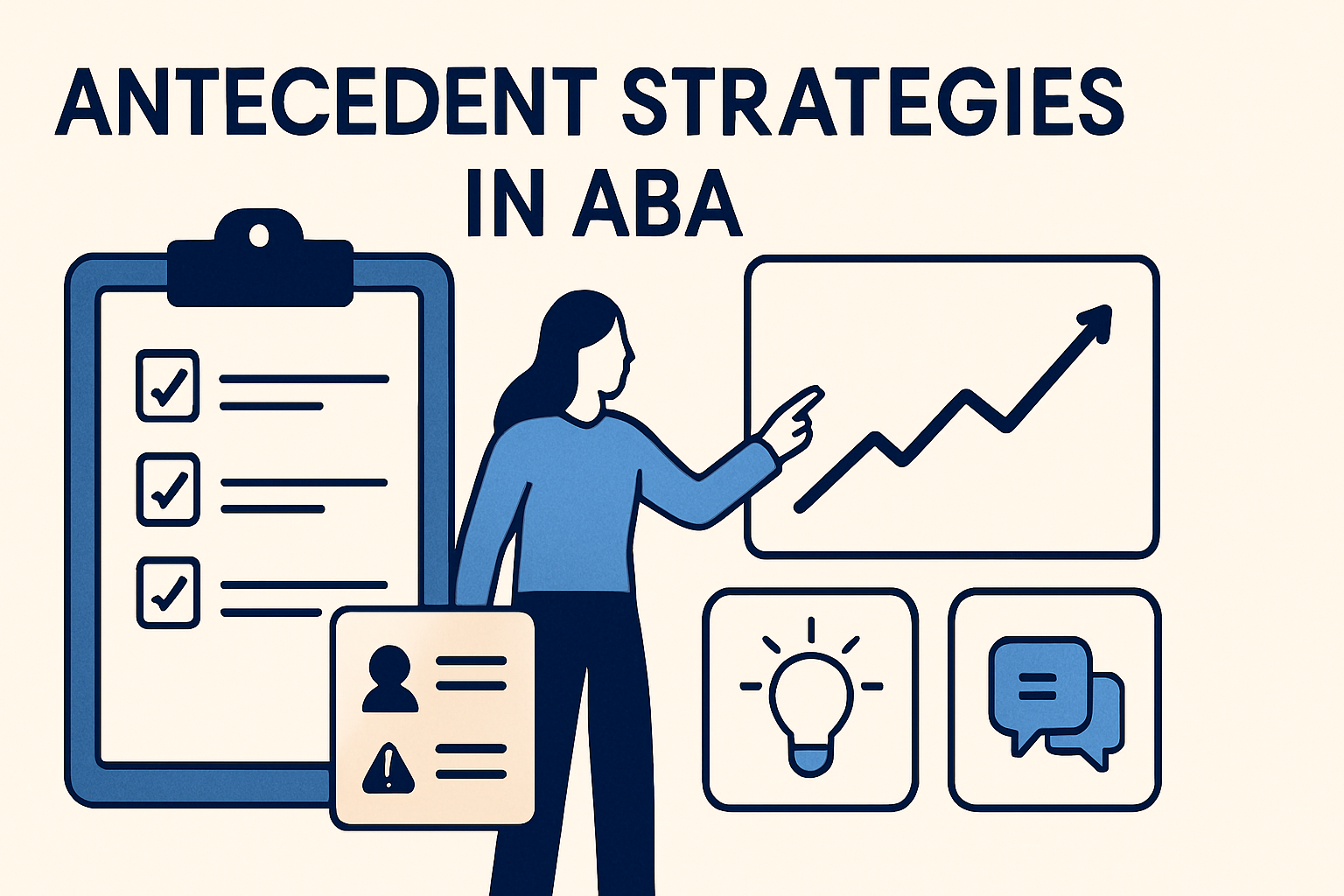
Key Terminology for the BCBA Exam
- Antecedent Intervention: Any environmental modification made before behavior occurs to prevent or reduce challenging behavior
- Antecedent Manipulation: Specific changes to the environment, task, or instructional methods
- Setting Event: Distant environmental factors that temporarily alter the value of consequences
- Motivating Operation (MO): Environmental variables that change the effectiveness of reinforcement
- Discriminative Stimulus (S^D): A stimulus that signals the availability of reinforcement for a specific response
Linking Function to Intervention: Antecedent Strategies in Action
The hypothesized function of behavior dictates the choice of antecedent strategy. Each behavioral function requires different environmental modifications to be effective.
Example 1: Escape-Maintained Behavior and Antecedent Modifications
Consider a scenario where a student elopes from the classroom during difficult math work. A functional behavior assessment reveals an escape function. Effective antecedent strategies might include:
- Noncontingent Escape: Providing scheduled breaks independent of behavior
- Task Modification: Breaking assignments into smaller, manageable chunks
- Choice Making: Allowing the student to select the order of tasks
These strategies alter the antecedent conditions to reduce the motivation to escape.
Example 2: Attention-Seeking Behavior and Environmental Arrangements
When a student calls out repeatedly during independent work to gain teacher attention, several antecedent strategies can help:
- Noncontingent Attention: Providing pre-scheduled check-ins before behavior occurs
- Visual Cues: Implementing a help card system for requesting assistance
- Strategic Seating: Placing the student closer to the teacher for easier access
These environmental arrangements address the attention function proactively.
Example 3: Automatic Reinforcement and Stimulus Control
For behaviors maintained by automatic reinforcement, such as hand mouthing during downtime, consider these antecedent strategies:
- Competing Stimuli: Providing appropriate oral stimulation like chewable jewelry
- Enriched Environment: Implementing structured activity schedules
- Sensory Modifications: Using gloves or alternative tactile materials
These interventions target the sensory function by providing alternative stimulation.
Antecedent Strategies on the BCBA Exam: Common Traps and Tips
BCBA exam questions often test your ability to distinguish between antecedent interventions and consequence-based strategies. Understanding common traps is essential for exam success.
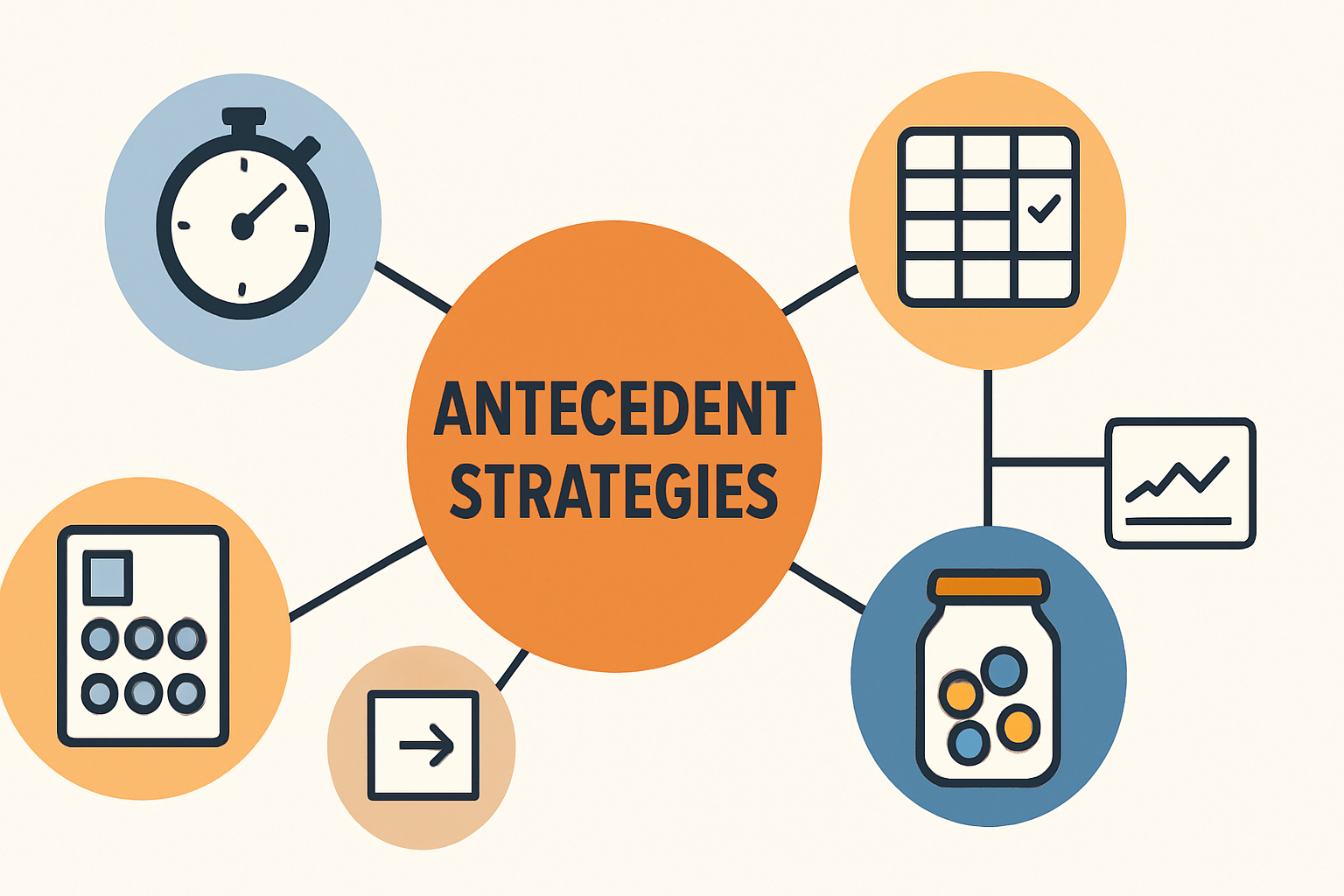
Trap #1: Confusing Antecedent with Consequence
Many exam questions present interventions that sound proactive but are actually consequence-based. For example, “allowing a break following the first instance of on-task behavior” represents differential reinforcement (DRA), not an antecedent strategy. True antecedent interventions occur before behavior, not contingent upon it.
Trap #2: Selecting an Intervention Without Considering Function
The correct antecedent intervention must always be function-based. Choosing an intervention that doesn’t match the behavioral function is a common exam error. For instance, using choice-making for automatically reinforced behavior would be inappropriate. Always link your intervention selection to the hypothesized function from the FBA.
Trap #3: Overlooking the Simplicity of Noncontingent Reinforcement (NCR)
Many candidates mistakenly classify noncontingent reinforcement as a consequence-based strategy. However, NCR is an antecedent intervention because reinforcement is delivered independent of behavior, thereby altering the motivating operation. This differs from functional communication training (FCT), which is consequence-based.
Your Antecedent Intervention Selection Checklist
Use this practical checklist when selecting antecedent strategies for clinical practice or exam questions:
- Conduct FBA: Complete a thorough functional behavior assessment first
- Identify Function: Determine the primary maintaining variable
- Select Matching Strategy: Choose interventions that directly address the function
- Consider Environmental Modifications: Look for ways to alter setting events or discriminative stimuli
- Implement Proactively: Apply interventions before challenging behavior occurs
- Monitor Effectiveness: Collect data to evaluate intervention success
- Adjust as Needed: Modify strategies based on ongoing assessment data
Summary and Key Takeaways for Exam Success
Antecedent strategies represent the proactive heart of effective behavior intervention. Remember these critical points for both clinical practice and BCBA exam preparation:
- Antecedent interventions occur before behavior and focus on prevention
- Always base intervention selection on the behavioral function identified through FBA
- Distinguish between setting events and immediate antecedents
- Recognize that noncontingent reinforcement is an antecedent strategy
- Use environmental modifications to alter motivating operations and discriminative stimuli
For more information on related topics, explore our guides on functional behavior assessment and motivating operations. Additional resources on behavior intervention planning are available through the Behavior Analyst Certification Board.


