

What is a High-Probability Request Sequence?
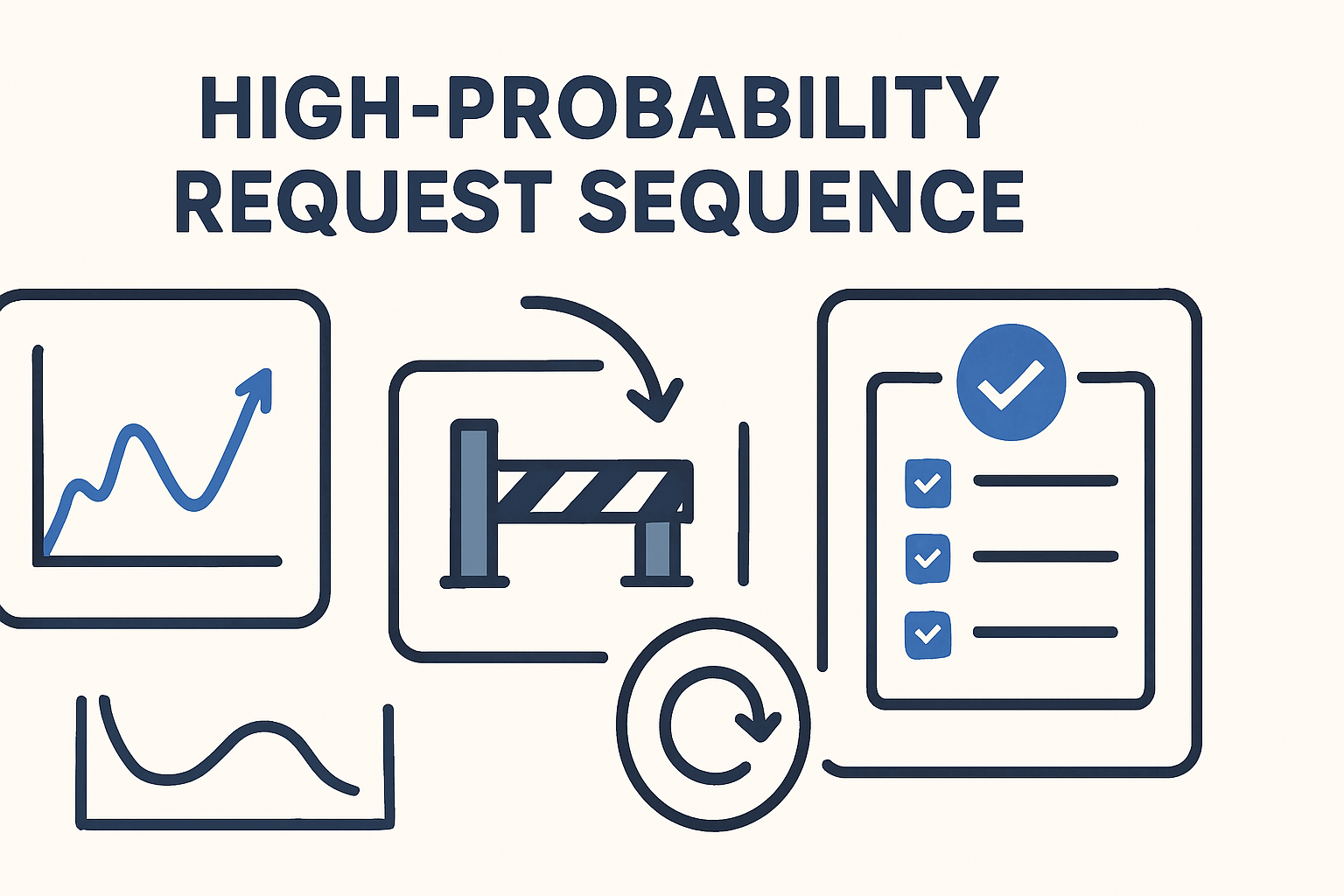
A High-Probability Request Sequence (often called ‘High P’) is an antecedent intervention strategy that builds behavioral momentum through carefully sequenced instructions. This procedure involves presenting several requests with a high probability of compliance immediately before presenting a target request with low probability of compliance.
Table of Contents
- What is a High-Probability Request Sequence?
- Implementing High P: Worked Examples from ABA Practice
- High P on the BCBA Exam: Relevance and Common Traps
- Quick Clinical Checklist for Using High P
- Summary and Key Takeaways
The technique leverages the concept of behavioral momentum from physics, where an object in motion tends to stay in motion. In behavioral terms, once a pattern of compliance is established through easy requests, that momentum carries over to more difficult demands.
Key Components and Behavioral Rationale
The core structure involves 3-5 high-probability requests followed by one low-probability request. High-p requests are those the learner consistently performs with at least 80% accuracy, while low-p requests are those with less than 50% compliance historically.
Behavioral momentum theory suggests that reinforced responding creates a state of persistence. When you reinforce compliance with several easy tasks, you establish a response pattern that makes it more likely the learner will continue complying, even when the task becomes more challenging.
Implementing High P: Worked Examples from ABA Practice
Understanding the theoretical foundation is essential, but practical application requires careful planning and implementation. These examples demonstrate how High P sequences work in real clinical scenarios.
Example 1: Increasing Compliance with Transition Demands
Consider a 5-year-old child who consistently resists cleaning up toys. The low-probability request is ‘Put the blocks in the bin.’ The hypothesized function is escape from demands.
An effective High P sequence might include:
- ‘Give me five!’ (high-p motor response)
- ‘Touch your nose’ (high-p imitation)
- ‘Jump once’ (high-p gross motor)
- ‘Where’s your ear?’ (high-p receptive identification)
- ‘Now put one block in the bin’ (low-p target request)
Each high-p request should be delivered quickly with immediate positive reinforcement (praise, token). The transition to the low-p request should be seamless, maintaining the established momentum.
Example 2: Building Vocal Imitation in Early Learners
For a learner with limited vocal skills who resists vocal imitation tasks, a High P sequence can build momentum toward vocal responses. The low-p request might be ‘Say ‘ah” while the function could involve automatic reinforcement or escape from difficult tasks.
A sequence might progress through:
- ‘Clap your hands’ (high-p motor imitation)
- ‘Wave bye-bye’ (high-p social gesture)
- ‘Touch the table’ (high-p receptive command)
- ‘Give me the ball’ (high-p object manipulation)
- ‘Now say ‘ah” (low-p vocal target)
Data collection should track both high-p compliance rates and low-p success to evaluate intervention effectiveness. Consider using our guide on data collection methods for proper measurement.
High P on the BCBA Exam: Relevance and Common Traps
The High-Probability Request Sequence appears frequently on the BCBA exam, particularly in sections testing intervention selection and implementation. Understanding both the procedure and common misconceptions is crucial for exam success.
Linking to the BACB Task List
High P sequences map directly to several Task List items in the 6th edition. Most notably, they fall under B-10: ‘Design and implement antecedent interventions to reduce problematic behavior and increase appropriate behavior.’
The procedure also connects to G-2: ‘Use interventions based on assessment results and the best available scientific evidence.’ When selecting High P, you’re choosing an evidence-based antecedent strategy based on functional assessment data.
Exam Traps and Misconceptions to Avoid
Several common errors can lead to incorrect answers on exam questions about High P sequences:
- Confusing High P with errorless learning: High P builds momentum through compliance, while errorless learning prevents errors through prompting
- Mistaking it for a consequence-based strategy: High P is purely antecedent-based; reinforcement occurs after compliance, but the sequence itself is antecedent
- Confusing with Noncontingent Reinforcement (NCR): NCR delivers reinforcement independent of behavior, while High P requires specific responses
- Mixing up with Premack Principle: Premack uses high-probability behaviors as reinforcers, not as sequenced requests
Remember that High P is a specific sequenced antecedent procedure that leverages behavioral momentum, not just ‘being nice’ or ‘building rapport.’ For more on antecedent strategies, see our antecedent intervention guide.
Quick Clinical Checklist for Using High P
Before implementing a High-Probability Request Sequence, complete this clinical checklist to ensure proper application:
- Identify target low-p request with documented low compliance rates
- Select 3-5 high-p requests with verified 80%+ compliance history
- Determine reinforcement for each successful response
- Plan delivery pacing to maintain momentum (2-3 seconds between requests)
- Prepare data collection system for both high-p and low-p responses
- Establish mastery criteria for fading the sequence
- Consider function of noncompliance when selecting high-p tasks
- Monitor for prompt dependency and adjust as needed
Summary and Key Takeaways
The High-Probability Request Sequence is a powerful antecedent intervention that builds behavioral momentum through sequenced compliance. By starting with requests the learner consistently performs, you establish a pattern that carries over to more challenging demands.
Key points to remember include the importance of verified compliance rates for high-p requests, the necessity of immediate reinforcement, and the critical distinction from other procedures like errorless learning or Premack. For BCBA exam preparation, focus on identifying when High P is appropriate based on functional assessment data and understanding its placement within the broader category of antecedent interventions.
Clinical implementation requires careful planning, proper data collection, and systematic fading once the target behavior reaches criterion. When used correctly, High P sequences can effectively increase compliance while maintaining the learner’s dignity and autonomy. For additional study resources, explore the BACB Task List 6th edition guide and consult the official BACB Task List document for complete details on tested content areas.
Complete BCBA Exam Prep
Turn this topic into exam-day practice
Practice concepts in context with five full-length 6th Edition mock exams, two bonus practice exams, a 6th Edition study guide, and key-term flashcards—all in one $120 USD package.
Get the $120 All-in-One Prep Pack
Review everything included on the product page before ordering. No pass guarantee is implied.



