
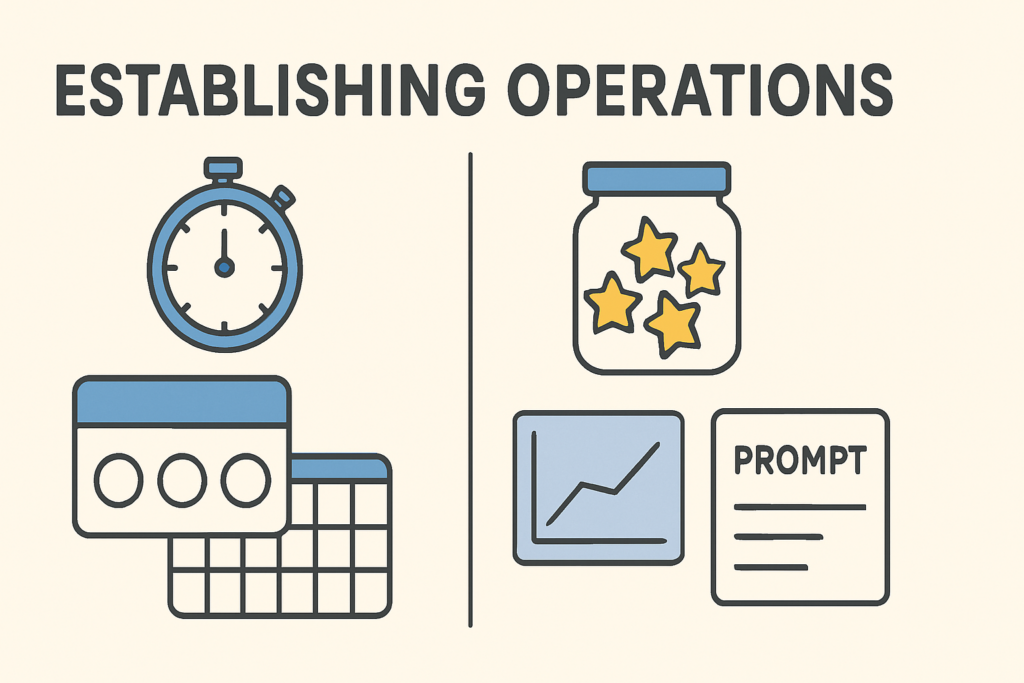
What Are Establishing Operations? A Core ABA Concept
In applied behavior analysis, establishing operations represent a fundamental concept that explains why certain behaviors occur at specific times. These are environmental events that temporarily increase the value of a particular reinforcer and make behaviors that have previously accessed that reinforcer more likely to occur. Understanding this concept is crucial for both clinical practice and exam success.
Table of Contents
- What Are Establishing Operations? A Core ABA Concept
- Identifying Establishing Operations in Practice: Worked Examples
- Establishing Operations on the BCBA Exam: What to Expect
- Quick-Reference Checklist and Summary
The Formal Definition and Key Characteristics
An establishing operation is formally defined as a type of motivating operation that increases the effectiveness of a reinforcer and increases the frequency of behavior that has obtained that reinforcer in the past. The key characteristic is that it creates a temporary state where a specific consequence becomes more valuable.
For example, food deprivation makes food more reinforcing, while social isolation makes social interaction more valuable. These operations are antecedent variables that occur before the behavior and influence its likelihood.
Establishing Operations vs. Motivating Operations: The Hierarchy
All establishing operations are motivating operations, but not all motivating operations are establishing operations. The broader category of motivating operations includes both establishing operations and their counterpart, abolishing operations.
While establishing operations increase reinforcer value, abolishing operations decrease it. This distinction is critical for accurate analysis and intervention planning. For more on this relationship, see our guide on SD vs MO differences.
Identifying Establishing Operations in Practice: Worked Examples
Moving from theory to application requires recognizing establishing operations in real-world scenarios. Let’s examine three common examples that illustrate how these operations function in different contexts.
Example 1: Food Deprivation and Manding
A child hasn’t eaten lunch for several hours, creating an establishing operation of food deprivation. This environmental event increases the value of crackers as a reinforcer and makes the mand ‘cracker’ more likely to occur.
- Antecedent: Child hasn’t eaten for 4 hours
- Behavior: Child says ‘cracker’
- Consequence: Receives cracker
- Function: Access to edible reinforcement
The food deprivation establishes crackers as a powerful reinforcer at that moment, increasing behaviors that have previously obtained food.
Example 2: Social Isolation and Attention-Seeking
An adult has been working alone in their home office all day, creating an establishing operation of social deprivation. This increases the value of social interaction and makes calling a friend more probable.
- Antecedent: 8 hours of social isolation
- Behavior: Calls a friend
- Consequence: Social conversation
- Function: Access to social reinforcement
The prolonged isolation establishes social contact as a high-value reinforcer, increasing behaviors that have previously obtained attention.
Example 3: Aversive Stimuli and Escape Behavior
Loud construction noise begins outside an office window, creating an establishing operation through the presentation of an aversive stimulus. This increases the value of ‘quiet’ and makes closing the window more likely.
- Antecedent: Sudden loud construction noise
- Behavior: Closes window
- Consequence: Noise reduction
- Function: Escape from aversive stimulation
The aversive noise establishes quiet as a negative reinforcer, increasing escape behaviors. For more on reinforcement types, see our negative reinforcement guide.
Establishing Operations on the BCBA Exam: What to Expect
The BCBA exam frequently tests your understanding of establishing operations through various question formats. Recognizing these patterns can significantly improve your performance on exam day.

Common Question Formats and How to Approach Them
Exam questions about establishing operations typically follow several predictable patterns. Being familiar with these formats helps you quickly identify what the question is asking.
- ‘Which is an example?’ questions present scenarios and ask you to identify the establishing operation
- ‘The value of the reinforcer…’ questions test your understanding of how establishing operations alter reinforcement effectiveness
- ‘Identify the MO’ questions require distinguishing between establishing and abolishing operations
- Scenario analysis questions present complex situations requiring multiple-step analysis
Top 3 Exam Traps and How to Avoid Them
Many candidates lose points on establishing operation questions due to common misunderstandings. Recognizing these traps can help you avoid them.
- Trap 1: Confusing EOs with discriminative stimuli – Remember that Sds signal reinforcement availability, while EOs alter reinforcement value
- Trap 2: Misidentifying abolishing operations – AOs decrease reinforcer value, while EOs increase it
- Trap 3: Overlooking temporal sequence – The establishing operation must occur BEFORE the behavior, not during or after
For more exam strategy insights, explore our BCBA exam study framework.
Quick-Reference Checklist and Summary
This concise reference section provides a practical tool for identifying establishing operations and summarizes key takeaways for your studies.
Your EO Identification Checklist
Use this three-step checklist when analyzing scenarios to determine if an establishing operation is present:
- Step 1: Did an environmental event occur that temporarily altered reinforcement value?
- Step 2: Did this event increase the effectiveness of a specific reinforcer?
- Step 3: Did it increase behaviors that have previously accessed that reinforcer?
- If yes to all three: You’ve identified an establishing operation
Key Takeaways for Your Studies
Mastering establishing operations requires understanding several interconnected concepts. Keep these essential points in mind:
- Definition mastery: EOs increase reinforcer value and behavior frequency
- Hierarchical understanding: All EOs are MOs, but not all MOs are EOs
- Temporal awareness: The EO must precede the behavior it influences
- Clinical application: Identifying EOs helps predict and influence behavior
- Exam readiness: Practice distinguishing EOs from Sds and AOs
For authoritative definitions and further reading, consult the Behavior Analyst Certification Board resources and Cooper, Heron, and Heward’s Applied Behavior Analysis textbook.
Ready to test what you just learned?
Put it into practice with a free, full-length BCBA mock exam — real exam-style questions, instant scoring, and answer explanations.



