

What is an MSWO Preference Assessment?
The MSWO preference assessment (Multiple Stimulus Without Replacement) is a systematic procedure used in applied behavior analysis to identify a hierarchy of potential reinforcers. This method efficiently establishes relative preferences among multiple items by presenting them simultaneously and removing selected items from subsequent presentations.
Table of Contents
- What is an MSWO Preference Assessment?
- Analyzing MSWO Data and Worked Examples
- MSWO on the BCBA Exam: Relevance and Common Traps
- MSWO Implementation Checklist and Summary
This assessment is particularly valuable when you need to determine which stimuli are most likely to function as effective reinforcers for skill acquisition programs. For comprehensive coverage of preference assessment methods, see our preference assessments guide.

Core Definition and When to Use It
The MSWO is defined by its without replacement procedure, meaning once an item is selected, it’s removed from the array for the remainder of the session. This creates a clear preference hierarchy based on selection order.
Use an MSWO when you need to:
- Establish a preference hierarchy from multiple items
- Work with clients who can scan multiple items simultaneously
- Efficiently identify relative preferences without conducting numerous pairwise comparisons
- Generate data for reinforcement selection in intervention programs
The Step-by-Step MSWO Procedure
Follow these precise steps to conduct a valid MSWO assessment:
- Prepare an array of 5-8 items based on caregiver report or prior observation
- Arrange items in a semi-circle or straight line within the client’s reach
- Present all items simultaneously with the instruction ‘Choose one’
- Record the selection order and allow brief access (5-30 seconds)
- Remove the chosen item from the array
- Re-present the remaining items and repeat the selection process
- Continue until all items are chosen or the client stops responding
- Document the complete selection sequence for analysis
Video Study: Preference Assessment
Watch: Preference Assessments Explained | 6th ed. | BCBA Exam Prep
Watch this lesson alongside the assessment procedures below, then compare the selection logic with the examples in this guide.
Prefer a second pass? Open this lesson on YouTube.
Analyzing MSWO Data and Worked Examples
Proper data analysis transforms raw selection data into meaningful preference hierarchies that inform intervention planning. The first item chosen represents the highest preference from the initial array, with subsequent selections indicating progressively lower preferences.
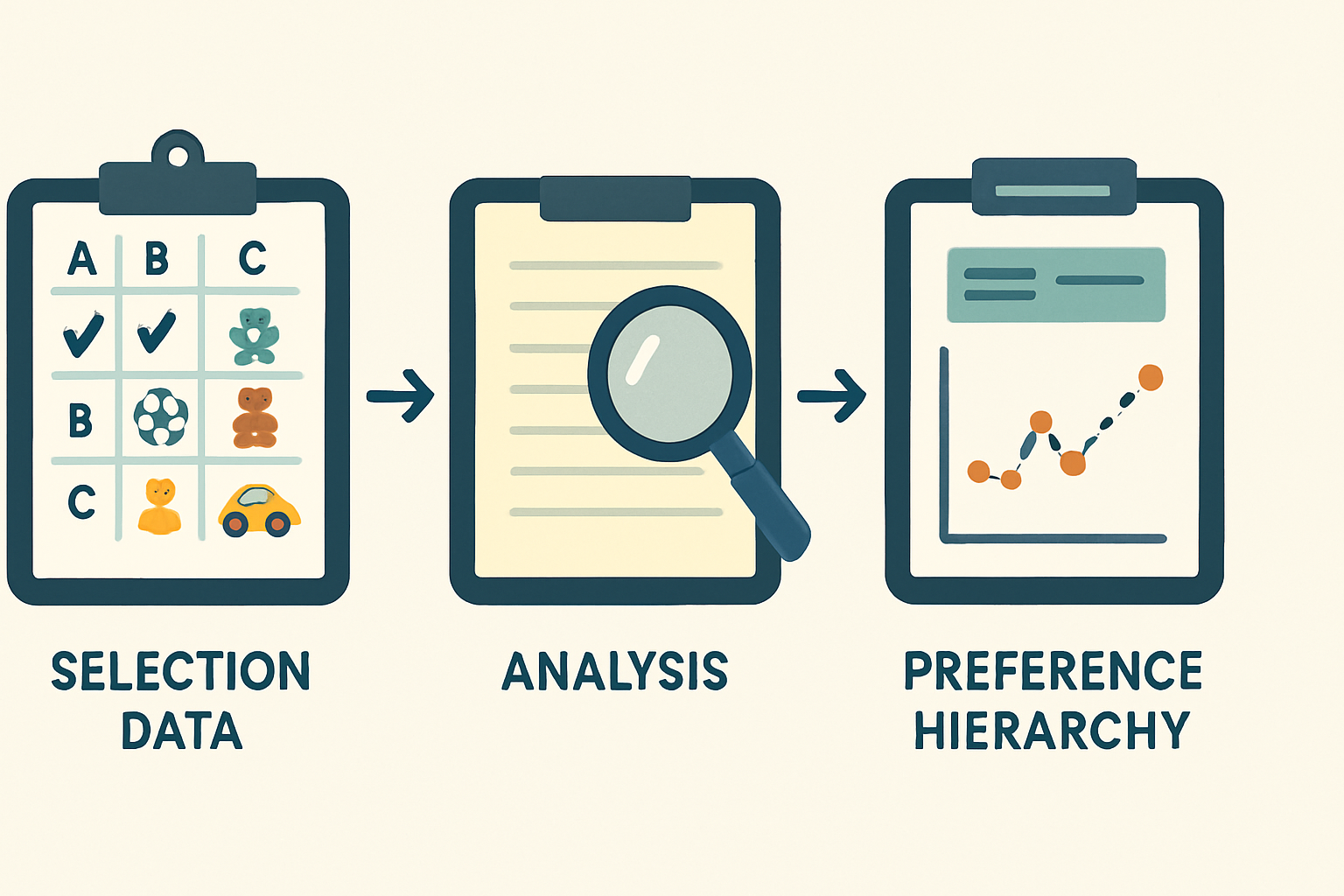
Example 1: Tangible Items for a Young Learner
Consider assessing toys with a 4-year-old client. The array includes: Bubbles, Ball, Train, Book, and Puzzle.
Selection order recorded: 1) Ball, 2) Bubbles, 3) Train, 4) Puzzle, 5) Book.
Analysis reveals this preference hierarchy:
- High preference: Ball (selected first)
- Medium-high: Bubbles (selected second)
- Medium: Train (selected third)
- Low-medium: Puzzle (selected fourth)
- Low preference: Book (selected last)
This hierarchy directly informs reinforcement selection for skill acquisition, with Ball serving as a powerful reinforcer for difficult tasks.
Example 2: Edibles and Potential Satiation
When assessing edible items, watch for satiation effects that can distort results. Consider this snack array: Chip, Cookie, Cracker, Fruit Snack, Pretzel.
The client selects: 1) Chip, 2) Cookie, then refuses further choices.
Analysis indicates Chip and Cookie are high-preference items, but the refusal suggests potential satiation. This highlights the importance of brief access periods and possibly conducting assessments across multiple sessions to obtain valid data.
MSWO on the BCBA Exam: Relevance and Common Traps
Understanding MSWO procedures and analysis is essential for exam success, as these assessments are frequently tested due to their procedural nuances and clinical applications.
Key Distinctions from Other Assessments
Master these critical differences to avoid confusion:
- MSWO vs. MSW: MSWO removes selected items (without replacement), while MSW replaces them (with replacement)
- MSWO vs. Paired Stimulus: MSWO presents all items simultaneously, while Paired Stimulus uses pairwise comparisons
- MSWO vs. Free Operant: MSWO establishes a hierarchy, while Free Operant measures duration without hierarchy
- MSWO vs. Single Stimulus: MSWO compares multiple items, while Single Stimulus presents items individually
Frequently Confused Concepts and Exam Traps
Watch for these common exam pitfalls:
- Confusing without replacement (MSWO) with with replacement (MSW)
- Mistaking MSWO for a duration-based assessment rather than selection-based
- Forgetting that satiation effects can influence results, especially with edibles
- Overlooking that the first selection represents highest preference from that array, not necessarily an absolute high-preference reinforcer
- Failing to recognize when multiple assessments are needed for reliable data
MSWO Implementation Checklist and Summary
Use this practical checklist to ensure proper MSWO implementation in clinical practice and exam preparation.
Quick-Reference Implementation Checklist
- [ ] Select 5-8 appropriate items based on client history
- [ ] Arrange items in consistent presentation format
- [ ] Present all items simultaneously with clear instruction
- [ ] Record exact selection order for each trial
- [ ] Remove chosen item from subsequent presentations
- [ ] Allow brief access (5-30 seconds) to selected item
- [ ] Continue until all items chosen or client stops responding
- [ ] Calculate preference hierarchy from selection data
- [ ] Use hierarchy to inform reinforcement selection in interventions
Summary: Why MSWO Matters for BCBAs
The MSWO preference assessment is an efficient clinical tool that generates valuable data for ethical, effective interventions. Its procedural precision makes it heavily tested on the BCBA exam, requiring thorough understanding of both implementation and analysis.
By mastering MSWO procedures, you ensure data-driven reinforcement selection that maximizes learning outcomes while demonstrating competency in assessment methodology. For more on assessment principles, explore our assessment in ABA guide.
Remember that while MSWO provides valuable hierarchy data, it should be part of a comprehensive assessment approach that may include other methods like functional behavior assessment when appropriate. For authoritative guidance on assessment standards, refer to the BACB Task List and relevant research literature.
Next step for BCBA exam prep
Turn this topic into exam-day practice
You have reviewed the key ideas. Take a full-length practice test to see what you can apply under exam conditions, then use your results to choose your next study step.
Take the Free BCBA Mock Exam
Continue with Five Full-Length Mocks — $99
Start with the free mock if you are still measuring your readiness. No pass guarantee is implied.



