

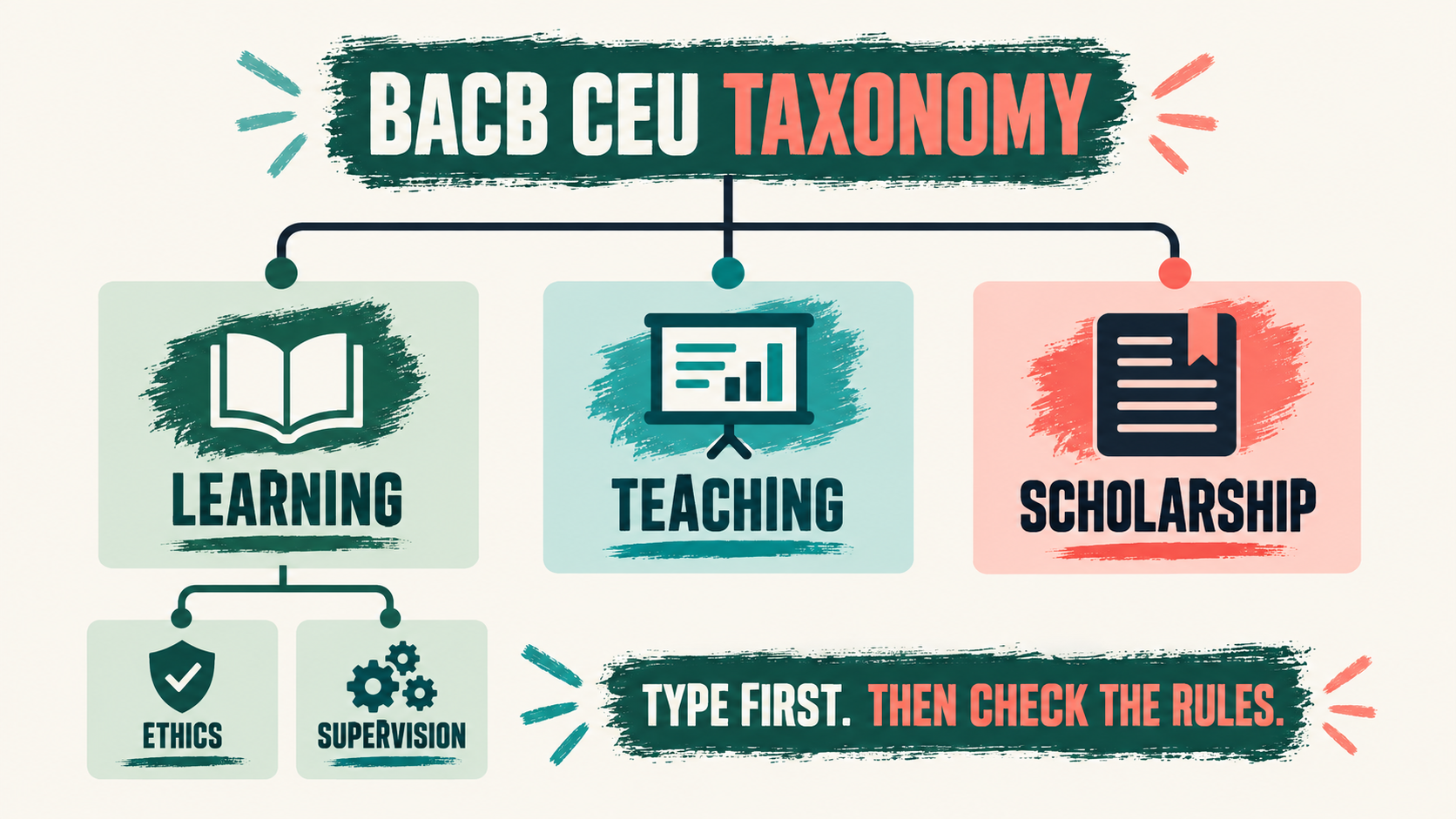
If you are trying to understand BACB CEU types, start with the classification—not the number on a certificate. The current BCBA Handbook describes three top-level continuing-education activity types: Learning, Teaching, and Scholarship. Within Learning CE, Ethics and Supervision are important subcategories. A live webinar, an online module, a university course, a teaching session, and a peer-reviewed publication may therefore be recorded differently even though all support professional development.
Table of Contents
- In This Guide
- BACB CEU Types at a Glance
- Learning, Teaching, and Scholarship
- Ethics and Supervision Subcategories
- Type Versus Format Versus Cycle Total
- How to Classify a CE Activity
- Documentation to Retain
- Common BACB CEU-Type Mistakes
- Frequently Asked Questions
- Take the Free BCBA Mock Exam
The practical goal is to label each activity correctly, keep the documentation that matches the label, and then compare your record with the rules for your current certification cycle. A type is not a shortcut around provider verification, category requirements, or cycle dates. Use the current BCBA Handbook and, for ACE events, the ACE Provider Handbook as the authority.
In This Guide
BACB CEU Types at a Glance
The current BCBA maintenance table organizes CEUs by the activity that produced the learning or professional contribution. The three top-level types are not three delivery formats and not three price levels. They describe what you did.
| Top-level type | Typical activity | Typical proof | Key check |
|---|---|---|---|
| Learning | ACE learning event, qualifying behavior-analytic graduate course, or certain BACB certification activities | ACE certificate, syllabus and transcript, or a BACB portal record depending on the activity | Verify provider, audience, content, category, duration, and completion evidence. |
| Teaching | Instruction for a Learning CE event or teaching a behavior-analysis university course | ACE Provider documentation for instruction time or a department-chair letter | Document that you taught, the time or course, and the source confirming it. |
| Scholarship | Publishing a behavior-analysis article or reviewing a peer-reviewed manuscript | Final published article or confirmation from the journal/editor | Keep the final publication or acceptable review confirmation and follow privacy instructions. |
These are the type choices you may see when entering a record in your BACB portal. The handbook says that non-repeating CEUs can be earned through the activity types, but the activity still has to satisfy the applicable requirements. A label cannot turn unrelated training, duplicate credit, or unsupported participation into qualifying CE.
Learning, Teaching, and Scholarship
Learning CE is the type most people mean when they discuss BACB CEU courses and events. The current BCBA Handbook lists behavior-analytic learning events offered by ACE Providers, qualifying didactic behavior-analytic graduate courses, and certain BACB certification activities. For an ACE event, the provider should supply the appropriate certificate or completion record. For university coursework, the syllabus and transcript matter. BACB activities may be recorded directly in the portal rather than through a third-party certificate.
Teaching CE is based on instruction you provide. The current handbook includes a single instruction session for a Learning CE event and teaching behavior-analysis university courses at an accredited, degree-granting university. The proof is therefore different from a learner certificate: you need documentation from the ACE Provider showing instruction time or a letter from the relevant academic department. Attending a class does not become Teaching CE just because the topic was educational.
Scholarship CE recognizes specified scholarly work. The handbook gives publication of an article on behavior analysis in a peer-reviewed journal and writing a review or decision letter for a peer-reviewed journal as examples. Save the final published article or confirmation from the journal, editor, or associate editor as the handbook directs. A personal blog post, an unpublished draft, or reading a paper is not automatically the same activity.
One helpful memory aid is: Learning means you acquire qualifying knowledge; Teaching means you provide qualifying instruction; Scholarship means you contribute to or evaluate published behavior-analytic knowledge. Always confirm the current table before submitting a record because documentation and conversion details can change.
Ethics and Supervision Subcategories
Ethics and Supervision are not extra top-level activity types in the current ACE taxonomy. They are Learning CE subcategories used when the content meets the applicable definition. This is why a certificate that simply says “ethics discussed” may not be enough to classify an entire event as Ethics CE.
- Ethics CE: the event should relate to BACB ethics requirements and/or cultural or contextual responsiveness, connect to behavior-analytic practice or applied research, and make those considerations a substantive focus rather than a passing reference.
- Supervision CE: the content should be behavior-analytic in nature and cover effective supervision as described in the current Supervisor Training Curriculum Outline and related BACB resources.
- Allocation: the ACE Handbook says a CEU may be counted as either Ethics or Supervision, but not both. An event may be split across types when the provider assigns the portions appropriately.
- Special training: CEUs from the 8-hour supervision training have their own Supervision-only treatment in the current handbook; do not relabel them as Ethics CE.
Read the event description and certificate together. A provider may advertise a broad topic, while the official category depends on what most of the event actually covers. If the label is unclear, ask the provider before you enter the credit in your portal.
Type Versus Format Versus Cycle Total
Three different concepts are often mixed together:
- Activity type: Learning, Teaching, or Scholarship describes what you did.
- Delivery format: live, online synchronous, asynchronous, conference, journal club, or another format describes how the activity happened.
- Cycle total: the number and category of CEUs your current credential and certification cycle require.
For example, a live webinar may be a Learning activity and may also be designated Ethics CE. An asynchronous module may also be Learning. A university instructor may record Teaching CE even if the course was delivered online. The format does not decide the type, and the type does not by itself tell you how many credits you still need.
Do not use an older article that still lists historical labels as a substitute for the current handbook. If you are evaluating event participation specifically, see our separate guide to BACB CEU events. It focuses on live versus online delivery, presence, active participation, duration, and evidence.
How to Classify a CE Activity
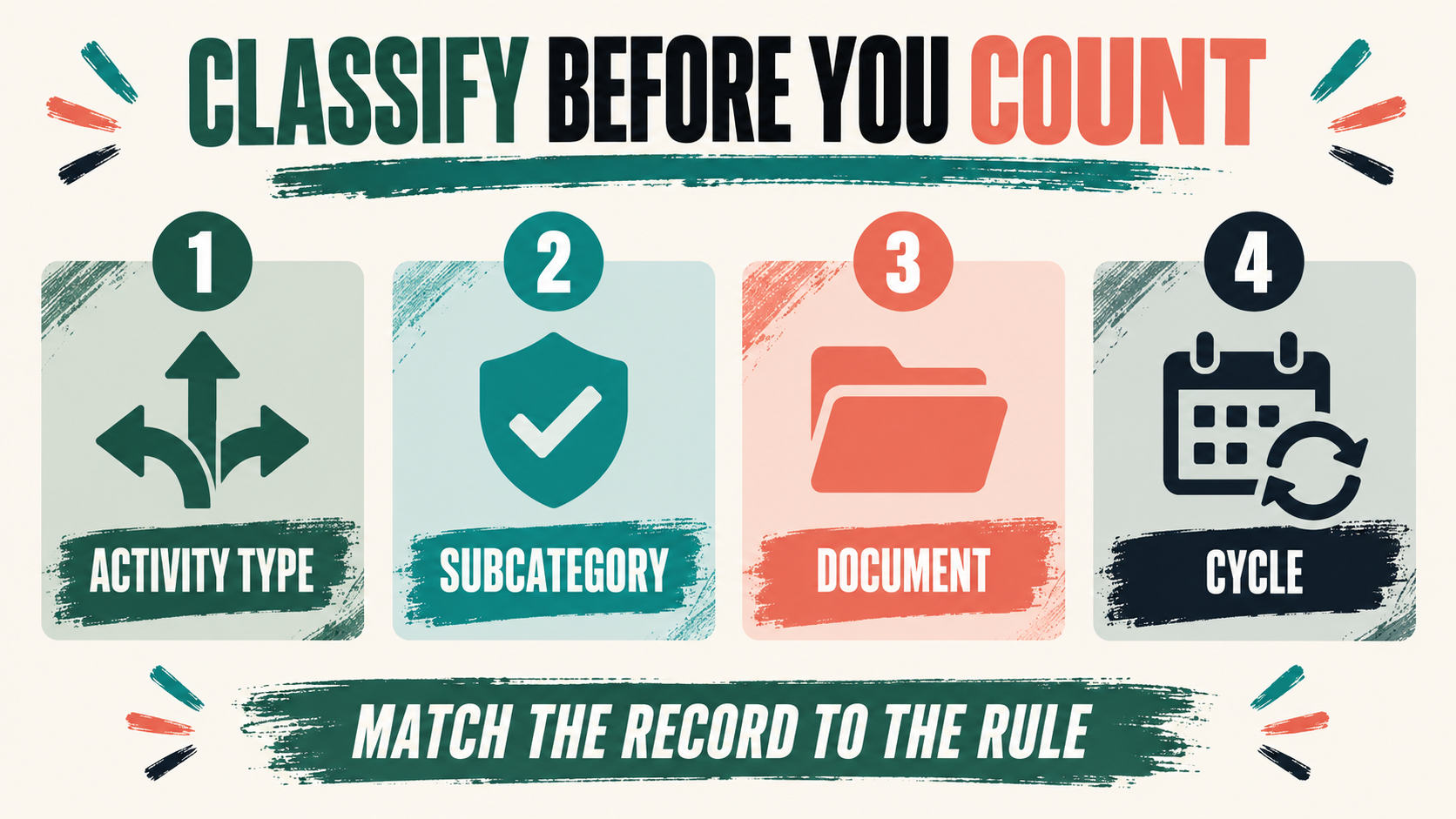
Use this workflow before entering a record. It is short enough to apply to every certificate and detailed enough to catch the most common classification errors.
- Name the activity: write the exact title, provider, date, and format shown on the supporting record.
- Choose the top-level type: select Learning, Teaching, or Scholarship based on the activity you personally completed.
- Check a Learning subcategory: if the content is Ethics or Supervision, verify that the majority and learning objectives support the designation.
- Match the evidence: use an ACE certificate for an event, syllabus and transcript for qualifying coursework, provider or department documentation for Teaching, or publication/review confirmation for Scholarship.
- Check the cycle: confirm the completion or publication date falls within the certification cycle to which you are applying the record.
- Check duplication: do not enter the same activity twice or assume extra credit from repeating the same CE activity.
For an ACE learning event, also verify the provider in the BACB ACE Provider Verification Registry. Authorization confirms the provider’s status; it does not mean the BACB has endorsed every individual event. If a provider’s name, category, or documentation does not match, pause and resolve the discrepancy before counting the credit.
Documentation to Retain
Your evidence should match the type you selected. Keep the record in a folder organized by certification cycle, not only by provider or course topic.
- Learning: certificate, event title, provider, completion date, credit amount, category, and supporting event details when supplied.
- University coursework: syllabus, transcript, course title, grade or pass status, and the dates that connect the course to the record.
- Teaching: ACE Provider confirmation of instruction time or a department-chair letter that identifies the university course taught.
- Scholarship: final published article PDF or journal/editor confirmation of a review or decision letter, with any requested author information redacted.
- Ethics or Supervision: the certificate or provider record should identify the category clearly; retain the course description when the category is not obvious from the certificate.
Enter information exactly as it appears on the supporting documentation. If the portal asks for a specific CEU type, do not guess based on the title. Use the handbook’s table and the provider’s record together, then keep a note explaining any category allocation or split.
Common BACB CEU-Type Mistakes
- Calling every CEU an event: graduate coursework, teaching, scholarship, and BACB activities can have different proof requirements.
- Calling Ethics a fourth top-level type: in current ACE guidance, Ethics and Supervision are Learning CE subcategories.
- Choosing a type by delivery mode: “online” describes format, not whether the record is Learning, Teaching, or Scholarship.
- Counting a topic mention as a category: a brief ethics reference may not make the majority of the event Ethics CE.
- Using a learner certificate for Teaching: instruction requires documentation that you taught and for how long.
- Repeating the same CE activity: repeat credit does not create new or expanded knowledge and should not be treated as a fresh qualifying activity.
- Mixing cycles: extra credit from one cycle generally cannot be moved forward simply because it was not needed.
Frequently Asked Questions
What are the three BACB CEU types?: The current BCBA Handbook identifies Learning, Teaching, and Scholarship as the three activity types. The correct documentation depends on which activity you completed. Are Ethics and Supervision separate CEU types?: They are Learning CE subcategories in the current ACE guidance. An event must meet the relevant content definition, and one CEU should not be counted as both Ethics and Supervision.
Is an online webinar always Learning CE?: Not solely because it is online. Delivery format and activity type are different questions. A learner attending an appropriate ACE event may record Learning CE, while an instructor teaching the event may have a Teaching record with different proof.
How many CEUs can I earn from each type?: Do not use a generic number without checking your current handbook and certification cycle. The current handbook describes the activity types and their documentation, while your cycle and role determine the requirements you must meet.
What if my certificate does not show the CEU type?: Save the certificate and the course description, then ask the provider for clarification. Do not select Ethics or Supervision only because the title sounds related. If the question affects your renewal, compare the answer with the current BACB handbook before entering it.
Organizing CE records is different from preparing for the BCBA examination. If you are studying for the exam, our free BCBA mock exam can help you practice scenario-based questions; it is not a CE activity and does not replace your supporting documents. Try the Free BCBA Mock Exam
Take the Free BCBA Mock Exam
If you want a low-pressure way to check your recall, use the free practice resource below. Take the Free BCBA Mock Exam



