
What Are Motivating Operations?
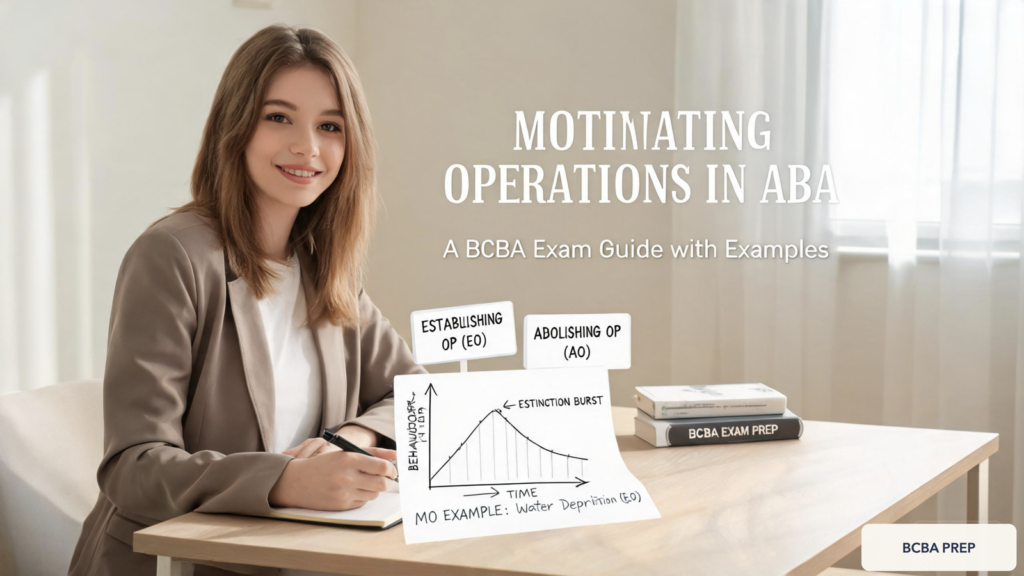
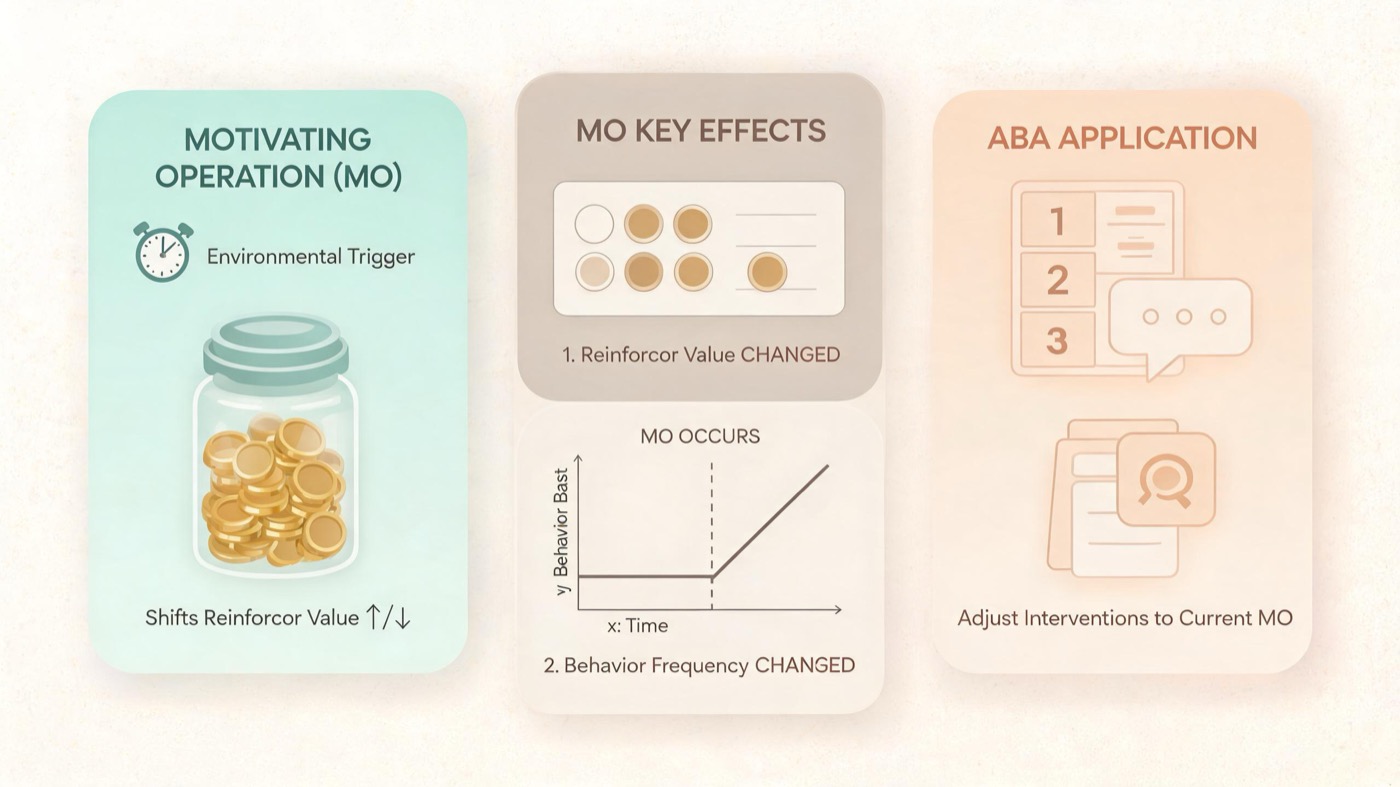
Motivating operations (MOs) are environmental events that temporarily alter the value of a reinforcer or punisher and change the frequency of behaviors that produce that consequence. In ABA, understanding MOs is essential for analyzing and influencing behavior. For example, food deprivation makes food more valuable (establishing operation), while satiation makes it less valuable (abolishing operation). MOs differ from discriminative stimuli (SDs) because MOs change the effectiveness of consequences, while SDs signal the availability of consequences. This distinction is a core concept for the BCBA exam. For a deeper comparison, see our guide on SD vs MO differences.
Table of Contents
- What Are Motivating Operations?
- Types of Motivating Operations: UMO and CMO
- Worked ABA Examples with Hypothesized Function
- Exam Relevance and Common Traps
- Quick Study Checklist for Motivating Operations
- Final Summary and Next Steps
- References
Types of Motivating Operations: UMO and CMO
Unconditioned Motivating Operations (UMO)
UMOs are unlearned MOs that have innate value-altering effects. They include states like food deprivation, water deprivation, sleep deprivation, pain, and changes in temperature. For instance, extreme heat increases the value of cool air and behaviors that access it. UMOs are universal and do not require learning history.
Conditioned Motivating Operations (CMO)
CMOs are learned MOs that acquire their value-altering effects through pairing with other MOs or consequences. There are three types:
- Surrogate CMO (CMO-S): A neutral stimulus paired with a UMO or another CMO and acquires the same motivating effect. Example: A tone that consistently precedes food deprivation eventually functions as a CMO-S, increasing the value of food.
- Reflexive CMO (CMO-R): A stimulus that evokes a behavior because it signals the onset of an aversive condition. Example: A warning light that precedes shock becomes a CMO-R; escape from the light is reinforced by avoiding shock.
- Transitive CMO (CMO-T): A stimulus that alters the value of another stimulus and evokes behavior that produces that stimulus. Example: A locked door (CMO-T) temporarily increases the value of a key and evokes key-seeking behavior. For more on CMOs, see our comprehensive CMO guide.
Worked ABA Examples with Hypothesized Function
Example 1: Task Refusal During Academic Work
Antecedent: Teacher presents a difficult math worksheet to a student. Behavior: Student throws the worksheet and says ‘I can’t do this.’ Consequence: Teacher removes the worksheet and tells the student to take a break. Hypothesized function: Escape from difficult task. The establishing operation is task difficulty, which momentarily increases the value of escape and evokes refusal behavior.
Example 2: Attention-Seeking After Deprivation
Antecedent: Caregiver is on a phone call for 10 minutes; child is playing alone. Behavior: Child yells loudly. Consequence: Caregiver ends the call and scolds the child (provides attention). Hypothesized function: Access to attention. The UMO (social deprivation) increases the value of attention, and yelling is reinforced by caregiver attention.
Example 3: Aggression to Access Tangible
Antecedent: Sibling is playing with a preferred toy. Behavior: Child hits the sibling. Consequence: Sibling drops the toy and child takes it. Hypothesized function: Access to tangible. The CMO-T (sibling having the toy) increases the value of the toy and evokes aggression to obtain it.
Exam Relevance and Common Traps
How the BCBA Exam Tests Motivating Operations
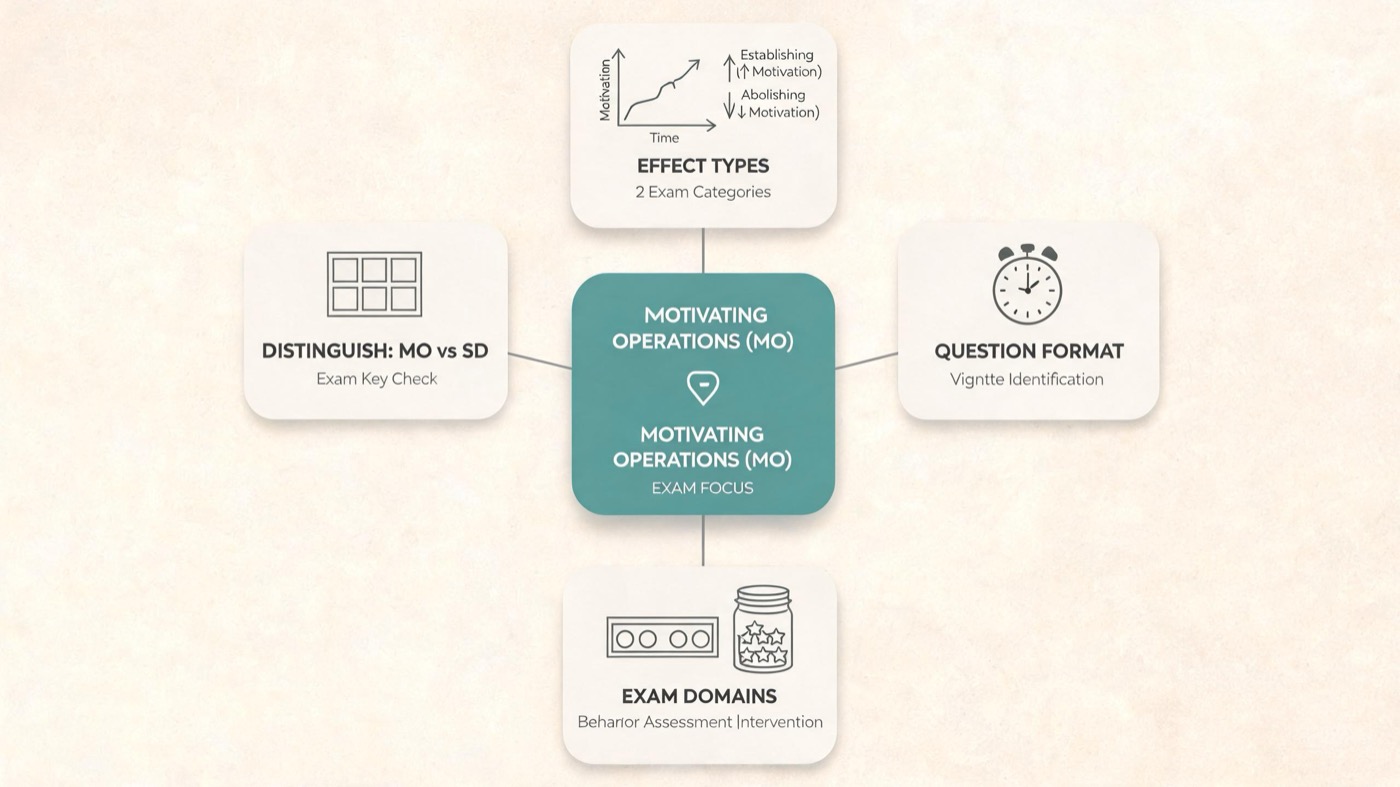
The BCBA exam often presents vignettes and asks you to identify the MO, distinguish between establishing and abolishing effects, or differentiate MOs from SDs. Common question formats include:
- Given a scenario, identify the type of MO (UMO, CMO-S, CMO-R, CMO-T).
- Determine whether the operation is establishing or abolishing.
- Choose the intervention that addresses the MO rather than manipulating consequences.
Mastering these distinctions is critical for the ‘Behavior Assessment’ and ‘Intervention’ areas of the BACB Task List.
Common Pitfalls Candidates Face
- Confusing MO with SD: Remember, MOs alter the value of a reinforcer; SDs signal availability. A common trap is to label a stimulus that signals ‘reinforcement available’ as an MO.
- Overlooking abolishing operations: Candidates often focus on establishing operations but forget that MOs can also decrease reinforcer effectiveness. For example, satiation after lunch is an abolishing operation for food.
- Misidentifying CMO type: Mixing up CMO-S, CMO-R, and CMO-T is common. Use the function: surrogate (warning effect), reflexive (escape from stimulus), transitive (access to something else).
- Ignoring the role of MO in maintenance: Some interventions fail because MOs are not addressed; e.g., providing attention to a client who is already satiated on attention may not reduce problem behavior.
Quick Study Checklist for Motivating Operations
Use this checklist for last-minute review before the exam:
- ✓ Define motivating operation and distinguish it from SD.
- ✓ Know the two effects: value-altering and behavior-altering (evocative vs. abative).
- ✓ List examples of UMOs (deprivation, satiation, pain, temperature changes).
- ✓ Describe the three types of CMOs and give an example of each.
- ✓ Practice identifying MOs in vignettes: ask yourself ‘What is currently valuable?’
- ✓ Understand establishing operations (increase reinforcer value) vs. abolishing operations (decrease value).
- ✓ Review BCBA exam prep 2025 materials for practice questions.
Final Summary and Next Steps
Motivating operations are fundamental to understanding why behavior occurs. They explain how environmental events influence the value of consequences and evoke or abate behavior. For the BCBA exam, focus on differentiating MOs from SDs, recognizing UMO vs. CMO types, and applying them to clinical scenarios. Practice with mock vignettes to solidify your skills. Ready to test your knowledge? Explore our free BCBA mock exam practice questions to assess your understanding of motivating operations and other key concepts. Good luck with your exam preparation!



