
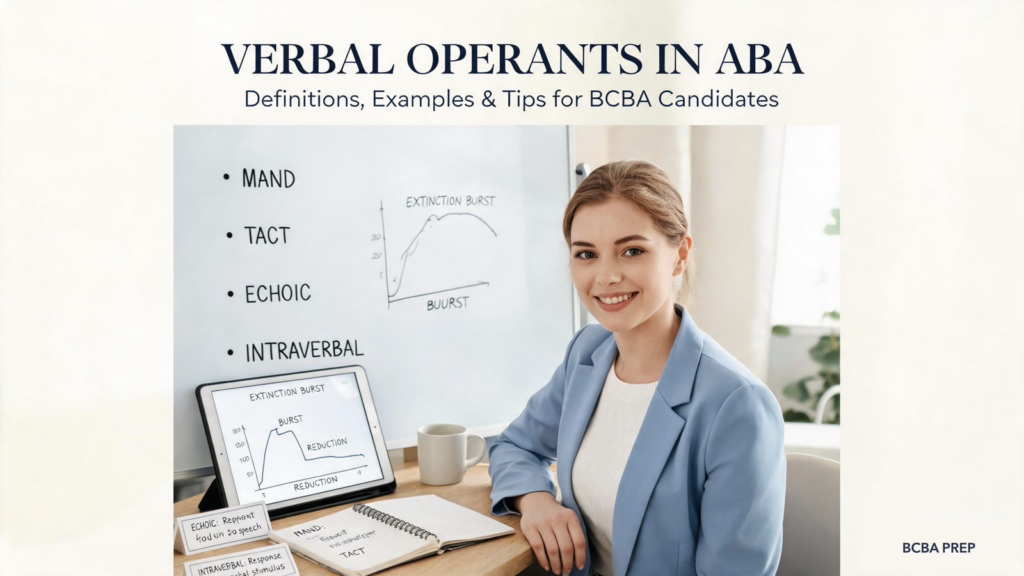
What Are Verbal Operants? A BCBA Exam Definition
Verbal operants are the foundational units of verbal behavior as defined by B.F. Skinner in his 1957 book, Verbal Behavior. On the BCBA exam, you need to understand that each operant is controlled by a specific set of antecedent and consequence variables. Unlike traditional language categories (e.g., nouns, verbs), verbal operants are classified by their controlling variables — the environmental events that evoke and maintain the response.
Table of Contents
- What Are Verbal Operants? A BCBA Exam Definition
- Verbal Operant Examples with ABC Analysis
- Exam Relevance: How Verbal Operants Appear on the BCBA Test
- Quick Checklist for Verbal Operants
- Summary and Next Steps
- References
Skinner identified five primary verbal operants covered on the BCBA task list: mand, tact, echoic, intraverbal, and textual. (Autoclitics also appear but are less frequently tested.) Memorizing the definition alone won’t be enough; you must be able to identify each operant in a scenario and explain its controlling variables.
The Five Types of Verbal Operants
- Mand: A request regulated by a motivating operation (MO). The consequence is specific access to the reinforcer. Example: saying ‘water’ when thirsty.
- Tact: A label of a non-verbal stimulus (object, action, property). The consequence is generalized social reinforcement (e.g., praise).
- Echoic: Repeating a verbal stimulus with point-to-point correspondence. The antecedent is a verbal model, and the consequence is social praise.
- Intraverbal: A verbal response to another’s verbal behavior without point-to-point correspondence. Example: answering ‘What is your name?’ with your name.
- Textual: Reading written words without requiring comprehension. The antecedent is text; the response is vocal.
Note: The BCBA exam often tests your ability to distinguish between intraverbal and echoic — a common source of errors. Echoic requires exact duplication of the model (e.g., repeating ‘dog’), while intraverbal does not (e.g., naming a dog when asked ‘What animal barks?’).
Verbal Operant Examples with ABC Analysis
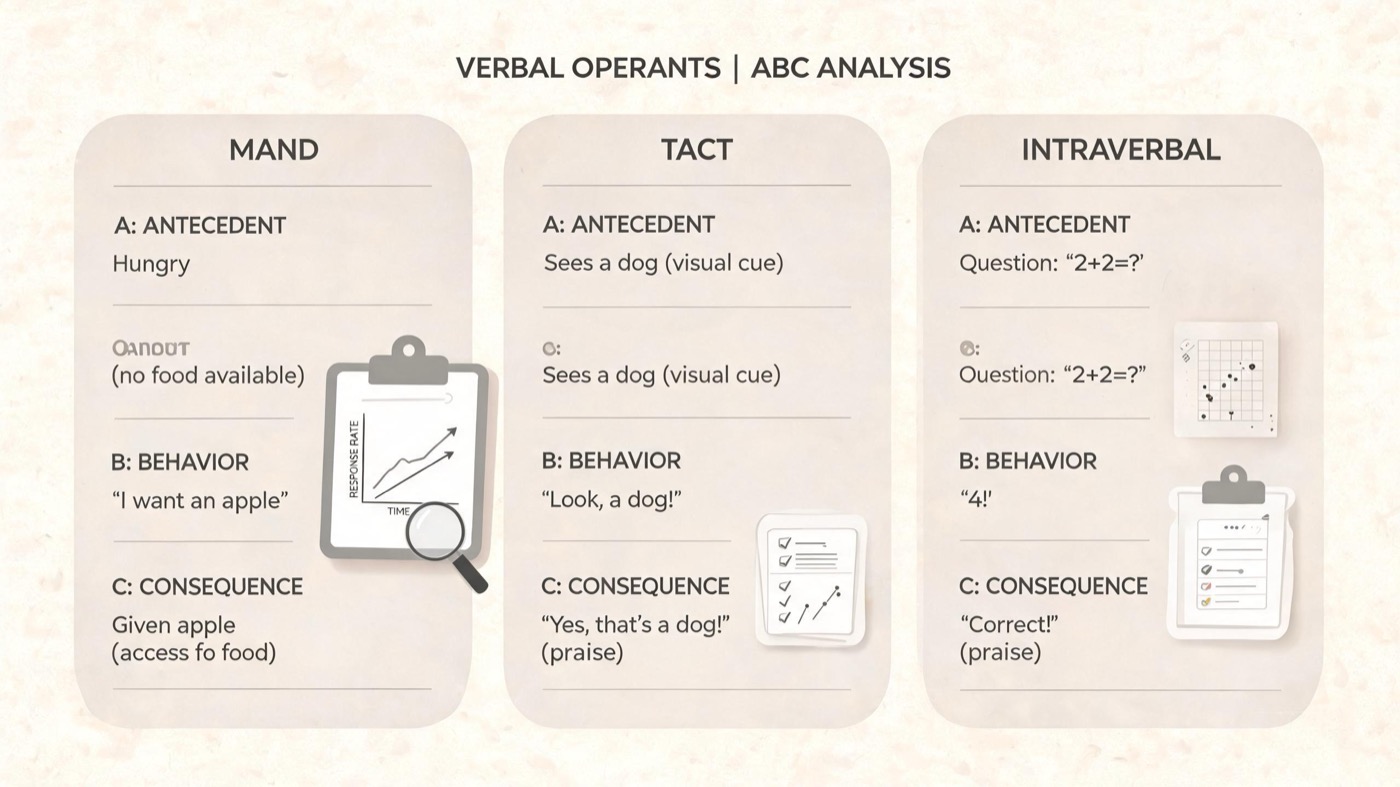
Applying the ABC (Antecedent-Behavior-Consequence) framework helps cement the differences. Below are three examples commonly seen on the exam.
Example 1: Mand – Requesting a Cookie
- Antecedent: Establishing operation (hunger) and a cookie in sight.
- Behavior: Child says ‘cookie’.
- Consequence: Caregiver gives a cookie.
- Function: Access to tangible. The response is controlled by the motivating operation.
Example 2: Tact – Labeling a Ball
- Antecedent: Non-verbal stimulus — a ball present in the environment.
- Behavior: Child says ‘ball’.
- Consequence: Parent says ‘Yes, that’s a ball!’ and smiles.
- Function: Social approval (generalized reinforcer). No specific MO is required.
Example 3: Intraverbal – Answering ‘What is your name?’
- Antecedent: Verbal stimulus (question) with no point-to-point correspondence.
- Behavior: Child says ‘Sarah’.
- Consequence: Listener says ‘Nice to meet you, Sarah!’ and continues conversation.
- Function: Social interaction. The response is not a direct copy of the question.
Example 4: Echoic – Repeating ‘Cookie’
- Antecedent: Adult says ‘say cookie’.
- Behavior: Child says ‘cookie’.
- Consequence: Adult says ‘Great job!’
- Function: Social praise. Note the point-to-point correspondence: the child’s vocal response matches the adult’s model.
For more practice with ABC analysis, check out our verbal operants BCBA exam guide for additional scenarios.
Exam Relevance: How Verbal Operants Appear on the BCBA Test
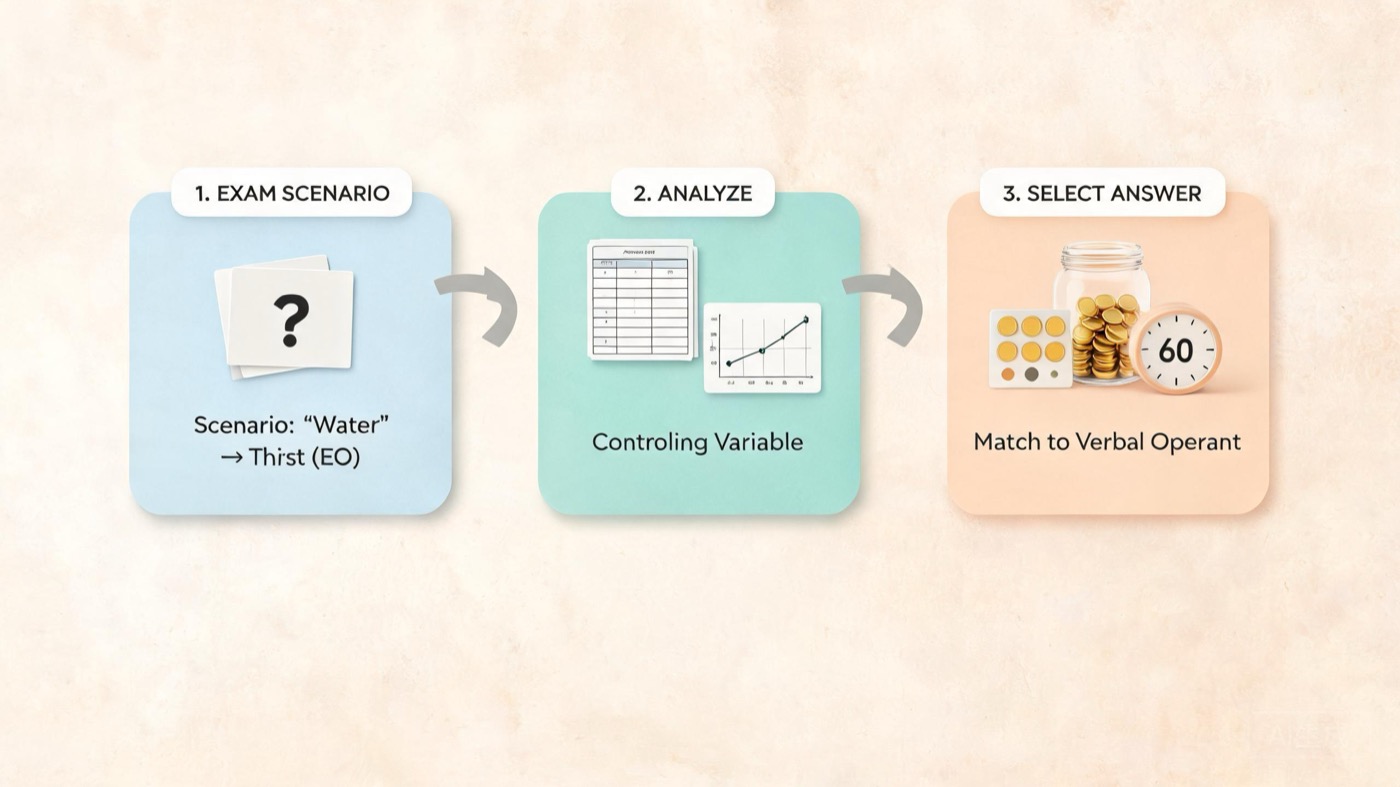
On the BCBA exam, verbal operants are assessed through multiple-choice questions and scenario-based items. You will be asked to identify which operant is being demonstrated, select the correct controlling variable, or recognize function-altering consequences. Expect 3–5 questions related to verbal behavior on the 6th edition task list, often under Domain B: Applications.
Common Traps to Avoid
- Intraverbal vs. Echoic Confusion: If the response exactly matches the vocal model (e.g., repeating a word), it’s echoic — even if the context looks like a conversation.
- Misidentifying the Controlling Variable: For a mand, the antecedent must be a motivating operation (deprivation or aversion), not just a discriminative stimulus. For example, seeing a cookie (SD) is not enough; the child must be hungry (MO).
- Assuming All Verbal Operants Are Vocal: Sign language, picture exchange, and text can all be forms of verbal behavior. A mand can be a gesture, and a tact can be a written word.
- Overlooking Textual vs. Intraverbal: Textual involves decoding written text (e.g., reading ‘cat’ aloud), while intraverbal involves responding to verbal stimuli without text (e.g., answering a question).
One exam trap: A question might describe a child saying ‘up’ when wanting to be lifted. The antecedent is the MO (desire for elevation), not the presence of an adult. The correct answer is mand. Another trap: A child repeating ‘red’ after hearing ‘say red’ — that is echoic, not intraverbal, because of point-to-point correspondence.
Quick Checklist for Verbal Operants
Use this checklist to review before your exam:
- Mand: MO present? Consequence is specific reinforcer? → Yes = Mand
- Tact: Non-verbal stimulus (object, action) present? Generalized social reinforcer? → Yes = Tact
- Echoic: Verbal model with point-to-point correspondence? Exact match? → Yes = Echoic
- Intraverbal: Verbal stimulus but no point-to-point correspondence? Complex response? → Yes = Intraverbal
- Textual: Written text as antecedent? Response is reading aloud? → Yes = Textual
For a deeper dive, revisit Skinner’s original work or the BACB task list. Also, consider taking a free BCBA mock exam to test your knowledge on verbal operants.
Summary and Next Steps
Understanding verbal operants is essential for BCBA exam success. Remember that each operant is defined by its controlling variables, not just the form of the response. Practice with ABC examples, watch out for common traps like confusing intraverbal with echoic, and use the quick checklist to solidify your knowledge.
For additional study, explore our BCBA exam prep guide and review the BACB’s 6th edition task list. Pair conceptual knowledge with quality BCBA mock exams to identify your strengths and areas for improvement.



