
Understanding the Unconditioned Response in ABA
As a BCBA candidate, you will encounter the concept of an unconditioned response early in your studies. It is a building block of respondent conditioning, also known as classical conditioning. In simple terms, an unconditioned response is a natural, automatic reaction to a stimulus that happens without any prior teaching or learning.
Table of Contents
- Understanding the Unconditioned Response in ABA
- What Is an Unconditioned Response in ABA?
- Unconditioned Response Examples in ABA Practice
- Why Unconditioned Responses Matter for the BCBA Exam
- Summary
For example, when you touch a hot stove, you instantly pull your hand away. That withdrawal is an unconditioned response. It is not something you learned; it is built into your biology. Understanding this concept is crucial for the BCBA exam because it forms the foundation for distinguishing between respondent and operant behavior.
This article provides a clear definition, explores key features, presents practical ABC examples, and highlights common exam traps to help you master this topic. If you need a broader refresher on respondent conditioning, check out our guide on respondent conditioning BCBA exam examples.
What Is an Unconditioned Response in ABA?
In ABA, an unconditioned response (UR) is defined as a reflexive, involuntary behavior that is automatically elicited by an unconditioned stimulus (US). The US-UR relationship is unlearned; it occurs naturally. For instance, a puff of air (US) to your eye automatically causes an eye blink (UR). No training is needed.
Key Features of an Unconditioned Response
- Unlearned: The response occurs without any prior conditioning or experience.
- Reflexive: It is an automatic, involuntary reaction, often involving the autonomic nervous system.
- Elicited by a US: The UR is always triggered by a specific unconditioned stimulus.
- Biologically relevant: URs usually serve a protective or survival function (e.g., withdrawal from pain, salivation to food).
- Consistent: The same US reliably produces the same UR across individuals.
Unconditioned vs. Conditioned Responses
A conditioned response (CR) is learned through pairing. For example, if a neutral stimulus (like a bell) is repeatedly paired with food (US), the bell eventually elicits salivation (CR). In contrast, the unconditioned response (salivation to food) occurs without any pairing. This distinction is central to respondent conditioning and is frequently tested on the BCBA exam. For more on respondent vs. operant behavior, see our article on respondent vs operant behavior.
Unconditioned Response Examples in ABA Practice
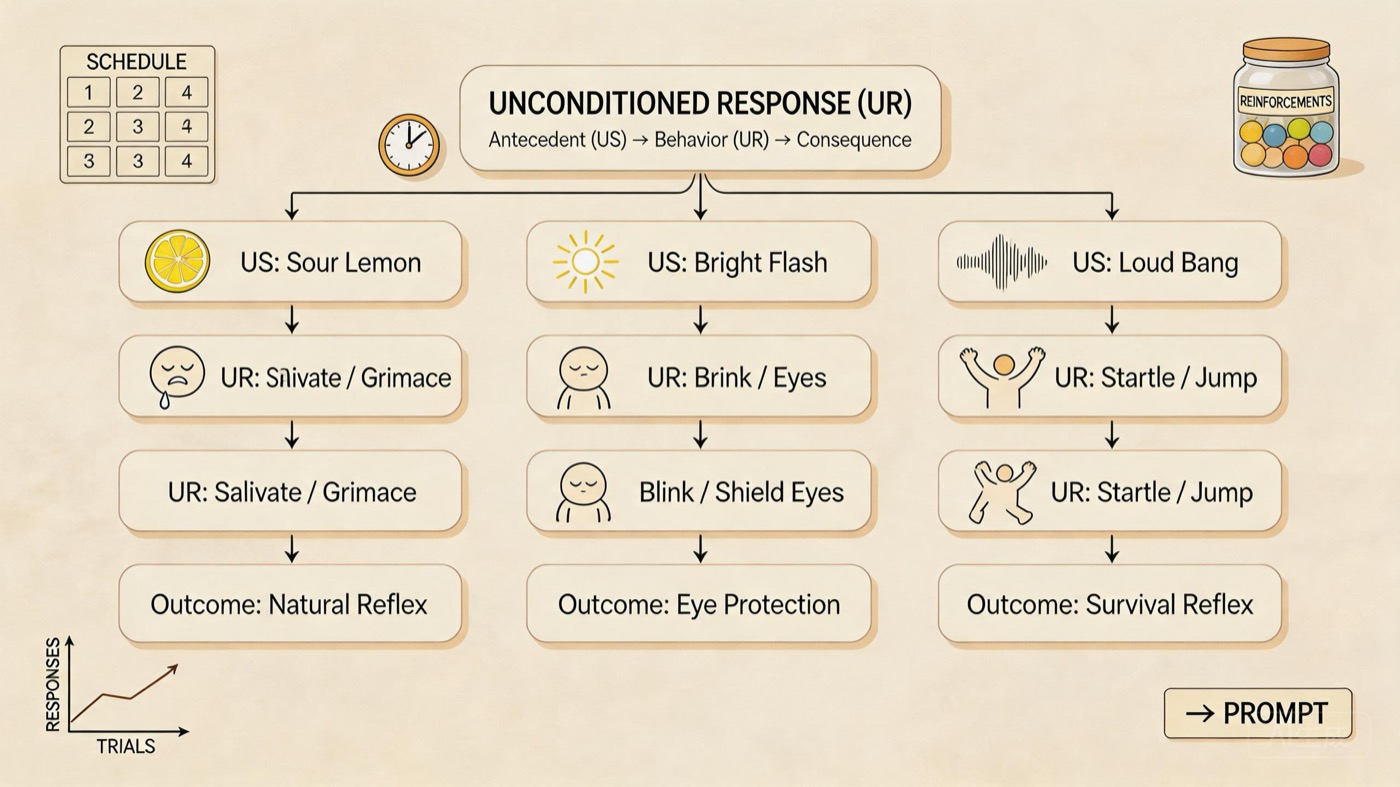
To solidify your understanding, let us examine three concrete ABC examples. Each follows the sequence: Antecedent (US) → Behavior (UR) → Consequence (natural outcome).
Example 1: Eye Blink to a Puff of Air
- Antecedent (US): A sudden puff of air directed at the eye.
- Behavior (UR): The eyelid closes automatically (eye blink).
- Consequence: The eye is protected from potential irritation or debris.
- Function: This is a protective reflex that keeps the eye safe.
Example 2: Withdrawal from Heat
- Antecedent (US): Touching a hot surface (e.g., a stove burner).
- Behavior (UR): The hand jerks away immediately.
- Consequence: Tissue damage is avoided.
- Function: This is a survival reflex that prevents burns.
Example 3: Startle Response to Loud Noise
- Antecedent (US): A sudden, loud sound (e.g., a door slamming).
- Behavior (UR): The person jumps, ducks, or tenses muscles.
- Consequence: Possible protection from a potential threat.
- Function: This is a defensive reflex that prepares the body for action.
These examples show how unconditioned responses are automatic and serve biological functions. In practice, BCBAs must differentiate these from operant behaviors, which are influenced by consequences. Review our guide on operant conditioning in ABA therapy for more context.
Why Unconditioned Responses Matter for the BCBA Exam
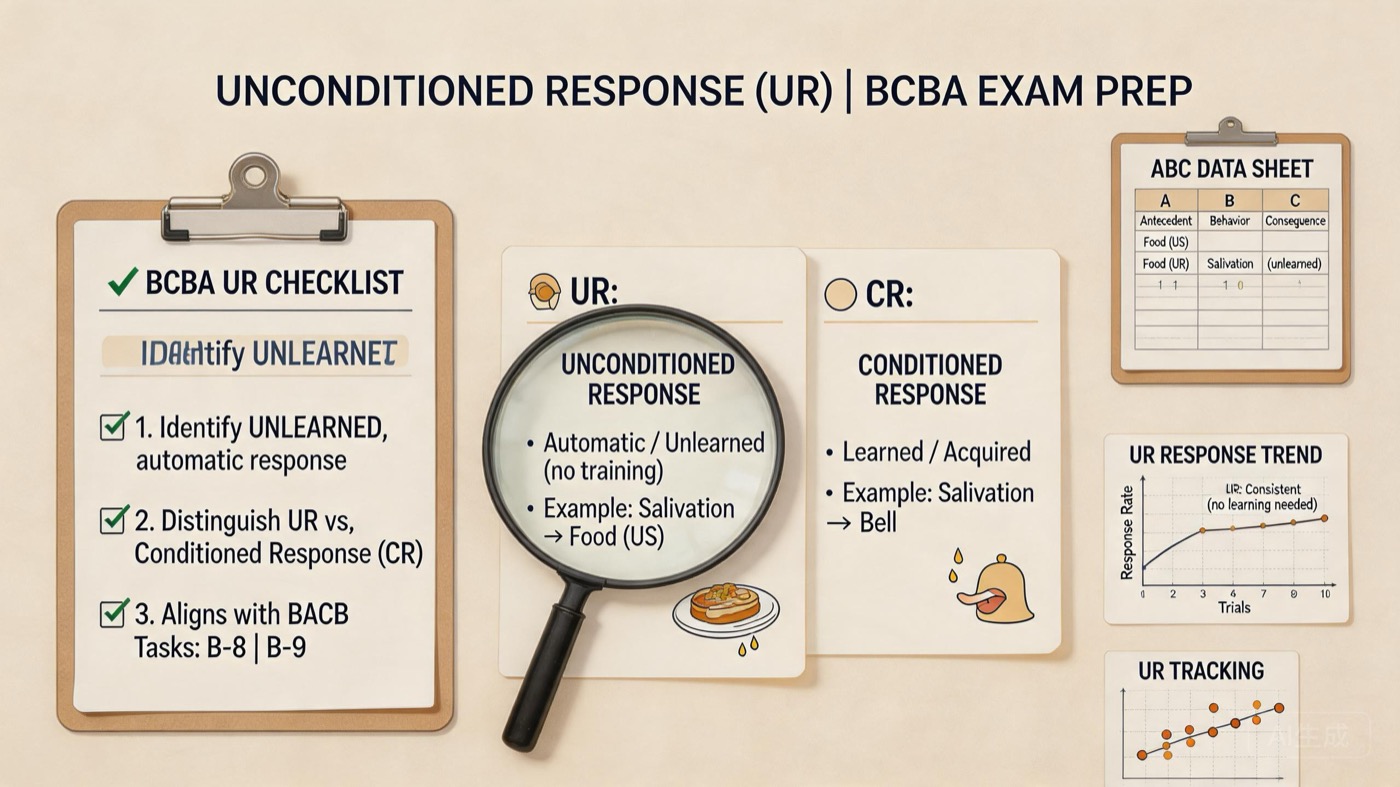
The concept of unconditioned response appears in the BACB Task List under items related to respondent conditioning and behavior functions (e.g., B-8, B-9). You will be expected to identify URs in scenarios and distinguish them from conditioned responses.
Common Exam Traps
- Confusing UR with CR: A common mistake is labeling a learned response (e.g., salivation to a bell) as an unconditioned response. Remember: if it was learned through pairing, it is a CR.
- Forgetting that UR is not learned: Some students add a “learning history” to a UR. A UR occurs without any prior teaching; it is innate.
- Misidentifying the unconditioned stimulus: The US must be the stimulus that naturally elicits the UR. For instance, in the eye blink example, the air puff is the US, not the blink itself.
- Overgeneralizing: Not every reflex is a UR in the context of respondent conditioning. Only those elicited by a US that is part of a pairing procedure are relevant. However, for the exam, all natural reflexes are considered URs.
- Neglecting biological function: Questions may ask why a UR occurs. The answer often relates to survival or protection.
Exam Relevance (Task List B-8, B-9)
- B-8: Define and provide examples of respondent and operant conditioning. You must be able to identify URs and CRs.
- B-9: Distinguish between respondent and operant behavior. URs are respondent behaviors; they are elicited, not emitted.
- Clinical application: Understanding URs helps in designing interventions for phobias, anxiety, and other respondent-based behaviors.
Quick Checklist for Identifying Unconditioned Responses
- Is the response reflexive? Yes, it occurs automatically without voluntary control.
- Does it occur without prior teaching? Yes, it is innate or biologically wired.
- Is it elicited by a natural stimulus? Yes, the US is a stimulus that naturally triggers the response (e.g., food, pain, loud noise).
- If yes to all three, then the behavior is an unconditioned response.
Use this checklist on exam questions to quickly rule out conditioned responses. For example, if a scenario describes a reflex like “pupil constriction to bright light,” you know it is a UR.
Summary
An unconditioned response is a reflexive, unlearned behavior that is automatically elicited by an unconditioned stimulus. It is a foundational concept in respondent conditioning and is essential for the BCBA exam. Remember the key features: unlearned, reflexive, biologically relevant. Study the ABC examples (eye blink, withdrawal, startle) and watch out for common traps like confusing UR with CR. Use the quick checklist to identify URs quickly. For more exam preparation resources, explore our BCBA mock exam 6th edition. Also, review the BACB Task List and consider accessing the official BACB website for the latest standards. Mastering this concept will boost your confidence on test day.



