
What Is Positive Punishment in ABA?
In applied behavior analysis, positive punishment definition refers to the addition of a stimulus immediately after a behavior that decreases the future frequency of that behavior. This is a core concept you must master for the BCBA exam. The key is that something is added to the environment (the “positive” in positive punishment means addition, not good), and the behavior decreases over time.
Table of Contents
- What Is Positive Punishment in ABA?
- Worked ABA Examples
- Exam Relevance and Common Traps
- Quick Checklist for Exams
- Summary
- References
Positive punishment is often confused with negative reinforcement because both involve aversive stimuli. However, they have opposite effects on behavior: punishment reduces behavior, while reinforcement increases it. Understanding this distinction is critical for exam questions.
Core Components
- Stimulus added: A consequence is presented (e.g., a reprimand, extra chore, unpleasant smell).
- Behavior decreases: The target behavior occurs less often in the future.
- Contingent delivery: The stimulus is delivered only after the behavior occurs.
- Aversive to the individual: The added stimulus must function as a punisher for that specific person (what is punishing for one may not be for another).
ABC Model and Hypothesized Function
To analyze positive punishment, use the ABC contingency: Antecedent → Behavior → Consequence. The antecedent sets the occasion, the behavior occurs, and the consequence (added stimulus) follows. The hypothesized function is that the added stimulus makes the behavior less likely to happen again. Importantly, function is determined by the effect on behavior, not by the topography of the consequence. For example, a loud reprimand may punish talking out but may reinforce attention-seeking behavior if the behavior increases.
Worked ABA Examples
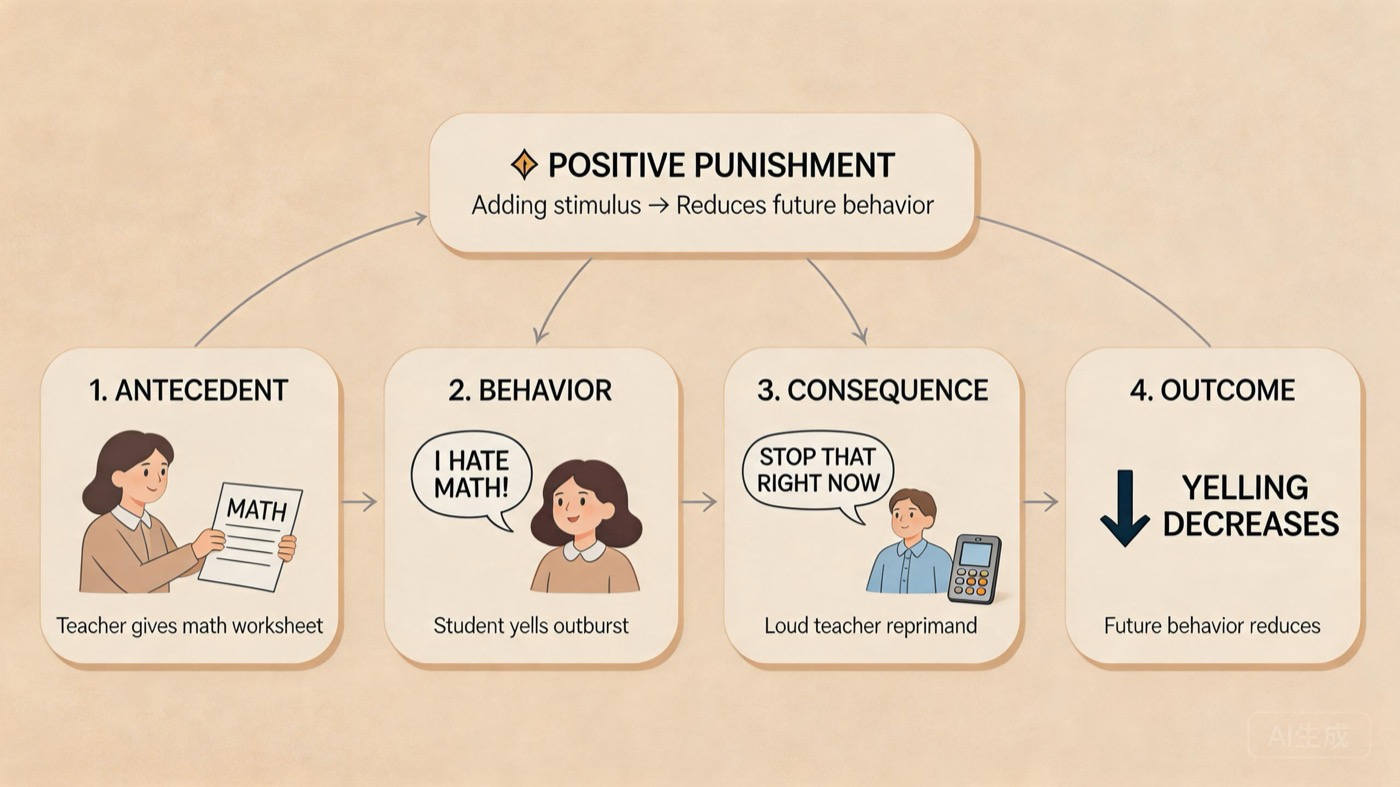
Example 1: Reprimand for Outbursts
Antecedent: Teacher gives a math worksheet. Behavior: Student yells, “I hate math!” Consequence: Teacher says loudly, “Stop that right now!” If the student’s yelling decreases in the future, the reprimand functioned as positive punishment. However, if the yelling increases, the reprimand may have served as positive reinforcement (attention). Always check the behavior trend.
Example 2: Extra Chores for Aggression
Antecedent: Sibling takes a toy. Behavior: Child hits sibling. Consequence: Parent assigns an extra chore (cleaning the garage). If hitting decreases, the added chore is a punisher. Contrast this with negative punishment, where the child would lose access to a preferred item (e.g., toy removal). The distinction: positive punishment adds an aversive; negative punishment removes a preferred stimulus.
Example 3: Spicy Sauce for Nail Biting
Antecedent: Individual feels bored. Behavior: Bites fingernails. Consequence: Applies bitter-tasting nail polish. If nail biting decreases, the bitter taste acts as automatic positive punishment (the stimulus is directly aversive, no social mediator). This example highlights automatic versus socially mediated punishment, a common exam distinction.
Exam Relevance and Common Traps
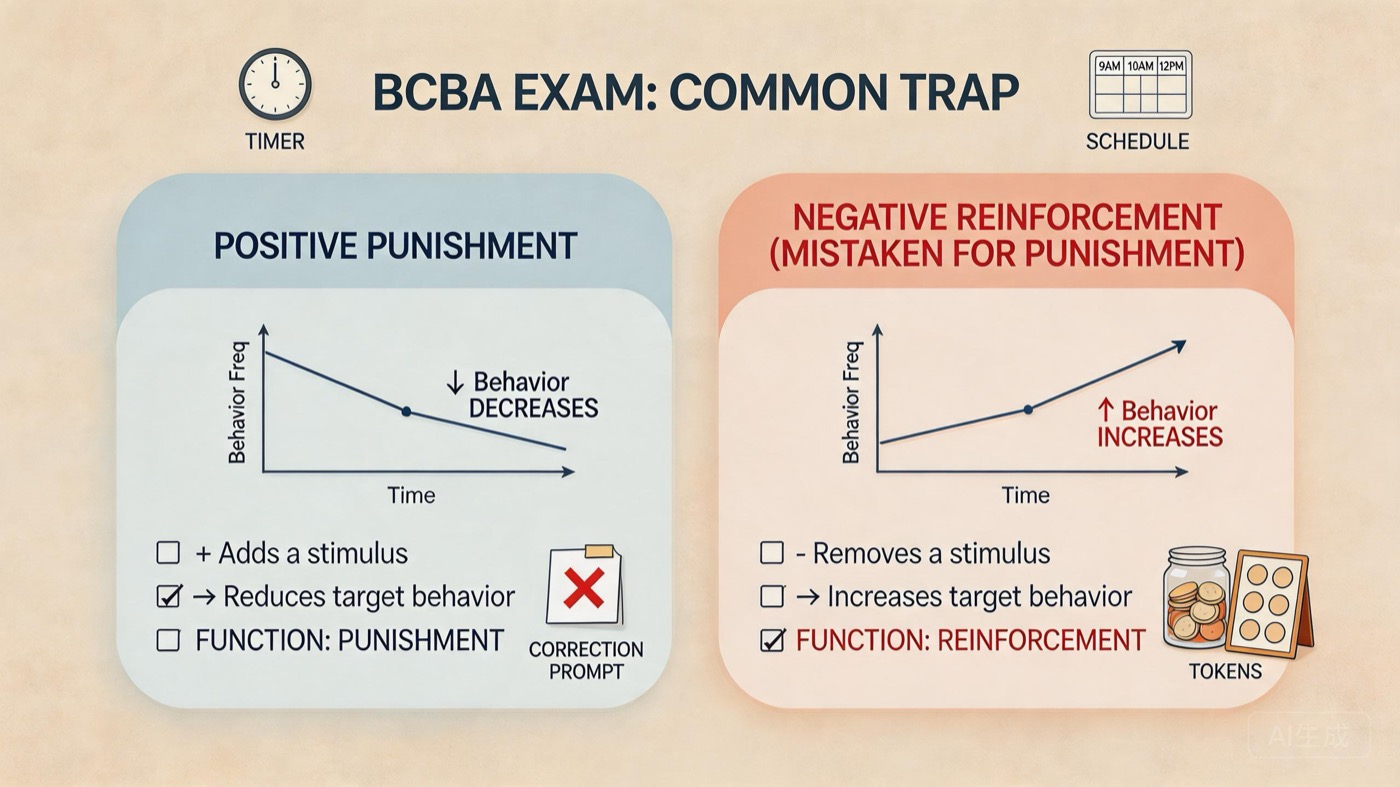
The BCBA exam often tests your ability to differentiate punishment from reinforcement, especially when the same consequence can serve either function depending on the context. Here are the most frequent traps:
Differentiating Punishment from Reinforcement
Many candidates confuse positive punishment with negative reinforcement. Remember: both involve aversive stimuli, but punishment decreases behavior, while reinforcement increases behavior. For example, a student who whines and then the teacher removes a difficult task is experiencing negative reinforcement (whining increases). If the teacher adds a reprimand and whining decreases, that’s positive punishment.
Topography vs. Function
A common mistake is assuming that a specific consequence (e.g., time-out, overcorrection) is always punishment. Function determines classification. Time-out (removal from reinforcement) is negative punishment only if behavior decreases. If a child engages in aggression to escape a task and time-out removes them from the task, the behavior may actually be maintained by negative reinforcement (escape). Always ask: “What happened to the behavior?” before labeling.
Automatic vs. Socially Mediated Punishment
When an aversive stimulus is directly produced by the behavior (e.g., burning hand from touching a hot stove), it is automatic punishment. When another person delivers the aversive stimulus (e.g., teacher scolding), it is socially mediated. Exam questions may ask you to identify the source.
Quick Checklist for Exams
Use this checklist when analyzing a scenario to determine if it represents positive punishment:
- Is a stimulus added after the behavior?
- Does the behavior decrease over time?
- Is the added stimulus aversive to the individual (based on their history)?
- Is the effect due to punishment, not reinforcement? (Check if behavior goes down, not up.)
- Is the function identified through data, not assumption?
By running through these questions, you can avoid common traps and select the correct answer on the exam. For more practice, check out our guide on punishment in ABA: ethics and side effects.
Summary
Key Takeaways
- Positive punishment definition: Add stimulus → decrease behavior. Opposite of negative reinforcement.
- Always use ABC analysis to confirm the consequence follows the behavior and the behavior decreases.
- Function over topography: The same consequence (e.g., reprimand) can punish or reinforce depending on the individual’s history.
- Watch for traps: Confusion with negative reinforcement, overlooking automatic punishment, and assuming consequence type based on form.
- Ethical considerations: Use punishment only when reinforcement-based procedures have been tried or are contraindicated. Review the BACB Ethics Code for guidance on the use of punishment.
Mastering positive punishment is essential for the BCBA exam. Use the checklist above to analyze scenarios quickly. For additional study resources, visit our BCBA exam prep page for mock exams and flashcards.



