
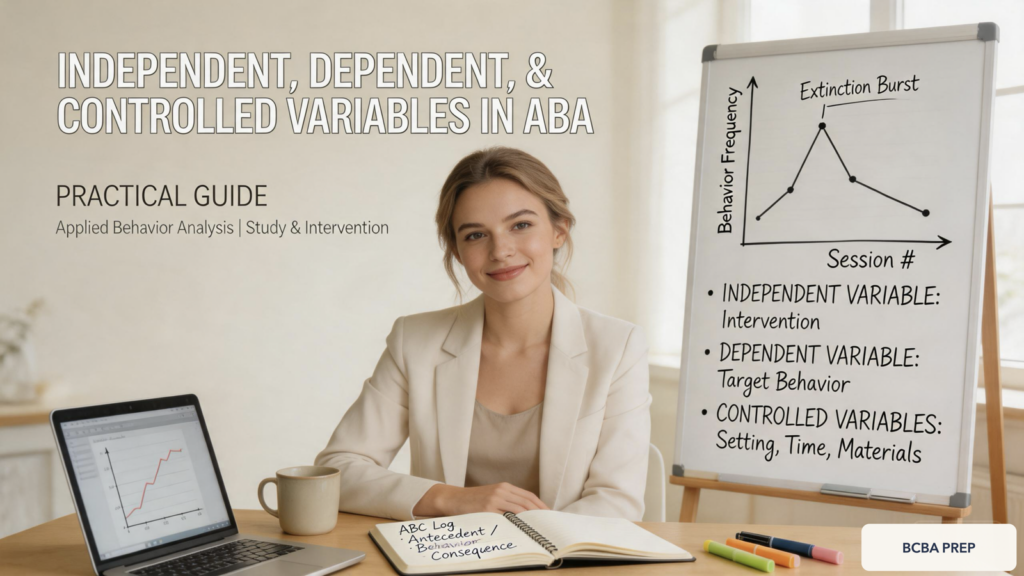
What Are Independent, Dependent, and C
In applied behavior analysis (ABA), understanding independent and dependent and controlled variables is fundamental to designing and evaluating interventions. These three variable types form the backbone of experimental control and allow behavior analysts to determine whether a change in behavior is due to the intervention or other factors.
Table of Contents
- What Are Independent, Dependent, and C
- ABA Examples Linking Variables to ABC Data and Function
- BCBA Exam Relevance and Common Traps
- Summary and Next Steps
Independent Variable (IV): The Intervention You Manipulate
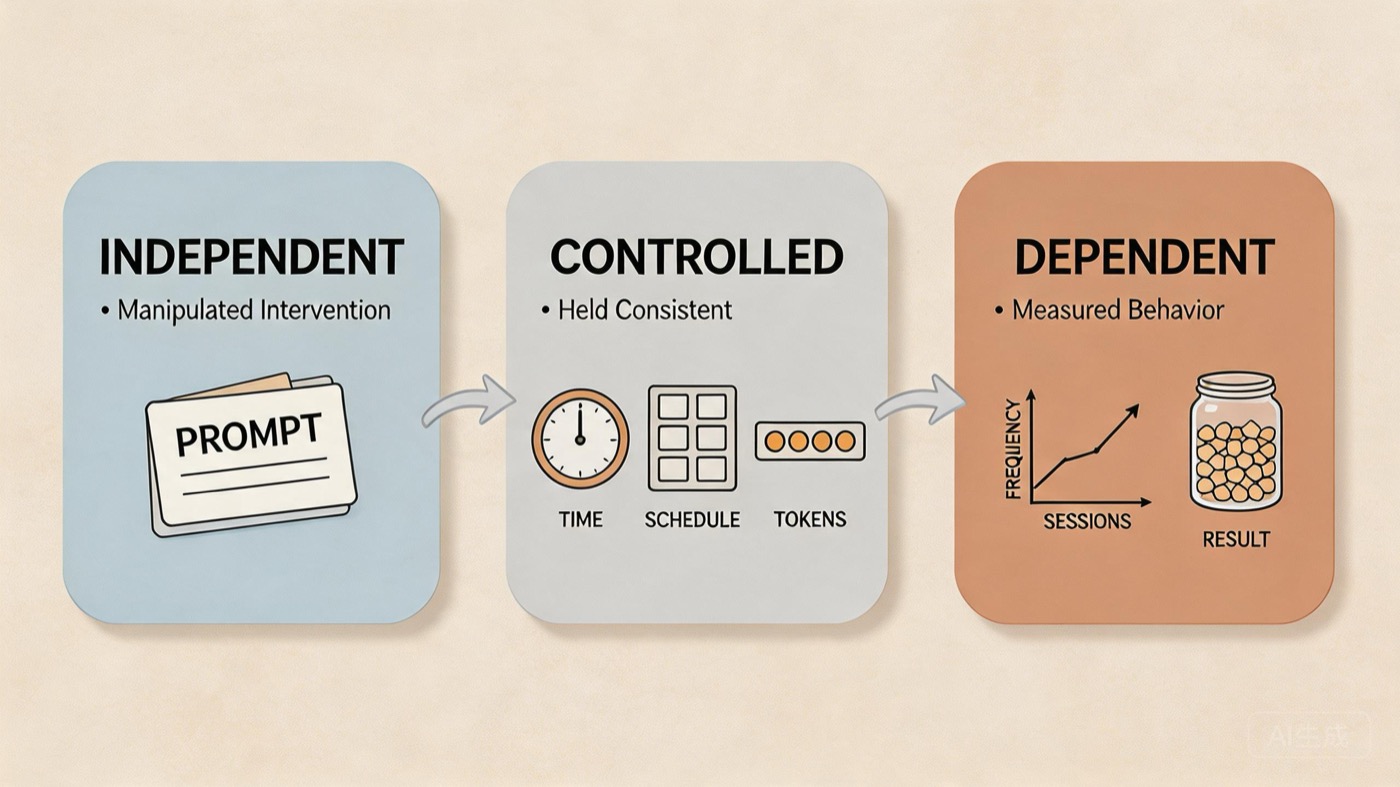
The independent variable is the condition or intervention that the researcher or practitioner deliberately changes. In ABA, the IV is typically a treatment such as a token system, a prompting procedure, or a schedule of reinforcement. The goal is to see if altering the IV produces a change in the target behavior.
For example, if you implement a DRO schedule to reduce aggression, the DRO schedule is the IV. You are manipulating the environment by delivering reinforcement contingent on the absence of aggression.
Dependent Variable (DV): The Behavior You Measure
The dependent variable is the observed outcome — the behavior that is measured and expected to change as a result of the IV. In ABA, the DV is always a behavior that is operationally defined and quantifiable. Common measures include frequency, duration, latency, or intensity of a behavior.
Continuing the example above, the frequency of aggression per session would be the DV. If the IV (DRO schedule) is effective, the DV should show a decrease in aggression.
Controlled Variables: Holding Conditions Constant
Controlled variables are factors that are kept constant across conditions to prevent them from influencing the results. These include the setting, time of day, therapist, materials, and any other potential confounds. Maintaining control over these variables enhances internal validity, ensuring that changes in the DV are attributable to the IV and not to extraneous factors.
For instance, if you conduct sessions at the same time each day with the same therapist and in the same room, you are controlling for time-of-day effects, therapist characteristics, and setting.
ABA Examples Linking Variables to ABC Data and Function
To see how these variables operate in real-world ABA, consider three examples that integrate ABC data and hypothesized behavioral function. Each scenario identifies the IV, DV, and controlled variables.
Example 1: Reducing Aggression with a Token System
A therapist implements a token system to reduce aggression in a child. The IV is the token system, where tokens are delivered for appropriate behavior and exchanged for a backup reinforcer. The DV is the frequency of aggression (e.g., hits per hour). Controlled variables include the same therapist, same time of day, and identical setting across sessions. ABC data suggest the function is access to tangibles, as aggression often occurred when preferred items were denied.
Example 2: Increasing On-Task Behavior Using a Timer
A teacher uses a visual timer to increase on-task behavior during independent work. The IV is the presence of the visual timer, which is either present or absent across conditions. The DV is the duration of on-task behavior measured in minutes. Controlled variables include task difficulty, seating arrangement, and time of day. The hypothesized function is escape from task demands, as the timer may reduce uncertainty about task duration.
Example 3: Evaluating a DRA Procedure for Vocal Stereotypy
A BCBA implements a DRA procedure to decrease vocal stereotypy while increasing appropriate vocalizations. The IV is the DRA procedure, which includes reinforcement of appropriate vocalizations and extinction of stereotypy. The DV is the count of vocal stereotypy per session. Controlled variables include the same seating, same materials, and identical instructional demands. The function is likely automatic reinforcement, as stereotypy persists in the absence of social consequences.
These examples illustrate how clear variable identification supports experimental control and functional analysis.
BCBA Exam Relevance and Common Traps
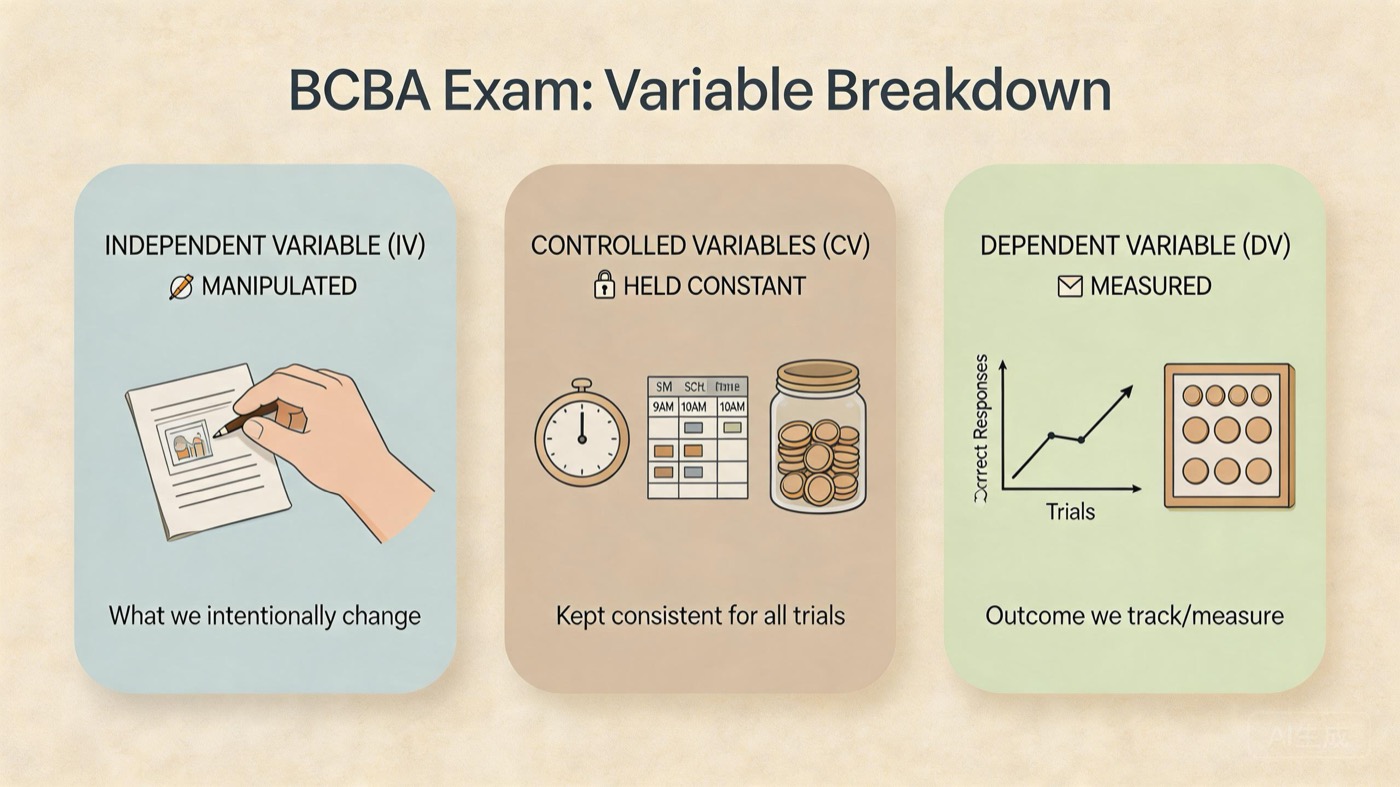
Questions about independent, dependent, and controlled variables appear frequently on the BCBA exam. They require you to distinguish between what is manipulated (IV), what is measured (DV), and what is held constant.
How Variable Questions Appear on the Exam
Most questions are scenario-based. You will read a brief description of a study or intervention and then be asked to identify the IV, DV, or a controlled variable. For example:
- “A behavior analyst implements a token economy to increase compliance. What is the independent variable?”
- “In a study evaluating the effects of a social story on sharing, what is the dependent variable?”
- “Which of the following is a controlled variable in this experiment?”
Common Traps and How to Avoid Them
- Confusing IV and DV: Remember, the IV is what you change; the DV is what you measure. A common trap is to identify the behavior (DV) as the IV. Avoid this by asking: “What did the experimenter manipulate?”
- Overlooking controlled variables: Many candidates forget to consider factors that are kept constant. Controlled variables are often listed as potential confounds in the scenario. Always scan for details like “same therapist,” “identical setting,” or “at the same time.”
- Misinterpreting operational definitions: If the behavior is not clearly defined, you might misidentify the DV. Ensure the DV is objectively measured, not a vague label.
Quick Checklist for Variable Identification
- Ask: What did the investigator change or introduce? That is your IV.
- Ask: What behavior or outcome is being tracked? That is your DV.
- Ask: What factors are described as constant across conditions? Those are controlled variables.
- Check that the IV is manipulated by the experimenter, not the participant.
- Verify that the DV is the behavior targeted for change, not an extraneous measure.
Summary and Next Steps
Mastering the distinction between independent, dependent, and controlled variables is essential for experimental design in ABA and success on the BCBA exam. Remember: the IV is manipulated, the DV is measured, and controlled variables are kept constant. Practice identifying these elements in case scenarios to strengthen your skills.
For further study, explore our BCBA exam prep materials and review single-subject experimental designs to see how variables are used in research. Additionally, consult the BACB’s official guidelines for more on experimental control.



