
Introduction
Verbal behavior is a core topic on the BCBA exam, and one of the trickiest concepts is understanding how a speaker’s verbal behavior can act as a discriminative stimulus (SD) for a listener. In essence, speakers serve as discriminative stimuli for listeners by signaling that a specific listener response will produce reinforcement. This article breaks down the definition, provides practical ABA examples, and highlights exam traps to help you master this concept.
Table of Contents
- Introduction
- What Does It Mean for a Speaker to Serve as an SD for a Listener?
- Examples of Speaker as SD for Listener in ABA
- Why This Distinction Matters for the BCBA Exam
- Quick Checklist: Speaker as SD for Listener
- Summary
What Does It Mean for a Speaker to Serve as an SD for a Listener?
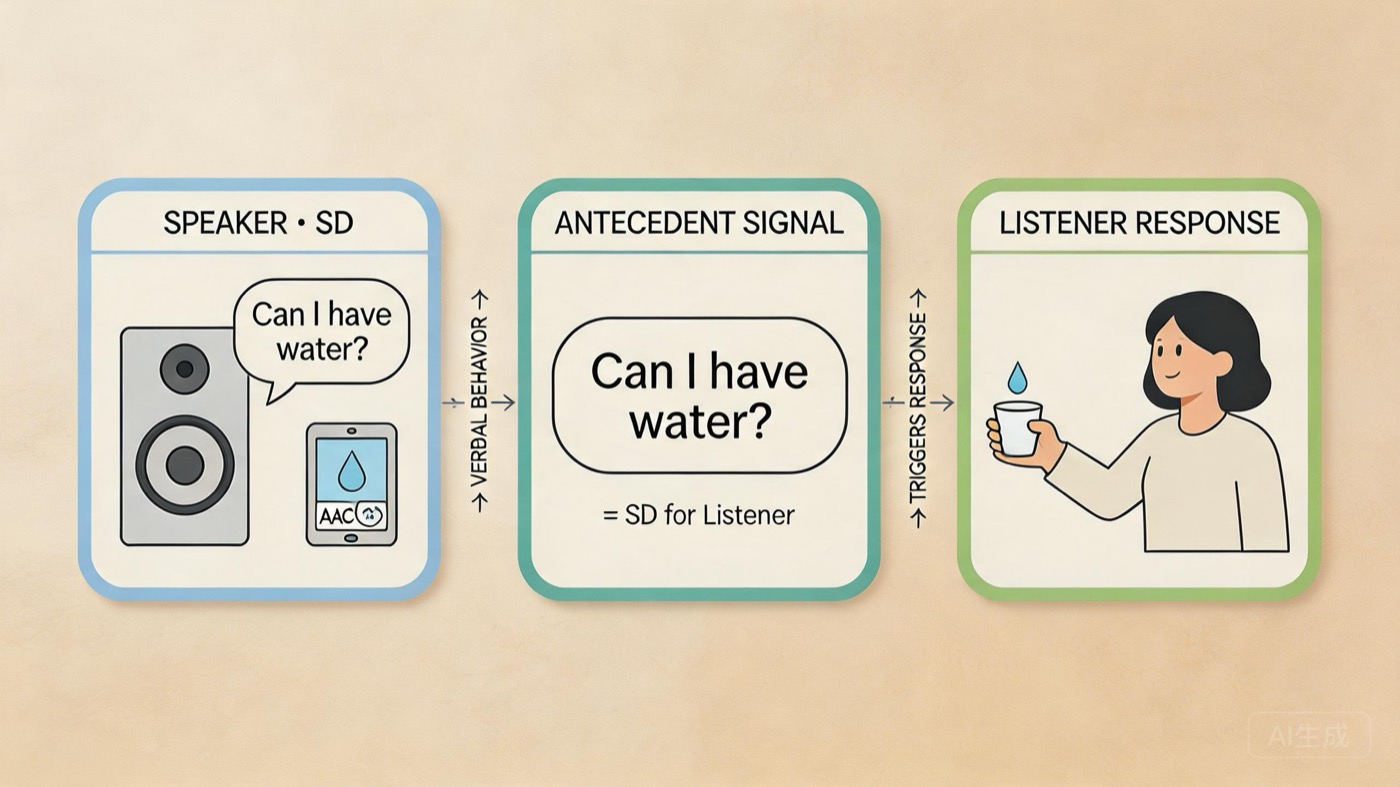
In a verbal episode, the speaker emits verbal behavior (e.g., a mand, tact, or intraverbal). That verbal behavior becomes part of the antecedent for the listener’s response. When the speaker’s verbal behavior reliably signals that a particular listener response will be reinforced, it functions as a discriminative stimulus for the listener. In other words, the listener’s behavior is under the stimulus control of the speaker’s verbal behavior.
The Three-Term Contingency in Verbal Behavior
Consider the standard three-term contingency:
- SD (Antecedent): The speaker’s verbal behavior (e.g., saying ‘Clap hands’)
- Response: The listener’s behavior (e.g., clapping hands)
- Consequence: Reinforcement for the listener (e.g., praise or continued interaction)
The speaker’s verbal behavior signals that reinforcement is available for a specific listener response. Without that SD, the listener is less likely to engage in the response.
Distinction from Other Types of SDs
Unlike non-social SDs (e.g., a red traffic light signaling to stop), a speaker’s verbal behavior is a social SD. It depends on a history of reinforcement within a verbal community. For example, the word ‘Hello’ does not inherently signal a greeting response; it does so because of learned contingencies. Understanding this distinction helps you identify when a speaker truly functions as an SD for a listener versus being controlled by other variables like motivating operations (MOs).
Examples of Speaker as SD for Listener in ABA
Let’s walk through three concrete examples with an ABC analysis and hypothesized function.
Example 1: Instruction Following
- SD (Speaker): The teacher says ‘Clap hands’
- Response (Listener): The child claps
- Consequence: The teacher says ‘Good job!’ and smiles
Hypothesized function: Social positive reinforcement (praise). The speaker’s instruction serves as an SD because, in the past, saying ‘Clap hands’ has reliably led to praise after the child claps.
Example 2: Intraverbal Exchange
- SD (Speaker): The peer asks ‘What’s your name?’
- Response (Listener): The listener says ‘John’
- Consequence: The peer continues the conversation
Hypothesized function: Social positive reinforcement (continued interaction). The question ‘What’s your name?’ sets the occasion for the listener to provide their name, which then leads to more conversation.
Example 3: Listener Responding (Receptive Identification)
- SD (Speaker): The therapist says ‘Point to the cat’
- Response (Listener): The learner points to a picture of a cat
- Consequence: The therapist says ‘That’s right!’ and provides a token
Hypothesized function: Social positive reinforcement (praise + token). The speaker’s verbal SD signals that pointing to the cat will produce reinforcement.
Why This Distinction Matters for the BCBA Exam
Exam questions often test your ability to identify the discriminative stimulus controlling the listener’s behavior. Misidentifying the SD can lead to incorrect answers, especially when MOs or other antecedents are present. The key is to focus on the relationship between the speaker’s verbal behavior and the listener’s response.
Common Exam Traps
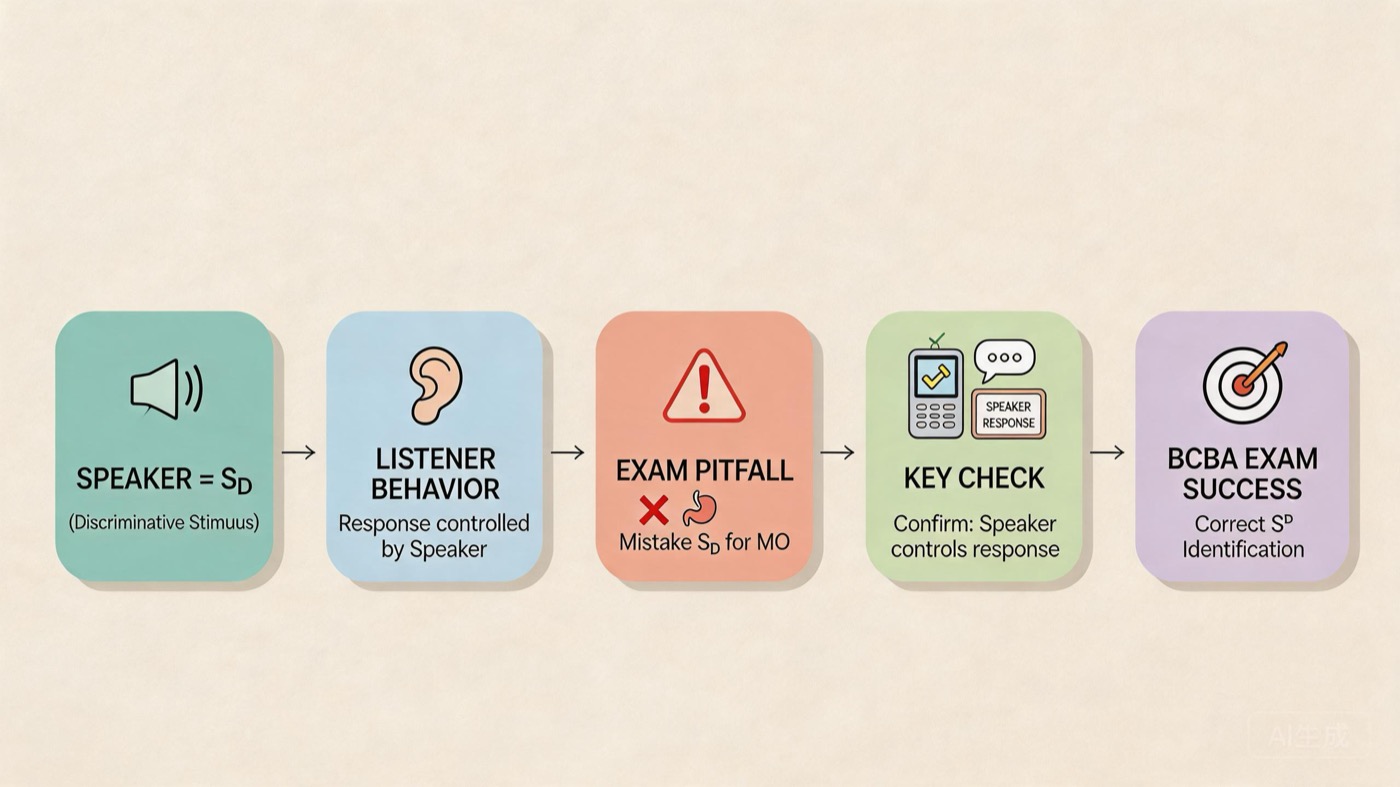
- Confusing the SD with an MO: An MO alters the value of a reinforcer and evokes behavior that has previously produced that reinforcer. The SD signals the availability of reinforcement. For example, a child asking for water (mand) is an MO for the listener to provide water, but the speaker’s request is also an SD for the listener’s response of giving water. Be careful to identify which variable is directly controlling the listener’s behavior.
- Thinking the speaker’s behavior is always an SD for the listener: Sometimes the speaker’s verbal behavior may not be an SD if the listener’s response is primarily under MO control or if the consequence does not consistently follow. Always ask: What is the antecedent that sets the occasion for the listener’s specific response?
- Neglecting to identify the consequence for the listener: The SD concept hinges on a history of reinforcement. If you cannot identify a consistent consequence for the listener, the speaker’s behavior may not be functioning as an SD.
Test-Taking Tips
- Always ask: ‘What is the SD for the listener’s response?’ Look for the immediate antecedent that signals reinforcement.
- Ask: ‘What consequence maintains the listener’s behavior?’ This helps confirm the function and the SD.
- Practice with mock scenarios: Use free BCBA mock exam questions to test your ability to distinguish SDs from MOs and other variables.
Quick Checklist: Speaker as SD for Listener
Use this checklist to analyze any verbal episode on the exam or in practice:
- Identify the speaker’s verbal behavior. What exactly does the speaker say or do?
- Confirm that it immediately precedes the listener’s response. Is the speaker’s behavior the direct antecedent?
- Verify that the listener’s response produces a specific reinforcer. Is there a consistent consequence?
- Rule out alternative controlling variables. Could an MO or another SD be in effect?
Summary
Understanding that speakers serve as discriminative stimuli for listeners is crucial for analyzing verbal behavior and passing the BCBA exam. Remember the three-term contingency, practice with real-world examples, and watch for common traps like confusing SDs with MOs. For more detailed study, check out our verbal operants guide and additional resources on BACB website. Keep practicing and you will master this concept.



