
What Is Multiple Probe Design in ABA?
In applied behavior analysis, the multiple probe design is a single-subject experimental design used to evaluate the effects of an intervention across multiple behaviors, settings, or participants. Unlike the multiple baseline design which requires continuous data collection during baseline, the multiple probe design collects data intermittently through probe sessions. This makes it more efficient and practical when continuous measurement is difficult or when extended baseline periods could be unethical or impractical.
Table of Contents
- What Is Multiple Probe Design in ABA?
- Multiple Probe vs Multiple Baseline: Key Differences
- Worked ABA Examples of Multiple Probe Design
- Exam Relevance and Common Traps
- Quick Checklist for Multiple Probe Design
The design involves taking a few baseline data points (probes) for each tier, implementing the intervention on one tier while maintaining probe conditions for others, then systematically applying the intervention across tiers. A functional relation is demonstrated when behavior change occurs only after the intervention is introduced for each tier, and data remain stable during probe-only phases.
Multiple Probe vs Multiple Baseline: Key Differences
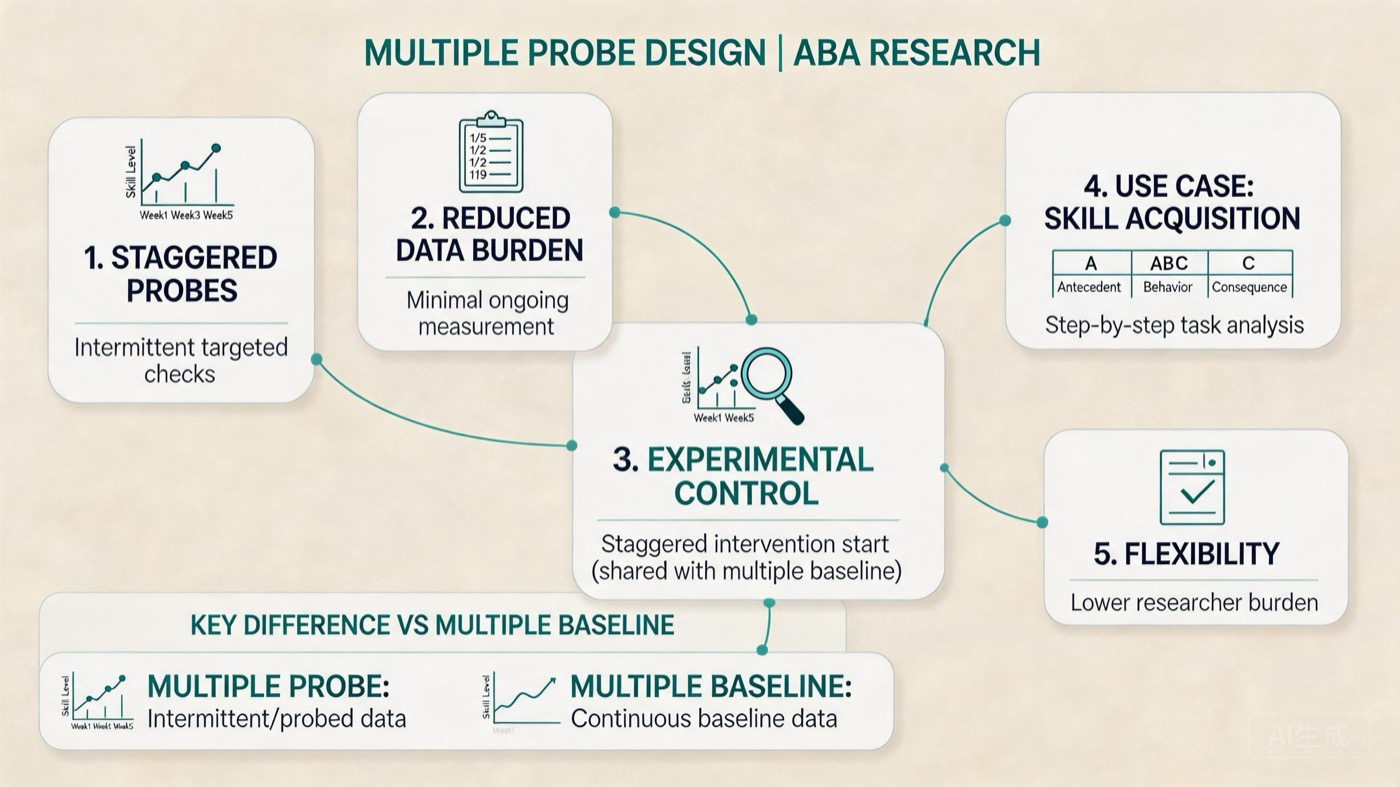
Both designs demonstrate experimental control by staggering intervention introduction, but they differ in data collection frequency and suitability. Here are the main distinctions:
- Data collection frequency: Multiple baseline requires continuous measurement throughout baseline; multiple probe uses intermittent probes.
- Practicality: Multiple probe is more practical when continuous observation is logistically challenging (e.g., across multiple classrooms) or when prolonged baseline may cause harm (e.g., self-injurious behavior).
- Risk of reactivity: Multiple probe reduces the risk of participant fatigue or practice effects caused by repeated testing.
- When to use: Use multiple probe when the behavior is unlikely to change without intervention, or when you cannot collect data every session. Use multiple baseline when continuous data are feasible and you need a dense baseline to detect trends.
- Visual analysis: Both rely on visual inspection of level, trend, and variability, but multiple probe graphs show gaps in data paths, making interpretation slightly different.
In short, multiple probe design is a variation of the multiple baseline design that offers flexibility when continuous measurement is not possible or desirable. Your choice depends on the clinical context and logistical constraints.
Worked ABA Examples of Multiple Probe Design
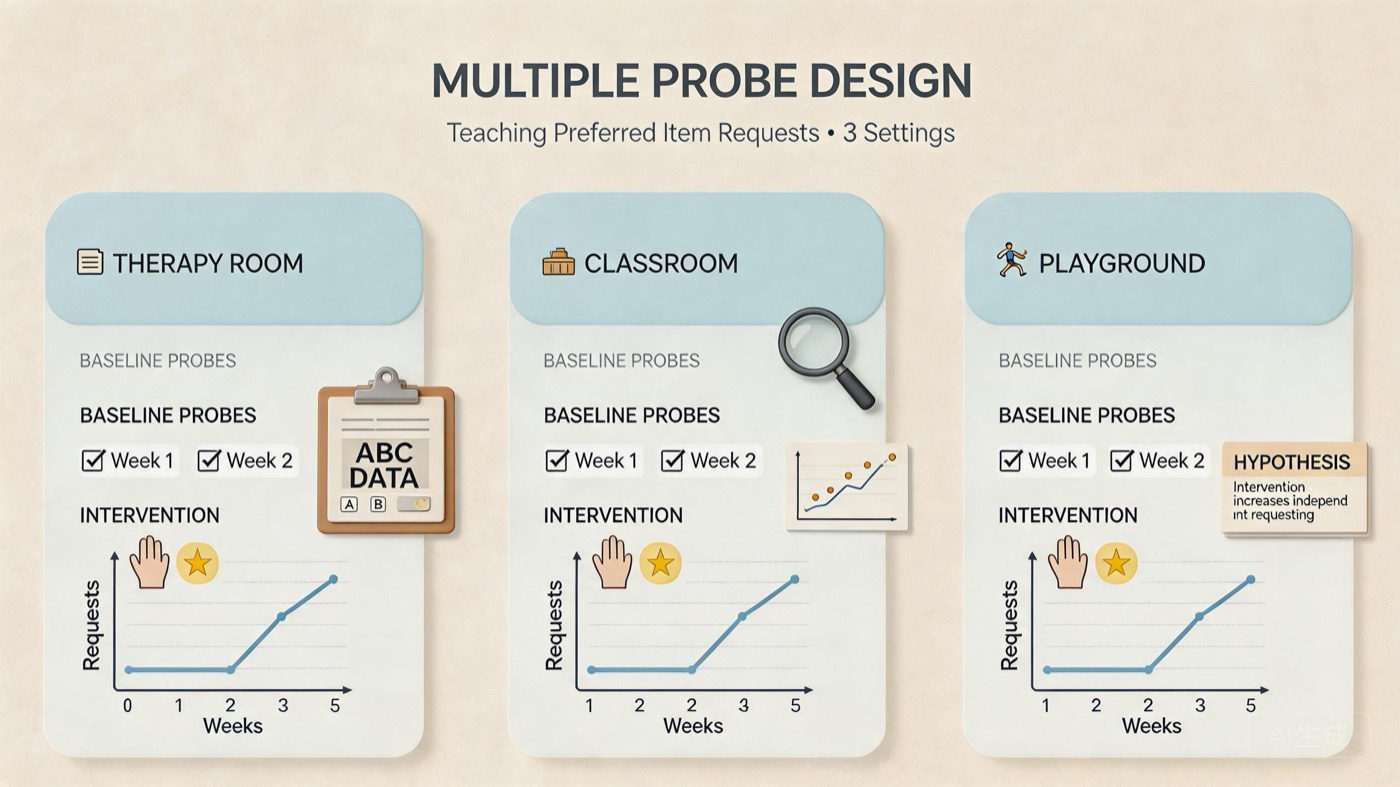
Example 1: Teaching Requesting (Mand) to a Child with Autism
A BCBA wants to teach a child to request preferred items across three settings: therapy room, classroom, and playground. Baseline probes are conducted once per week for two weeks in each setting. The intervention (prompting and reinforcement) is first introduced in the therapy room while probe data continue in the other settings. Results show the child begins requesting independently in the therapy room, while data in the classroom and playground remain low. After a stable change, intervention is introduced in the classroom, and eventually the playground. The hypothesized function is positive reinforcement (access to preferred items).
Example 2: Increasing On-Task Behavior in a Classroom
A teacher targets on-task behavior for three students during independent work time. Continuous data collection is impractical, so probe data are collected once every three days. The intervention (self-monitoring checklist and brief teacher prompts) is applied to Student A first. Probes show Student A’s on-task behavior increases, while Students B and C remain at baseline levels. The intervention is then applied sequentially to B and C. The hypothesized function is automatic reinforcement (completion of work provides its own reward) or escape from task demands (the checklist reduces avoidance behavior).
Exam Relevance and Common Traps
For the BCBA exam, you must be able to identify multiple probe design in a scenario and distinguish it from multiple baseline. Common traps include confusing the two, misinterpreting the graph (e.g., expecting continuous data lines), or overgeneralizing when to use probes. Here are specific pitfalls:
- Confusing probe baseline with traditional baseline: Probes are intermittent, not continuous. On the exam, look for phrases like ‘probe data collected every few days’ or ‘intermittent baseline measures.’
- Assuming probes are only for low-rate behaviors: Probes can be used for any behavior when continuous measurement is impractical, not just low-frequency ones.
- Thinking probes cannot detect trend: Even with few data points, you can assess stability and level; the BACB 6th edition task list emphasizes that experimental control can be demonstrated with probe data.
- Forgetting to justify the design: In exam scenarios, be ready to explain why a multiple probe design was chosen over a multiple baseline (e.g., practical constraints, ethical considerations).
Mastering this concept will help you answer questions about experimental design and single-subject designs with confidence.
Quick Checklist for Multiple Probe Design
- Use when continuous baseline data collection is impractical, unethical, or disruptive.
- Collect probe data intermittently across tiers (behaviors, settings, or participants) before intervention.
- Introduce intervention to one tier at a time; continue probes for other tiers.
- Demonstrate experimental control by showing behavior change only after intervention is introduced for each tier.
- Interpret graphs by examining level shifts and trend changes relative to probe-only phases.
- Justify your choice when asked: highlight reasons like limited resources, participant fatigue, or safety concerns.
- Know the limitations: fewer data points may make it harder to detect unstable baselines; use caution when baseline variability is high.
Final tip: Practice reading multiple probe graphs in mock exams. The free BCBA mock exam questions on our site include visual analysis items to sharpen your skills. For a deeper dive, review the BACB 6th Edition Task List (external link) for formal definitions and eligibility criteria.


