
What Are the 4 Functions of Behavior in ABA?
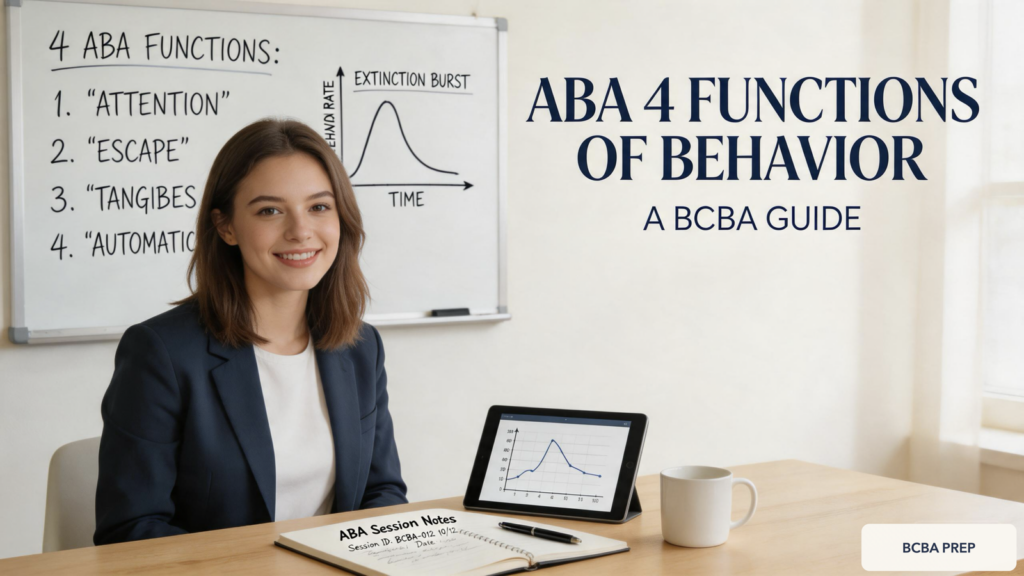
In Applied Behavior Analysis, every behavior serves a purpose. The ABA 4 functions of behavior explain why a behavior occurs and guide effective intervention. The mnemonic SEAT helps you recall them: Sensory (automatic reinforcement), Escape, Attention, and Tangible (access to items/activities). Identifying the function is essential for designing function-based treatments. Without understanding the function, interventions may inadvertently reinforce the behavior or fail to produce meaningful change.
Table of Contents
- What Are the 4 Functions of Behavior in ABA?
- How to Identify the Function: ABC Analysis with EXAMPLES
- How to Conduct an FBA to Pinpoint the Function
- Why the 4 Functions Matter for the BCBA Exam
Sensory (Automatic Reinforcement)
Here, the behavior itself produces a reinforcing sensory consequence. No social mediation is required. For example, hand-flapping may provide proprioceptive input that feels good. The behavior occurs even when the person is alone. Another common example is rocking back and forth for vestibular stimulation. Because sensory behaviors are automatically reinforced, they can be challenging to address; competing sensory alternatives or noncontingent access to sensory activities are often effective.
On the BCBA exam, remember that automatic reinforcement means the behavior maintains itself without external social consequences. If a behavior occurs in isolation, it likely has a sensory function.
Escape (Avoidance)
This function involves behavior that helps a person get out of or avoid a task, demand, or situation. For instance, a child whines when asked to do homework, and the whining stops when the demand is removed. The behavior is reinforced by escaping the demand. Escape can also involve aversive social situations, such as a child hiding under the desk when asked to speak in front of the class. In all cases, the consequence that maintains the behavior is the removal or avoidance of the aversive stimulus.
When conducting a functional assessment, look for patterns where the behavior occurs immediately after an instruction or demand and ceases when the demand is withdrawn. Escape-maintained behaviors are common in academic settings and may require strategies like task modification, demand fading, or providing choices.
Attention
Behavior maintained by attention seeks to gain social interaction, whether positive (praise) or negative (scolding). A common example: a tantrum when a parent is on the phone; the parent looks and scolds, inadvertently reinforcing the tantrum. Attention can come from peers or adults. Even reprimands can serve as reinforcement if the child finds any social attention desirable.
On the exam, you may see behaviors that occur primarily when attention is low or when the person is ignored. The key is to notice the contingent delivery of social attention as a consequence. Interventions often involve differential reinforcement of alternative behaviors (DRA) or noncontingent reinforcement (NCR) to reduce the motivation for attention-seeking behavior.
Tangible (Access to Items/Activities)
This function occurs when behavior produces access to a desired item or activity. For example, a child cries in the store until the parent buys candy. The behavior is reinforced by obtaining the tangible item. Tangible functions also include access to activities, such as a student yelling to get extra computer time. It is important to distinguish between attention and tangible: if the reinforcer is the item or activity itself (and not social interaction), the function is tangible.
In practice, it is common for a behavior to have multiple functions. For example, a child might tantrum both to get a toy (tangible) and to gain the parent’s reaction (attention). A thorough functional assessment can identify which function is primary or if both maintain the behavior.
How to Identify the Function: ABC Analysis with EXAMPLES
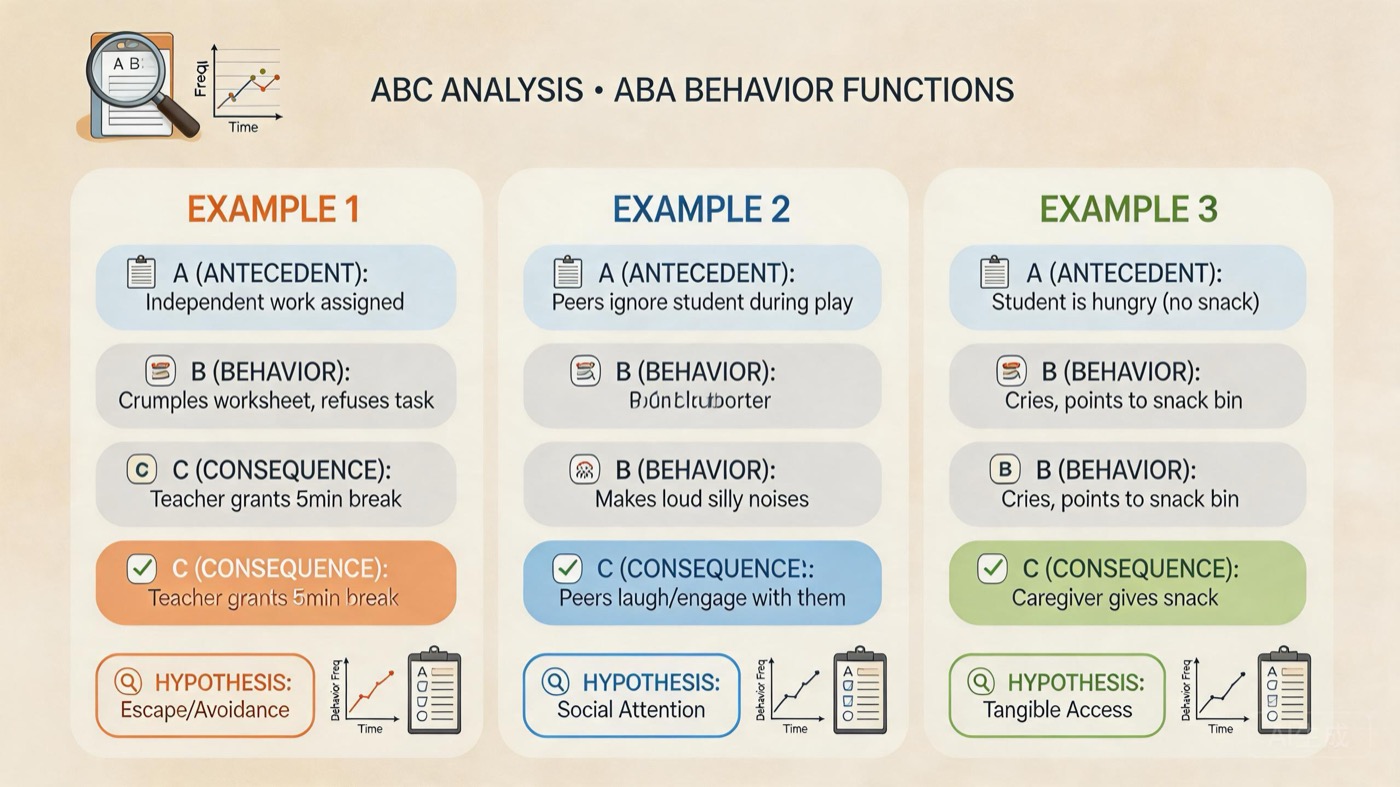
To determine the function, collect ABC data (Antecedent-Behavior-Consequence). The antecedent triggers the behavior, and the consequence maintains it. Below are three real-world examples with hypothesized functions. When collecting ABC data, it is crucial to record objective descriptions and not assume intent. Look for patterns over multiple occurrences.
Example 1: Escape-Motivated Disruption
- Antecedent: Teacher gives a math worksheet.
- Behavior: Student throws pencil.
- Consequence: Sent to hallway (escapes worksheet).
- Hypothesized function: Escape.
Example 2: Attention-Maintained Calling Out
- Antecedent: Teacher works with another student.
- Behavior: Child calls out answer.
- Consequence: Teacher says ‘good job’ and looks over.
- Hypothesized function: Attention.
Example 3: Automatic Sensory Reinforcement – Spinning
- Antecedent: Alone in room (no social demands).
- Behavior: Spins in circles.
- Consequence: Sensation of spinning.
- Hypothesized function: Sensory/automatic.
A fourth example illustrates a tangible function:
- Antecedent: Sibling playing with a favorite toy.
- Behavior: Snatches the toy.
- Consequence: Gets the toy.
- Hypothesized function: Tangible.
Remember: the same topography can serve different functions. For instance, hitting may function to escape chores, gain attention, or access a preferred item. Always use data, not assumptions.
How to Conduct an FBA to Pinpoint the Function
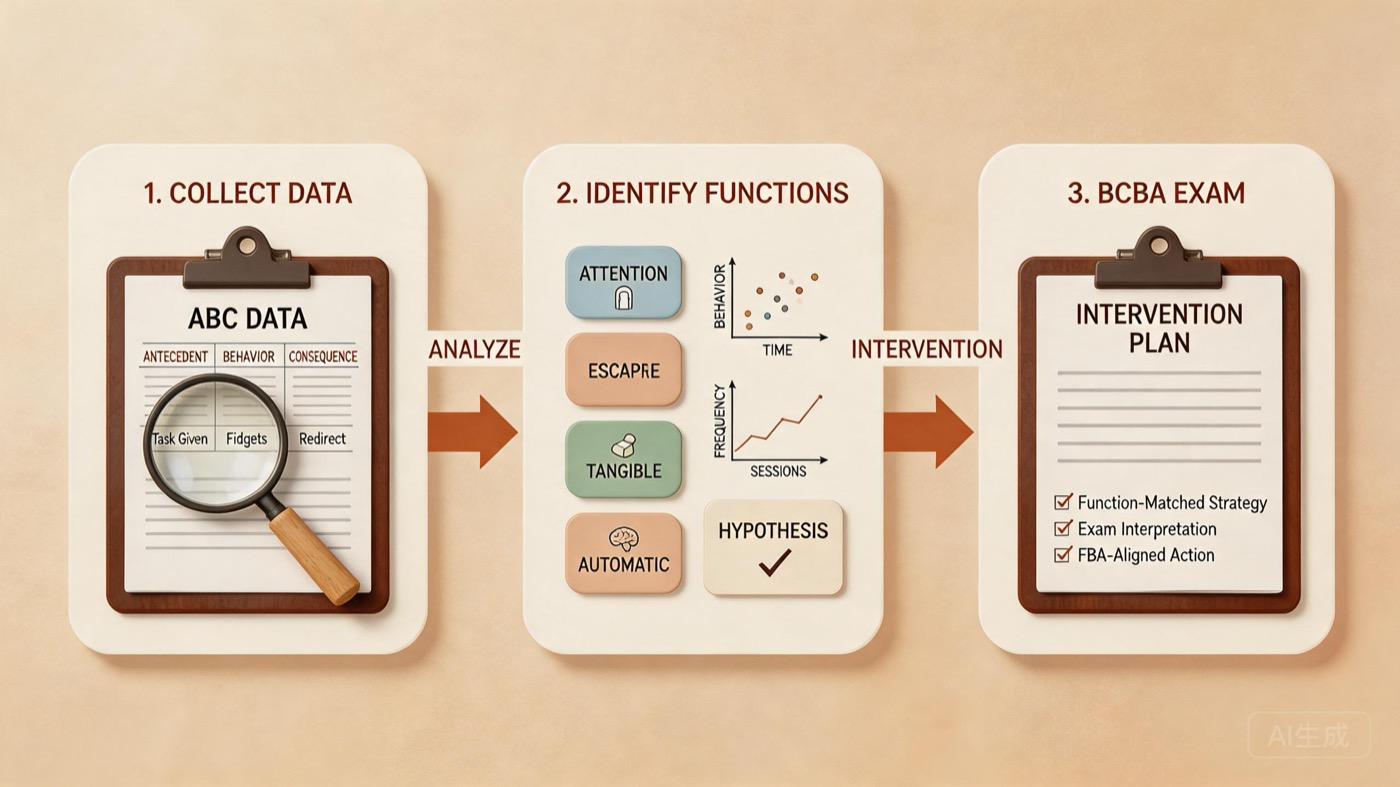
A functional behavior assessment (FBA) is a systematic process for identifying the function of behavior. BCBA candidates must be familiar with indirect assessments (e.g., interviews, rating scales), descriptive assessments (e.g., ABC data collection), and functional analysis (FA) which experimentally tests function. On the exam, you might be asked to interpret FA graphs showing higher rates of behavior in a test condition (e.g., escape) versus control (play). Understanding the logic of FA conditions (attention, demand, alone, tangible, and control) is essential.
Another common exam topic is the functional analysis condition for automatic reinforcement. In an alone condition, if the behavior persists without any social interaction, it suggests a sensory/automatic function. In contrast, if behavior occurs only when demands are present, escape is likely.
When narrowing down possible functions, consider, “What is the reinforcer?” and “Is it socially mediated?” Socially mediated functions (escape, attention, tangible) require another person to deliver the consequence, while automatic functions do not. This distinction is a key exam point.
Why the 4 Functions Matter for the BCBA Exam
Understanding the functions is critical for functional behavior assessment (FBA) and for passing the BCBA exam. You will be asked to interpret data and select function-based interventions. Two common traps can trip you up.
Common Exam Traps to Avoid
- Confusing topography with function: The same behavior (e.g., hitting) can serve different functions. Do not assume based on what it looks like; always analyze ABC data.
- Overlooking automatic functions: When no social consequence is observed, consider automatic reinforcement. If the behavior persists in isolation, sensory function is likely.
- Assuming a single function: Behaviors can have more than one function. For example, a child may tantrum to both escape a task and gain a preferred item. When assessing, look for multiple functions and address each.
- Misidentifying the reinforcer: For escape functions, the reinforcer is the removal of an aversive stimulus; for attention, it is the social interaction; for tangible, it is the item/activity. Be precise on what maintains the behavior.
Quick Checklist for Exam Review
- Recall the SEAT mnemonic (Sensory, Escape, Attention, Tangible).
- Practice ABC analysis with sample scenarios until it becomes automatic.
- Identify the function from data – look for patterns in antecedents and consequences.
- Remember that a single behavior can serve multiple functions; assessment must address all.
- Understand the conditions in a functional analysis: alone, attention, demand, tangible, and control (play).
For more in-depth study, check out our guide on four functions of behavior ABA and explore functional behavior assessment (FBA). For additional authoritative information, visit the BACB website.


