
Experimental control is a core concept in behavior analysis. It refers to the demonstration that changes in the dependent variable (DV) are reliably produced by changes in the independent variable (IV), and not by other factors. In simpler terms, you have shown that your intervention caused the behavior change.
Table of Contents
- What Is Experimental Control in ABA?
- Why Experimental Control Matters for the BCBA Exam
- ABA Examples of Experimental Control
- Quick Checklist for Experimental Control
- How to Demonstrate Experimental Control in Your Exam Answers
What Is Experimental Control in ABA?
Experimental control is the gold standard for demonstrating that an intervention works. In behavior analysis, we use single-subject designs to show that the independent variable (IV) — typically the intervention — reliably produces changes in the dependent variable (DV), or the target behavior. Without experimental control, you cannot claim a functional relation exists.
Practice this concept
Definition and Core Components
Experimental control is achieved when a functional relation is established. This requires:
- Replication of the effect across participants, settings, or time.
- Internal validity – ruling out confounding variables.
- Consistent data patterns showing that behavior changes only when the IV is introduced or removed.
It is distinct from experimental design (the structure of the study) and experimental manipulation (the act of changing the IV). Control is the outcome, not the method itself.
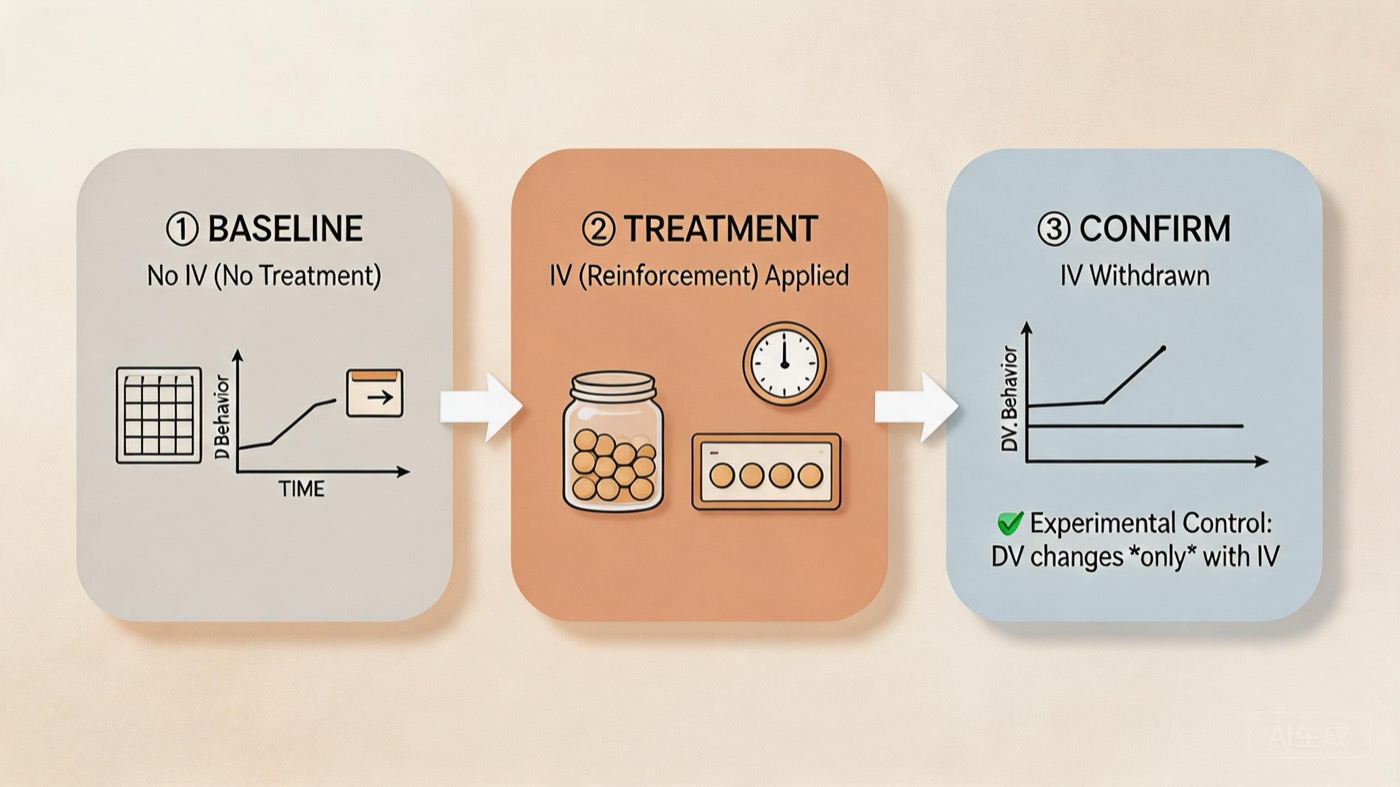
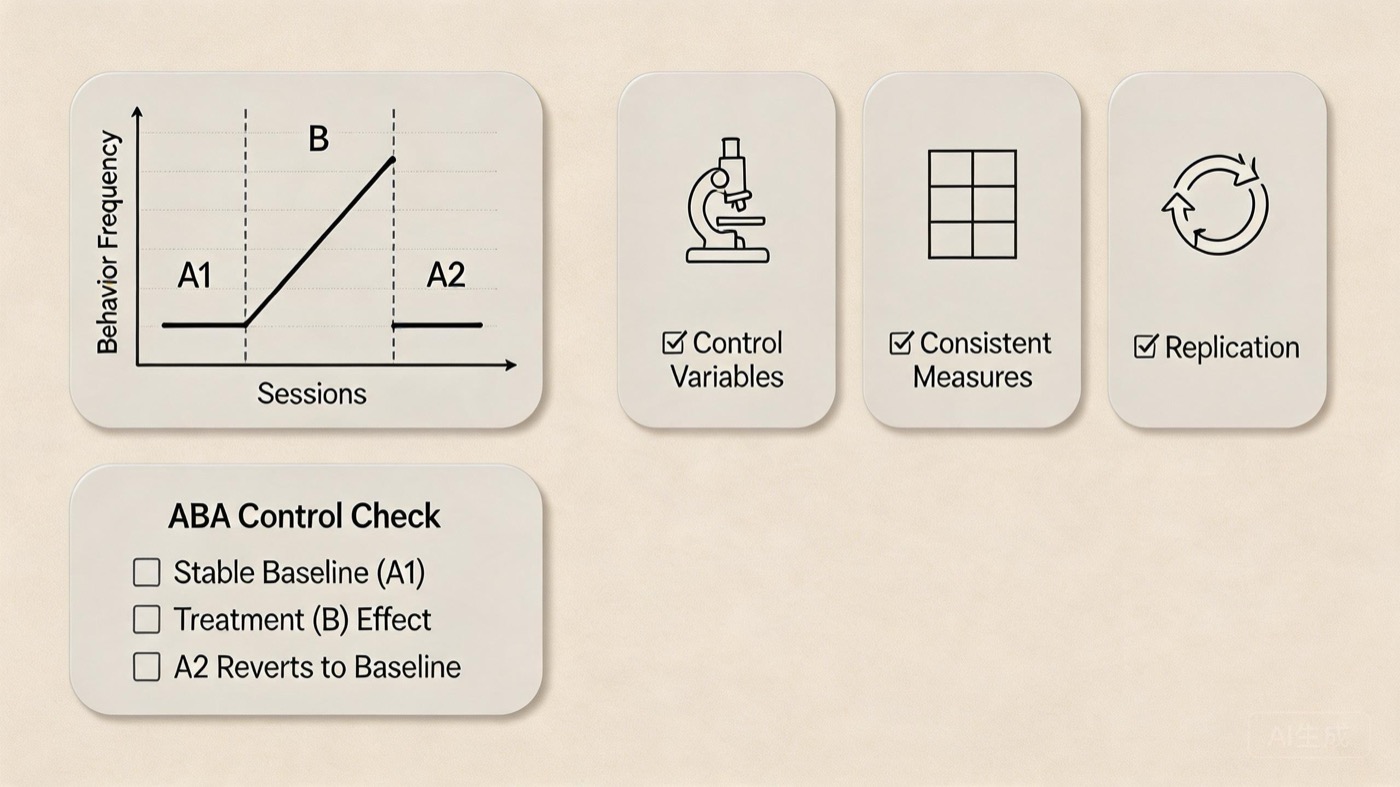
For example, consider a simple ABAB reversal design. The researcher introduces the intervention (B), then withdraws it (A), then reintroduces it (B). If the behavior consistently improves during B phases and deteriorates during A phases, experimental control is demonstrated. The replication of the effect across phases confirms that the IV, not an extraneous variable, is responsible for the change.
A common misconception is that a single demonstration of behavior change is sufficient. In reality, behavior analysts require at least three demonstrations of a functional relation to claim experimental control. This is why most single-subject designs incorporate multiple replications, either within a participant (e.g., reversal, multielement) or across participants (e.g., multiple baseline).
Why Experimental Control Matters for the BCBA Exam
On the BCBA exam, questions about experimental control often test your ability to identify whether a functional relation has been demonstrated. You must also recognize threats that weaken control.
Experimental Control and Internal Validity
Experimental control is a prerequisite for internal validity. Without it, you cannot confidently say the IV caused the DV change. Common threats include:
- History – unplanned events that affect the DV.
- Maturation – natural changes over time.
- Multiple treatment interference – effects carry over from one condition to another.
- Instrumentation – changes in measurement devices or observers.
For deeper review, see our guide on single-subject experimental designs.
Common Exam Traps: Confusing Experimental Control with Other Concepts
Many candidates confuse experimental control with:
- Experimental design (e.g., reversal vs. multiple baseline) – control is the result, not the design itself.
- Experimental manipulation – simply applying the IV does not guarantee control; you need replication.
- Treatment integrity – delivering the IV as planned is important but does not alone prove control.
- Internal validity – while related, internal validity is the degree to which a study rules out confounds; experimental control is the actual demonstration.
Another trap: some exam scenarios will present data with high variability. Even if there is a visible change in level, high variability weakens experimental control because it makes it harder to attribute changes solely to the IV. Always check the consistency of the data.
ABA Examples of Experimental Control
Let’s look at two exam-friendly examples that illustrate experimental control in typical ABA interventions.
Example 1: Functional Communication Training (FCT)
ABC: Antecedent (demand), Behavior (aggression), Consequence (escape). Hypothesized function: escape. The intervention (FCT) teaches a mand for break. Experimental control is shown when aggression decreases only when FCT is implemented and reverses when withdrawn. In a reversal design, if aggression is high during baseline, drops during FCT, rises again when FCT is removed, and drops again when reintroduced, you have demonstrated experimental control. The
replication across phases confirms the functional relation.
Example 2: Differential Reinforcement of Alternative Behavior (DRA)
ABC: Antecedent (task presentation), Behavior (request break), Consequence (break). Hypothesized function: escape. Experimental control is demonstrated when requesting increases and problem behavior decreases only during the DRA condition, with replication across phases. For instance, in a multiple baseline across settings (home, school, clinic), if problem behavior decreases only when DRA is introduced in each setting, experimental control is established across participants or conditions.
Notice that in both examples, the key is replication. Without replication across phases or conditions, you cannot rule out the possibility that the behavior changed due to an extraneous variable like a new medication or a change in routine.
Quick Checklist for Experimental Control
Use this checklist to evaluate experimental control in exam scenarios:
- Is there a clear IV and DV?
- Does the data show a change when the IV is introduced?
- Is the effect replicated (within or across participants)?
- Are confounds ruled out (e.g., history, maturation, instrumentation)?
- Is the design appropriate to demonstrate control (e.g., reversal, multiple baseline, multielement)?
- Is there low variability in the data? High variability can obscure the effect.
When an exam question asks whether experimental control was achieved, run through these points. If any one is missing, the answer is likely no.
How to Demonstrate Experimental Control in Your Exam Answers
When writing scenario-based answers on the BCBA exam, follow these tips:
- Reference data patterns – describe level, trend, and variability changes across conditions and connect them to IV introduction/withdrawal.
- Mention replication – note that effects were repeated (e.g., in an ABAB design, the effect was replicated across both B phases).
- Rule out threats – briefly state why history or maturation is unlikely (e.g., “The behavior changed immediately upon IV introduction, and the baseline was stable, ruling out maturation.”)
- Use the term functional relation – demonstrates you understand experimental control.
- Be specific – instead of saying “the intervention worked,” say “experimental control was demonstrated because the target behavior decreased only when the IV was present, with replication across three data points in each phase.”
For more practice, check out our BCBA mock exam (6th edition).
Remember: experimental control is the bedrock of behavior analysis. Master it, and you will ace questions on research design, data interpretation, and clinical decision-making. For authoritative details, refer to the BACB Task List.
Next step for BCBA exam prep
Turn this topic into exam-day practice
Use this topic as a focused review, then test it in exam-style conditions with a free mock before deciding whether five full-length mocks are the right next step.
Start the Free BCBA Mock ExamContinue with Five Full-Length Mocks — $99
Review the included materials and access details before ordering. No pass guarantee is implied.



