
Introduction: The Foundation of Functional Assessment
Understanding why behaviors occur is the cornerstone of effective applied behavior analysis. The four functions of behavior provide a systematic framework for analyzing and addressing challenging behaviors. This concept is essential for BCBA candidates and practicing behavior analysts alike.
Table of Contents
- Introduction: The Foundation of Functional Assessment
- Defining the Four Functions of Behavior
- Applying the Concepts: Worked ABA Examples (ABC Format)
- Exam Relevance and Common Traps for BCBA Candidates
- Quick-Reference Checklist for Identifying Function
- Summary and Next Steps for Your Studies
These functions are often remembered using the SEAT mnemonic: Sensory/Automatic, Escape, Attention, and Tangible. Mastering this framework enables you to move beyond describing what a behavior looks like to understanding why it persists.
Defining the Four Functions of Behavior
Each function represents a different type of reinforcement maintaining a behavior. Accurate identification is crucial for developing effective interventions.
Sensory/Automatic (Automatic Reinforcement)
This function occurs when behavior produces its own reinforcement through internal sensory consequences. The behavior feels good or reduces discomfort without requiring social mediation. Examples include rocking, hand-flapping, or scratching an itch.
Automatic reinforcement can be positive (adding pleasurable stimulation) or negative (removing aversive stimulation). It’s important to distinguish this from socially-mediated functions.
Escape (Negative Reinforcement)
Behavior maintained by escape functions to remove or avoid an aversive stimulus, task, or demand. The term ‘negative’ refers to removal, not to the quality of the behavior. Common examples include tantrums during difficult academic work or aggression when presented with non-preferred activities.
This function is particularly relevant in educational and clinical settings where demands are frequently presented.
Attention (Social Positive Reinforcement)
Behavior occurs to gain access to social interaction from others. This includes praise, conversation, or even reprimands. The key is that the behavior produces social contact.
Many challenging behaviors in social settings are maintained by attention functions, making this a frequent target for intervention.
Tangible (Social Positive Reinforcement)
Behavior functions to obtain preferred items, activities, or privileges. While similar to attention, tangible reinforcement involves non-social consequences. Examples include accessing toys, food, or preferred electronic devices.
Distinguishing between attention and tangible functions requires careful analysis of the specific consequences maintaining the behavior.
Applying the Concepts: Worked ABA Examples (ABC Format)
Translating theory to practice requires analyzing real scenarios using the Antecedent-Behavior-Consequence framework. These examples demonstrate how to identify function through systematic observation.
Example 1: Escape Function in a Classroom
Consider this common educational scenario:
- Antecedent: Teacher presents a difficult math worksheet requiring multi-step problem solving
- Behavior: Student tears worksheet, throws materials, and yells ‘I can’t do this!’
- Consequence: Teacher removes worksheet, tells student to take a break in calm-down corner
The functional hypothesis here is escape from academic demands. The behavior successfully removed the challenging task, making future escape behaviors more likely under similar conditions.
Example 2: Tangible vs. Attention Function
The same behavior topography can serve different functions depending on context:
- Scenario A (Tangible): Child hits sibling who is playing with preferred toy. Parent intervenes by giving child the toy to stop the hitting. Function: access to tangible item.
- Scenario B (Attention): Child hits sibling while parent is on phone. Parent immediately ends call to address the behavior. Function: access to attention.
This demonstrates why topography alone cannot determine function. The maintaining consequences differ despite identical behaviors.
Exam Relevance and Common Traps for BCBA Candidates
This topic appears frequently on the BCBA exam because it’s foundational to functional behavior assessment and intervention design. Understanding common pitfalls can improve your exam performance.
Trap 1: Confusing Topography with Function
The exam tests your ability to look beyond what a behavior looks like to understand why it occurs. Crying, aggression, or property destruction can serve any of the four functions depending on context.
Always analyze the three-term contingency (ABC) rather than making assumptions based on behavior form alone.
Trap 2: Misinterpreting ‘Negative’ and ‘Positive’
In reinforcement terminology, ‘positive’ means addition and ‘negative’ means removal. A behavior maintained by negative reinforcement (escape) is not necessarily ‘bad’ – it’s simply behavior that removes something.
This distinction is crucial for accurate functional analysis and intervention planning.
Trap 3: Overlooking Automatic Reinforcement
Automatic reinforcement is often the default incorrect answer when social consequences are clearly present. Remember that this function should be considered only when no social contingency is evident.
For comprehensive understanding of reinforcement principles, review our guide on reinforcement in ABA.
Quick-Reference Checklist for Identifying Function
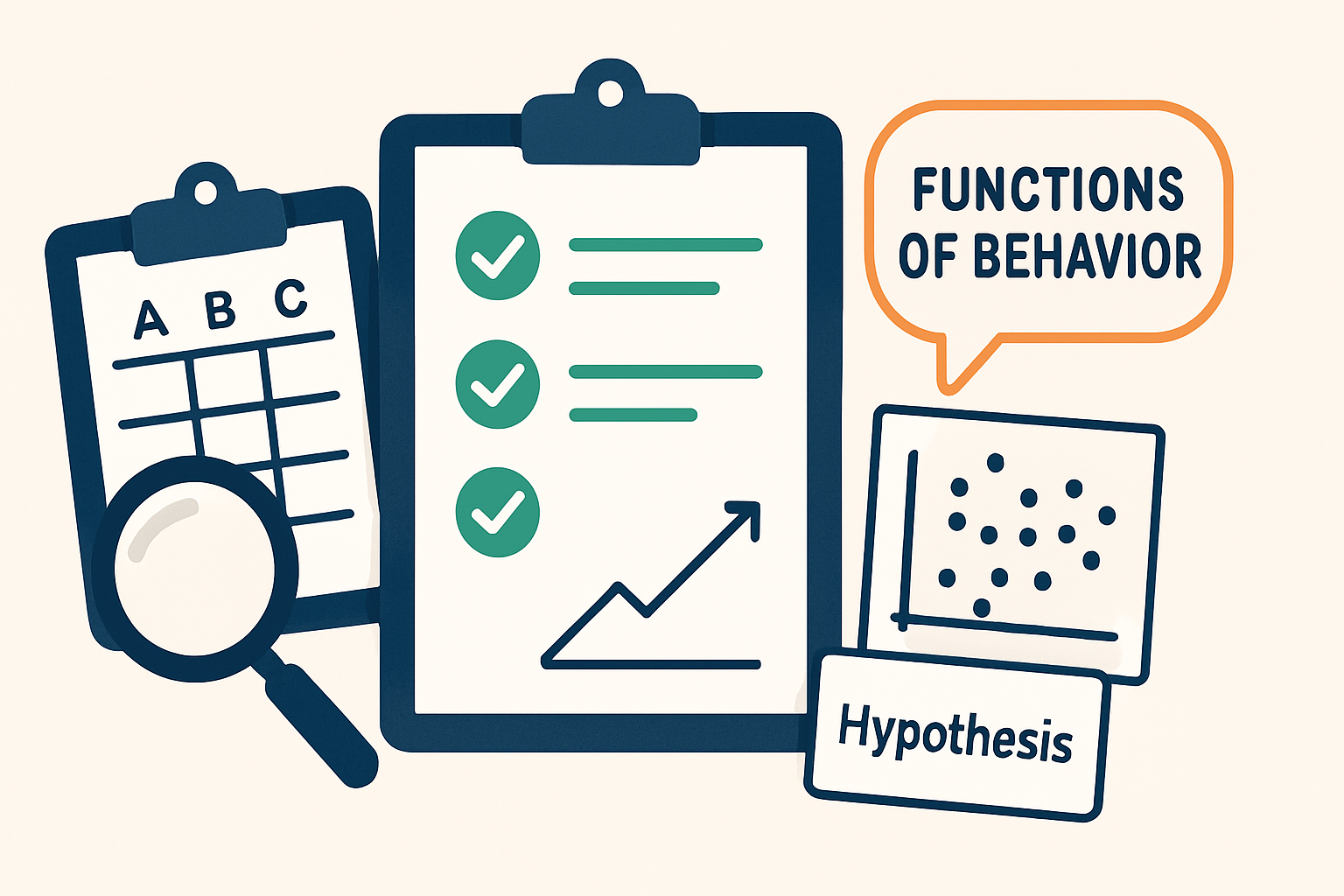
Use this practical tool during observations or when analyzing case scenarios:
- Observe the immediate consequence: What happens right after the behavior?
- Ask ‘What changes?’: Does something get added or removed?
- Check for social mediation: Is another person involved in the consequence?
- Consider the antecedent: What was happening just before the behavior?
- Look for patterns: Does the behavior occur under specific conditions?
- Test your hypothesis: Would changing the consequence affect the behavior?
This systematic approach aligns with evidence-based practice in behavior analysis.
Summary and Next Steps for Your Studies
Mastering the four functions of behavior provides a powerful framework for understanding and addressing challenging behaviors. Remember that accurate identification requires careful analysis of antecedents and consequences rather than assumptions based on topography.
For further study, consider exploring related topics like functional behavior assessment methods and functional communication training. The BACB’s Professional and Ethical Compliance Code also emphasizes the importance of functional assessment in ethical practice.
Practice applying these concepts to diverse scenarios, and remember that real-world behavior often involves multiple or combined functions. Continued study of behavioral principles will strengthen your analytical skills for both clinical practice and exam success.
Complete BCBA Exam Prep
Turn this topic into exam-day practice
Practice concepts in context with five full-length 6th Edition mock exams, two bonus practice exams, a 6th Edition study guide, and key-term flashcards—all in one $120 USD package.
Get the $120 All-in-One Prep Pack
Review everything included on the product page before ordering. No pass guarantee is implied.



