

What Is Contiguity in Behavioral Terms?
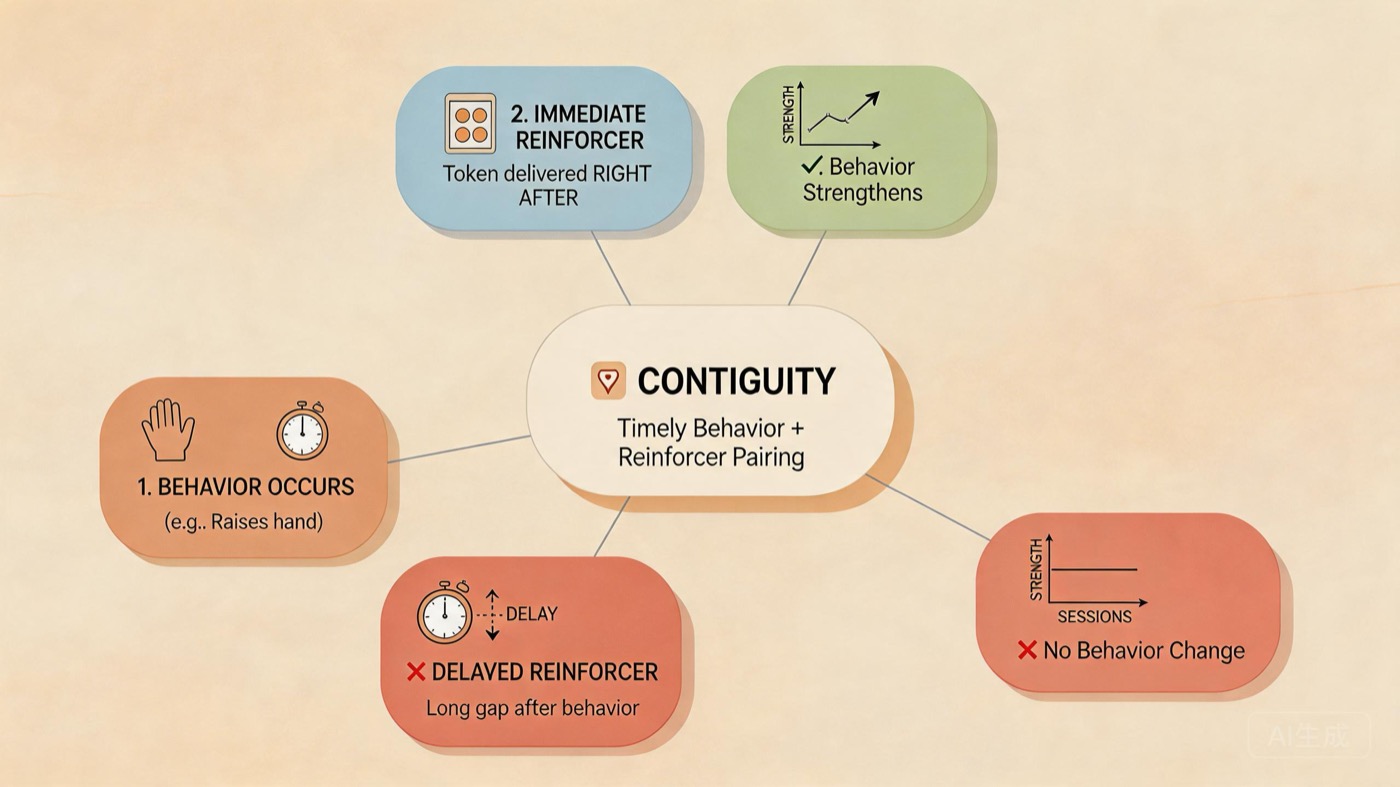
In behavior analysis, to define contiguity means to refer to the close temporal relationship between a behavior and its consequence. It is a fundamental concept in both operant and respondent conditioning. Contiguity alone is not sufficient for learning; it must often be paired with contingency—the causal dependency between behavior and outcome. However, without contiguity, reinforcement or punishment is unlikely to be effective. The core idea is that events occurring very close in time become associated in the organism’s learning history. This temporal pairing is what allows the learner to detect a pattern and adjust future behavior accordingly.
Table of Contents
- What Is Contiguity in Behavioral Terms?
- Why Contiguity Matters in Operant Conditioning
- ABA Examples of Contiguity in Action
- Common Exam Traps Related to Contiguity
- Quick Contiguity Checklist for Exam Day
- Summary: The Role of Contiguity in Behavior Analysis
- References
The Temporal Pairing Principle
Contiguity hinges on the temporal pairing of events. When a consequence follows a behavior immediately (within seconds), the association is stronger. For example, if a child raises their hand and the teacher calls on them within one second, the hand-raising is more likely to increase. Delays weaken the temporal pairing, making it harder for the learner to connect the behavior with the outcome. In respondent conditioning, contiguity is also critical: the pairing of a neutral stimulus with an unconditioned stimulus must occur closely in time for a conditioned reflex to develop. For instance, if a tone is played just before presenting food (within 0.5 seconds), the tone becomes a conditioned stimulus that elicits salivation. Delaying the food by several seconds would weaken the association. On the BCBA exam, expect questions that test your understanding of how even small delays can disrupt learning.
Consider a scenario where a dog is learning to sit on command. If the treat is given 10 seconds after the sit behavior, the dog may not associate the treat with sitting. Instead, it may associate the treat with some other behavior it performed during the delay, such as standing or looking around. This illustrates why immediate consequences are so crucial in shaping behavior. The temporal pairing principle is often tested in terms of its impact on reinforcement effectiveness and the development of stimulus control.
Why Contiguity Matters in Operant Conditioning
Contiguity plays a critical role in the effectiveness of reinforcement and punishment. Even a powerful reinforcer may fail to strengthen behavior if it is delivered too late. Understanding this helps BCBAs design interventions that maximize learning. Moreover, contiguity affects not only the acquisition of new behaviors but also the maintenance and generalization of existing skills. When consequences are immediate, the behavior-environment relationship is clearer, leading to more efficient learning. Delayed consequences can lead to superstitious behavior, where the learner accidentally pairs an irrelevant behavior with the outcome. For example, a student who receives a sticker 5 minutes after completing a worksheet might engage in irrelevant behaviors (e.g., tapping the desk) that become inadvertently reinforced.
Contiguity vs. Contingency
These two terms are often confused on the exam. Contiguity refers to temporal closeness: the behavior and consequence occur close in time. Contingency refers to causal dependency: the consequence is delivered only if the behavior occurs. Both are necessary for effective operant conditioning. However, contiguity without contingency can produce accidental correlations, while contingency without contiguity weakens the learning process. For instance, if a teacher says “good job” every hour regardless of student behavior, there is no contingency (the praise does not depend on any specific behavior) even if it is temporally close to some behaviors. Conversely, if a parent promises a toy at the end of the week for completing chores each day, the contingency is clear but the delay weakens contiguity. On the exam, pay attention to both the timing and the if-then relationship. For more on how consequences affect behavior, see this guide.
Contiguity and the Matching Law
The matching law describes how behavior is distributed among alternatives based on the rate of reinforcement. Contiguity influences choice because immediate reinforcers have a stronger impact than delayed ones, even if the overall rate is equal. For example, a pigeon in a concurrent schedule may peck more at a key that delivers food every 30 seconds with a 1-second delay compared to another key that delivers food every 30 seconds with a 10-second delay. The immediacy of reinforcement shifts preference. This is why token economies often use immediate token delivery paired with delayed backup reinforcers—the token serves as a conditioned reinforcer that bridges the delay. Learn more about the matching law in ABA.
ABA Examples of Contiguity in Action
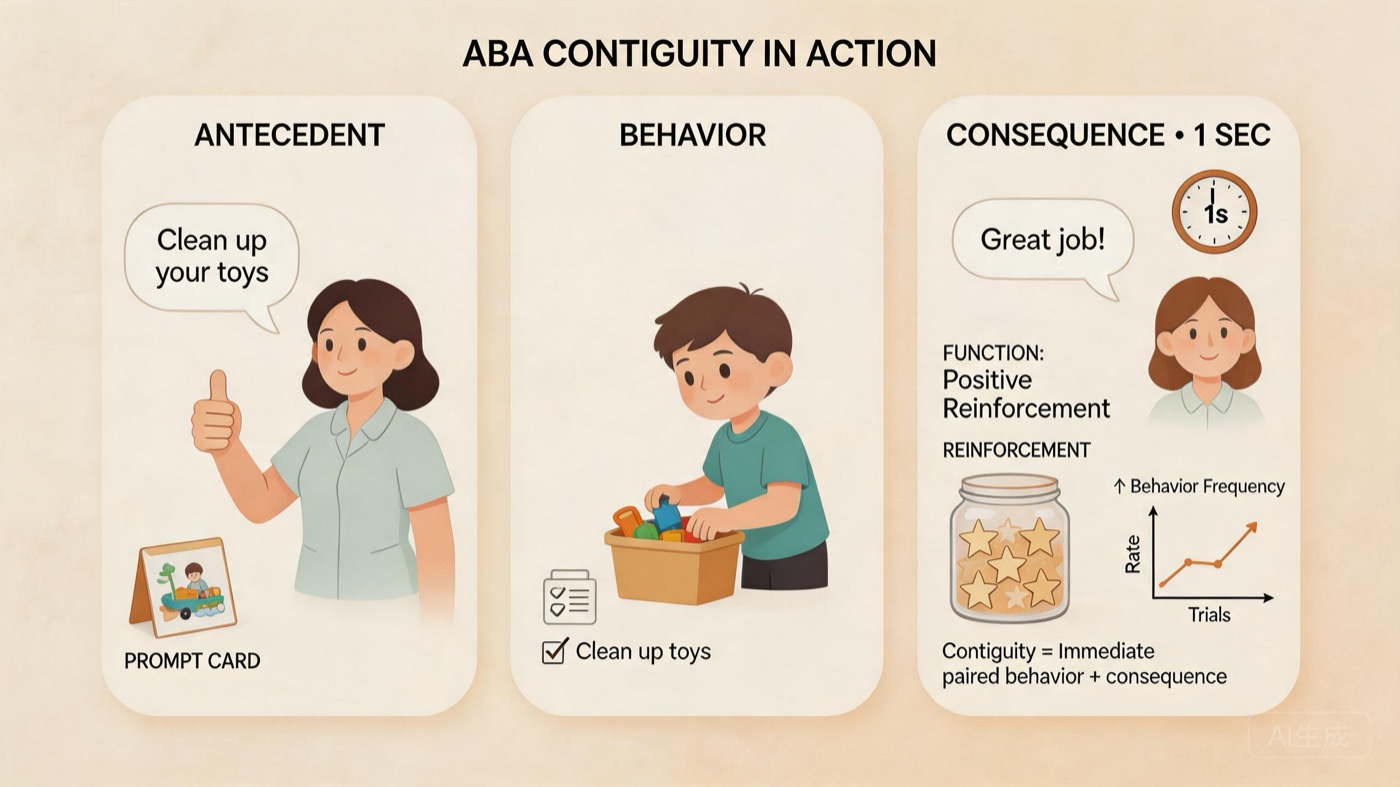
Here are three examples that illustrate contiguity in real-world ABA scenarios. Each highlights how the timing of consequences affects behavior change.
Example 1: Immediate Praise for Compliance
Antecedent: Teacher says “Clean up your toys.” Behavior: Child cleans up. Consequence: Teacher delivers praise within 1 second. Function: Positive reinforcement. The immediate praise establishes strong contiguity, making the behavior more likely to recur. In practice, this is often more effective than praising after a delay, because the child clearly connects the praise to the cleaning behavior.
Example 2: Delayed Time-Out for Aggression
Antecedent: Peer takes a toy. Behavior: Child hits peer. Consequence: Time-out begins 10 minutes later. Function: Attempted punishment, but contiguity is weak. The delay reduces the temporal pairing, so the time-out may not effectively decrease aggression. In fact, the child might associate the time-out with something else that happened in the meantime, such as being sent to the principal’s office, rather than the hitting. This is a common mistake in behavior intervention plans.
Example 3: Token Delivery in a Token Economy
Antecedent: Worksheet completion. Behavior: Correct responses. Consequence: Token delivered immediately. Function: Positive reinforcement. Strong contiguity maintains the behavior. Token economies rely on immediate token delivery to bridge delays to backup reinforcers. For instance, a student earns a token immediately after each correct answer, and later exchanges tokens for a preferred activity. The token acquires reinforcing value through its proximity to the backup reinforcer, which is made possible by contiguity.
Common Exam Traps Related to Contiguity
BCBA exam questions often test subtle distinctions. Watch for these two traps, and also be aware of a third: misidentifying delayed conditioning as effective.
Confusing Contiguity with Contingency
Trap: Assuming that because two events occur close together, one causes the other. Remember: contiguity is necessary but not sufficient for contingency. A stimulus may be temporally paired with a behavior without being functionally related. For example, a student may receive a sticker every time the teacher is near, even if the sticker is not contingent on any specific behavior. The sticker is contiguous with teacher presence, but not contingent on student behavior. On the exam, when you see a temporal pairing, ask yourself: Is there a clear if-then relationship? If not, it’s contiguity without contingency.
Overlooking Delayed Consequences
Trap: Forgetting that delayed consequences weaken contiguity. When a question describes a delay of more than a few seconds, consider whether the consequence is likely to be effective. Typically, delays reduce the effectiveness of consequences. However, note that conditioned reinforcers can bridge delays. For instance, a token delivered immediately after behavior maintains contiguity even if the backup reinforcer is delayed. So watch for situations where an immediate conditioned reinforcer is present—this can preserve the learning effect despite a delayed primary reinforcer.
Quick Contiguity Checklist for Exam Day
- Check the time interval between behavior and consequence (less than 1 second is ideal).
- Distinguish between contiguity (temporal) and contingency (causal).
- Identify whether immediate consequences are present or delayed.
- Remember that contiguity alone does not guarantee learning; contingency must also be in place.
- Consider how delayed reinforcement affects response strength in matching law scenarios.
- Look for conditioned reinforcers that bridge delays—these maintain contiguity even if the primary reinforcer is delayed.
Summary: The Role of Contiguity in Behavior Analysis
To define contiguity is to understand the importance of timing in behavior change. It is a foundational concept that interacts with contingency to produce effective reinforcement and punishment. On the BCBA exam, you will be asked to identify contiguity in examples and differentiate it from correlation. Keep the temporal pairing principle in mind, and use the checklist above to avoid common traps. Remember that while contiguity alone does not guarantee learning, its presence is essential for efficient conditioning. Mastery of this concept will help you design better interventions and ace exam questions. For a deeper dive into related concepts, review operant conditioning in ABA.


